
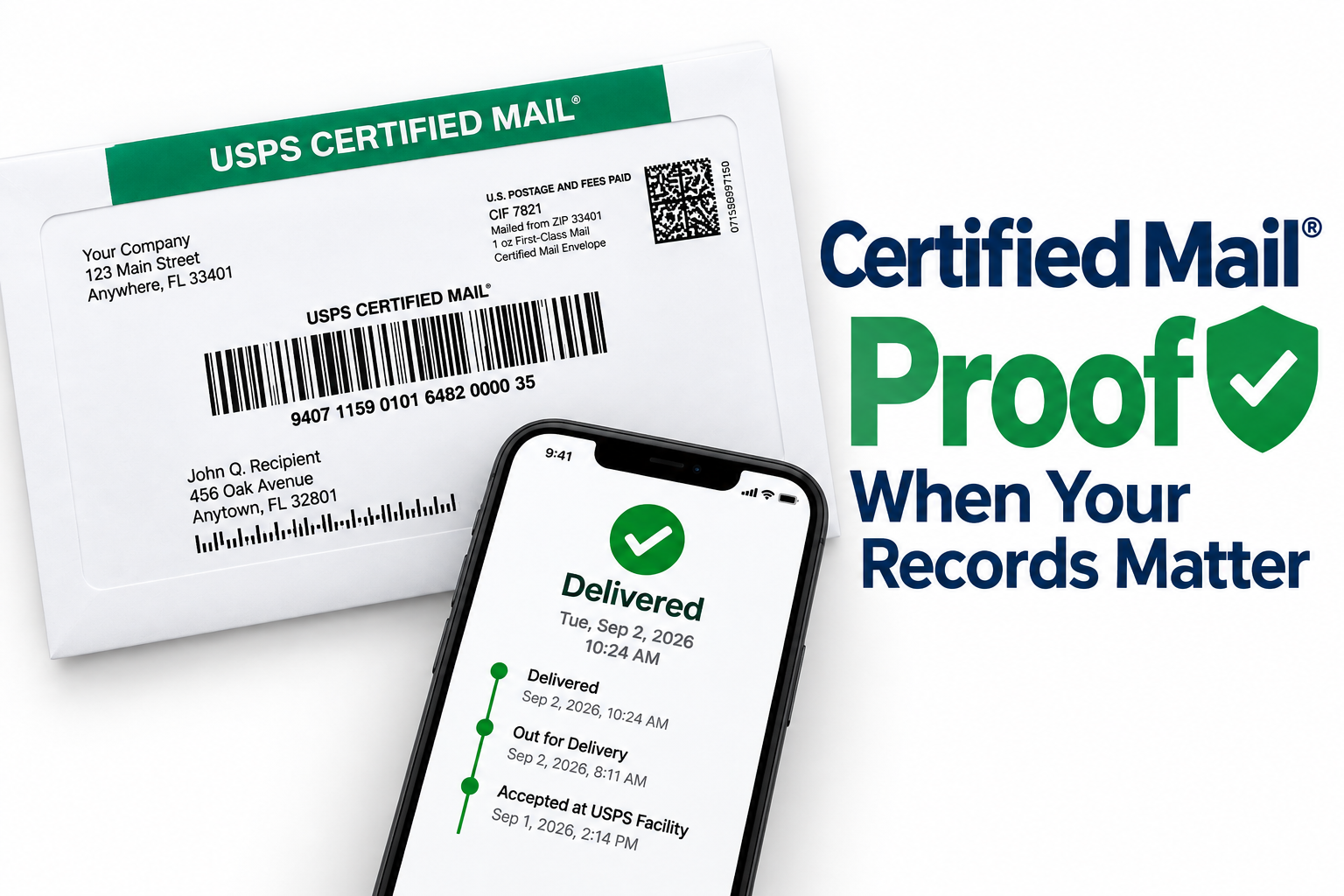
 Government Notice Is Due-Process Notice
Tax levy notices, code-enforcement orders, permit revocations, utility shutoff letters, benefit overpayment notices, assessment letters, and farm-loan servicing notices all have something in common: your agency must be able to show what was sent, when it was mailed, and what happened next.
If your office cannot prove the notice was mailed and delivered, or document the delivery attempt, the action may stall. Hearings can be rescheduled. Enforcement can be delayed. Taxpayers, borrowers, and property owners may challenge the process. Your staff may then spend days reconstructing mailing files for an audit, public-records request, litigation hold, or court response.
Municipalities and government agencies use online USPS Certified Mail to create proof of mailing and delivery for tax and levy notices, code-enforcement and permit notices, utility and assessment letters, overpayment notices and loan-servicing notices. You print live-postage Certified Mail labels on any office printer or upload your PDF notice and address list for same-business-day Print & Mail, and you get a notarized affidavit of mailing, USPS acceptance scans, certified mail tracking events and available Electronic Return Receipt signature records stored searchable for 10 years, with no monthly fees, no contracts and no procurement-heavy equipment leases.
What Does Your Agency Need To Prove?
Here is just a few of the records your clerk’s office, legal department, tax office, or compliance team may need:
- Proof of mailing with the postmark date matched to the applicable statutory clock.
- USPS acceptance scans tied to the Intelligent Mail Postal Barcode.
- Certified mail tracking events for each notice.
- Delivery or attempted-delivery records when the recipient does not accept the item.
- Available Electronic Return Receipt signatures and delivery details.
- A notarized affidavit of mailing for the notice campaign.
- Searchable records for 10 years across staff changes, administrations, audits, and records requests.
Certified Mail Labels brings these records together instead of leaving your agency to manage paper receipts, spreadsheets, green cards, and disconnected USPS tracking screens.
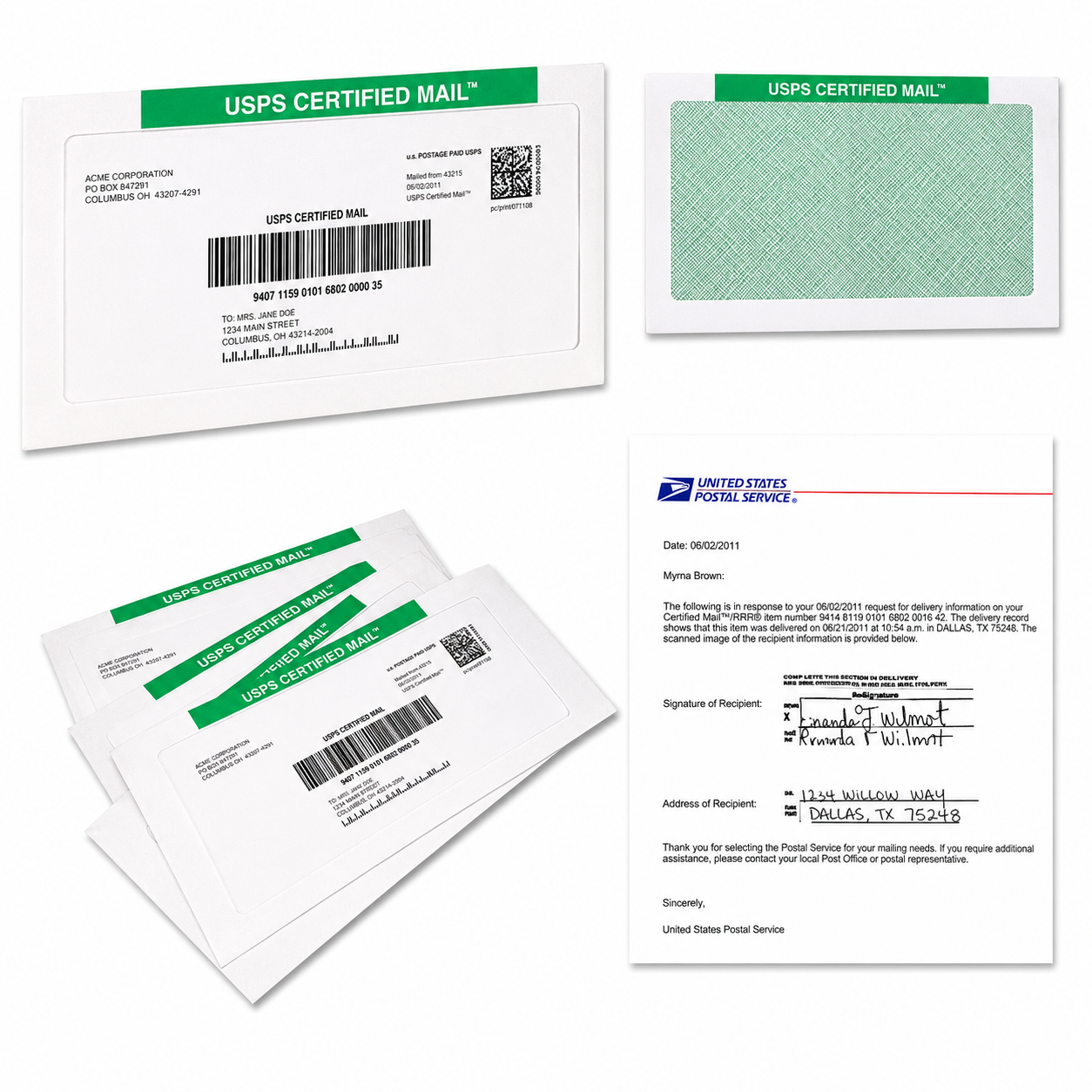
Which Federal Notice Rules Name Certified Mail?
Federal requirements vary by notice type. Your agency should identify the rule, regulation, statute, or internal policy that applies to the specific notice.
- IRS notice and demand: 26 U.S.C. § 6303(a) requires notice and demand for tax to be left at the person’s dwelling or usual place of business, or sent by mail to the person’s last known address.
- IRS notice of intent to levy: 26 U.S.C. § 6331(d)(2) names certified or registered mail as one permitted method when the notice is mailed to the taxpayer’s last known address, no less than 30 days before the day of the levy.
- USDA Farm Service Agency notices: 7 CFR 766.101(c) addresses notice delivery for covered farm-loan servicing matters, including certified mail to the borrower’s last known address under the applicable borrower-status requirements.
- 2026 USDA rule: The final rule, Driving Efficiency in Farm Loan Delivery, published at 91 FR 56741, Docket FSA-2026-0463, amended 7 CFR part 766 effective October 1, 2026. It aligns the regulation with the statutory notice mandate in 7 U.S.C. § 1981d, including advance notice requirements for borrowers at least 90 days past due before acceleration, foreclosure, contract termination, or debt collection referral.
- Federal records management: 44 U.S.C. § 3101 requires federal agency heads to make and preserve records containing adequate and proper documentation of agency decisions and essential transactions, protecting the legal and financial rights of the Government and affected persons.
State tax-collection rules, municipal codes, utility regulations, housing requirements, and agency policies differ. Use these federal anchors as examples, not as a substitute for reviewing your own requirements with counsel.
How Much Can Better Mailing Control Save?
At volume, small differences in USPS Certified Mail cost become meaningful budget savings.
USPS Notice 123 lists the July 12, 2026 Return Receipt rates as:
- Paper Return Receipt green card: $4.65 per piece.
- Electronic Return Receipt: $2.91 per piece.
- Savings: $1.74 per notice.
That means:
- 1,000 notices: $1,740 saved.
- 5,000 notices: $8,700 saved.
For a full 1-ounce Certified Mail letter with Electronic Delivery Confirmation, the quoted online example is $7.28 online versus $11.02 at the counter. A difference of $3.74 per piece. For a county mailing thousands of assessment notices each year, that difference can provide real budget relief.
Review current charges in USPS Notice 123, because postage and extra-service rates can change.
How Certified Mail Labels Fits Your Agency Workflow
You do not need a postage meter, specialized equipment, or a trip to the Post Office for every notice campaign.
Self-Print Labels For Clerk And Counter Offices
Use our label-printing flow to create and print USPS Certified Mail labels online.
- You’ll print live-postage labels on a standard office printer.
- You’ll use plain paper or adhesive sheets.
- You won’t need PS Form 3800.
- You won’t need a postage meter.
- You won’t need an equipment lease.
- You’ll receive tracking information tied to each mailing.
- You can keep notice preparation inside your existing office workflow.
Print & Mail For Time-Sensitive Notice Packets
For hearing notices, enforcement packets, tax letters, and other documents, use our Print & Mail service.
Upload your PDF notice and address list. We handle printing, envelope inserting, postage application, and mailing.
- $8.43 for a 1-page letter in the stated example.
- Orders submitted before 5:00 PM Eastern are mailed the same business day.
- You’ll receive USPS proof of acceptance.
- You’ll receive a notarized affidavit of mailing.
- You’ll avoid printing, folding, stuffing, and Post Office trips.
- You’ll get a consistent process even when your staff is remote, short-handed, or managing a deadline.
Bulk Uploads And System Integrations
For assessment notices, code-enforcement campaigns, utility notices, and recurring government mailings, use Excel and CSV bulk uploads, API, and secure SFTP automation.
- Upload Excel or CSV recipient lists.
- Automate recurring notice batches.
- Connect tax, land, case-management, or billing systems.
- Send files through secure SFTP.
- Use one USPS SCAN form so the batch can be accepted in one scan.
- Scale from a small clerk’s office to thousands of pieces.
This is legal compliance mailing designed for real government workloads, not a process that depends on one employee remembering where the green cards were filed.
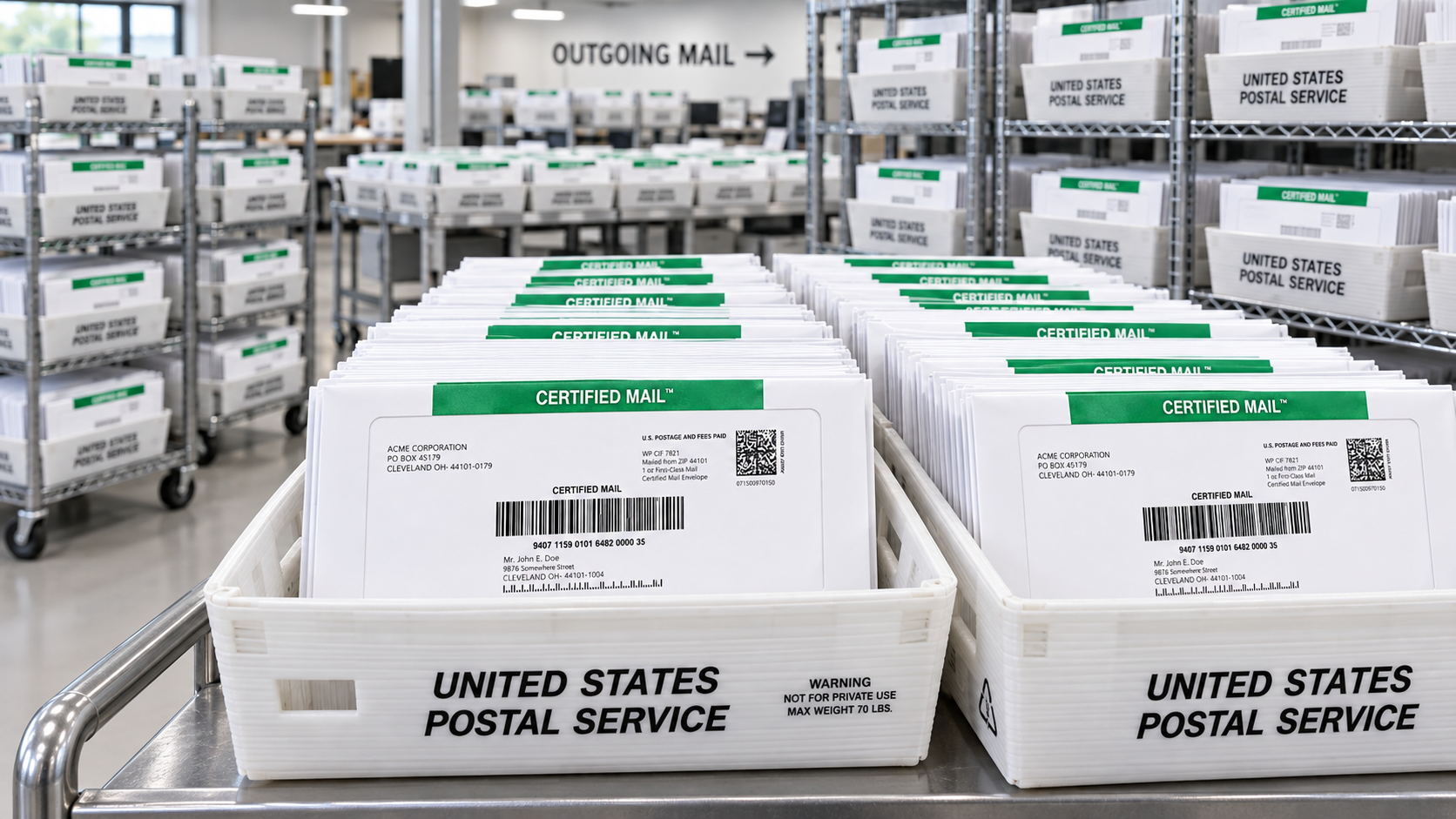
What Happens To Your Notice Records?
The free 10-Year Compliance Archive stores the mailing evidence your agency may need later:
- Proof of mailing.
- Notarized affidavits.
- USPS acceptance and SCAN form records.
- Postmark dates.
- Intelligent Mail Postal Barcode information.
- Certified mail tracking events.
- Delivery and attempted-delivery records.
- Available Electronic Return Receipt signature records.
- Searchable reports for audits, disputes, and records requests.
You can search historical activity without relying on paper files or a former employee’s inbox. The archive supports your records-management process; it does not replace your agency’s own retention schedule or legal hold procedures.
For signatures and digital delivery records, see our Electronic Return Receipt information. The electronic option replaces the paper green card with an available digital delivery record and signature image.
Why Government Agencies Choose Certified Mail Labels
Certified Mail Labels has created more than 33 million labels and served more than 200,000 customers since 2006. We are BBB Accredited and trusted by Fortune 500 companies.
You’ll get:
- No monthly fees.
- No contracts.
- No equipment leases.
- No procurement-heavy mailing hardware.
- No software installation for basic label printing.
- Same-business-day Print & Mail service.
- Bulk certified mail tools for recurring campaigns.
- Certified mail tracking and reporting.
- A searchable 10-year archive.
- Support when your team needs help.
Start with one notice campaign, upload one address list, or schedule a workflow review for your department. You can create and print USPS Certified Mail labels online, send a PDF through Print & Mail, or review bulk and API/SFTP options to modernize your process and reduce certified mail cost.
Last reviewed October 1, 2026. Rates verified against USPS Notice 123; the IRS, FSA and records citations verified against the U.S. Code, the eCFR and the Federal Register. Federal and state notice rules shift. Re-verify citations quarterly and confirm specifics with counsel.
Certified Mail Labels provides the mailing and the proof, not legal advice; confirm notice requirements with your own counsel.
Frequently Asked Questions
Which Federal Notices Must Go By Certified Mail?
The IRS notice of intent to levy names certified or registered mail as one permitted mailed-delivery method under 26 U.S.C. § 6331(d)(2). For USDA Farm Service Agency matters, 7 CFR 766.101(c), as amended, addresses certified-mail notices for covered delinquent-borrower servicing situations. Other federal, state, and local notices may have different requirements.
What Did The 2026 USDA Rule Change?
The USDA final rule, 91 FR 56741, Docket FSA-2026-0463, aligned 7 CFR part 766 with 7 U.S.C. § 1981d, including advance notice for borrowers at least 90 days past due before specified collection actions. Review the rule and confirm the application to your matter with agency counsel.
How Do Agencies Keep Notice Records?
Agencies can preserve proof of mailing, USPS acceptance scans, SCAN form records, postmark dates, tracking events, delivery records, and available signature records in a centralized archive. Certified Mail Labels provides a searchable 10-year archive at no extra charge.
How Do We Prove 5,000 Assessment Notices Were Mailed?
Upload your Excel or CSV address list, generate the batch, and use the associated tracking, acceptance, SCAN form, affidavit, and delivery records. You can search and export campaign information when an audit, hearing, dispute, or records request requires proof.
What Does Electronic Return Receipt Cost Compared With The Green Card?
USPS Notice 123 lists Electronic Return Receipt at $2.91 and paper Return Receipt at $4.65 as of July 12, 2026. The difference is $1.74 per piece, or $8,700 across 5,000 notices.
Can A Small Clerk’s Office Use Certified Mail Labels Without Procurement?
Yes. A small office can print labels from a standard office printer with no postage meter, equipment lease, monthly fee, or contract. For offices that prefer not to print and mail in-house, Print & Mail handles the PDF, address list, printing, inserting, postage, and same-business-day mailing before the cutoff.