
Certified Mail Tracking Summary Report: USPS Scans, EDC & 10-Year Records
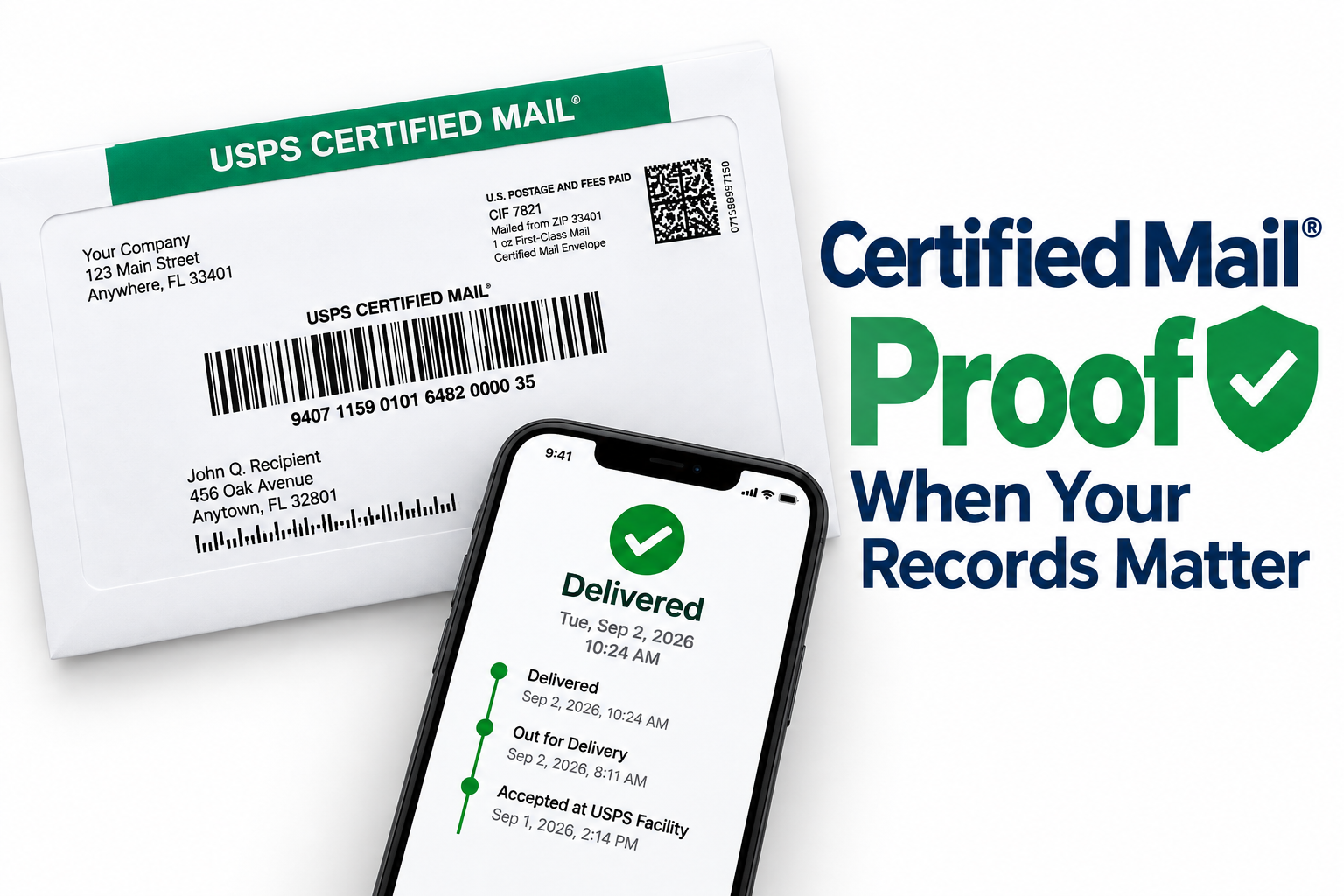 Your Certified Mail tracking record should tell you more than whether a letter says “Delivered.”
The Certified Mail Labels Summary Tracking Report brings your USPS Certified Mail activity into one searchable view so you can find a mailing, review its USPS scan history, identify delivery exceptions, open an Electronic Delivery Confirmation report, and retrieve an Electronic Return Receipt when that service was purchased.
Your Certified Mail Labels tracking and delivery records remain searchable in your account for up to 10 years.
That means a tracking number sent months or years ago can remain connected to the recipient, mailing information, custom reference fields, USPS tracking events, delivery record, and available supporting reports.
This guide explains how to use the Summary Tracking Report, what common USPS tracking scans mean, how to read your Electronic Delivery Confirmation, and which records to retain for legal, compliance, tax, government, property-management, collections, insurance, and other important mail.
What Is the Certified Mail Tracking Summary Report?
The Certified Mail Tracking Summary Report is the central tracking and reporting area inside your Certified Mail Labels account.
Use it to:
- Locate individual Certified Mail pieces
- Search by available recipient or mailing information
- Search using custom reference fields
- Review USPS tracking activity
- Identify delivered and undelivered mail
- Review attempted-delivery events
- Open Electronic Delivery Confirmation reports
- Access Return Receipt Electronic signatures when purchased
- Update tracking information
- Review historical mailing records
- Research delivery exceptions
For older mailings, use the available Tracking Archive to search historical records retained in your Certified Mail Labels account.
Already Have a Certified Mail Labels Account?
Sign in and navigate to Reports > Summary Tracking Report to review your mailings.
How to Access Your Certified Mail Tracking Report
- Sign in to your Certified Mail Labels account.
- From the main navigation, select Reports.
- Select Summary Tracking Report.
- Use the available search fields to locate the mailing you need.
- Click Search to display the matching tracking records.
- Open the applicable record to review its detailed USPS tracking history.
- When available, select EDC to open the Electronic Delivery Confirmation report or RRE to view the purchased Return Receipt Electronic signature record.
You can also use Update & Create Report when you want the system to retrieve available tracking information and generate the latest report.

Example: Certified Mail Labels tracking controls for Electronic Delivery Confirmation and Return Receipt Electronic.
How to Find a Certified Mail Record Faster
A tracking system becomes more useful when you can find a mailing without already knowing the USPS tracking number.
Depending on the information saved with the mailing, you can use the Summary Tracking Report to search or filter using available fields and custom reference information.
Custom references can be especially useful for organizations that need to connect postal records to an internal system.
Examples include:
- Client matter number
- Property address
- Tenant reference
- Account number
- Claim number
- Parcel number
- Invoice number
- Case number
- Department code
- Batch identifier
Tip for Batch Mailings
If you create Excel batch labels, use a consistent value in a custom reference field for each record in the batch.
For example:
Custom Field 1: PROPERTY-NOTICES-MARCH
You can later search that reference to pull the related mailing records together instead of looking up each tracking number individually.
How to Read USPS Certified Mail Tracking Scans
Certified Mail tracking is an event history. It is not continuous GPS tracking.
USPS records events as the mailpiece moves through acceptance, processing, transportation, delivery attempts, and final disposition.
The wording can vary, but the mailing generally progresses through stages like these:
The tracking number and postage record exist. This does not, by itself, mean USPS has accepted the physical envelope.
USPS records receiving or accepting the mailpiece into the postal system.
USPS records processing and movement between facilities. These events do not mean the item has been delivered.
USPS reports that the mailpiece is in the delivery process.
USPS records the delivery result. Read the actual status rather than assuming every final scan means successful delivery to the intended recipient.
Common Certified Mail Tracking Statuses and What They Mean
| USPS Tracking Status | What It Generally Means | What to Review |
|---|---|---|
| Shipping Label Created / USPS Awaiting Item | The electronic label record exists, but this is not an individual USPS acceptance event. | Confirm whether the physical letter was handed to USPS. |
| Shipment Received, Acceptance Pending | USPS has recorded receipt of a shipment or group of pieces while additional processing is pending. | Keep the batch or handoff record and continue monitoring. |
| Accepted / USPS in Possession of Item | USPS has recorded receipt or acceptance of the mailpiece. | Preserve the acceptance event when mailing-date documentation matters. |
| Arrived at USPS Facility | The mailpiece has reached a USPS processing facility. | No action is normally required; continue tracking. |
| Departed USPS Facility | The mailpiece has left a USPS processing facility. | Continue monitoring. |
| In Transit to Next Facility | The mailpiece is moving through the USPS network. | This is not a delivery event. |
| Out for Delivery | The mailpiece has entered the local delivery process. | Wait for the completed or attempted-delivery event. |
| Notice Left | USPS could not complete delivery under the circumstances shown in tracking. | Review the USPS reason and available pickup or redelivery information. |
| Available for Pickup | The Certified Mail piece is being held for recipient pickup. | Monitor whether the recipient claims the item. |
| Delivered | USPS reports a completed delivery event. | Review the full history and available EDC or purchased Return Receipt. |
| Refused | USPS reports that delivery was refused. | Retain the event and follow the procedure governing your notice. |
| Unclaimed | The item was not claimed during the applicable holding process. | Review whether your legal or compliance workflow requires another action. |
| Return to Sender | USPS is returning the mailpiece to the sender. | Determine why the mailing was returned and preserve the tracking history. |
These descriptions explain postal events. They do not determine whether a particular notice has satisfied a statute, regulation, contract, court rule, or other legal requirement.
For a more detailed guide, visit Certified Mail Tracking Scans .
Example: How a Certified Mail Tracking History Can Tell a Different Story
A tracking record should be read from beginning to end.
For example, a mailpiece may eventually display a Delivered event even though it was never delivered to the intended recipient. That can happen when USPS returns an unclaimed piece and ultimately records delivery back to the original sender.
 Historical Certified Mail tracking example illustrating acceptance, attempted delivery, unclaimed mail, return to sender, and final delivery back to the sender.
What This Example Shows
- USPS acceptance: The lower portion of the history records USPS receiving the mailing.
- Delivery attempt: USPS later records that a notice was left because delivery could not be completed.
- Unclaimed mail: The recipient did not complete pickup or delivery.
- Return to sender: USPS returned the piece.
- Final “Delivered” scan: The final delivery was back to the original sender—not to the intended recipient.
Why this matters: Do not interpret a status from one line alone. Review the full tracking sequence before deciding what happened to the letter.
What Is the Certified Mail Labels Electronic Delivery Confirmation?
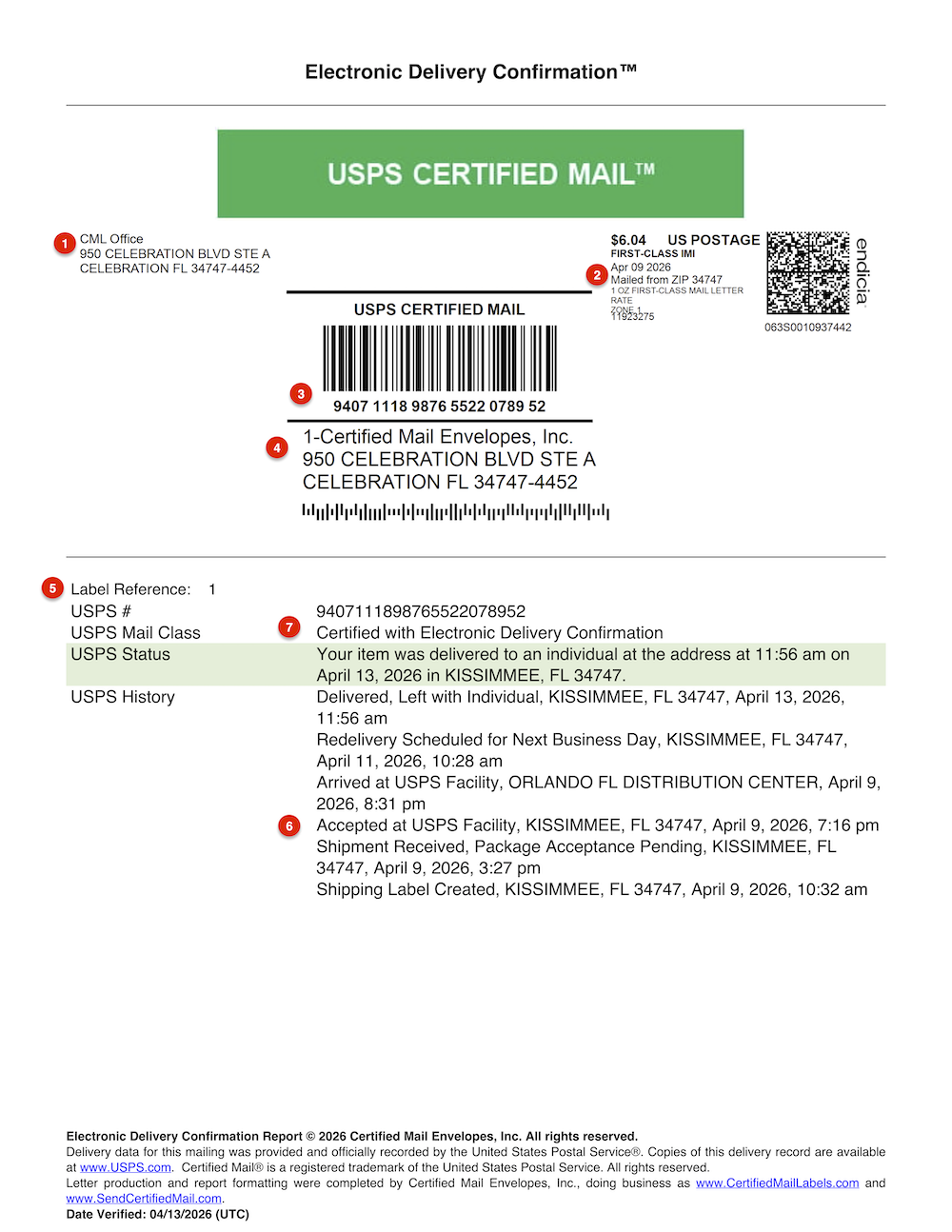
The Certified Mail Labels Electronic Delivery Confirmation™ (EDC) is a downloadable PDF report that organizes the mailing record and available USPS tracking activity into one document.
When a Certified Mail Labels mailing reaches a delivery event, the system can generate the EDC and make it available within the account. The report can also be sent to the email address configured for delivery-confirmation notifications.
Electronic Delivery Confirmation records are retained in the Certified Mail Labels account for up to 10 years.
Example of the Certified Mail Labels Electronic Delivery Confirmation report.
What Information Is Included in the EDC?
The Electronic Delivery Confirmation can bring several important parts of the Certified Mail record into one PDF.
| EDC Record | Why It Matters |
|---|---|
| Return Address | Identifies the sender associated with the mailing. |
| Delivery Address | Shows the address used on the Certified Mail Label. |
| Certified Mail Tracking Number | Links the report to the USPS mailpiece and tracking history. |
| Label Reference | Connects the mailing to your internal case, client, property, account, claim, or other reference. |
| Postage Information | Documents postage associated with the mailing transaction. |
| USPS Acceptance Activity | Shows available USPS events associated with entry into the mailstream. |
| USPS Tracking History | Shows recorded movement, attempts, exceptions, and other tracking events. |
| Delivery Information | Shows the final available USPS delivery event and related information. |
Because the report brings these elements together, it can be easier to store with a legal file, property record, client matter, account history, tax file, government record, or audit packet than a collection of disconnected screenshots.
Learn more about Electronic Delivery Confirmation .
EDC vs. Return Receipt Electronic: What Is the Difference?
The Electronic Delivery Confirmation and USPS Return Receipt Electronic are related records, but they are not the same thing.
| Record | Electronic Delivery Confirmation | Return Receipt Electronic |
|---|---|---|
| Generated from Certified Mail tracking activity | Yes | Associated with the underlying mailing |
| Shows mailing and tracking information | Yes | Focused primarily on the Return Receipt delivery record |
| Shows delivery status | Yes | Yes |
| Provides USPS Return Receipt signature record | No | Yes, when available |
| Included with standard CML Certified Mail reporting | Yes | No — must be selected when mailing |
| Stored with CML mailing history | Yes | Yes, when purchased and received |
If a law, court rule, contract, client instruction, or compliance procedure specifically requires Certified Mail, Return Receipt Requested, do not substitute the EDC for the USPS Return Receipt unless the governing requirement allows it.
Learn more: Return Receipt Electronic vs. Electronic Delivery Confirmation .
Where Do I Find My Return Receipt Electronic Signature?
If Return Receipt Electronic was purchased for the mailing, the signature record becomes available separately from the EDC.
To locate it:
- Open Reports > Summary Tracking Report.
- Search for the mailing.
- Locate the RRE column.
- When the record is available, select View.
- Open, save, or print the USPS Return Receipt Electronic record.
Return Receipt Electronic must be selected as part of the mailing service when the Certified Mail piece is created.
The EDC does not itself provide the USPS Return Receipt signature record.
How Do I Refresh Tracking and Create an Updated Report?
Certified Mail Labels updates tracking information in the account, but you can also request available current information for a record.
From the Summary Tracking Report:
- Locate the mailing.
- Open the tracking record.
- Select Update & Create Report.
- Allow the system to retrieve available USPS tracking information.
- Select View Report when the updated report becomes available.
For compliance or recordkeeping purposes, preserve the report that corresponds to the point in the mailing process you need to document.
Use the Summary Tracking Report to Find Delivery Exceptions
The tracking report should not only be used to confirm successful delivery.
It can be even more valuable for finding mail that needs attention.
Examples include:
- Delivery attempted
- Notice left
- Available for pickup
- Insufficient address
- Forwarded
- Refused
- Unclaimed
- Returned to sender
For high-volume compliance mail, exception management is often more useful than repeatedly checking every successfully delivered letter.
A practical workflow is:
- Search or filter for unresolved mail.
- Review the full tracking history.
- Confirm the recipient address.
- Determine whether your notice procedure requires follow-up.
- Document the action taken.
What Should You Save With a Certified Mail Record?
The Summary Tracking Report is one part of the documentation.
For important mail, consider retaining:
- The final notice or letter
- The recipient and address
- Your internal reference number
- The Certified Mail tracking number
- The mailing or postage record
- Available USPS acceptance information
- The complete tracking history
- The Electronic Delivery Confirmation
- Return Receipt Electronic when purchased
- Returned-mail or exception information
- Any required follow-up documentation
This creates a more complete record than keeping only the final USPS status.
Why the 10-Year Certified Mail Archive Matters
USPS tracking is useful while a mailing is active, but compliance records may be needed long after delivery.
Certified Mail Labels maintains tracking and delivery information in your account for up to 10 years.
That can be valuable when records are later needed for:
- Litigation
- Audits
- Property files
- Collections disputes
- Government reviews
- Insurance matters
- Tax correspondence
- Customer-service inquiries
- Internal compliance reviews
The CML archive is separate from the standard public USPS tracking experience and is intended to keep the mailing history easier to retrieve from one account.

Certified Mail Labels keeps searchable mailing and tracking records available in the account for up to 10 years.
Tracking Certified Mail in Batches
The value of the Summary Tracking Report increases as mailing volume grows.
If you send 500 notices, you should not need to open 500 USPS tracking pages one by one.
Certified Mail Labels supports Excel and CSV batch workflows so each piece can retain:
- Recipient information
- Certified Mail tracking number
- Custom reference
- USPS tracking history
- Delivery status
- Available EDC report
- Available Return Receipt Electronic record
Using consistent reference fields also makes it easier to filter a mailing project inside the Summary Tracking Report.
Sending Certified Mail in Volume?
Create labels from Excel or CSV data and keep every recipient, tracking number, and internal reference connected.
Certified Mail Reports: Which One Should You Use?
| Report or Record | Use It For |
|---|---|
| Summary Tracking Report | Searching mailings, reviewing status, monitoring delivery, and locating related reports |
| Detailed USPS Tracking History | Understanding the sequence of USPS events for an individual mailpiece |
| Electronic Delivery Confirmation | Keeping mailing, tracking, acceptance, and delivery information together in a downloadable PDF |
| Return Receipt Electronic | Retrieving the USPS return-receipt delivery and available signature record when purchased |
| USPS SCAN Form | Documenting USPS handoff of eligible tracked batch mailings through a master barcode |
| Mail Manifest | Reviewing labels created, addresses, tracking numbers, postage, references, and other mailing data |
| Firm Book | Keeping an itemized list of recipients and tracking numbers associated with a batch or mailing project |
See the full Certified Mail Reports overview for additional reporting options.
Want Tracking Like This for Your Next Certified Mail Letter?
Every Certified Mail Labels mailing includes a USPS tracking number and access to the Certified Mail Labels reporting workflow.
Create the label online, mail the envelope, and keep the resulting tracking and delivery information associated with the transaction.
Create One Certified Mail Label
Print USPS Certified Mail postage from your home or office without handwriting traditional Certified Mail forms.
Need Tracking Data Connected to Your Existing System?
For recurring high-volume mail, manually downloading reports may not be the most efficient workflow.
Certified Mail Labels supports API and SFTP automation for organizations that need mailing and tracking activity connected to existing systems.
Automated workflows can help connect:
- Source-system recipient data
- Internal reference numbers
- Certified Mail tracking numbers
- USPS status information
- Delivery records
- Return Receipt data when selected
This can be useful for law firms, property managers, government offices, financial institutions, insurance companies, healthcare organizations, collections teams, utilities, and other organizations sending recurring compliance mail.
Want to See the Tracking and Reporting Workflow Live?
The easiest way to understand the reporting tools is to see how a real mailing moves from label creation through USPS acceptance, tracking, delivery, EDC generation, Return Receipt retrieval, and long-term archive access.
Schedule a Live Demo
A member of our Customer Support Team can walk through Summary Tracking, EDC reports, Return Receipt Electronic, SCAN Forms, batch processing, custom references, automation, and 10-year records.
Frequently Asked Questions About Certified Mail Tracking Reports
Where can I track Certified Mail sent through Certified Mail Labels?
Log in to your Certified Mail Labels account and select Reports > Summary Tracking Report. Use the available search fields or select Search to display matching tracking records.
How long does Certified Mail Labels keep tracking records?
Certified Mail Labels keeps tracking and delivery information available in the account for up to 10 years.
What is an Electronic Delivery Confirmation?
The Certified Mail Labels Electronic Delivery Confirmation is a downloadable PDF report that combines mailing information, the Certified Mail tracking number, available acceptance and tracking activity, and delivery information into one record.
Does the EDC contain the recipient's signature?
No. The EDC is not a USPS Return Receipt signature record. If you need the available recipient or authorized-agent signature, Return Receipt Electronic should be purchased when the mailing is created.
Where can I find my Return Receipt Electronic?
Open the Summary Tracking Report, locate the delivered mailing, and look for the available RRE link or button associated with the record.
Can I update my Certified Mail tracking report?
Yes. Within the tracking record, use the available Update & Create Report option to retrieve available USPS tracking information and generate an updated report.
What does “USPS Awaiting Item” mean?
It generally means the electronic label information exists, but that status is not the same as an individual USPS acceptance event for the physical mailpiece.
What does “Accepted” mean in USPS tracking?
An acceptance event indicates that USPS recorded receipt or acceptance of the tracked mailpiece. Review the full event details for the date, time, and location information available for that scan.
What does “Notice Left” mean?
It means USPS could not complete delivery under the circumstances shown in the tracking record and left or generated notice information for the recipient.
What does “Unclaimed” mean?
An unclaimed status indicates that the mailpiece was not claimed through the applicable delivery or pickup process. It may then be returned to the sender.
Can a returned letter eventually show “Delivered”?
Yes. A returned mailpiece can eventually receive a Delivered scan when USPS delivers it back to the original sender. Review the full tracking history to determine who received the final delivery.
Can I search Certified Mail by something other than the tracking number?
Yes. Depending on the data associated with your mailing, the Summary Tracking Report can use available search fields and custom references to help locate records.
Can I track a batch of Certified Mail letters?
Yes. Batch-created mailpieces retain individual tracking numbers. Consistent custom reference fields can also help you filter and review records associated with a particular batch or project.
Does the Summary Tracking Report prove legal compliance?
The report documents available mailing and USPS tracking information. Whether a mailing satisfies a particular law, court rule, regulation, contract, or notice requirement depends on the governing requirement.
Turn Certified Mail Tracking Into a Usable Record
A tracking number is useful. A searchable mailing record is better.
The Certified Mail Labels Summary Tracking Report gives you one place to locate Certified Mail pieces, understand USPS scan events, monitor delivery exceptions, access Electronic Delivery Confirmation reports, retrieve purchased Return Receipt Electronic records, and search historical mailing activity.
For individual senders, that makes it easier to find evidence when a question comes up later.
For organizations sending hundreds or thousands of legal, regulatory, financial, property, tax, insurance, government, or compliance notices, it creates a repeatable way to connect USPS activity with the underlying business record.
Create your next Certified Mail label online, or schedule a Live Demo with a member of our Customer Support Team today to see the complete tracking and reporting workflow.
Create a Certified Mail Label Schedule a Live Demo