
Getting the Mailing Method Right
Last reviewed: October 2026
If you send workers’ compensation or unemployment notices, the correct mailing method depends on the state, agency, notice type, and deadline involved. Some rules require written notice but do not require certified mail. Other procedures specifically name certified mail, return receipt requested, or another documented service method. The safest process is to confirm the rule with your own counsel, identify the required proof, and preserve evidence of what was sent, when it was mailed, and whether it was delivered.
This page is reviewed every January and again after any state legislative session that amends the notice statute.
Disclaimer: This is a general educational guide, not legal advice. State workers’ compensation and unemployment rules change frequently. Confirm the current requirements for your notice, state, and deadline with your own counsel or the relevant agency.
Why Does The Mailing Method Matter For Workers’ Compensation And Unemployment Notices?
Every state system depends on written notices moving between agencies, employers, carriers, third-party administrators, claimants, and former employees.
Common mailing tasks include:
- Notice of injury or claim responses
- Claim acceptance, controversion, or contest notices
- Benefit denials and payment decisions
- Hearing notices and assessment orders
- Unemployment separation and wage-information responses
- Appeals, reconsideration requests, and supporting documents
- Notices to workers, claimants, employers, representatives, or government agencies
The cost of a lost notice is more than postage. A missing or late document can create a dispute about whether notice was received, whether a response window opened, or whether an appeal was filed on time.
That is why legal compliance mailing is built around proof. You want a reliable record showing:
- The final document that was sent
- The exact recipient and address
- The mailing date
- USPS acceptance and tracking events
- Delivery confirmation
- The recipient signature, when required or useful
- A searchable archive for future audits or disputes
Certified mail is not automatically required for every workers’ compensation or unemployment notice. But when the rule, agency instruction, or your risk profile calls for stronger evidence, certified mail online can make the process faster and easier.
What Do Ohio Workers’ Compensation Rules Require?
Ohio provides one of the clearest examples of an agency using certified mail for important workers’ compensation enforcement notices.
Under Ohio Revised Code § 4123.511, the Bureau of Workers’ Compensation must notify the claimant and employer within seven days after receiving a claim. The notice identifies the receipt of the claim and the facts alleged.
The same section also establishes written notices of orders and appeal rights. For example, an employer or claimant may have only a limited period after receiving an order to appeal.
Ohio’s certified-mail requirement appears more specifically in Ohio Administrative Code Rule 4123-14-02. For certain actions involving non-complying employers, the Bureau must send written notice by certified mail with return receipt requested to the employer’s residence or usual place of business.
The rule also provides for:
- Certified-mail notices of hearings
- Certified-mail delivery of findings and orders to the assessed party
- A response period after receipt or mailing of the notice
- A formal record supporting the agency’s enforcement process
Ohio’s § 4123.84 addresses the one-year claim period for specific body parts and permits written or facsimile notice to the Industrial Commission or Bureau in qualifying circumstances. It also requires certain notices to be posted by self-insuring employers.
Practical takeaway: Ohio does not make every workers’ compensation communication a certified-mail item. But where Rule 4123-14-02 applies, using ordinary mail would not match the stated method. Verify the specific notice category before mailing.
What Does California Workers’ Compensation Law Say About Mailing?
California shows why you should examine the wording of the rule rather than assume every notice has the same mailing requirement.
Under California Labor Code § 5401, an employer generally must provide a claim form and notice of potential eligibility within one working day after receiving notice or knowledge of a work-related injury that causes qualifying lost time or medical treatment beyond first aid.
The completed claim form is deemed filed when it is:
- Personally delivered to the employer
- Received by the employer by first-class mail
- Received by the employer by certified mail
That makes certified mail an official filing channel in the California workers’ compensation process. It does not mean every employer notice must be sent by certified mail. It means certified mail can provide a documented way to send and establish receipt of the claim form.
California also has posting duties. Under Labor Code § 3550, employers must post workers’ compensation carrier information and employee rights in a conspicuous location. The notice must include information about reporting injuries, medical care, time limits, and protections against discrimination.
The required notice also addresses protections under Labor Code § 132a, which prohibits discrimination connected to an employee’s workers’ compensation claim activity.
Practical takeaway: California has multiple notice channels: personal delivery, first-class mail, certified mail, and workplace posting. Match the method to the specific document and keep evidence of the completed process.
How Does New York Combine Electronic Reporting And Paper Notice?
New York demonstrates that electronic filing does not eliminate the need for paper notice and mailing records.
The New York Workers’ Compensation Board’s Subject Number 046-717 authorizes certified mail, return receipt requested, as an alternative method for serving certain legal papers and subpoenas on the Board. The procedure includes specific addresses, an “URGENT LEGAL MAIL” marking, and additional service requirements.
The Board also states that received legal papers are date-stamped and logged with the date and method of receipt. That is exactly the type of documented service trail that matters when timing or delivery is disputed.
New York’s eClaims materials show another important point. Carriers and claim administrators may report information electronically, but required paper forms and reports may still need to be mailed to parties. The Board’s eClaims change log includes mailing requirements for reports sent to claimants and representatives, including situations involving changes to claim status or liability.
Practical takeaway: Do not assume an electronic filing replaces a required paper notice. For each event, identify whether you must file electronically, mail a paper copy, or do both.

What Is The Verified State-by-State Mailing Summary?
The following table summarizes the verified examples covered in this guide. It does not create rules for states not listed.
| State | Verified workers’ compensation notice rule | Mailing method takeaway |
|---|---|---|
| Ohio | Under Ohio Rev. Code § 4123.511, BWC must notify the claimant and employer within seven days after receiving a claim. Under Ohio Admin. Code Rule 4123-14-02, certain BWC enforcement notices, hearing notices, and findings/orders use certified mail; specified notices require return receipt requested. § 4123.84 addresses written or facsimile notice and tolling for specific claim circumstances. | Use certified mail with return receipt when Rule 4123-14-02 applies. Do not assume the same method is required for every Ohio claim notice. |
| California | Labor Code § 5401 requires a claim form and eligibility notice within one working day in qualifying injury situations. A claim form is deemed filed when personally delivered or received by first-class or certified mail. § 3550 requires workplace posting, including rights and anti-discrimination information connected to § 132a. | Certified mail is an accepted filing channel for the claim form. Posting requirements are separate and are not satisfied by mailing alone. |
| New York | Subject Number 046-717 permits certified mail, return receipt requested, for specified service of legal papers and subpoenas on the Board. New York eClaims materials also identify paper forms and reports that must be mailed to parties even when claim data is filed electronically. | Treat electronic reporting and paper mailing as separate obligations when the Board’s event instructions require both. |
| Federal UCFE baseline | 20 CFR § 609.6 requires prompt written notice of determinations and redeterminations for Unemployment Compensation for Federal Employees, including information about the determination and reconsideration or appeal rights. | The federal rule establishes written notice and due-process information. It does not make certified mail a universal method for every state unemployment notice. |
Most states follow the same general pattern: an agency or employer sends written notice, the recipient has a response or appeal window, and the mailing record may become important later. The exact mailing mechanics are state-specific. If your state is not in this table, check the current statute, regulation, agency instructions, and notice form with your own counsel.
How Should You Choose Between Certified Mail, Return Receipt, And Regular Mail?
Start with the notice itself. Ask four practical questions:
-
Who must receive the document?
Is it an agency, employer, employee, claimant, carrier, attorney, or representative? -
What does the rule say about service?
Look for terms such as “certified mail,” “return receipt requested,” “personal service,” “first-class mail,” “received,” or “mailed.” -
What date controls the deadline?
Some procedures focus on mailing. Others focus on receipt, filing, service, or a date printed on an agency decision. -
What proof will you need later?
Basic tracking may show delivery. An electronic return receipt can provide a digital proof record with delivery details and available signature information.
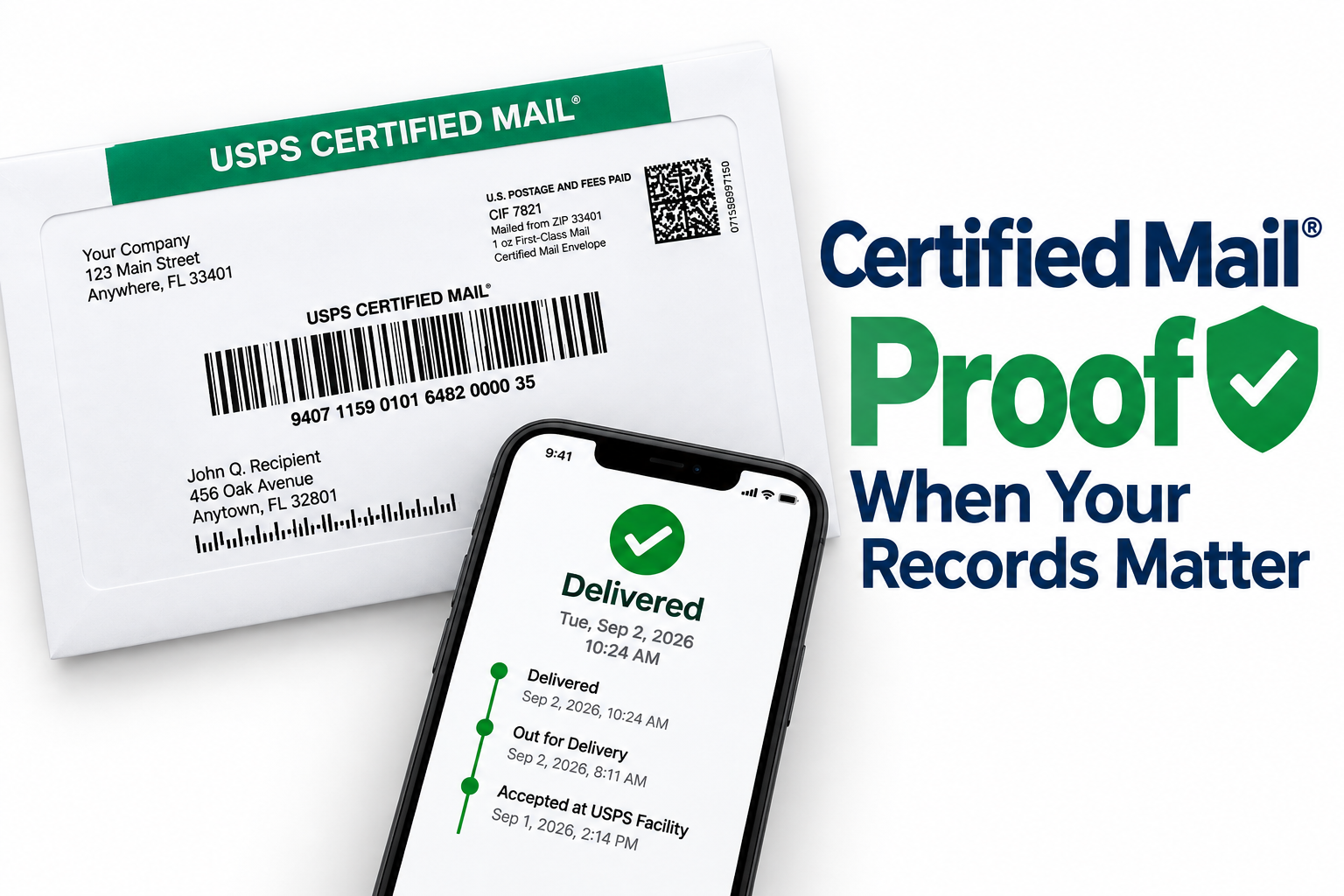
When you need stronger documentation, use USPS Certified Mail labels with the appropriate add-ons. You can create and print Certified Mail Labels online from your office, without a trip to the Post Office. You’ll receive USPS tracking information and can maintain a cleaner mailing record.
For signature-level proof, review the Electronic Return Receipt USPS option. It provides a digital delivery record instead of requiring you to manage a paper green card.

How Can You Make Recurring Notice Mailings Easier?
If you send one notice, online label creation may be enough. If you send hundreds or thousands, a repeatable process matters more.
Here are practical options:
- Send from your office: Create labels online, print on a standard office printer, and skip the Post Office trip.
- Use full-service mailing: With Print & Mail, upload the PDF notice and address list. The service prints, inserts, applies postage, and hands the mailing to USPS the same business day for qualifying orders submitted before 5:00 PM Eastern.
- Process bulk certified mail: Use Excel batch labels for recurring employer, claimant, agency, or representative lists.
- Automate high-volume work: Third-party administrators and carriers can review API and SFTP automation for system-generated mailings and secure file transfers.
- Keep records available: Use Certified Mail reports and searchable digital records to locate tracking events, delivery confirmations, and signature records.
Certified Mail Labels also provides a 10-year compliance archive at no extra charge, helping you retrieve mailing evidence when an audit, appeal, dispute, or internal review occurs.
What Should Your Notice-Mailing Checklist Include?
Before sending a time-sensitive notice, confirm:
- The document is complete and dated.
- The recipient name and address match the current file.
- The correct state and agency rule has been reviewed.
- The required service method is selected.
- Copies are sent to every required representative.
- The mailing date and deadline are recorded.
- USPS tracking is connected to the matter or claim.
- Delivery or signature evidence is saved.
- Undeliverable mail is escalated promptly.
- The record is retained under your compliance policy.
The best process is not complicated. It is consistent, documented, and easy for another employee to understand.
Frequently Asked Questions About State Notice Mailing Requirements
Is certified mail required for every workers’ compensation notice?
No. Requirements vary by state, agency, notice type, and proceeding. Ohio Rule 4123-14-02 provides a verified example of certified mail with return receipt for specific BWC enforcement notices. California permits certified mail as a filing method for certain claim forms. Those examples do not mean every notice nationwide requires certified mail.
Is certified mail required for unemployment notices?
Not universally. Unemployment systems generally require written determinations and information about appeal or reconsideration rights. 20 CFR § 609.6 provides a federal UCFE due-process example. Check the applicable state unemployment law and agency instructions before choosing the mailing method.
What is the difference between certified mail tracking and an electronic return receipt?
Certified mail tracking documents USPS acceptance and delivery events. An electronic return receipt can provide a digital delivery record with recipient, address, date, time, and available signature information. Select the service that matches your evidence needs and the applicable rule.
Can I send certified mail online without visiting the Post Office?
Yes. You can use an online platform to create and print live-postage USPS Certified Mail labels from your office. This can reduce travel, simplify repeat mailings, and give you centralized tracking records.
What should third-party administrators and carriers use for bulk notice mailings?
For occasional batches, Excel or CSV uploads can help generate multiple labels. For recurring, system-generated programs, API or secure SFTP workflows can automate data transfers and mailing instructions. Full-service Print & Mail is another option when you want the PDF notices printed, inserted, postage-applied, and handed to USPS for you.
How long should workers’ compensation and unemployment mailing records be kept?
Your retention period should follow your legal, regulatory, contractual, and internal compliance requirements. A long-term searchable archive can make records easier to retrieve. Certified Mail Labels provides a 10-year digital archive for mailing proof, tracking, delivery confirmation, and signature records, but confirm the retention period required for your own organization.
When the notice matters, do not leave the mailing record to chance. Start sending Certified Mail online, use the method your state rule requires, and preserve proof that your notice was handled correctly. You’ll save time, reduce administrative work, and keep the documentation you may need later.