
Certified Mail Requirements and the Postmark Date Rule
Last reviewed: October 2026
If you are mailing a state tax protest, appeal, refund claim, or response to a tax department notice, the postmark date usually controls whether your filing is timely, not the date the agency receives it. Certified mail is often not mandatory, but it gives you a dated USPS receipt, certified mail tracking, and evidence connected to the specific piece of mail. Your state’s statute or tribunal rule still controls, so confirm the filing deadline and accepted delivery method before mailing.
This is a general guide about mailing mechanics, not legal or tax advice. State rules change frequently, and you should confirm the applicable requirements with your own counsel or tax advisor.
This page is reviewed every January and again after any state legislative session or state tax agency rule change that affects filing deadlines.
Why Does the Postmark Date Matter for State Tax Filings?
A state tax department may give you a deadline to protest an assessment, appeal a determination, submit a refund claim, or answer a notice. When the applicable rule follows a “timely mailing equals timely filing” approach, the filing is generally treated as timely when it is properly mailed and bears a postmark on or before the deadline.
That means the delivery date may be later than the deadline. The key issue is usually whether you can prove the mailing was timely.
The federal model is found in 26 U.S.C. § 7502, titled “Timely mailing treated as timely filing and paying.” The general rule applies when a qualifying document is delivered by U.S. mail and bears a postmark dated on or before the last prescribed date.
The regulation at 26 CFR § 301.7502-1 adds important practical details:
- The postmark date can control even when the agency receives the document after the deadline.
- If the USPS postmark is illegible, the sender has the burden of proving the postmark date.
- If delivery takes longer than ordinary delivery time, the sender may have to prove the document was mailed timely.
- A properly postmarked certified mail receipt can establish the postmark date.
- Proof of proper registered or certified mail use and a properly addressed envelope is prima facie evidence of delivery for a document.
The practical takeaway is simple: do not focus only on mailing the document. Focus on creating and preserving proof that you mailed the correct document on time.
Is Certified Mail Required for a State Tax Protest or Appeal?
Usually, certified mail is a strong recommendation rather than a universal requirement. However, the answer depends on the state, tax type, filing method, and tribunal handling the matter.
Some state rules recognize a USPS postmark. Others use the date the agency receives the filing. Some require electronic filing, a particular delivery service, or a separate petition process. A state tax department notice may also contain filing instructions that differ from the general rule.
Before you mail, check:
- The exact deadline and what event starts the deadline.
- Whether the deadline is measured from the notice date, mailing date, service date, or receipt date.
- Whether the filing must be mailed, hand-delivered, or submitted electronically.
- The correct tax department, appeals office, or tribunal address.
- Whether supporting documents and payment must be included.
- Whether certified mail, registered mail, or another approved method is required or recommended.
Certified Mail Labels does not determine which filing method your state requires. Our role is to help you execute and prove the filing your state’s rules require.
What Is the Difference Between Mailing a Letter and Proving the Postmark?
An ordinary first-class letter may be delivered successfully, but it may leave you with limited evidence if the envelope is lost, damaged, or marked with an illegible postmark.
The real-world risk is not only “Was the document mailed?” It is “Can you prove when it entered the mail and connect that mailing date to the document?”
With ordinary mail, you may have no dated receipt tied to the envelope. A postage meter mark may be difficult to read or may not provide the delivery evidence your situation requires. If the envelope arrives late, the agency may question when it was deposited.
A certified mail workflow gives you more documentation:
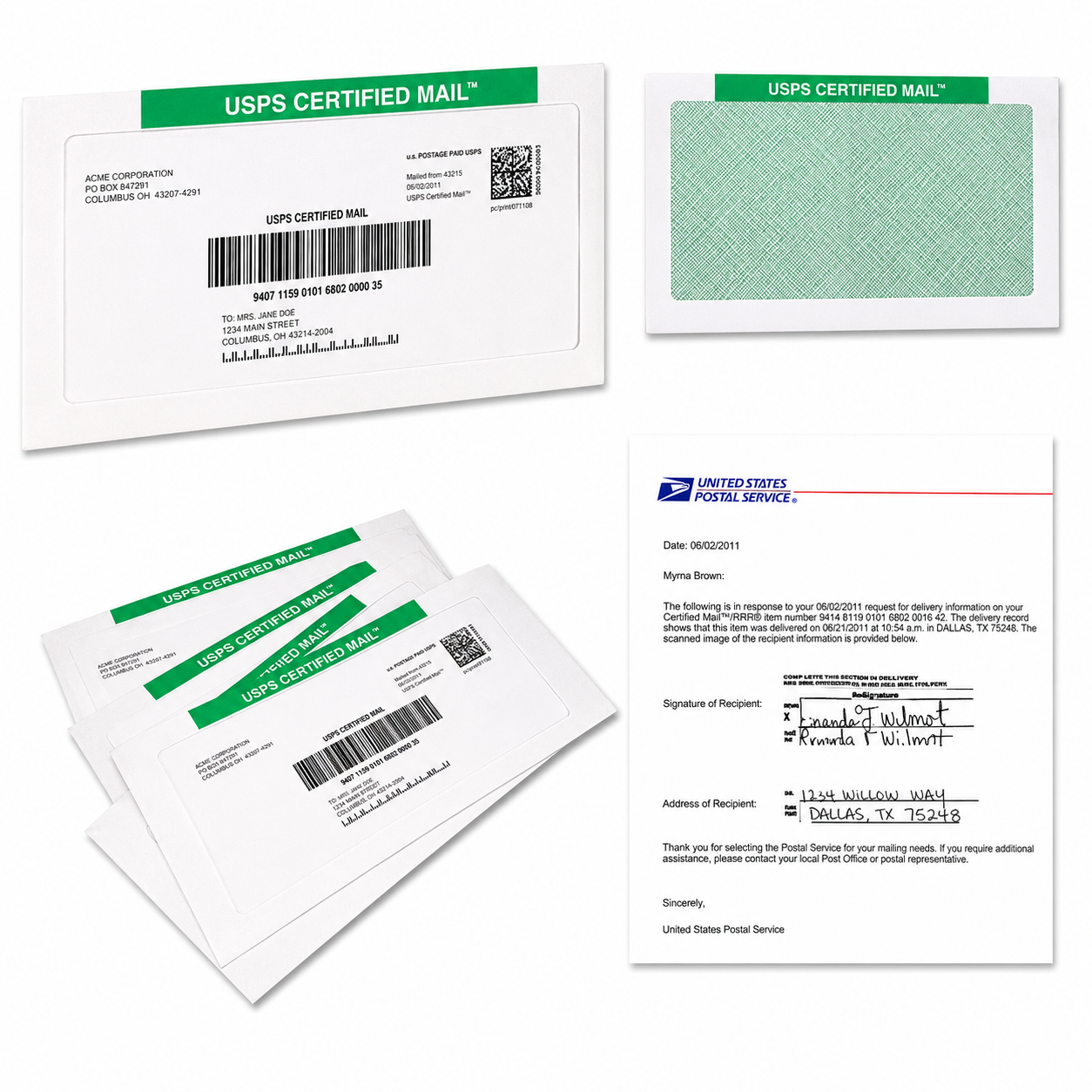
- A USPS certified mail receipt.
- A mailing date associated with the certified piece.
- A tracking number for the envelope.
- USPS acceptance and delivery events.
- Optional electronic delivery confirmation.
- Optional electronic return receipt and signature record.
- A digital record you can save with the filed document.
This documentation supports a more complete legal compliance mailing process. It does not guarantee that a state will accept the filing, and it does not replace reading the state’s deadline rule.
How Do Federal Postmark Rules Treat Certified Mail?
Under 26 U.S.C. § 7502 and 26 CFR § 301.7502-1, a timely USPS postmark can establish the filing date for qualifying federal documents.
The regulation specifically explains that when a document is sent by certified mail and the sender’s receipt is postmarked by the postal employee to whom the document is presented, the date on that receipt is treated as the postmark date. The regulation states that the risk of the document not being postmarked on the day it is deposited may be eliminated by using registered or certified mail.
The regulation also gives certified mail proof special evidentiary value. For a document, proof that the sender properly used certified mail, received a postmarked receipt, and addressed the envelope correctly constitutes prima facie evidence that the document was delivered.
That federal rule does not automatically govern every state tax filing. It is a helpful model, but each state may have its own statute, regulation, or tribunal rule.
What Do California and Texas Rules Show?
The following examples illustrate why you should verify the exact state provision before mailing.
| State or Rule | What the Rule Generally Provides | Practical Mailing Point |
|---|---|---|
| Federal baseline | Under 26 U.S.C. § 7502 and 26 CFR § 301.7502-1, a qualifying document with a timely postmark may be treated as filed on the postmark date. | Keep the postmarked certified mail receipt and tracking record. |
| California | California Revenue and Taxation Code § 1933 provides that the postmark on an original return is prima facie evidence that the return was delivered on the date of the U.S. postmark. | Confirm the rule for the specific tax, protest, appeal, or refund matter. |
| Texas | Texas Tax Code § 111.054 addresses timely filing by mail and provides that the postmark or carrier receipt is prima facie evidence of the delivery date to the post office or carrier. Section 111.104 addresses refund claims and their filing requirements. | Do not assume the refund deadline and mailing-evidence rule are located in the same section. Check both the deadline rule and the mailing rule. |
| Other states | Many state tax departments apply a similar postmark principle, but the wording and exceptions vary. | Check the statute or rule for the specific state tax department and tribunal. |
Texas also has a long-standing comptroller practice of accepting a petition as timely when the envelope shows a timely postmark, even if the petition arrives later. Treat that as general agency practice, not as a substitute for checking the current statute, rule, notice instructions, or advice from your tax professional.
How Should You Send Certified Mail for a Tax Filing?
When you are ready to mail, use a repeatable process. Here are practical steps to help you create a clear record:
- Read the notice first. Identify the filing deadline, recipient address, required form, and delivery method.
- Prepare the complete filing. Include the protest, appeal, refund claim, response, exhibits, payment, and any required signature.
- Confirm the address. Use the exact address listed by the tax department or tribunal.
- Choose your mailing date carefully. Do not assume a drop-off late in the day will receive that day’s postmark.
- Create USPS Certified Mail labels online. Use a certified mail label printing flow to prepare the mailing from your home or office.
- Obtain the receipt. Keep the USPS receipt showing the date the certified piece was accepted.
- Save the tracking number. Use certified mail tracking to monitor acceptance and delivery.
- Request electronic proof when appropriate. An Electronic Return Receipt can provide a digital delivery record and available signature information.
- Keep the complete file together. Save the final document, envelope or label record, receipt, tracking history, delivery confirmation, and return receipt.
- Do not rely on a screenshot alone. Download and preserve the actual records in your compliance or matter-management system.
Certified mail cost is usually modest compared with the administrative burden of reconstructing a missed or disputed filing. The value is not just delivery visibility. It is the organized proof connected to a specific envelope and filing.
How Can Accounting Firms and Tax Departments Handle Volume?
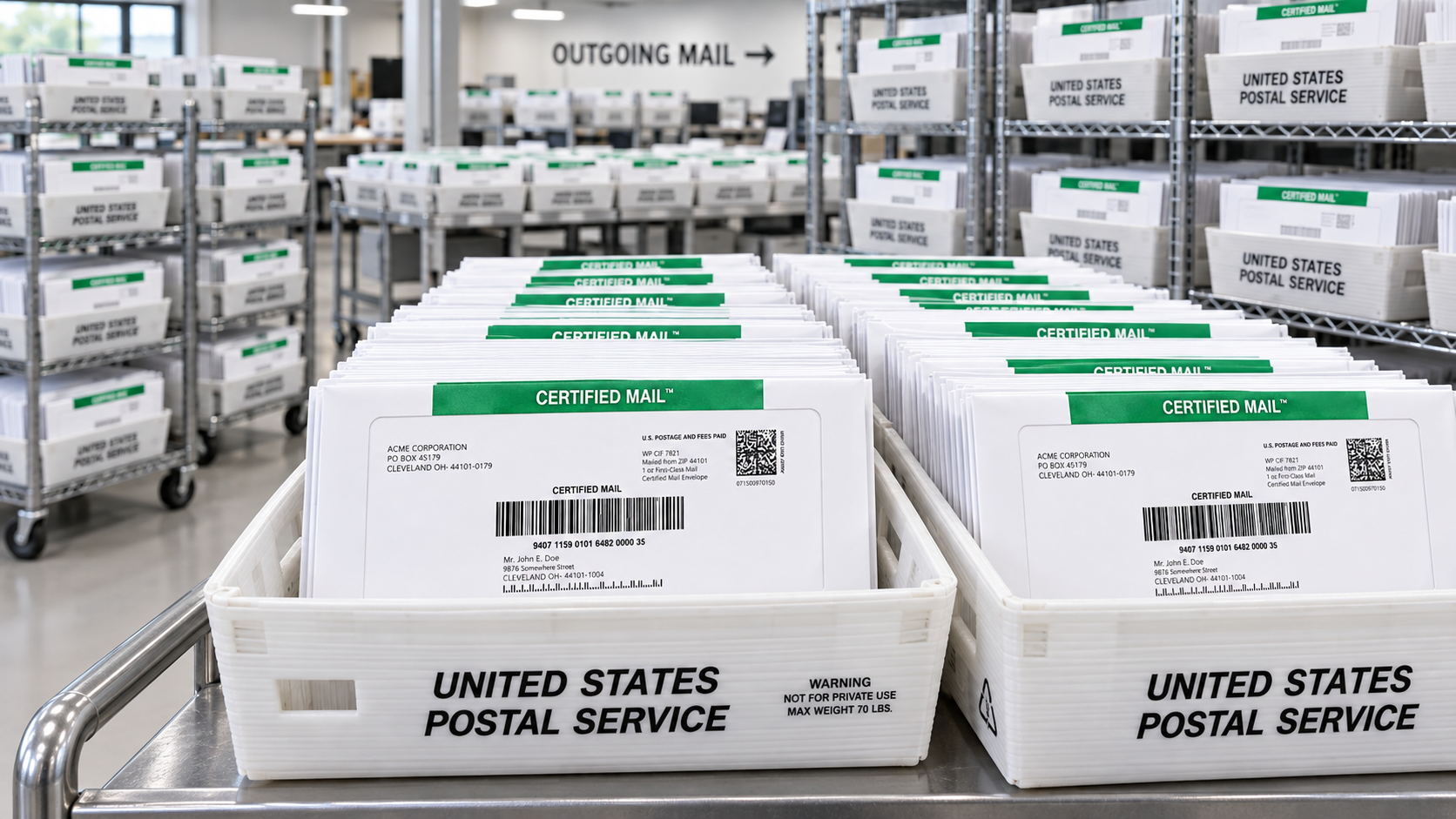
Tax departments, accounting firms, municipalities, and businesses may mail dozens, hundreds, or thousands of notices, responses, assessments, or compliance documents. Manually preparing every envelope creates avoidable risk:
- Addresses may be entered incorrectly.
- Documents may be matched to the wrong recipient.
- Receipts may be misplaced.
- Tracking numbers may not be connected to the correct account.
- Staff may spend hours printing, folding, inserting, and visiting the Post Office.
- Filing records may be difficult to retrieve during an audit or dispute.
For higher volume, Excel batch processing lets you upload a spreadsheet or CSV file and create labels in batches. For recurring mailings, API and secure SFTP automation can connect mailing activity with billing, tax, case-management, or records systems.
You’ll get a more consistent process:
- You’ll upload structured recipient data.
- You’ll create multiple USPS Certified Mail labels at once.
- You’ll connect tracking data with internal reference numbers.
- You’ll receive electronic delivery and signature records when selected.
- You’ll reduce manual entry and repetitive postal work.
- You’ll have reporting that is easier to search during audits or disputes.
If your team prefers to outsource production, our Print & Mail full-service option can help tax departments and accounting firms upload PDFs and address lists for printing, inserting, postage application, and same-business-day mailing for qualifying orders received before 5:00 p.m. Eastern.
How Long Should You Keep Certified Mail Proof?
Keep the mailing record for at least as long as your tax, accounting, audit, litigation, and document-retention requirements call for. A useful file may include:
- The signed or final filing.
- A copy of the notice that created the deadline.
- The recipient address used.
- Certified mail receipt and mailing date.
- Tracking history.
- USPS acceptance information.
- Delivery confirmation.
- Electronic Return Receipt or signature record.
- Internal notes showing who prepared and approved the mailing.
Certified Mail Labels provides a searchable digital archive for mailing records, tracking events, delivery confirmations, and signature records. A long-term archive can make it easier to answer a future question without searching through paper receipts or old email attachments.

What Should You Confirm Before Mailing a State Tax Appeal?
Use this quick checklist before you send:
- Confirm whether the state counts from postmark, receipt, or electronic submission.
- Confirm whether the filing must be submitted to a tax department or a separate tribunal.
- Confirm the deadline, including any weekend or holiday adjustment.
- Confirm the correct mailing address.
- Confirm whether certified mail is required, recommended, or unavailable.
- Confirm whether a signature, payment, form, or authorization is required.
- Create the USPS Certified Mail label before the deadline day whenever possible.
- Obtain and save the dated receipt.
- Monitor certified mail tracking.
- Save all documents in one searchable matter file.
When the deadline matters, a fast and easy mailing workflow can help you avoid uncertainty. You can skip the Post Office trip, print certified mail online, and keep the proof your records may need.
Frequently Asked Questions About State Tax Certified Mail
Does the delivery date control a mailed tax filing?
Usually, the postmark date controls when the applicable rule treats timely mailing as timely filing. However, some state proceedings count from receipt, require electronic filing, or impose special delivery rules. Confirm the specific state requirement.
Is certified mail legally required for a tax protest?
Not always. Many rules recognize ordinary USPS postmarks, but certified mail is often recommended because it provides a dated receipt, tracking, and stronger delivery evidence. The notice or tribunal rule may impose different requirements.
What happens if the USPS postmark is illegible?
Under the federal regulation, the sender may have the burden of proving the date the postmark was made. This is one reason to keep a postmarked certified mail receipt and related USPS records.
Does certified mail prove that the document inside was complete?
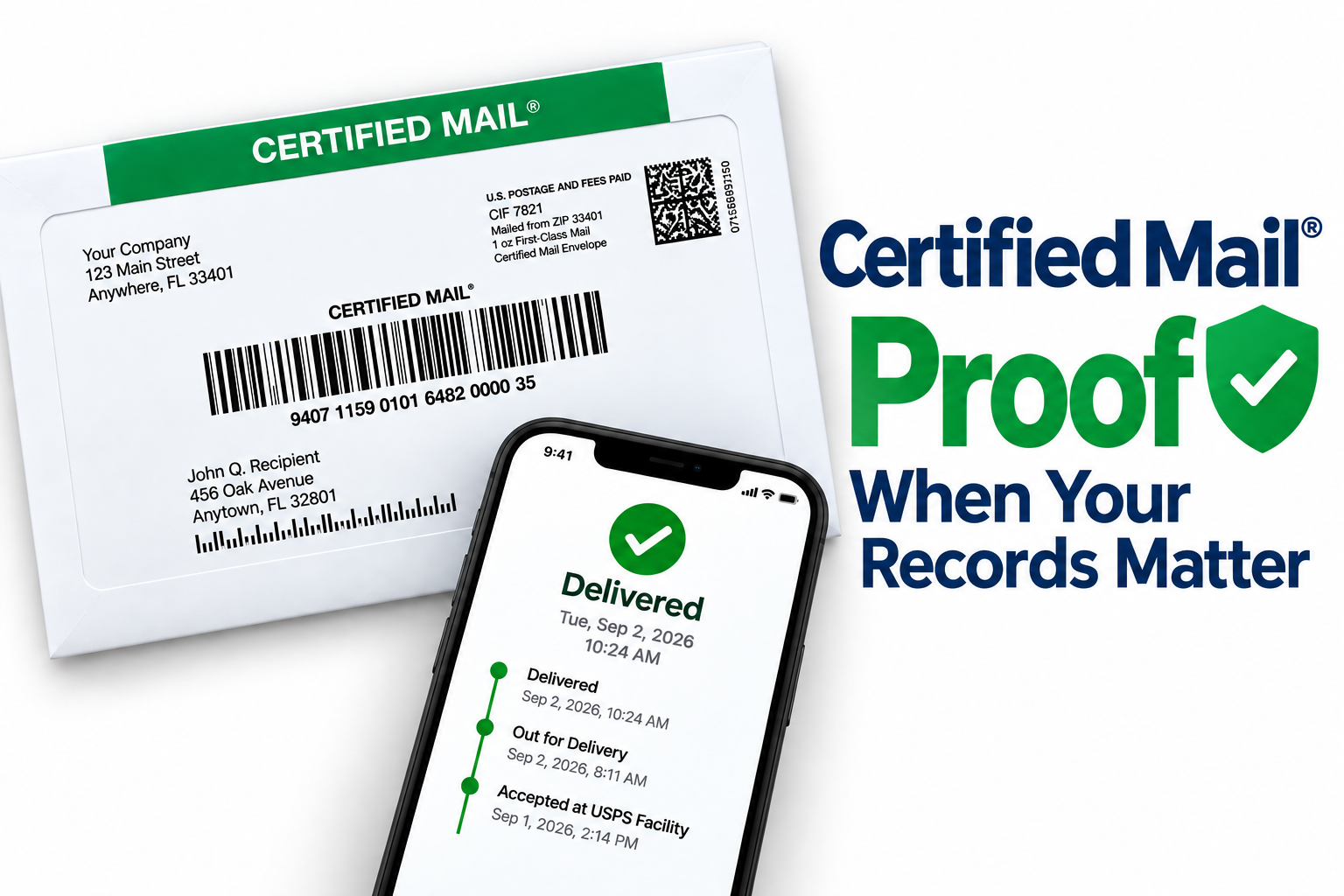 Certified mail evidence generally connects the mailing to the envelope or certified piece. It does not independently prove the contents were complete, accurate, signed, or filed with the correct agency. Keep a copy of the final document and your internal mailing record.
Can I send state tax notices in bulk?
Yes, if the state’s rules allow the selected mailing method and your process correctly matches each document to each recipient. Excel, API, and SFTP options can help organizations manage recurring or high-volume mailings.
Where can I get certified mail proof after delivery?
Use USPS tracking and any selected delivery confirmation or Electronic Return Receipt service. Certified Mail Labels also provides digital reporting and searchable records to help you retrieve mailing information later.
Ready to Make Your Tax Mailing Process Easier?
Start by reviewing your state’s deadline rule and confirming the filing method with your counsel or tax advisor. Then use a documented process to prepare the filing, create the USPS Certified Mail label, obtain the receipt, monitor certified mail tracking, and preserve the complete record.
For one-time filings, certified mail online can save time and reduce administrative hassle. For tax departments and accounting firms, bulk processing, Print & Mail, Electronic Return Receipt, and long-term digital records can make legal compliance mailing easier to manage at scale.