
 When sending time-sensitive documents, it’s not enough to just put a letter in the mail. Whether you are submitting tax forms, sending legal notices, or mailing important government forms, you may need to prove exactly when the document was sent.
Why Proof of Mailing Matters for Time-Sensitive Documents
Many individuals and businesses assume that mailing a letter automatically protects them. In reality, without proper documentation, it can be difficult, or impossible, to verify the mailing date.
That’s where understanding USPS services and following a structured process becomes critical.
What Qualifies as a Time-Sensitive Document?
Time-sensitive documents are any communications tied to a deadline, legal obligation, or required response.
Common examples include:
- Tax forms and supporting documentation
- Legal notices and formal correspondence
- Compliance and regulatory communications
- Government forms and filings
- Financial disputes or demand letters
These documents often contain sensitive documents or personal information, making proper handling and documentation even more important.
The Common Mistake: Assuming Mailing Equals Proof
One of the most common misconceptions is that once a document is mailed, it is automatically documented.
This is not the case.
The following actions do not reliably provide proof of mailing:
- Printing postage online
- Dropping a letter in a mailbox
- Relying solely on a postmark
While these steps begin the mailing process, they do not confirm that the United State Postal Service (USPS) has officially accepted the mail piece.
Without that confirmation, your mailing may not create an official record if questioned.
What Actually Counts as Proof of Mailing
To properly document a mailing, you need verifiable confirmation that USPS took possession of your letter.
Reliable proof of mailing includes:
- A USPS Acceptance Scan
- A mailing receipt from the Post Office
- A unique tracking number
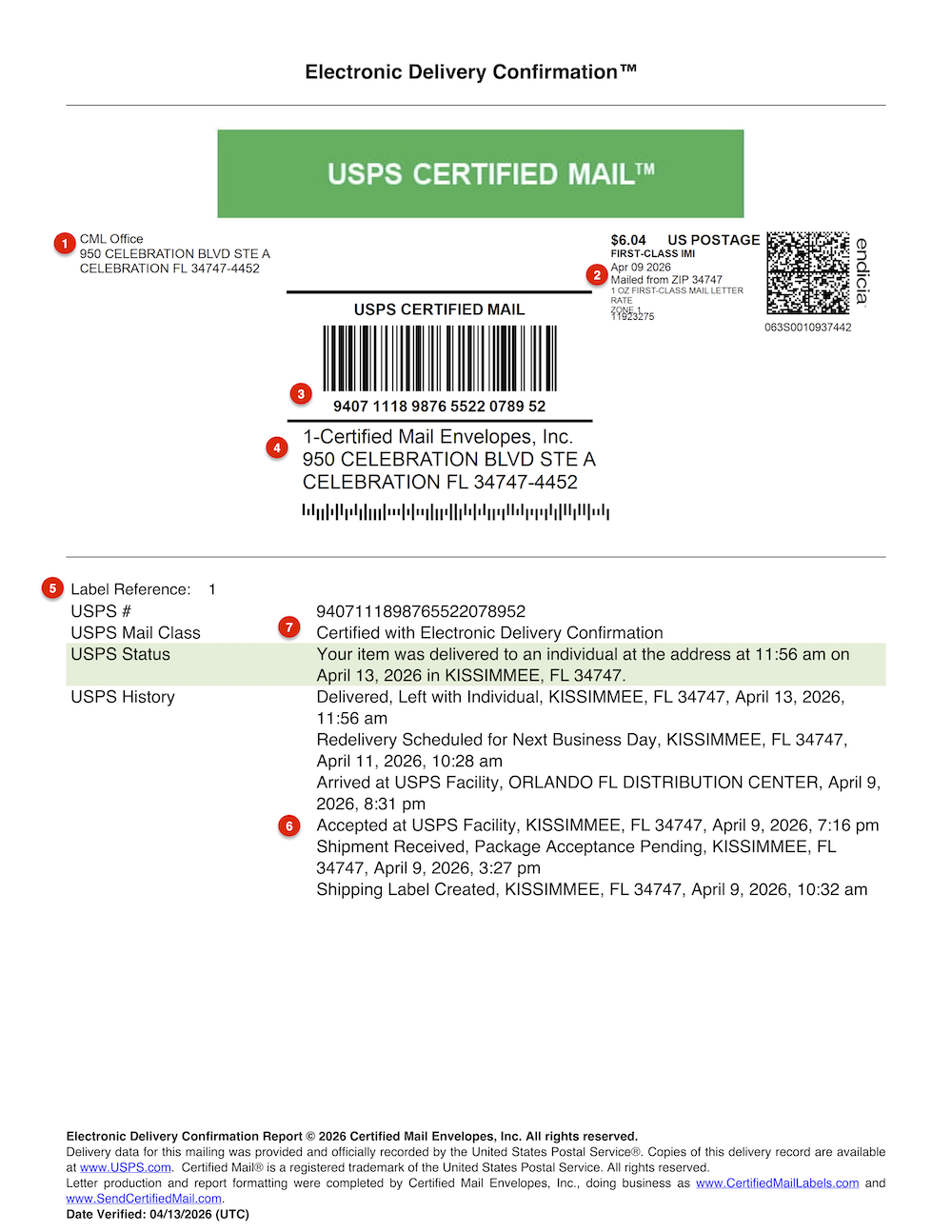
- Proof of delivery through tracking updates
- Return Receipt documentation (if requested)
Some senders may consider using a USPS Certificate of Mailing (Form 3817). While Form 3817 provides evidence that an item was presented to USPS, it does not include tracking or delivery confirmation. The Certificate of Mailing cost is lower, but it offers limited protection compared to Certified Mail.
Step-by-Step: How to Prove You Sent a Time-Sensitive Document
Following a consistent process ensures your mailing is properly documented and defensible.
Step 1: Prepare Your Document Carefully
Start by ensuring your document is:
- Complete and accurate
- Properly addressed
- Clearly tied to the required deadline
This is especially important when handling sensitive documents such as legal filings or tax-related communications.
Step 2: Use USPS Certified Mail
Using Certified Mail is one of the most effective ways to document your mailing.
Certified Mail provides:
- A unique tracking number
- Proof of delivery
- Documentation that the item entered USPS custody
For additional protection, you can add a Return Receipt, which provides a signature record from the recipient.
For faster delivery of urgent materials, some senders may combine Certified Mail with Priority Mail to ensure both speed and documentation.
Step 3: Present Your Mail for Acceptance
This is the most critical step.
To establish proof of mailing, your document must be accepted by the United State Postal Service.
You should:
- Bring your letter to the Post Office
- Request an Acceptance Scan
- Obtain a mailing receipt
This creates the official timestamp tied to your mailing.
Step 4: Use a SCAN Form for Multiple Mailings
If you are sending multiple time-sensitive documents, a SCAN Form helps streamline acceptance.
It allows USPS to:
- Scan one barcode
- Accept all related mail pieces
- Create a single documented acceptance event
This is especially useful for businesses managing large volumes of compliance mail.
Step 5: Retain All Mailing Documentation
After mailing, keep all related records to support your official record.
This includes:
- Mailing receipts
- Tracking history
- Delivery confirmation
- Return Receipt records
Proper record keeping ensures you can demonstrate compliance if needed.
Step 6: Verify Tracking After Mailing
After sending your document, confirm that your tracking shows:
- USPS acceptance
- Movement through the system
- Final delivery or delivery attempt
This step completes your documentation and confirms proof of delivery.
Common Mistakes to Avoid
Even experienced senders can make mistakes that weaken documentation.
Avoid:
- Dropping mail in a mailbox without acceptance
- Not obtaining a mailing receipt
- Choosing lower-level USPS services without tracking
- Failing to retain records
Each of these can limit your ability to prove mailing when it matters most.
How Certified Mail Labels Helps Streamlines the Process
Certified Mail Labels provides a streamlined way to manage compliance mail and properly document time-sensitive communications.
With Certified Mail Labels, you can:
- Create Certified Mail labels online
- Assign tracking numbers automatically
- Generate SCAN Forms for batch mailings
- Access proof of delivery and Return Receipt records
- Store mailing documentation securely for 10 years
For urgent shipments, you can also integrate with Priority Mail options to balance speed and compliance.
For users who prefer a fully managed solution, Send Certified Mail handles printing and mailing on your behalf. Ensuring proper USPS acceptance and documentation.
Follow the Process to Protect Your Mailings
When sending time sensitive documents, proof of mailing is not automatic. It must be created through a structured process.
By using the right USPS services, obtaining acceptance at the Post Office, and retaining documentation, you can ensure your mail is supported by a reliable official record.
This protects you from disputes, missed deadlines, and compliance issues.
 Get Started Today
Certified Mail Labels helps individuals and businesses send time sensitive documents with confidence.

Create a free account today and start mailing with built-in tracking, documentation, and compliance tools. Schedule a Live Demo with our Customer Support Team today to learn more!