
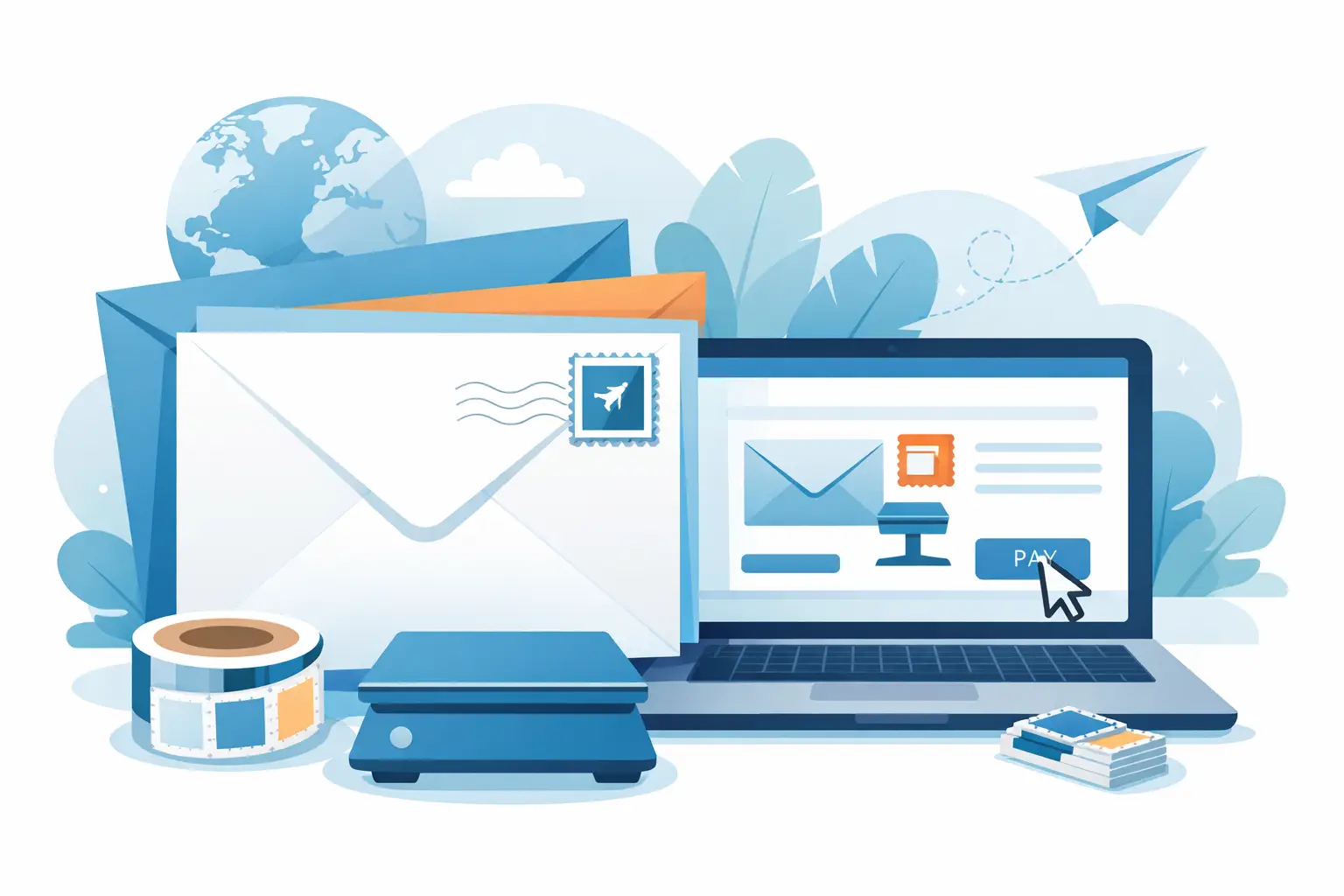
 If your office is still buying stamps by the sheet and guessing postage at the mailroom scale, first class envelope postage online is probably the simplest process upgrade you can make. For firms that send invoices, notices, statements, client letters, and compliance documents, printing postage as part of the label creation workflow cuts out manual steps and gives staff a more controlled way to prepare outgoing mail.
The practical benefit is not just convenience. It is consistency. When postage is applied online, the mailing process becomes easier to standardize across users, locations, and recurring document types. That matters for administrative teams that need predictable output, cleaner records, and fewer trips to the post office.
What first class envelope postage online actually means
At its most basic level, first class envelope postage online means generating and printing USPS-compliant postage for a standard letter envelope through an online system instead of using retail stamps or a postage meter. The envelope is prepared from a desktop workflow, typically with the delivery address, return address, and postage printed together or as coordinated components.
For many organizations, that changes the job from a manual mailing task into a repeatable office process. Staff can prepare envelopes one at a time or in batches, print what they need, and move the mail directly into outgoing handling without waiting in line for postage.
This is especially useful when mailing deadlines matter. A law office sending notices, a property manager mailing statements, or an accounting team sending time-sensitive correspondence does not want envelope preparation to depend on who has stamps or whether someone can get to the post office before closing.
When online postage makes more sense than stamps
Stamps still work. They are familiar, simple, and fine for occasional personal mail. But in a business setting, they create avoidable friction.
The first issue is control. Stamps are hard to track at the user level, easy to misplace, and not ideal when multiple employees handle outgoing mail. The second is accuracy. If staff are uncertain about weight, format, or surcharges, they may overpay or underpay. The third is speed. A stamp-based process often turns routine mailing into a supply-management problem.
First class envelope postage online is usually the better choice when your team sends recurring mail, needs a cleaner record of mailing activity, or wants to combine addressing and postage into one print step. It is also a better fit when envelopes need to be prepared by administrative staff who are not postal experts. A structured system reduces guesswork.
How the process works in practice
Most online postage workflows follow a straightforward sequence. A user enters the recipient address, confirms the mail class and envelope type, prints the label or envelope with postage, and places the piece into outbound mail. In some systems, that same workflow can support Certified Mail, tracking records, manifests, and reporting for more documentation-sensitive mailings.
The real value is that the process can be repeated without re-teaching it every time. Once the office standard is established, staff can produce first-class envelopes quickly and with fewer exceptions. That matters in operations where mailing is frequent but not complex enough to justify a full mailroom platform.
For lower-volume senders, this saves time at the individual transaction level. For higher-volume departments, it creates a more manageable workflow because mailing data, postage activity, and user actions are handled in a system rather than through loose paper logs.
What to check before you print
Not every envelope qualifies the same way, and this is where small errors can create delays. Before printing first class envelope postage online, confirm the envelope size, thickness, weight, and machinability. A standard business envelope with normal paper inserts is usually straightforward, but bulky contents, uneven thickness, clasps, or unusual dimensions can affect the rate or even the mail class.
Address quality also matters. A clean, correctly formatted delivery address reduces the chance of delays or returns. If you are mailing on behalf of a regulated office, consistency in return address formatting is equally important because it affects professionalism and internal accountability.
This is one of the trade-offs of online postage. It is faster, but only if users follow the setup rules. A good system reduces the room for error, but the organization still needs basic mailing standards.
Cost expectations and where savings really come from
A common question is whether first class envelope postage online costs less than buying postage at the post office. The answer depends on what you are comparing.
The postage itself may be similar to standard USPS pricing for qualifying letter mail. The larger savings usually come from labor, fewer interrupted work cycles, and reduced handling errors. If an employee spends twenty minutes driving to the post office or standing in line just to mail routine envelopes, that labor cost can easily exceed the postage difference.
There are also soft savings that become meaningful over time. Online preparation reduces rework, improves consistency, and makes it easier to document who prepared mail and when. For businesses with recurring notices, invoices, statements, or formal correspondence, those operational gains often matter more than a few cents on a single envelope.
If your office also sends accountable mail, it can help to keep both ordinary first-class and documentation-heavy mailing in one system. That reduces training needs and makes mailing policies easier to enforce.
First-class mail versus Certified Mail
This distinction matters because some offices use the two interchangeably when they should not. First-Class Mail is appropriate for standard business correspondence that needs timely delivery but not a formal mailing record. Certified Mail adds tracking, proof of mailing, delivery status, and optional Return Receipt documentation.
If the letter has legal, regulatory, financial, or contractual significance, ordinary first-class postage may not be enough. The right question is not just how to mail the envelope, but what evidence you may need later. A payment reminder may be fine as first-class mail. A formal notice to cure, tax notice, benefits determination, or legal deadline letter may require a stronger chain of documentation.
That is where process design matters. Some organizations benefit from using one platform for both everyday first-class envelopes and more sensitive Certified Mail pieces, so staff can choose the right service without changing tools or creating separate records.
Why online postage fits documentation-focused offices
For administrative teams, mailing is rarely a standalone task. It is part of a larger workflow that includes document generation, approval, dispatch, tracking, and file retention. First class envelope postage online fits that reality because it moves envelope preparation closer to the document workflow itself.
Instead of printing a letter, stuffing an envelope, searching for postage, and relying on manual handoff, the office can prepare mail in a more controlled sequence. That improves throughput and reduces the number of points where mail can be delayed or mishandled.
This is particularly relevant for firms that need defensible records. Even when a piece is only being sent as first-class mail, a documented preparation process can still support internal accountability. Teams know what was sent, by whom, and on what date.
Certified Mail Labels is built around that operational model, giving users a way to prepare USPS mailing materials online while maintaining process discipline for both everyday and compliance-sensitive correspondence.
Choosing the right setup for your volume
The best workflow depends on how often you mail and how standardized your process is. A small office sending a few envelopes a week may only need simple online label creation and printing. A larger department may need batch processing, account funding controls, user permissions, manifests, acceptance documentation, and reporting.
This is where many organizations either overbuy or underbuild. If your volume is modest, keep the process simple. If mailing is spread across multiple users or locations, add controls early so the workflow does not become fragmented. The right setup is the one that removes manual handling without creating administrative overhead of its own.
Common mistakes to avoid
Most problems with first class envelope postage online are not technical. They come from inconsistent office habits. Users print with the wrong envelope stock, apply the wrong mail class, skip address checks, or assume every letter qualifies at the same rate.
Another common issue is treating online postage as only a purchasing tool. It works better when it is treated as part of a mailing procedure. Define who prepares mail, who verifies exceptions, and how records are retained when needed. That small amount of structure keeps the system efficient.
For organizations that send both routine letters and accountable notices, the biggest mistake is not setting clear decision rules. Staff should know when first-class mail is sufficient and when tracking or proof of delivery is required.
A better way to handle routine outbound mail
When envelope preparation is handled online, the mailing process becomes easier to control, easier to delegate, and easier to repeat. That is the real advantage. First class envelope postage online is not just about replacing stamps. It is about removing small delays that add up across the week and giving your office a cleaner outbound mail process.
If your team sends business-critical correspondence on a regular schedule, the best mailing workflow is the one people can follow correctly under normal office pressure. Make it simple, make it consistent, and make sure the level of documentation matches the importance of the letter.