
Why Certified Mail Is the Standard Even When It Is Not Required
Last reviewed: October 2026
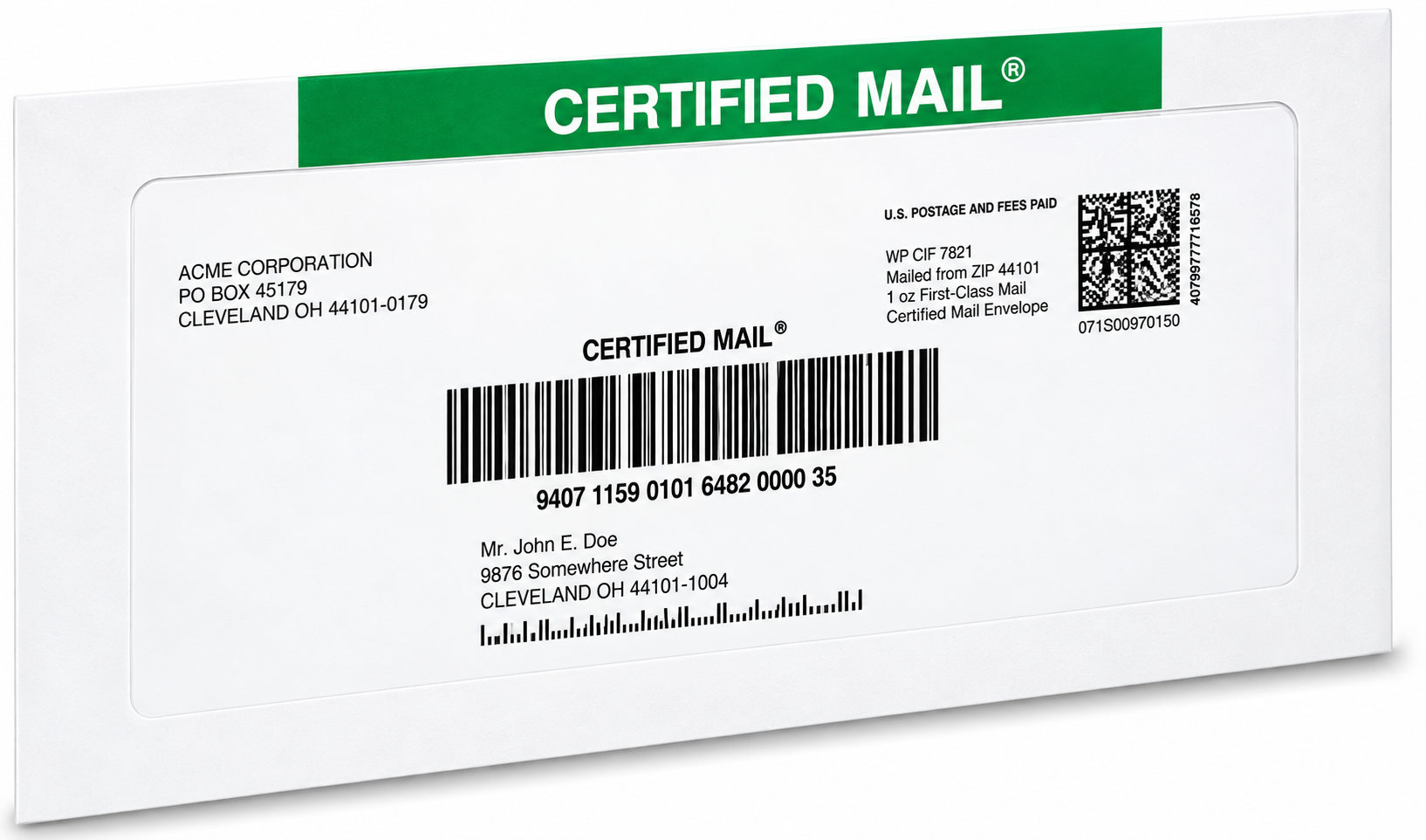
Neither the FDCPA nor Regulation F requires a debt collector to send a validation notice by certified mail. However, certified mail has become the industry standard because it creates a dated USPS acceptance record, tracking history, delivery information, and an available signature record. Evidence that can help show when and how a legally significant notice was sent.
This page is reviewed every January and after any CFPB rulemaking or amendment affecting Regulation F.
Disclaimer: This article is a general guide for collection agencies, debt buyers, collection law firms, and compliance teams. It is not legal advice. Confirm your mailing procedures and validation-notice requirements with your own compliance counsel. Federal and state rules change frequently.
Is Certified Mail Required for an FDCPA Validation Notice?
No. 15 U.S.C. § 1692g does not mandate certified mail. The statute requires a debt collector to send a written notice with specific information. It does not prescribe certified mail, USPS Certified Mail, a signature, or any other particular delivery method.
Regulation F, 12 C.F.R. § 1006.34, also does not require certified mail. It requires validation information to be provided in the initial communication, within five days after the initial communication, or orally in the initial communication in certain circumstances. When the information is sent in writing, § 1006.42 requires the disclosure to be sent in a manner reasonably expected to provide actual notice and in a form the consumer can keep and access later.
So why do collection agencies and debt buyers continue to use certified mail?
Because the law may not require certified mail, but your compliance team still needs to prove what happened.
A validation letter with no mailing record can create an evidentiary gap. Certified mail helps close that gap with a documented chain of mailing, acceptance, tracking, delivery, and, when requested, signature information.
Read 15 U.S.C. § 1692g on GovInfo and 12 C.F.R. § 1006.34 on eCFR.
What Does 15 U.S.C. § 1692g Actually Require?
Section 1692g is the FDCPA’s core validation-of-debts provision. Within five days after the initial communication, the debt collector generally must send a written notice unless the required information was already included in the initial communication.
The notice must contain five key items:
- The amount of the debt.
- The name of the creditor to whom the debt is owed.
- A statement that the debt will be assumed valid unless the consumer disputes it within 30 days after receiving the notice.
- A statement explaining that, if the consumer disputes the debt in writing within the 30-day period, the collector will obtain verification of the debt or a copy of a court judgment and mail it to the consumer.
- A statement explaining that, upon the consumer’s written request within 30 days, the collector will provide the name and address of the original creditor if that creditor is different from the current creditor.
The statute also establishes what happens after a written dispute or original-creditor request. Under § 1692g(b), the collector must cease collection of the debt, or the disputed portion, until the required verification, judgment, or original-creditor information is mailed to the consumer.
The important timing point is that the 30-day period runs from the consumer’s receipt of the notice. That makes the date and method of mailing important in practice, even though certified mail itself is not required.
What Does Regulation F Add to the Validation Notice Process?
Regulation F creates additional structure around the validation notice.
Under 12 C.F.R. § 1006.34, a debt collector must provide the required validation information:
- In the initial communication; or
- Within five days after the initial communication; or
- Orally in the initial communication in circumstances permitted by the rule.
The notice must include more detailed information about the debt, including the consumer’s name and address, the collector’s dispute address, creditor information, account information, an itemization date, the amount of the debt, and an itemization of interest, fees, payments, and credits where applicable.
Regulation F also requires information about consumer protections, including:
- The end date of the validation period;
- The consumer’s right to dispute the debt in writing;
- The collector’s obligation to cease collection after a timely written dispute;
- The right to request the name and address of the original creditor; and
- The consumer’s right to dispute the debt or request original-creditor information electronically when the notice is sent electronically.
Does Regulation F Provide a Deemed-Receipt Assumption?
Yes. Regulation F defines the validation period as the period that starts when the collector provides the validation information and ends 30 days after the consumer receives or is assumed to receive it.
Under § 1006.34(b)(5), a collector may assume that the consumer received the validation information on a date at least five days after the collector provides it, excluding Saturdays, Sundays, and legal public holidays.
This deemed-receipt assumption can simplify administration. It does not eliminate the need for a defensible mailing process. Your records should still show when the notice was prepared, when it was accepted by USPS, the tracking number, delivery activity, and the letter that was sent.
Can You Use Model Form B-1?
Regulation F includes Model Form B-1 for validation notices. Under § 1006.34(d)(2), a collector using Model Form B-1 receives a safe harbor for the information and form requirements of § 1006.34(c) and § 1006.34(d)(1), subject to the conditions in the rule.
Using the model form does not make certified mail mandatory. It also does not replace the need to document the mailing. Notice content and mailing proof are separate parts of your compliance process.
The CFPB’s December 2020 final rule created the Part 1006 framework in 85 FR 76887, and the validation-notice provisions were further amended effective January 19, 2021, in 86 FR 5854.
Why Do Collection Agencies Use Certified Mail Anyway?
Certified mail is used because it provides practical evidence that ordinary first-class mail often does not.
A standard first-class letter may be properly addressed and placed in the mail, but the sender may have limited evidence showing:
- The date the letter entered the USPS mailstream;
- Whether USPS accepted the piece;
- Where the piece traveled;
- Whether delivery was attempted;
- Whether it was delivered or returned; or
- Whether someone signed for it.
That matters when a consumer disputes receiving the validation notice, challenges the timing of a collection activity, or argues that the collector cannot prove the required notice was sent.
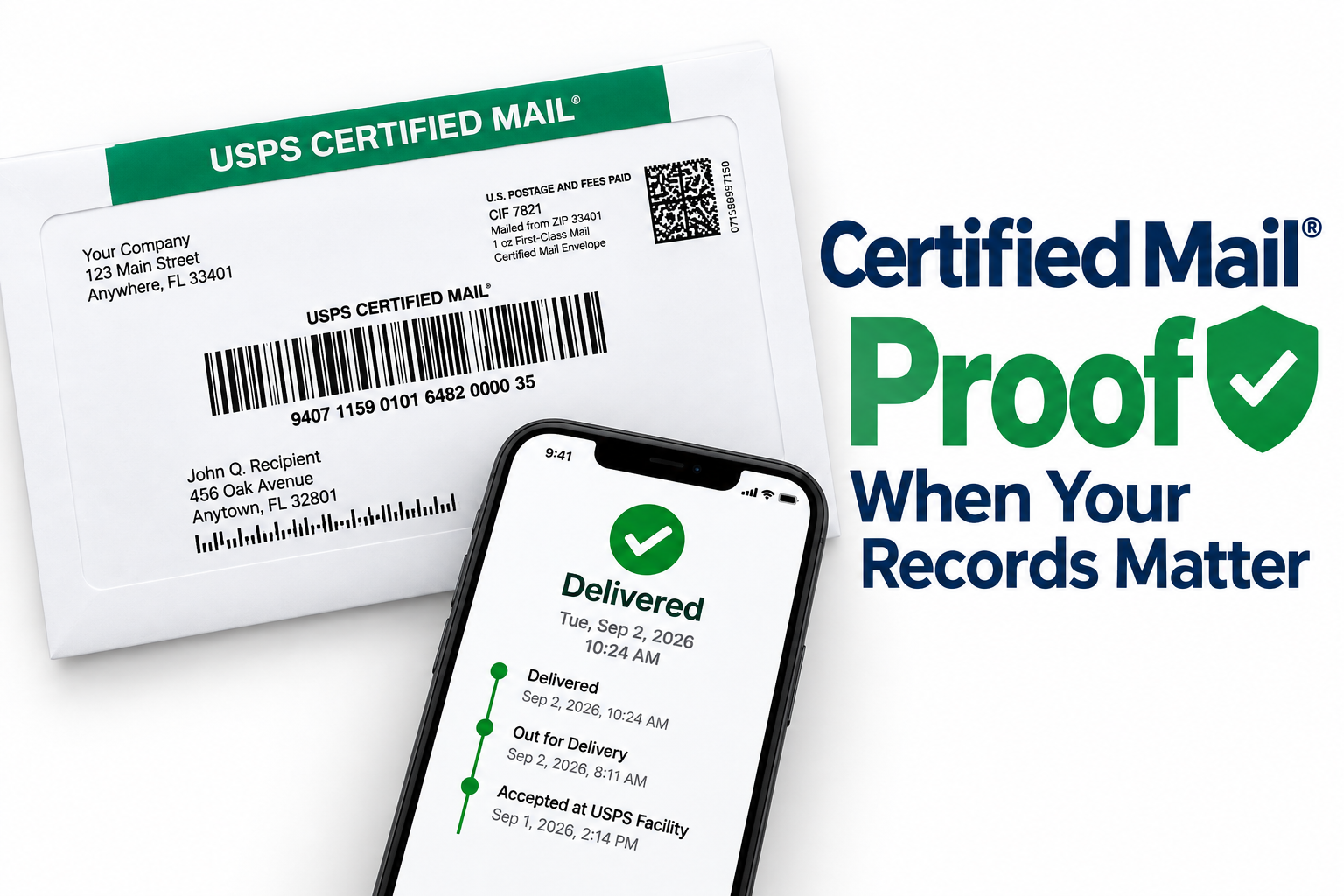
Certified mail gives your legal compliance mailing process a stronger record.
How Does Certified Mail Help With the Dispute Clock?
The dispute and verification obligations under § 1692g(b) depend on dates. If the consumer sends a written dispute, the collector needs a reliable process for identifying when the validation period began and whether the dispute was timely.
Certified mail does not decide every legal issue about receipt. It does not guarantee that a consumer personally read the notice. It does not replace legal analysis of the facts.
But it does give your team useful records:
- A dated USPS acceptance event;
- A unique tracking number for each notice;
- Tracking activity that can be reviewed later;
- Delivery or attempted-delivery information;
- A signature record when return receipt is requested; and
- A connection between the mailing record and the consumer’s letter.
That is why certified mail is often treated as cheap insurance. It helps address one of the most common evidentiary problems in FDCPA defense: a notice the collector cannot prove it sent.
Does Electronic Return Receipt Reduce Certified Mail Cost?
Yes. For high-volume validation-letter programs, Electronic Return Receipt can reduce the cost of obtaining delivery and signature information.
Current USPS pricing cited in the official USPS Extra Services price information lists:
- Electronic Return Receipt: $2.91 per piece;
- Paper Return Receipt, commonly called the green card: $4.65 per piece.
That is a difference of $1.74 per piece.
For an agency mailing 1,000 validation letters, the difference can add up to $1,740 before considering other postage or processing costs. For larger debt portfolios, the savings become even more meaningful.
Electronic Return Receipt USPS records can provide delivery details and a recipient signature in digital form. Instead of waiting for paper cards to return and then manually filing them, your team can retrieve and store electronic records with the related tracking information.
Learn more about Electronic Return Receipt for USPS Certified Mail.

What Is the Best Workflow for Mailing Validation Notices?
Your process should make it easy to connect four things:
- The exact validation letter sent;
- The consumer and address list used;
- The USPS acceptance and tracking record; and
- The delivery or return-receipt record.
A practical workflow looks like this:
1. Prepare and Review the Validation Notice
Create the letter using your approved template or Model Form B-1 workflow. Confirm the debt information, itemization, consumer response options, dispute address, and applicable state-law language with your compliance counsel.
Keep a final PDF copy of the version approved for mailing.
2. Upload the Letter and Address List
For individual notices, you can create and print USPS Certified Mail labels online and print them using a standard office printer or adhesive sheets.
For agencies sending many validation letters, upload the PDF letter and recipient address list through a bulk process. This reduces manual data entry and helps keep addresses, tracking numbers, and letter records together.
3. Print and Mail the Same Business Day
With a full-service process, you upload the PDF letter and address list, and the service handles printing, envelope inserting, postage application, and USPS mailing. Orders submitted before the stated cutoff can be mailed the same business day with USPS proof of acceptance.
That helps you avoid the common administrative delay of printing letters, stuffing envelopes, applying postage, driving to the Post Office, and manually organizing receipts.
See the Print & Mail full-service workflow.
4. Monitor Certified Mail Tracking
Use the tracking number to review acceptance scans, movement, delivery attempts, delivery status, and return activity.
A centralized Certified Mail tracking process gives your compliance team a clearer way to answer questions when a consumer, client, auditor, or attorney asks what happened to a notice.
5. Preserve the Records in a Searchable Archive
A strong process does not stop when the letter leaves your office. Keep the records where your team can find them later.
Certified Mail Labels provides a searchable compliance archive for 10 years, including mailing history, tracking activity, and proof records.

What Records Should You Keep and for How Long?
Your retention policy should be established with compliance counsel and aligned with applicable federal, state, contractual, litigation-hold, and client requirements. As a practical recordkeeping checklist, retain:
- The final copy of the validation letter;
- The consumer name and mailing address used;
- The date the letter was generated;
- The USPS acceptance scan or mailing record;
- The tracking number;
- The postmark or mailing-date information available for the piece;
- All certified mail tracking events;
- Delivery, attempted-delivery, or return information;
- Electronic Return Receipt or paper signature records;
- The related account or portfolio reference; and
- Any dispute, verification, or original-creditor request connected to the notice.
For organizations using Certified Mail Labels, the 10-year searchable archive can help keep these records available without requiring your team to manage paper receipts, spreadsheets, and disconnected tracking screenshots.
How Can Agencies Send Validation Letters in Bulk?
Collection agencies, debt buyers, municipalities, and collection law firms may mail hundreds, thousands, or more validation notices during a campaign. Manual label creation is slow and increases the chance of mismatched addresses, missing records, or inconsistent filing.
For volume programs, consider:
These options can help your team automate address uploads, generate labels, manage tracking numbers, and organize records for later retrieval.
Government receivables also show why scale matters. The U.S. Census Bureau reported that state and local governments collected approximately $2.1 trillion in tax revenue in 2021. Taxes, court fines, utility receivables, and other government-related accounts can create large volumes of legally significant notices. A reliable bulk certified mail process helps agencies and their service providers manage that volume more consistently.
Is Certified Mail Worth Using for Validation Notices?
For most collection operations, certified mail is a practical risk-control measure even when it is not legally required.
You get:
- A dated USPS acceptance record;
- Certified mail tracking;
- Delivery and attempted-delivery information;
- Optional electronic signature records;
- Lower return-receipt costs than paper green cards;
- Same-business-day print-and-mail support;
- Bulk Excel, API, and SFTP options;
- No trip to the Post Office; and
- A searchable 10-year compliance archive.
Start by reviewing your current validation-notice workflow. Then learn how to send Certified Mail online, upload your letter and address list for full-service mailing, or contact Certified Mail Labels about bulk automation.
Certified mail is not the legal requirement. Proof is the practical requirement. It is cheap insurance against the most common evidentiary gap in FDCPA defense. A validation notice the collector cannot prove it sent.
Frequently Asked Questions About FDCPA Validation Notices and Certified Mail
Is certified mail required under 15 U.S.C. § 1692g?
No. Section 1692g requires a written validation notice with specified information, but it does not require certified mail or a particular USPS service.
Does Regulation F require validation notices to be sent by certified mail?
No. Regulation F requires validation information to be provided in the initial communication, within five days after the initial communication, or orally in certain circumstances. Written disclosures must be sent in a manner reasonably expected to provide actual notice and in a form the consumer can keep and access later.
What is the five-day deemed-receipt assumption under Regulation F?
Under 12 C.F.R. § 1006.34(b)(5), a collector may assume the consumer received validation information on a date at least five days after it was provided, excluding Saturdays, Sundays, and legal public holidays.
What does certified mail prove?
Certified mail can provide a USPS acceptance record, tracking events, delivery or attempted-delivery information, and an available signature record when return receipt is requested. It does not automatically resolve every legal question about actual receipt.
How much can Electronic Return Receipt save?
The cited USPS prices are $2.91 for Electronic Return Receipt and $4.65 for paper Return Receipt. That is a savings of $1.74 per piece, before regular postage and other applicable fees.
How long should validation-notice mailing records be kept?
Retention periods depend on your compliance program, client agreements, litigation holds, and applicable law. Many organizations choose long-term retention for the letter, acceptance scan, tracking events, delivery record, and receipt information. Certified Mail Labels provides a searchable archive for 10 years.