
Certified vs. Priority: Choosing the Right USPS Mail Service
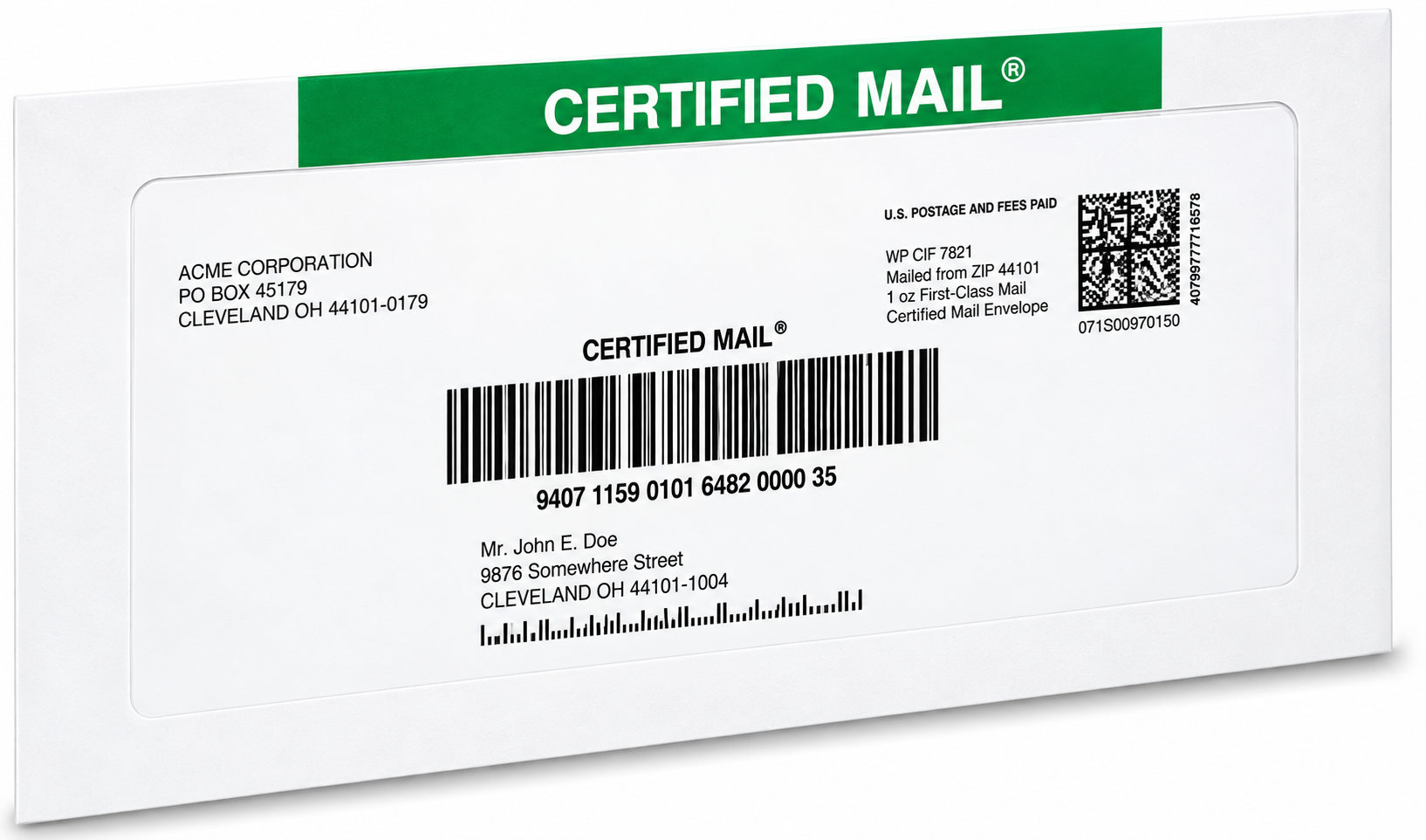 Certified Mail and Priority Mail solve two different problems. Certified Mail is an add-on to your postage that proves your letter was mailed and delivered, with a recorded signature at the destination. Priority Mail is a faster delivery class for packages and documents that need speed, with tracking and built-in insurance. Pick Certified Mail when you need proof, and Priority Mail when you need pace.
This page breaks down what each service actually does, which one fits common mailing goals, and how to send either one online without a Post Office trip.
What Is Certified Mail?
Certified Mail is a USPS add-on service that provides proof of mailing and delivery. Every Certified Mail item gets a unique tracking number, and the recipient must sign when it arrives. You also have the option of a Return Receipt, which gives you a copy of that signature, paper or electronic.
It is the default choice for law firms, government agencies, and compliance teams who need to document that a specific document reached a specific recipient.
Key Features of Certified Mail
- Tracking and accountability: every piece carries a unique tracking number with scan events at each USPS checkpoint.
- Proof of mailing and delivery: a mailing receipt up front, and an optional Electronic Return Receipt for a signed proof of delivery.
- Signature required: someone must sign at the destination, which is what makes the record legally useful.
What Is Priority Mail?
Priority Mail is a USPS delivery class built for speed. Packages and documents typically arrive within 1 to 3 business days, with tracking included. It is the right tool when the goal is getting something there quickly, not proving who received it.
Key Features of Priority Mail
- Fast delivery: typically 1 to 3 business days to most domestic destinations.
- Tracking included: every Priority Mail shipment is trackable end to end.
- Flat Rate packaging: if it fits in a Flat Rate box or envelope, it ships at one price regardless of weight, which makes heavier shipments cost-effective.
Certified Mail vs Priority Mail: Which Should You Use?
| Your goal | Best choice | Why |
|---|---|---|
| Legal, financial, or government documents that must be provably delivered | Certified Mail | Mailing receipt, tracking, and a recorded signature at delivery |
| A package that needs to arrive fast | Priority Mail | 1 to 3 business day delivery class with tracking and Flat Rate options |
| A document that needs both speed and proof | Priority Mail with the Certified Mail add-on | Priority Mail carries it fast; Certified Mail adds the proof-of-delivery record |
| Heavy items at a predictable price | Priority Mail Flat Rate | One price regardless of weight, as long as it fits the packaging |
One clarification that trips people up: Certified Mail is an add-on service, not a mail class. It rides along with First-Class Mail or Priority Mail postage. That is why "Certified Mail with Priority" is a real combination, not a contradiction.
Why Send Certified Mail Online?
The counter experience means a form, a line, and retail pricing. With Certified Mail Labels, you create and print live-postage Certified Mail labels online from any standard printer:
- Create a free account, no monthly fees and no contract.
- Enter the recipient's address and pick your services: Certified Mail, Return Receipt, Restricted Delivery, or Priority Mail.
- Print the label, attach it, and hand the envelope to USPS or drop it in any collection box.
- Track delivery and access records from the free 10-year compliance archive.
Because labels use live USPS postage and skip the counter, you pay less per letter than retail rates, with no hidden fees and no equipment to lease. For teams handling high volumes of compliance mail, Excel batch labels let you create multiple labels at once, and API and SFTP automation handles enterprise workflows with USPS SCAN Forms.
And if you would rather not print at all, our Print & Mail service prints, inserts, applies postage, and hands your letters to USPS the same business day for orders placed by 5:00 PM Eastern, with a notarized affidavit of mailing included.
Get Started Today
Certified Mail and Priority Mail are both reliable USPS services; the right one depends on whether you need proof, speed, or both. For documents where the delivery record matters, Certified Mail Labels makes the process fast, affordable, and fully documented, with online access 24/7. Want a walkthrough? See how the platform works or schedule a free live demo with our team.
FAQ: Certified Mail vs Priority Mail
What is the difference between Certified Mail and Priority Mail?
Certified Mail is an add-on service that proves a letter was mailed and delivered, with tracking and a recorded signature at delivery. Priority Mail is a delivery class that moves packages and documents quickly, typically within 1 to 3 business days, with tracking included.
Can I combine Certified Mail with Priority Mail?
Yes. Certified Mail is an add-on service that can ride along with Priority Mail postage, so a shipment can be both fast and provably delivered. You can also add it to First-Class Mail.
Does Priority Mail require a signature on delivery?
No. Priority Mail includes tracking but does not require a signature. If you need a signed proof of delivery, add the Certified Mail service to your Priority Mail shipment.
Which is cheaper, Certified Mail or Priority Mail?
It depends on weight and the services you add. Certified Mail adds a flat service fee to your postage, while Priority Mail is priced by weight, zone, or Flat Rate box. Check current USPS pricing on the postal rates page before you mail.
Does Priority Mail include insurance?
Yes, Priority Mail includes built-in insurance coverage on eligible shipments. Certified Mail does not include insurance; its value is the proof of mailing, tracking, and delivery signature.
Can I send Certified Mail or Priority Mail without going to the Post Office?
Yes. You can create and print labels online with live USPS postage, then hand the item to USPS or drop it in a collection box. Full-service and bulk automation options are also available for businesses.