
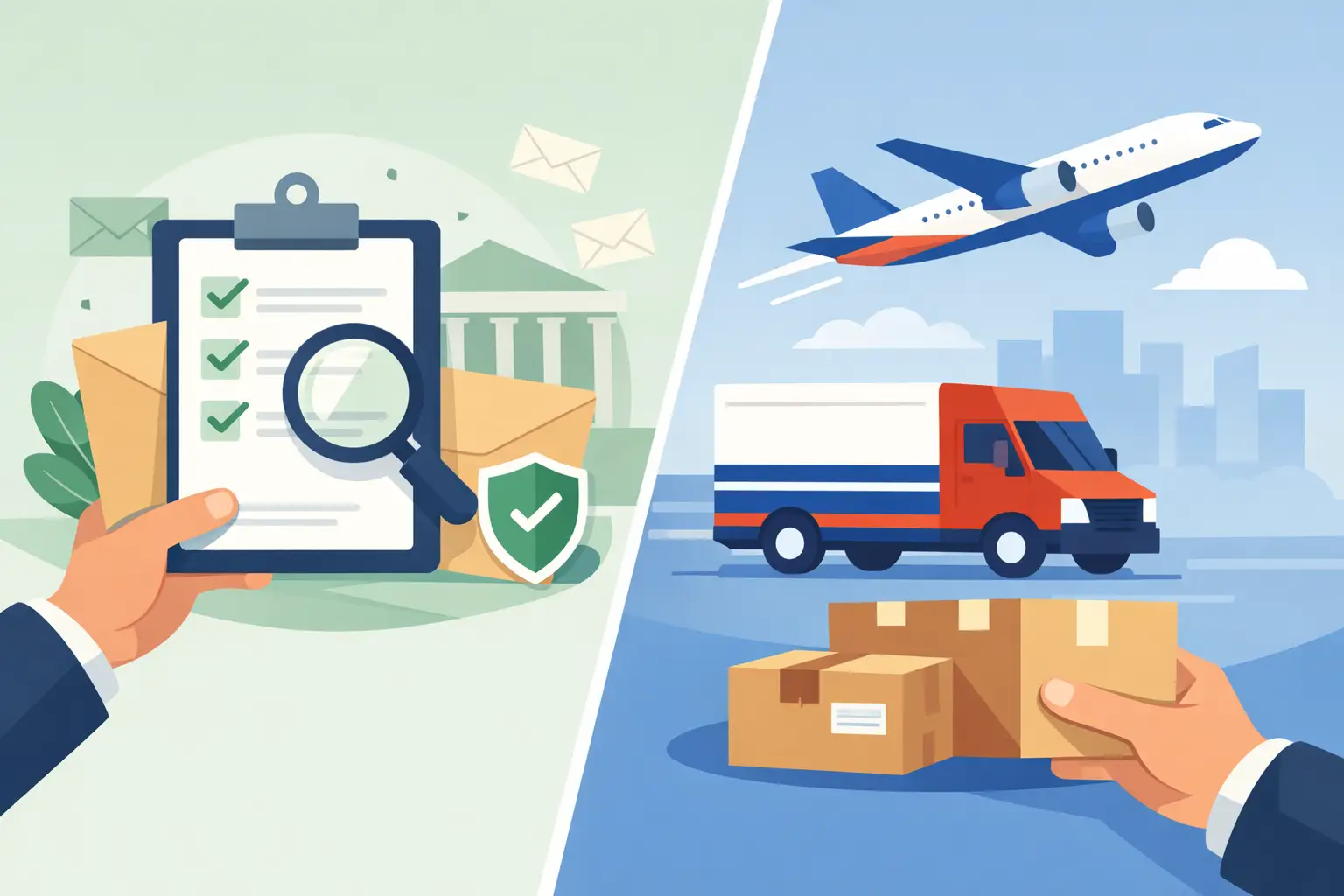
 If a notice has to be documented, "fast" is not always the right standard. When people compare Certified Mail versus Priority Mail, they are often comparing two USPS services built for different operational goals. One is designed around evidence and accountability. The other is designed around delivery speed and package handling.
That distinction matters in offices where mail is part of a legal, financial, regulatory, or customer-service process. A law office sending a demand letter, a property manager issuing a formal notice, or an accounting team mailing time-sensitive records may all need tracking. But tracking alone is not the same as documented proof of mailing, proof of delivery, or a retained chain of record.
Certified Mail versus Priority Mail: the core difference
Certified Mail is an add-on service used with First-Class Mail or Priority Mail that provides a mailing receipt, USPS tracking, and delivery record options such as Return Receipt. Its purpose is documentation. It helps establish that an item was mailed, entered into the USPS system, and delivered or that a delivery attempt was made.
Priority Mail is a USPS mail class. Its purpose is transportation. It is generally used for packages or larger mailpieces that need faster handling than standard ground or regular letter mail. It includes tracking and typically offers one- to three-business-day delivery estimates, but it does not by itself create the same compliance-oriented record as Certified Mail.
This is where confusion starts. Priority Mail can move faster, and it includes tracking. Certified Mail can also be used with Priority Mail in some cases. But if someone asks whether Certified Mail and Priority Mail are interchangeable, the answer is no. They solve different problems.
When Certified Mail is the better choice
Certified Mail is the better fit when the mailing itself may later need to be defended, referenced, or produced as evidence. That usually means the sender needs more than a scan that says a package moved through the network. They need documentation tied to a specific article number and mailing event.
Common examples include legal notices, tax correspondence, collections letters, employment documentation, insurance notices, HOA communications, compliance notices, and account-related mail that may later be disputed. In these situations, the question is rarely "How fast can this get there?" It is usually "Can we prove we sent it correctly, and can we show what happened next?"
Certified Mail supports that requirement because it creates a documented mailing trail. If Return Receipt service is added, the sender can also obtain delivery signature evidence. For organizations with retention obligations, that record can be just as important as delivery itself.
There is a trade-off. Certified Mail is usually used for letters and flats, not general package movement. It is process-driven, and the value comes from documentation rather than speed. If the mailing is urgent in a legal sense but still needs formal proof, speed may be secondary to the audit trail.
When Priority Mail makes more sense
Priority Mail is usually the better choice when the sender cares most about moving a physical item quickly and with standard USPS package tracking. This applies to contracts with original documents enclosed, replacement materials, office shipments, supplies, or customer deliveries where timing matters more than formal mailing proof.
It is also a more natural fit for boxes, thicker envelopes, and heavier contents. Priority Mail packaging options, weight allowances, and service expectations are built around package logistics. If you are sending something bulky or time-sensitive and you simply need to know where it is in transit, Priority Mail is often the more efficient option.
The trade-off is that tracking does not equal legal-grade documentation. For many business uses, Priority Mail tracking is enough. For notices, disputes, account actions, and regulated correspondence, it may not be.
Delivery speed versus proof of mailing
This is the practical decision point for most mailers.
Priority Mail is associated with faster delivery estimates. If the document or item needs to arrive quickly and there is no formal requirement to prove mailing in a compliance context, Priority Mail may be the cleaner choice.
Certified Mail, by contrast, is about establishing a record. The sender receives proof that the item was accepted into the mailstream and can monitor delivery status through USPS tracking. When Return Receipt is added, the sender gains another layer of delivery evidence.
For many professional offices, that difference outweighs delivery speed. A lease violation notice mailed one day later but backed by a documented mailing record can be operationally stronger than a faster shipment that lacks the same evidentiary value.
Tracking is not the same in practice
Both services involve USPS tracking, but they are used differently.
Priority Mail tracking is primarily a logistics tool. It helps the sender and recipient monitor package movement and estimated delivery. It answers operational questions such as whether the parcel is delayed, out for delivery, or delivered.
Certified Mail tracking supports process control and recordkeeping. It is tied to a mailing service intended to show acceptance and delivery activity for accountable correspondence. In many offices, the tracking number is not just for customer visibility. It becomes part of a file, case record, account history, or compliance archive.
That distinction becomes more important over time. If a dispute surfaces six months later, a generic memory that something was mailed is not very useful. A stored record tied to a specific Certified Mail transaction is.
Cost depends on what you are buying
Some mailers compare price and assume the lower-cost option is better. That can be misleading because the services are not equivalent purchases.
With Certified Mail, you are paying for documentation features added to the underlying postage. With Priority Mail, you are paying for a faster mail class and package handling. One buys evidence and mail accountability. The other buys transportation speed and package service.
That means the right cost comparison is not just postage versus postage. It is cost versus business risk. If a missed delivery record could create legal exposure, internal rework, customer dispute costs, or collection delays, Certified Mail may be the less expensive choice overall even if the transaction cost is higher than regular letter mail.
Can you use both?
Yes. In some cases, Priority Mail and Certified Mail can be used together. That approach is useful when the sender needs both expedited handling and documented mailing proof.
Still, this should be used intentionally, not by default. If the item is a standard compliance notice, Certified Mail with the appropriate underlying class is often enough. If the item is bulky, time-sensitive, or operationally urgent and also needs accountable proof, combining services may be justified.
The decision should be based on mailpiece type, delivery urgency, and documentation requirements. Offices that send recurring notices can save time by standardizing that decision instead of making it case by case at the counter.
The workflow question most offices overlook
For recurring senders, the real issue is not only Certified Mail versus Priority Mail. It is whether the mailing process itself is controlled.
Manual preparation creates avoidable failure points: handwritten forms, missing tracking numbers, inconsistent record retention, trips to the post office, and difficulty retrieving proof later. That is manageable for a one-off letter. It becomes a serious administrative burden when sending notices every week.
A better process centralizes label creation, postage, tracking, acceptance records, and proof of delivery in one system. For organizations that rely on Certified Mail repeatedly, that reduces counter time and improves record consistency. Certified Mail Labels is built for that workflow, especially when audit-ready mailing history matters as much as getting the envelope out the door.
Which one should you choose?
Choose Certified Mail when the mailing needs documented proof, delivery accountability, or a defensible record. Choose Priority Mail when speed, package handling, and standard tracking are the primary concern.
If you need both faster movement and formal mailing evidence, using Priority Mail with Certified Mail may be appropriate. But the key is to make the choice based on the risk attached to the mailing, not habit.
The easiest way to decide is to ask one question before you print postage: if this letter or package is challenged later, what exactly will you need to prove?