
Tenant Notices, Security Deposits, and Eviction Documentation
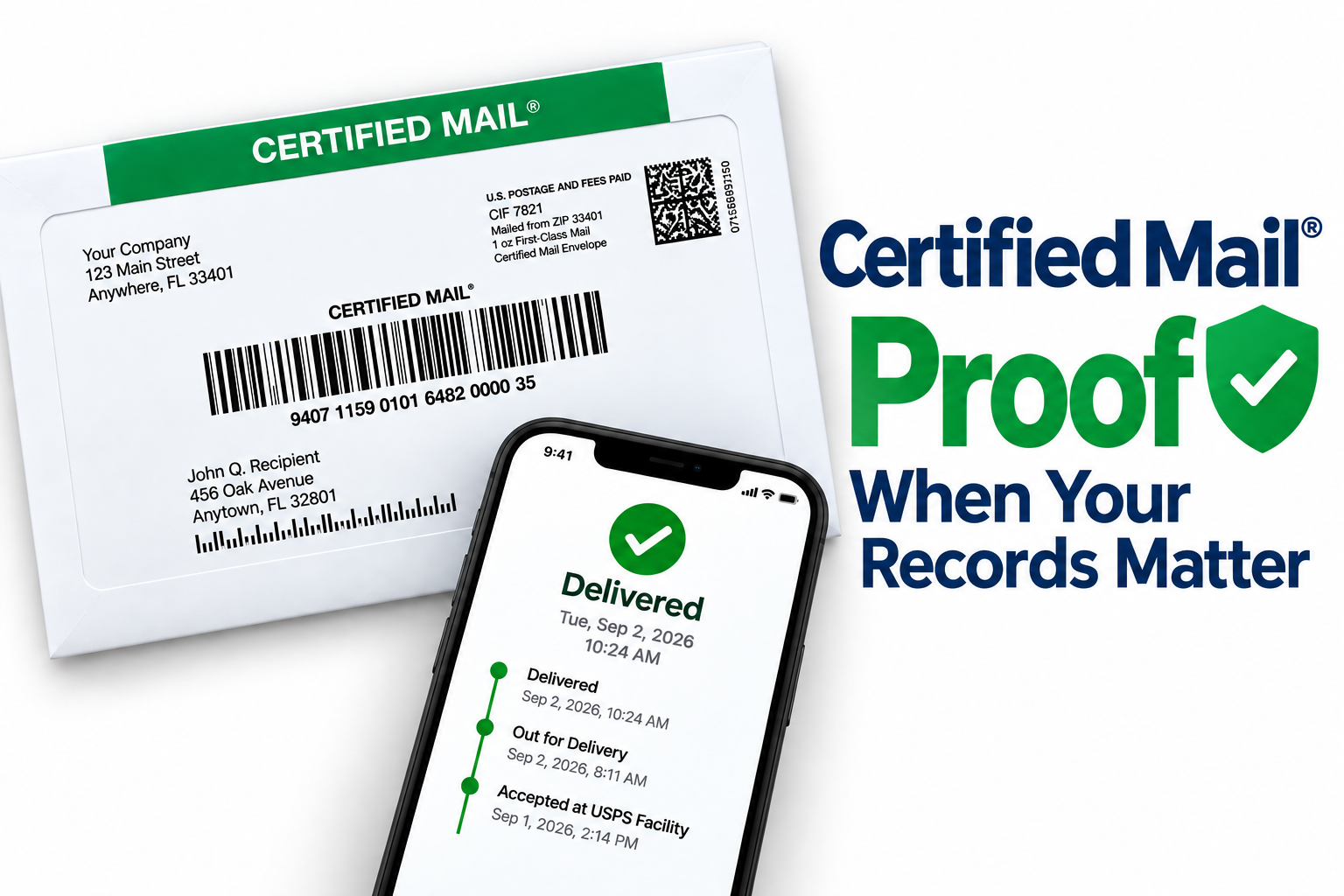
Evictions are won and lost on the notice file. A pay-or-quit notice that cannot be proven served, a security-deposit accounting that arrived too late, or a HUD Section 8 termination notice mailed without proof can cause the case to stall. The unit sits unrented, the operator pays the carry cost, and the property team must start the process again.
Property managers use online USPS Certified Mail to create proof that tenant notices (rent demands, cure-or-quit notices, lease violations, non-renewals, security-deposit itemizations, Section 8 termination notices and lien-related correspondence) were mailed and delivered. You can print live-postage Certified Mail labels on any office printer or upload your PDF letter and address list for same-business-day Print & Mail, and you get a notarized affidavit of mailing, USPS acceptance scans, certified mail tracking events and available Electronic Return Receipt signature records stored searchable for 10 years.
How Can You Build A Defensible Notice File?
Your lease, state law, local procedure or HUD program may require specific notice content, timing and delivery methods. Those legal requirements vary. Your job as the operator is to execute the required mailing correctly and preserve the evidence showing what happened.
Here is just a few records your property management team may need when an eviction file is reopened, a deposit dispute resurfaces or a compliance reviewer asks for documentation:
- Proof of mailing with the postmark date.
- USPS acceptance scan tied to the Intelligent Mail Postal Barcode.
- Certified mail tracking events.
- Delivery or attempted-delivery record.
- Available Return Receipt signature.
- Notarized affidavit of mailing.
- The original notice or PDF sent to the tenant.
- The complete notice file searchable for 10 years.
With Certified Mail tracking, you can move beyond “we mailed it” and produce a dated, organized record tied to the specific tenant, property and notice.
What Does HUD Require For Section 8 Termination Notices?
For the HUD Section 8 Moderate Rehabilitation program, 24 CFR 882.511(d)(2)(iii) states that a termination notice must:
“Be served on the Family by sending a prepaid first class properly addressed letter (return receipt requested) to the tenant at the dwelling unit or by delivering a copy of the notice to the dwelling unit.”
That is a direct federal instruction to use a return-receipt mailing or deliver a copy to the dwelling unit. Certified Mail with Electronic Return Receipt is a modern way to create and retain that return-receipt record.
State landlord-tenant statutes govern most private evictions. Deadlines, service methods and notice requirements vary by state and sometimes by municipality, lease language or property type. Use Certified Mail as the mailing and proof solution, but coordinate the overall service process with your counsel.
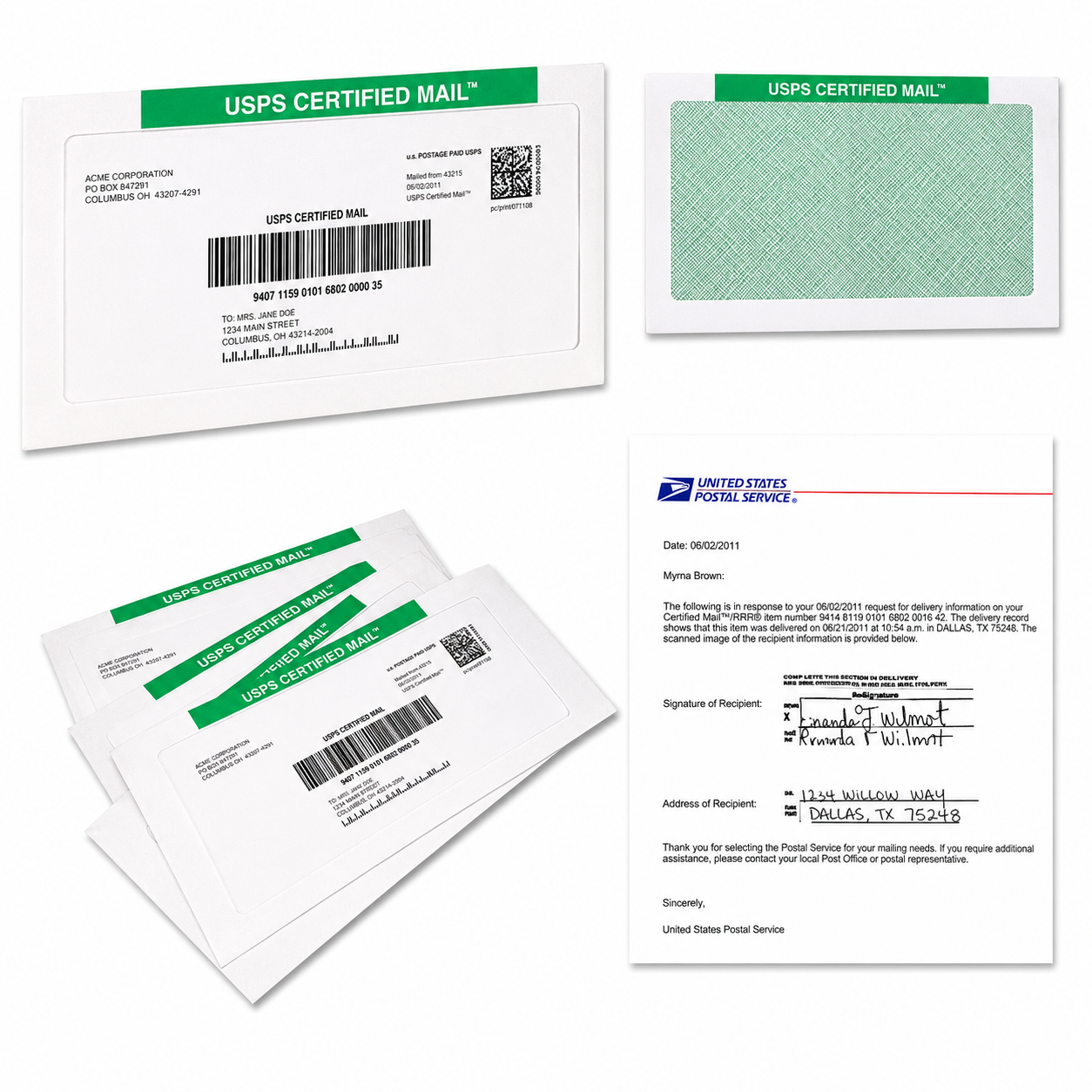
Which Property Management Notices Should You Send With Proof?
Certified Mail can support many high-consequence communications, including:
- Rent demands and delinquency notices.
- Pay-or-quit and cure-or-quit notices.
- Lease violation notices.
- Notices of termination or non-renewal.
- Rent-increase notices when proof is important.
- Security-deposit itemizations and deduction notices.
- Deposit refund and dispute correspondence.
- HUD or Section 8 termination notices.
- Lien-related correspondence.
- Compliance notices involving property rules or resident obligations.
You should not assume Certified Mail replaces personal service, posting, delivery to the dwelling unit or another legally required method. Instead, make it part of a documented workflow that follows your counsel’s instructions.
What Happens If You Get The Mailing Wrong?
The cost of an incomplete notice file can be much higher than the mailing fee. Your operator may face:
- A dismissed or delayed eviction filing.
- Re-notice and re-filing costs.
- Months of unpaid carry on a non-producing unit.
- Statutory penalties involving security deposits.
- Tenant damages claims.
- Additional staff time and court appearances.
- Reputational damage with courts, owners or HUD field offices.
That is why your mailing process should capture the letter, address, mailing date, acceptance scan, tracking events, delivery outcome and available signature in one place.
How Much Can You Save With Certified Mail Online?
A full 1-ounce Certified Mail letter with Electronic Delivery Confirmation is $7.28 online versus $11.02 at the Post Office counter with a paper green card. That is $3.74 saved per piece, while also eliminating a staff trip to the Post Office for every notice.
The USPS Notice 123 Price List, effective July 12, 2026, lists:
- Paper Return Receipt: $4.65.
- Electronic Return Receipt: $2.91.
Choosing Electronic Return Receipt instead of the paper green card saves $1.74 per piece. Across 1,000 notices, that is $1,740 saved. Across 5,000 notices, that is $8,700 saved.
You get the same operational advantage with lower administrative friction:
- No Post Office trip.
- No PS Form 3800 from the counter.
- No postage meter.
- No monthly fees.
- No contracts.
- No equipment leases.
How Does Certified Mail Fit Into Your Property Workflow?
Certified Mail Labels gives you options based on the size and urgency of your mailing.
Day-To-Day Notices: Print Certified Mail Online
For individual rent demands, lease violations or non-renewal notices, use our label-printing flow to create and print USPS Certified Mail labels online.
You can:
- Upload or enter your tenant address.
- Create a live-postage USPS label.
- Print certified mail online on a standard office printer.
- Print on regular paper or adhesive sheets.
- Apply the label to your envelope.
- Track the item after USPS acceptance.
You do not need counter forms, special equipment or a postage meter.
Deposit Accounting And Violation Packages: Use Print & Mail
For security-deposit accounting, inspection documents and multi-page violation packages, use our Print & Mail service.
Upload your PDF letter and address list, and we handle:
- Printing.
- Folding and envelope insertion.
- Postage application.
- Certified Mail preparation.
- USPS handoff and acceptance proof.
The price is $8.43 for a 1-page letter, and orders submitted before 5:00 PM Eastern are mailed the same business day with USPS proof of acceptance.
Portfolio Campaigns: Upload Excel Or CSV
For a lease-expiration campaign, rent-increase notices or portfolio-wide compliance mailing, upload an Excel or CSV address list. You can create a batch instead of entering each tenant individually.
This helps your team:
- Send notices across multiple properties.
- Keep addresses and internal references organized.
- Reduce repetitive data entry.
- Create a consistent mailing record.
- Use one USPS SCAN form so the batch is accepted in one scan.
High Volume: Connect API Or SFTP
For property-management software and recurring notice programs, use the bulk, API and SFTP automation page. Your system can send mailing data securely for portfolio-scale processing, while tracking events and available delivery records can be associated with the correct property or tenant reference.
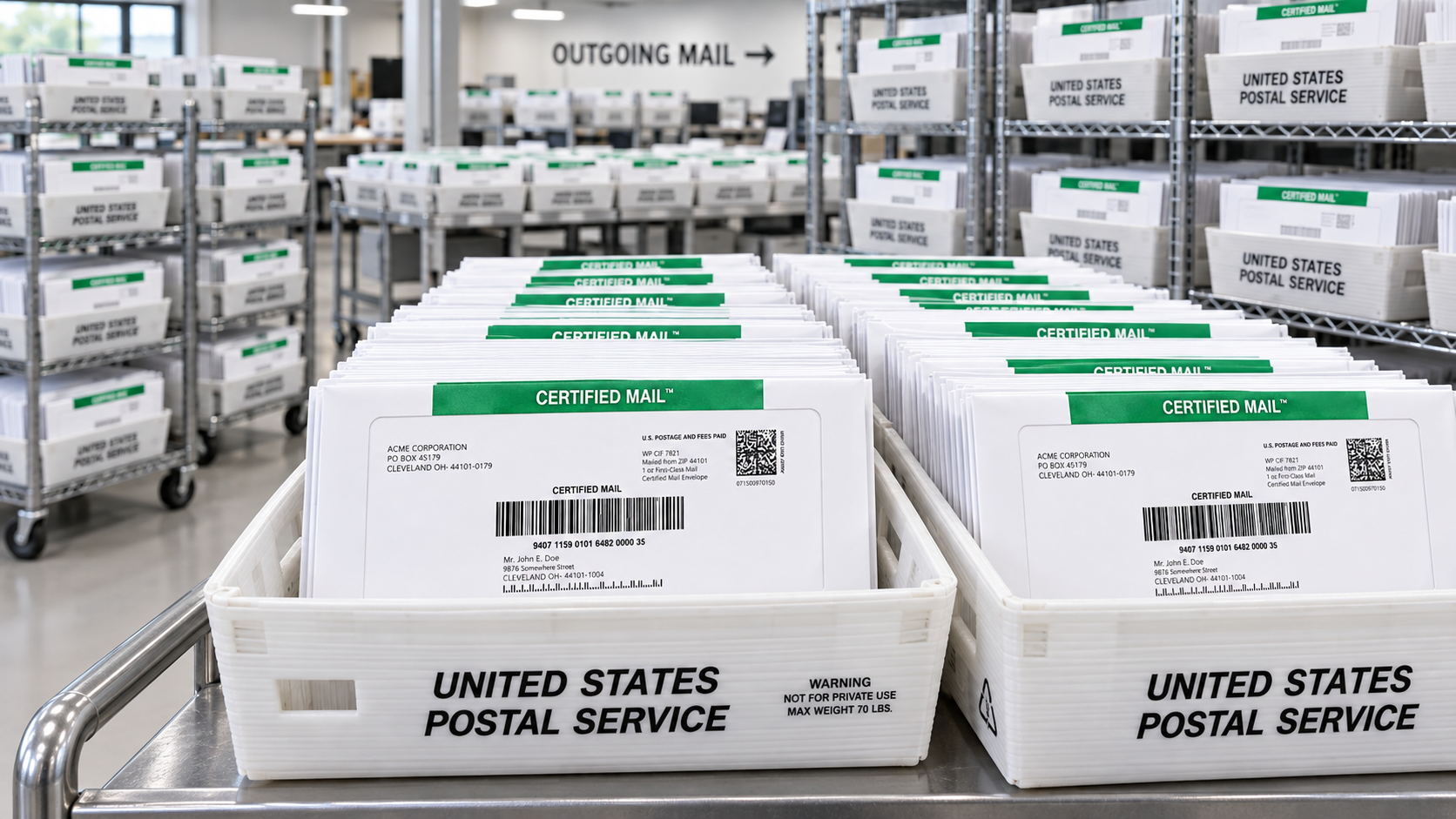
Why Use Electronic Return Receipt?
Electronic Return Receipt is the digital alternative to the paper green card. It provides an electronic delivery record with available recipient signature information and keeps the result connected to the Certified Mail tracking record.
Learn more on our Electronic Return Receipt page.
You’ll get:
- Digital delivery documentation.
- Available recipient signature information.
- Faster access than waiting for a paper card.
- Lower cost than paper Return Receipt.
- A record connected to the mailing and tracking number.
If a tenant refuses or does not claim the certified letter, the tracking file still records the delivery attempt or other USPS status. That record is valuable because it shows what happened to the mailing. Your counsel should determine what that outcome means under the applicable law and service requirements.
How Long Should Property Managers Keep Notice Records?
Certified Mail Labels includes a free, searchable 10-Year Compliance Archive. It can hold:
- Proof of mailing.
- Notarized affidavits.
- USPS acceptance scans.
- Postmark dates.
- Certified mail tracking events.
- Delivery confirmations.
- Available Electronic Return Receipt signature records.
- Mailing reports and supporting documents.

When an eviction file is reopened years later or a tenant challenges a deposit deduction, your team can search for the mailing instead of searching through paper folders, inboxes and disconnected spreadsheets.
Why Property Managers Trust Certified Mail Labels
Since 2006, Certified Mail Labels has helped create more than 33 million labels for more than 200,000 customers. We are BBB Accredited and trusted by Fortune 500 companies.
You get a modern legal compliance mailing workflow without monthly fees, contracts or equipment leases. You can send certified mail from home, from a regional office or from a centralized compliance department, and your team can choose self-printing, full-service Print & Mail or automated bulk processing.
Start with Certified Mail online, upload your next notice package or schedule a demonstration for your portfolio. You’ll save time, reduce mailing costs and build a stronger notice file without sending staff to the Post Office.
Last reviewed October 1, 2026. Rates verified against USPS Notice 123; the HUD citation verified against the eCFR. Federal and state housing rules shift. Re-verify citations quarterly and confirm specifics with counsel.
Confirm notice requirements with your own counsel, since Certified Mail Labels provides the mailing and the proof, not legal advice.