
Appeal Notices, Termination Letters and HIPAA-Safe Delivery
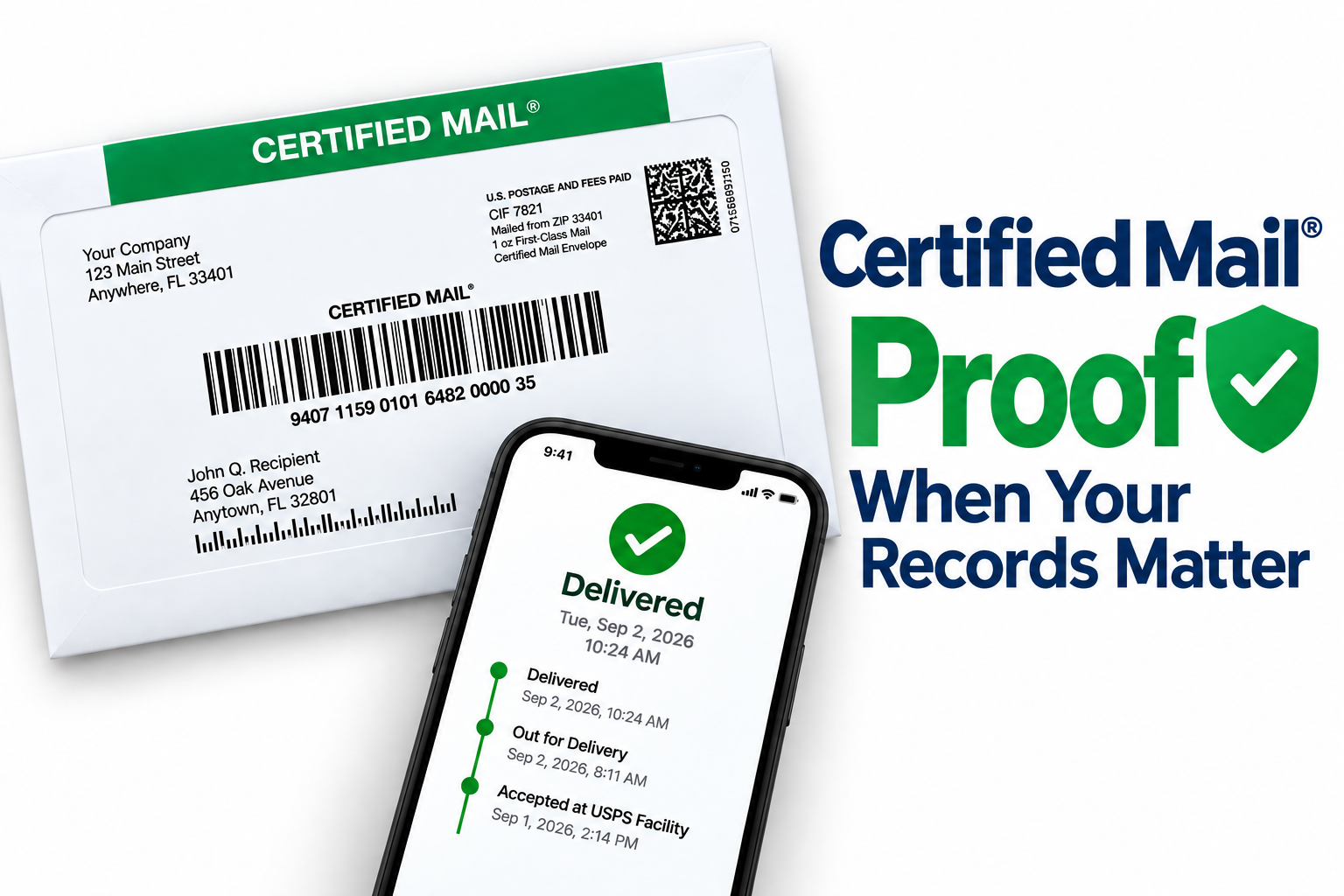
Healthcare notices live at the intersection of patient rights and regulator deadlines. Plan appeal determination notices, out-of-network and termination notices, Medicare Advantage non-coverage notices, breach notifications, discharge letters, and payer correspondence may all require timely, documented delivery. When you cannot prove a notice was mailed on time, the result can be a coverage dispute, state department of health complaint, OCR HIPAA investigation, or costly administrative review.
Healthcare providers use online USPS Certified Mail to create proof of mailing and delivery for appeal notices, network termination and discharge letters, benefit denial notices, breach notification letters, and payer correspondence. You can print live-postage Certified Mail labels on any office printer or upload your PDF letter and address list for same-business-day Print & Mail. You receive a notarized affidavit of mailing, USPS acceptance scans, certified mail tracking events, and available Electronic Return Receipt signature records stored in a searchable archive for 10 years, with no PHI ever posted to the Post Office counter file.
Why Do Healthcare Notices Need Documented Mailing Proof?
The notice itself is only part of your process. Your organization also needs a defensible record showing what happened, when it happened, and where the mailing stands.
For breach notifications, the HIPAA Breach Notification Rule requires written notification by first-class mail to the individual’s last known address, or by electronic mail when the individual agrees to electronic notice. See 45 CFR 164.404(d)(1)(i).
Certified Mail adds a documented proof layer to the required mailing process. It can help your compliance, release-of-information, patient communication, and legal teams show:
- When the notice entered the mailstream.
- That USPS accepted the piece.
- Which tracking number was assigned.
- Whether delivery was completed or attempted.
- Whether an available recipient signature was captured.
- Where the supporting records are stored.
This is legal compliance mailing built for organizations that cannot afford to search through clinic mailrooms, paper files, or missing green cards.
What Records Should Your Healthcare Team Keep?
Here is just a few of the records your team may need when responding to a payer inquiry, patient complaint, audit, legal demand, or regulator request:
- Proof of mailing with the postmark date.
- USPS acceptance scan tied to the Intelligent Mail Postal Barcode.
- Certified mail tracking events.
- Delivery or attempted-delivery record.
- Available Electronic Return Receipt signature.
- Notarized affidavit of mailing.
- The notice file and related mailing records searchable for at least the six-year HIPAA documentation period where applicable.
Under 45 CFR 164.316(b)(2)(i), covered entities and business associates must retain required Security Rule documentation for six years from creation or the date it was last in effect, whichever is later. Certified Mail Labels provides a 10-year searchable archive, giving your organization additional retention time and easier retrieval.
State requirements may add more. 45 CFR 160.203(b) preserves state laws relating to the privacy of individually identifiable health information when they are more stringent than the HIPAA Privacy Rule. Your state health-privacy and patient-notice rules may require additional steps, longer retention, or a different delivery method.
How Does Certified Mail Fit Into Your Provider Workflow?
You do not need to send staff from a clinic to a Post Office counter or ask compliance employees to chase paper receipts across multiple locations.
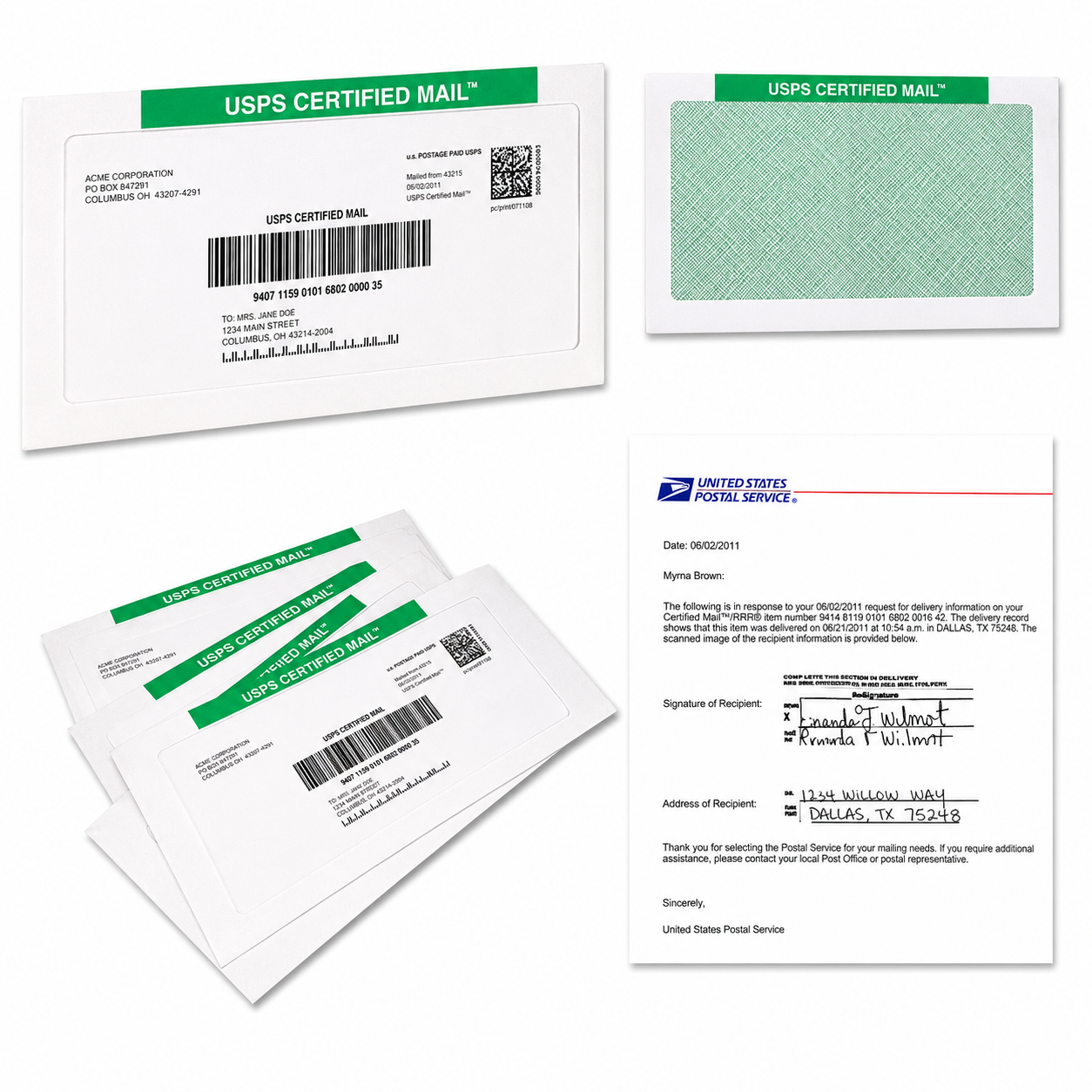
Here are just a few ways your team can use the platform:
- You’ll create and print labels online for clinic-level correspondence without PS Form 3800, a postage meter, or special equipment.
- You’ll print labels on a standard office printer or use adhesive sheets.
- You’ll upload a PDF letter and address list for full-service Print & Mail.
- You’ll receive same-business-day mailing for Print & Mail orders submitted before 5:00 PM Eastern.
- You’ll get printing, envelope inserting, postage application, USPS acceptance, and tracking handled in one workflow.
- You’ll pay $8.43 for a one-page Print & Mail letter based on the current service example, including printing, inserting, Certified Mail postage, tracking, and USPS acceptance.
- You’ll upload Excel or CSV files for payer-wide, clinic-wide, or campaign mailings.
- You’ll connect through API or secure SFTP for recurring notices from patient communication, EHR, billing, or case-management systems.
- You’ll use a single USPS SCAN form so an entire batch can be accepted in one scan.
- You won’t need monthly fees, contracts, or equipment leases.
For individual or clinic-level mailings, start with our create and print USPS Certified Mail labels online flow. For letters that must be printed, inserted, and mailed for you, use our Print & Mail service.
Is Electronic Return Receipt Better Than Chasing Paper Green Cards?
A paper Return Receipt can create extra handling for distributed healthcare teams. Staff may wait for the green card, scan it, match it to a patient notice, and store it in the correct system.
Electronic Return Receipt USPS service provides a digital alternative when a recipient signature is needed. The available record can include delivery information, date of delivery, tracking details, and signature information.
You’ll get:
- Digital records instead of paper green cards.
- Easier matching to a notice or patient file.
- Faster access for audits and disputes.
- Lower per-piece cost than paper Return Receipt.
- Searchable storage with your other mailing records.
The Electronic Return Receipt information page explains how this USPS service works. You can also review our Certified Mail reports and delivery records.
How Much Can Your Healthcare Organization Save?
The cost difference becomes significant when you send hundreds or thousands of patient notices.
The current USPS Notice 123 lists paper Return Receipt at $4.65 and electronic Return Receipt at $2.91. That is a savings of $1.74 per piece when the electronic option meets your documentation needs.
- Across 1,000 patient notices: $1,740 saved.
- Across 5,000 patient notices: $8,700 saved.
A full 1-ounce Certified Mail letter with Electronic Delivery Confirmation is shown at $7.28 online compared with $11.02 at the counter, a savings of $3.74 per piece.
- Across 1,000 notices: $3,740 saved.
- Across 5,000 notices: $18,700 saved.
Review current fees in USPS Notice 123 before launching a large campaign. Rates and service fees can change.
What Happens When You Need Proof Years Later?
A notice may be challenged long after it leaves your office. Your organization should not have to reconstruct a mailing from old spreadsheets, staff emails, and paper receipts.

The Certified Mail Labels 10-Year Compliance Archive stores and organizes:
- Proof of mailing.
- Notarized affidavits of mailing.
- USPS acceptance scans.
- Postmark dates.
- Intelligent Mail Postal Barcode information.
- Certified mail tracking events.
- Delivery and attempted-delivery records.
- Electronic Delivery Confirmation.
- Available Electronic Return Receipt and signature records.
You’ll be able to search by tracking number, recipient details, date, status, and other mailing information. No more searching through clinic cabinets for a missing receipt. No more waiting for a paper card to appear. You get a long-term evidence trail in one place at no extra archive fee.
Can You Automate Bulk Certified Mail?
Yes. Healthcare systems, third-party administrators, and multi-location provider groups can upload address lists through Excel and CSV batch processing, or use the bulk API and SFTP automation page.
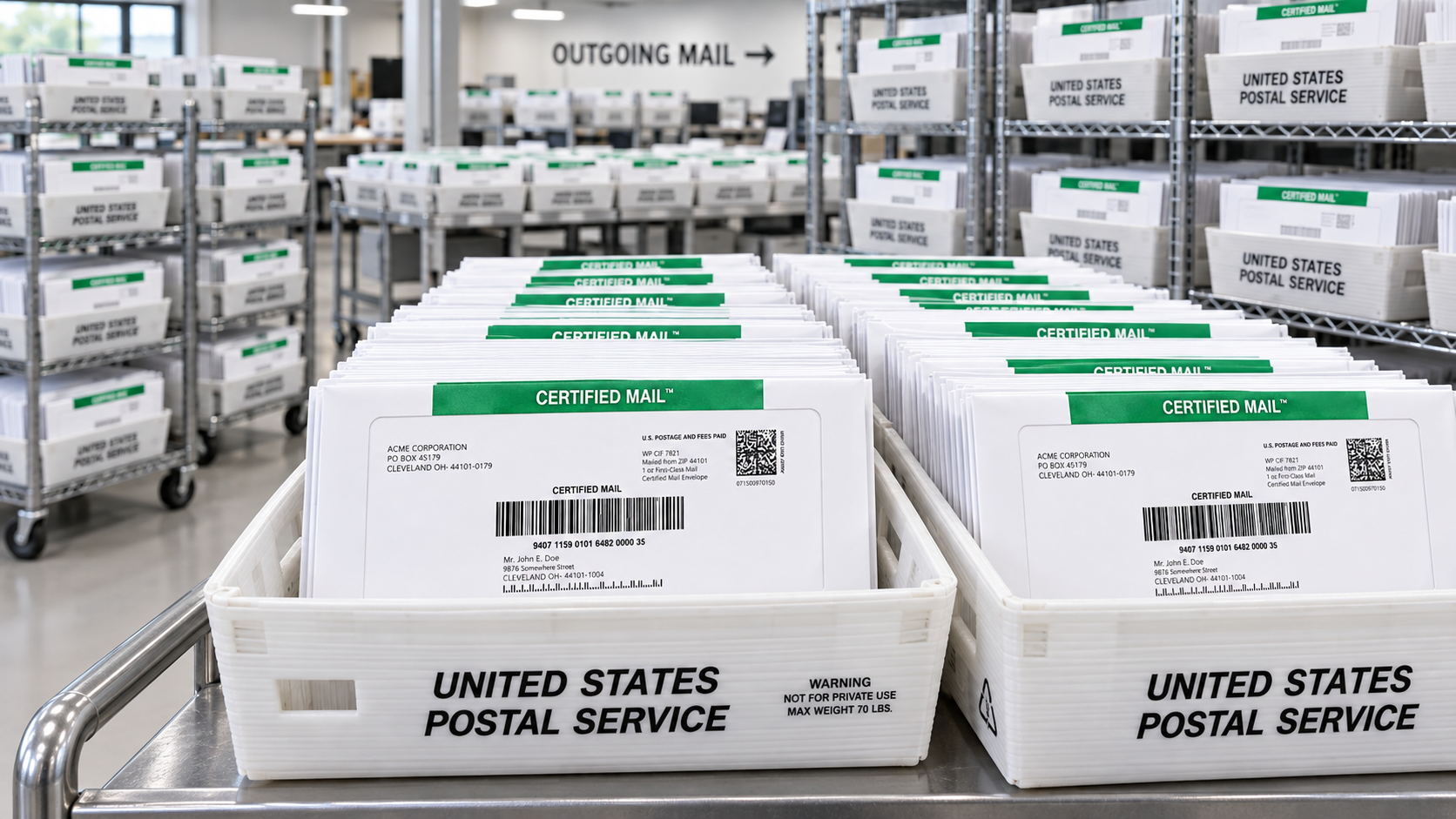
You’ll get a workflow that supports:
- Large appeal determination campaigns.
- Network termination correspondence.
- Payer or plan notices.
- Benefit denial and non-coverage letters.
- Patient discharge communications.
- Breach notification mailings.
- Recurring correspondence generated from business systems.
- Centralized tracking and reporting across clinics.
You can send only the information needed to create and track the mailpiece. Your organization remains responsible for its own HIPAA safeguards, access controls, data-minimization practices, vendor review, and applicable business associate requirements. The certified mail record is business-associate-style evidence of delivery, not a disclosure of PHI.
Frequently Asked Questions
Does HIPAA Require Breach Notification by First-Class Mail?
Yes, 45 CFR 164.404(d)(1)(i) requires written notification by first-class mail to the individual’s last known address, unless the individual has agreed to electronic notice. Certified Mail can add proof of mailing and delivery to that required mailing process. Confirm the correct method for your situation with counsel.
What Records Must We Keep and for How Long?
45 CFR 164.316(b)(2)(i) requires certain Security Rule documentation to be retained for six years. Your organization may have additional retention obligations under state law, payer contracts, litigation holds, or internal policy. Certified Mail Labels archives available mailing records for 10 years.
Can State Health-Privacy Laws Add Requirements Beyond HIPAA?
Yes. 45 CFR 160.203(b) recognizes an exception for more stringent state privacy laws. Review state-specific notice and health-privacy requirements before selecting your mailing workflow.
How Do We Prove an Appeal Notice Was Mailed on Time?
Use a record set that includes the postmark date, USPS acceptance scan, Intelligent Mail Postal Barcode, tracking events, delivery or attempted-delivery record, and affidavit of mailing. Store those records with the notice and appeal reference in a searchable archive.
Is Certified Mail Itself a PHI Risk?
Certified Mail is a mailing method, not a substitute for your HIPAA safeguards. Minimize information on the envelope, use appropriate access controls and secure transfer methods, and review vendor and business associate requirements. No PHI is posted to the Post Office counter file when you create the mailing through the online workflow.
What Does It Cost Per Notice Compared With the Counter?
A full 1-ounce Certified Mail letter with Electronic Delivery Confirmation is shown at $7.28 online versus $11.02 at the counter, saving $3.74 per piece. Electronic Return Receipt is $2.91, compared with $4.65 for paper Return Receipt, based on USPS Notice 123.
Start Building a More Reliable Healthcare Notice Process
You already have the notice, the deadline, and the responsibility. Now make the mailing record easier to create, easier to track, and easier to prove.
Certified Mail Labels has created more than 33 million labels and served 200,000+ customers since 2006. We are BBB Accredited and trusted by Fortune 500 companies. You’ll get online Certified Mail, same-business-day Print & Mail, bulk certified mail automation, electronic return receipt options, tracking, affidavits, and a free 10-year searchable compliance archive, with no monthly fees, contracts, or equipment leases.
Create and print your labels online, send your PDF through Print & Mail, or schedule a workflow discussion for high-volume healthcare correspondence.
Last reviewed October 1, 2026. Rates verified against USPS Notice 123; HIPAA citations verified against the eCFR. Federal and state health-privacy rules shift. Re-verify citations quarterly and confirm specifics with counsel.
Certified Mail Labels provides the mailing and the proof, not legal advice; confirm notice requirements with your own counsel.