
Regulation F, Dispute-Proof Records and Cost Control at Volume
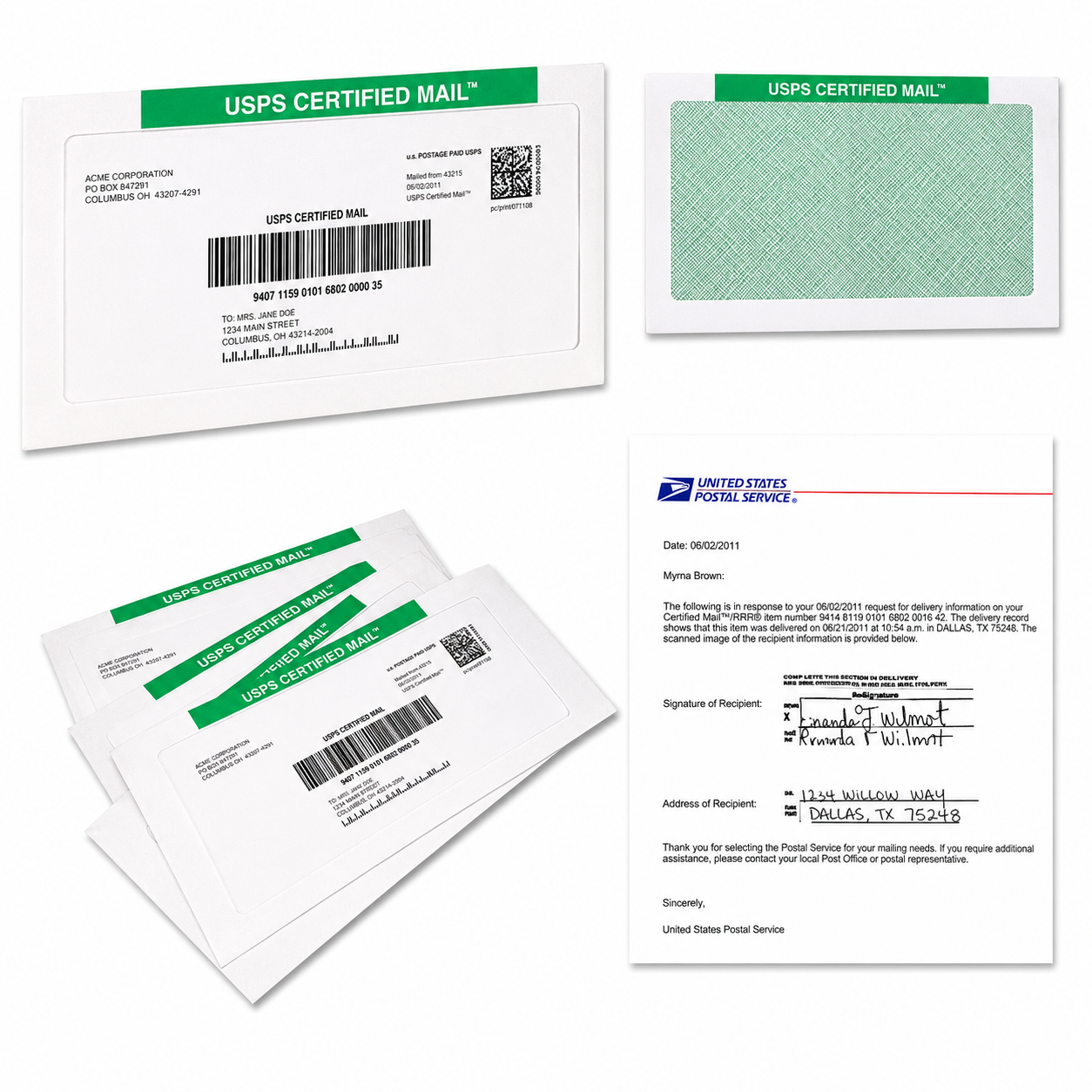
Since the Regulation F validation-notice regime took effect, your collection letter is a regulated document, and the proof you mailed it, with what contents, is the defense. A validation notice that cannot be tied to a mailing record, a mailing that arrives and cannot be proven, or a green card lost in a drawer is how a compliance program loses a CFPB exam finding or faces a consumer lawsuit.
Collection agencies use online USPS Certified Mail to create proof that validation notices and collection letters were mailed, when they were mailed and to whom. You upload your compliant letter, address the piece, print live-postage Certified Mail labels on any office printer or have us print and mail the entire batch the same business day, and you get a notarized affidavit of mailing, USPS acceptance scans, certified mail tracking events and available Electronic Return Receipt signature records stored searchable for 10 years.
What Does Regulation F Require You To Prove?
12 CFR 1006.34 (Regulation F, the CFPB rule under the Fair Debt Collection Practices Act) requires debt collectors to provide validation information to the consumer. The statutory source is 15 U.S.C. 1692g, the FDCPA validation-of-debts provision enacted by Congress.
Under 12 CFR 1006.34(c)-(d), the validation information must be clear and conspicuous and must include required information about the debt, consumer protections, and how the consumer can respond. 12 CFR 1006.34(d)(3) addresses permitted optional disclosures, while 12 CFR 1006.34(d)(2) provides the safe harbor when you use Model Form B-1 from Appendix B to Part 1006, or a permitted substantially similar variation.
Certified Mail does not replace a compliant notice. Regulation F does not require validation notices to be sent by Certified Mail. But your mailing record is what makes the required notice provable: which version was mailed, to which consumer, on what date, and what happened after USPS accepted it.
That is the difference between saying “we sent it” and producing a complete legal compliance mailing file.
What Should Your Regulation F Mailing Record Include?
Here is just a few of the records your team should be able to retrieve quickly when an examiner, outside counsel, or a consumer dispute requires documentation:
- Proof of mailing with the postmark date tied to the specific letter version.
- USPS acceptance scan tied to the Intelligent Mail Postal Barcode.
- End-to-end certified mail tracking showing when the piece reached the consumer.
- Delivery or attempted-delivery records for each validation notice.
- Available Electronic Return Receipt signature records when a recipient signs.
- A notarized affidavit of mailing confirming the mailing event.
- USPS SCAN form records for high-volume campaigns.
- The letter PDF, address record, tracking number and internal reference connected in one file.
- Searchable retention for 10 years, so your staff can pull a piece-years-later file in seconds.
You do not want compliance staff searching desk drawers for green cards during an exam. You want a searchable archive that connects the consumer, address, document version, barcode, mailing date, acceptance event, tracking history and delivery record.

Why Is Certified Mail Cost Control Important At Volume?
A paper return receipt can become expensive and difficult to manage across thousands of validation notices. USPS Notice 123 lists the paper green-card Return Receipt at $4.65 and Electronic Return Receipt at $2.91 per piece. That is a $1.74 saving per piece.
- 5,000 validation notices: $1.74 × 5,000 = $8,700 saved
- 10,000 validation notices: $1.74 × 10,000 = $17,400 saved
The electronic return receipt is the electronic version of PS Form 3811. Instead of waiting for a physical card to arrive back at your office, you receive a PDF delivery record with available signature information.

Your broader certified mail cost can also improve when you move away from the Post Office counter. A full 1-ounce Certified Mail letter with Electronic Delivery Confirmation runs approximately $7.28 online versus $11.02 at the Post Office counter. A $3.74 per-piece difference.
- 10,000-piece campaign: $3.74 × 10,000 = $37,400 saved
These savings can help you protect margins across portfolio placements, recurring validation notices, dispute responses, settlement letters and other regulated communications. Rates can change, so verify current prices before each campaign using USPS Notice 123.
How Do You Send 5,000 Validation Notices?
Certified Mail Labels gives you a practical process for bulk certified mail without a trip to the Post Office, postage meter, special equipment or long-term contract.
Option 1: Create And Print Labels From Excel Or CSV
Use our label-printing flow to create live-postage USPS Certified Mail labels online. Upload your Excel or CSV address list, map the required fields and generate a batch of labels.
You’ll get:
- Batch label creation from address lists.
- Labels that print on standard office printers or adhesive sheets.
- USPS Intelligent Mail barcodes and tracking numbers.
- Electronic Delivery Confirmation options.
- A consolidated process for recurring collection campaigns.
- No monthly fees, no contracts, no equipment leases and no postage meter.
This option works well when your operations team already produces compliant letters and needs a faster, more controlled way to address and mail them.
Option 2: Upload The Letter And Let Us Print And Mail
With our Print & Mail service, you upload the PDF letter and address list. We print the notices, insert them into envelopes, apply postage and mail the pieces for you.
For orders submitted before 5:00 PM Eastern, we print and mail the order the same business day. Every piece includes USPS proof of acceptance and a notarized affidavit of mailing.
You’ll save internal staff time because your team does not have to:
- Print thousands of pages.
- Match letters to addresses.
- Fold and insert documents.
- Apply labels and postage.
- Drive completed batches to the Post Office.
- Assemble proof files manually after delivery.
Option 3: Automate Recurring Volume With API Or SFTP
For high-volume collection operations, use our bulk Excel, API and SFTP automation options. Your collection software can send mailing data through an API, or your team can place approved files in a secure SFTP workflow.
You’ll receive:
- Automated address and mailing-data processing.
- USPS Certified Mail tracking numbers connected to your records.
- High-volume batch handling.
- A single USPS SCAN form for thousands of pieces.
- Processing updates for your internal systems.
- Less manual data entry and fewer handoff points.
This is especially useful for recurring portfolio campaigns, first-party collection arms, healthcare receivables, financial institutions and agencies that generate notices from a centralized platform.
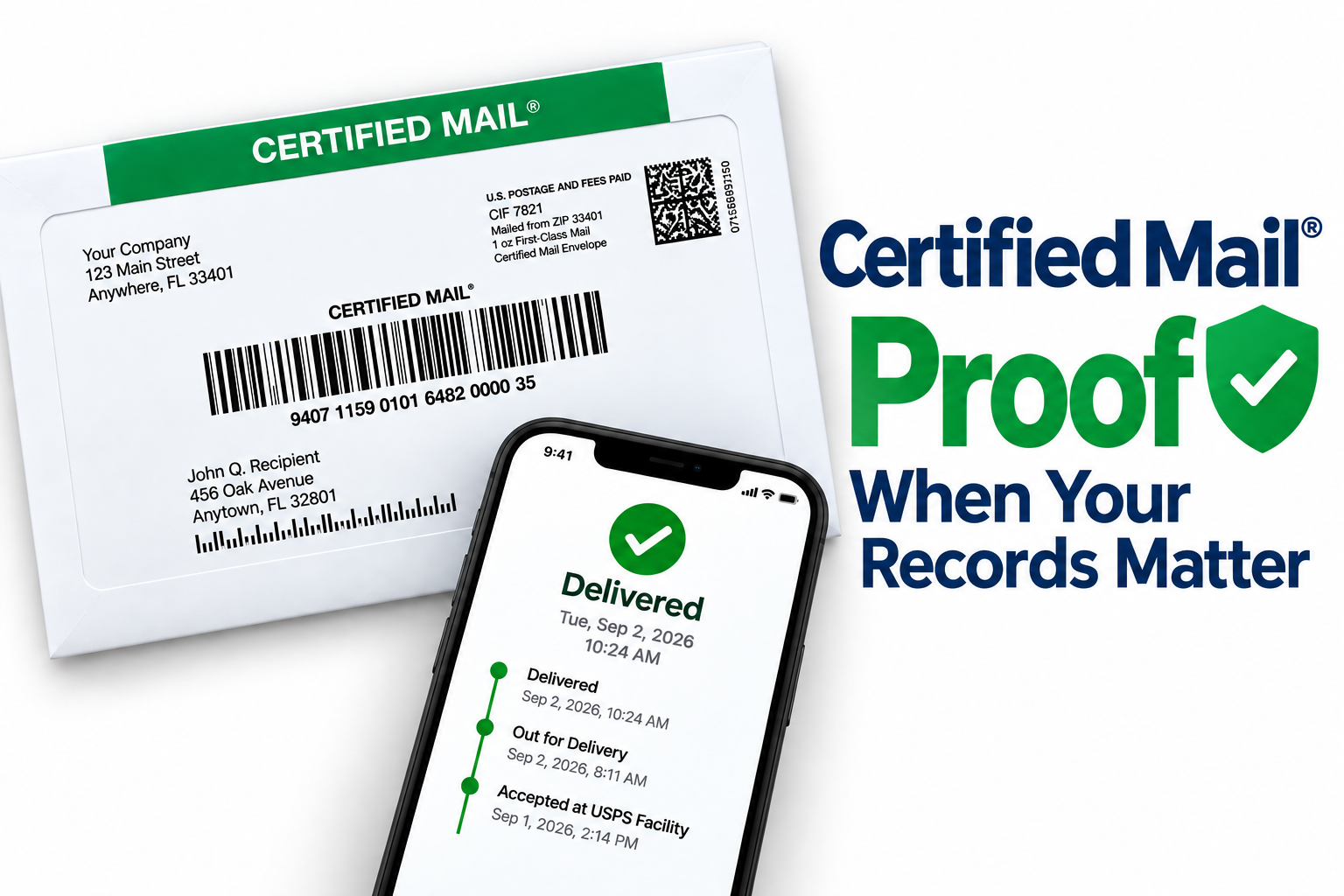
What Happens When You Cannot Produce The Mailing Record?
A missing record is not just an administrative inconvenience. It can create exposure through:
- CFPB supervision findings.
- State attorney general actions.
- Consumer lawsuits where the collector cannot produce the mailing record.
- Write-offs of portfolios where required notice cannot be shown.
- Staff hours spent assembling green cards and scattered tracking records.
- Delays responding to disputes, audits and outside counsel requests.
We understand that your notice process is important. Certified Mail Labels helps you create a repeatable record from the letter version to the delivery outcome, with proof that remains available long after the original campaign is complete.
Since 2006, more than 200,000 customers have created over 33 million labels through our platform. We are BBB Accredited and trusted by Fortune 500 companies. You get a modern, reliable process without monthly fees, contracts, equipment leases or a postage meter.
Frequently Asked Questions About Regulation F Certified Mail
Does Regulation F Require Validation Notices By Certified Mail?
No. Regulation F and 15 U.S.C. 1692g do not require you to use USPS Certified Mail or a return receipt. Certified Mail is a business and evidentiary choice. The value is that it helps you prove when a notice was mailed, where it was addressed, when USPS accepted it and what delivery events followed.
What Is Model Form B-1 And Why Does It Matter?
Model Form B-1 is the CFPB’s model validation notice in Appendix B to Part 1006. Under 12 CFR 1006.34(d)(2), using Model Form B-1 provides a safe harbor for the information and form requirements in the rule. Section 1006.34(d)(3) identifies optional disclosures that may be used with the model form or a permitted variation. Confirm your notice design and modifications with counsel.
How Do We Prove We Mailed 5,000 Notices?
Upload your Excel or CSV address list, create batch labels, or send your mailing data through API or SFTP. Certified Mail Labels connects the mailing information to USPS barcodes, acceptance scans, tracking events, delivery records and available signatures. A USPS SCAN form can support consolidated acceptance for high-volume batches.
What Does Electronic Return Receipt Cost Compared With The Green Card?
Based on USPS Notice 123 rates stated above, Electronic Return Receipt is $2.91 per piece and paper Return Receipt is $4.65 per piece. The electronic option saves $1.74 per piece and returns a digital delivery record with available signature information. Learn more about Electronic Return Receipt.
How Long Do You Keep Validation-Mailing Records?
Certified Mail Labels provides a searchable 10-Year Compliance Archive at no extra charge. Records can include proof of mailing, the notarized affidavit, USPS acceptance and SCAN form records, postmark date, Intelligent Mail Postal Barcode, tracking events and available signature records.
Can We Automate Mailing From Our Collection Software Via API Or SFTP?
Yes. API and secure SFTP workflows are available for qualifying high-volume and recurring mailing operations. Your team can define data formats, processing rules and system connections so certified mail tracking and delivery records can be matched back to your collection records.
Start Building A Better Regulation F Mailing Record
Create and print your USPS Certified Mail labels online, upload your PDF and address list for same-business-day Print & Mail, or connect your recurring workflow through API or SFTP.
Start your next campaign with Certified Mail Labels and reduce certified mail cost while creating searchable proof of mailing, acceptance, delivery and available signature records.
Last reviewed October 1, 2026. Rates verified against USPS Notice 123; Regulation F and FDCPA citations verified against the eCFR and U.S. Code. Federal and state collection rules shift. Re-verify citations quarterly and confirm practices with counsel.
Certified Mail Labels provides the mailing and the proof, not legal advice; confirm validation notice practices with your own counsel.