
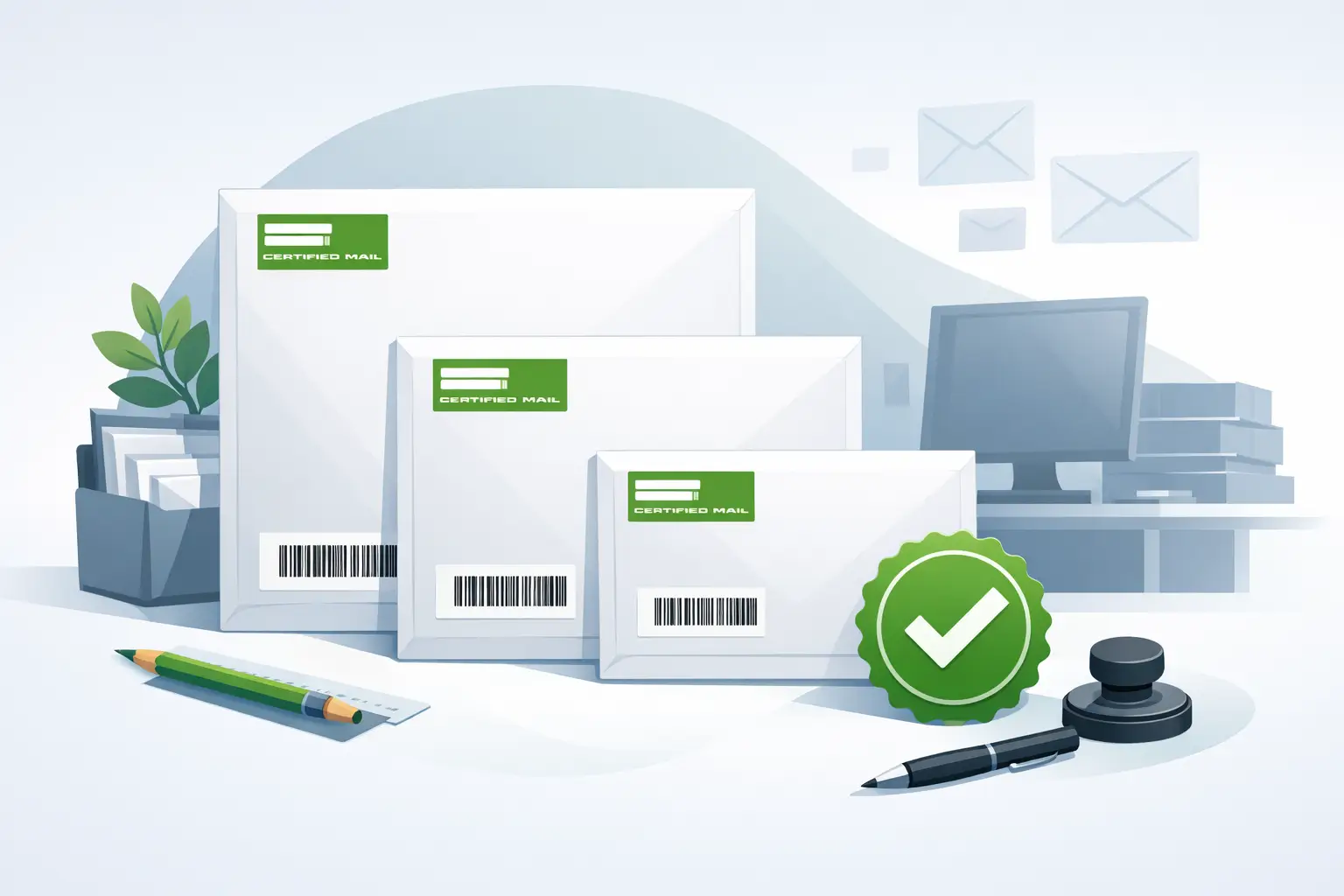
 A Certified Mail piece can be delayed before it ever enters the mailstream if the envelope is too small for the documents, too crowded for the label, or classified at the wrong USPS mail shape. For legal notices, account correspondence, tenant communications, and other records-sensitive mail, envelope selection is part of the mailing process, not an afterthought.
The right Certified Mail envelope sizes protect the contents, provide clear space for addresses and service labels, and help your team maintain a consistent, auditable workflow. The best choice depends on the document format, page count, enclosure thickness, and whether the mailpiece qualifies as a letter or a flat.
Common Certified Mail Envelope Sizes
Certified Mail can be prepared on several envelope formats, provided the mailpiece meets USPS requirements for the chosen class and shape. Most offices use one of four sizes repeatedly because they fit routine correspondence and work well with printed labels.
#10 envelopes: 4 1/8 x 9 1/2 inches
The #10 business envelope is the standard choice for a one- to several-page letter folded into thirds. It is appropriate for notices, demand letters, billing correspondence, policy updates, and routine legal or administrative communications.
A #10 envelope is efficient when the contents remain relatively thin. However, it can become difficult to use when multiple pages, supporting exhibits, cards, or folded forms make the envelope bulky. A crowded #10 envelope may also leave insufficient clear space for the delivery address, return address, Certified Mail label, and postage.
For recurring correspondence, #10 Certified Mail envelopes support a familiar office workflow. Teams can standardize document templates, folding procedures, label placement, and mailing records around one format.
#9 envelopes: 3 7/8 x 8 7/8 inches
A #9 envelope is smaller than a #10 and is generally used for reply mail or short, compact documents. It can work for a single folded notice, but it offers less room for service markings and addressing.
For most Certified Mail applications, #9 envelopes are a secondary option rather than a default. If the sender needs to include a return envelope, a #9 may be useful inside a larger outbound piece. It is less practical for correspondence that requires several inserts or prominent operational labeling.
6 x 9 inch envelopes
A 6 x 9 envelope provides more usable area than a standard business envelope while remaining compact. It is often a good choice for documents that should not be folded as tightly, such as certificates, thicker notices, photographs, or small groups of supporting pages.
This size can also make label placement easier. The added face area gives staff more flexibility to keep the recipient address visible and the Certified Mail barcode readable. Before standardizing on this format, confirm that the completed piece meets the applicable USPS dimensions, thickness, and weight requirements for the selected mail category.
9 x 12 and 10 x 13 inch envelopes
Large catalog-style envelopes are useful for full-page documents, multipage packets, lease notices, legal exhibits, medical or financial records, and correspondence that should not be folded. A 9 x 12 envelope is a common choice for standard letter-size documents. A 10 x 13 envelope provides additional capacity for thicker sets of papers.
These envelopes are often mailed as flats rather than letters. That distinction affects postage and processing. A large envelope may be operationally correct for the contents but cost more than a folded letter in a #10 envelope. The trade-off is usually worthwhile when folding would damage documents, complicate review, or create an unprofessional presentation.
Letter Size vs. Flat Size Matters
Envelope dimensions do more than determine how documents fit. They affect USPS classification and postage. A mailpiece that falls within letter-size standards may qualify for letter pricing, while a larger or thicker piece may be treated as a flat.
As a general planning reference, letter-size mail is rectangular and typically falls within a range of 3 1/2 to 6 1/8 inches high, 5 to 11 1/2 inches long, and up to 1/4 inch thick. Large envelopes, commonly called flats, are generally larger than letter-size pieces and can be up to 12 inches high, 15 inches long, and 3/4 inch thick.
Weight also matters. Certified Mail service is available with eligible USPS mail classes, but the total postage is based on the mailpiece's class, weight, shape, and any additional services selected. Do not assume that a larger envelope only requires the same postage as a standard business letter plus a Certified Mail fee.
When a document package is close to a threshold, weigh and measure the sealed envelope rather than estimating from the number of pages. Paper stock, inserts, labels, and return materials can change the final classification.
Leave Space for the Mailing Workflow
The face of a Certified Mail envelope must carry more information than ordinary correspondence. Your office needs room for the sender's return address, the recipient's delivery address, postage, and the Certified Mail label or electronic label information. If a physical Return Receipt is used, it also requires careful placement.
Avoid selecting an envelope based only on what fits inside it. A small envelope may hold the papers but create a cramped exterior that increases the risk of covering the address, wrinkling a barcode, or placing labels over seams and folds.
Keep the delivery address on a flat, uncluttered area. Do not place labels across the envelope flap, over a closure seam, or where they can lift during handling. If your organization uses window envelopes, verify that the recipient address remains fully visible after the document is folded and inserted. A shifted page can make a correctly prepared label ineffective.
Certified Mail Labels supports online creation and printing of Certified Mail Labels, which can reduce handwriting errors and help offices apply consistent label information across recurring mailings. The envelope still needs adequate clear space for the printed material and postal acceptance process.
Match Envelope Size to Document Risk
The lowest-cost envelope is not always the best operational choice. For routine letters, a #10 envelope may be the practical standard. For high-value notices or documentation that may later be reviewed in a dispute, using a larger envelope can reduce handling mistakes and preserve the condition of the enclosed records.
Consider a 9 x 12 envelope when the contents include original signatures, full-page exhibits, court-related paperwork, certified copies, or documents that should remain flat. Consider a 10 x 13 envelope when a packet is too thick for a 9 x 12 without forcing the closure or producing an uneven mailpiece.
If the envelope will be retained as part of an internal file, choose a format that allows staff to identify the correspondence easily from the outside. A clearly printed recipient address, case reference, or internal routing notation can support retrieval later, provided it does not interfere with USPS addressing and label requirements.
Avoid Common Envelope Selection Errors
A few recurring mistakes create unnecessary rework. The first is overfilling a standard envelope. When the contents strain the seams or closure, move up to a larger size instead of forcing the packet into a #10.
The second is treating every large envelope as a simple letter. Larger dimensions and thickness can change the postage category, so check the completed mailpiece before printing final postage. The third is using an envelope with an awkward surface, oversized clasp, or uneven closure area that limits label placement. Clasp envelopes can be useful for internal routing, but the exterior should remain suitable for postal processing and securely sealed for mailing.
Finally, do not apply labels before confirming the document set. A last-minute added exhibit may change the weight or require a larger envelope, leaving staff to replace labels and reconcile records.
Build a Repeatable Envelope Standard
Organizations that send Certified Mail regularly should limit the number of envelope formats their teams use. A practical standard may include #10 envelopes for routine folded letters, 6 x 9 envelopes for compact thicker correspondence, and 9 x 12 or 10 x 13 envelopes for full-page packets.
Document the approved size for each common correspondence type. Include the expected page range, whether pages are folded, the typical postage category, and where labels are placed. This gives administrative staff clear instructions while making quality checks faster for mailroom, legal, property management, and compliance teams.
The right envelope size gives your Certified Mail a clean start: the documents fit properly, the label is readable, and the record of mailing can move into your files without avoidable exceptions.