
 A delivery signature is only useful when the person or department that needs it can retrieve it quickly. So, where are delivery signatures stored for Certified Mail? The answer depends on how the item was sent, which delivery-confirmation service was selected, and whether your organization uses a mailing platform that maintains its own long-term records.
For compliance-sensitive mail, the practical question is bigger than locating a signature on a tracking page. You need to know what document serves as proof, how long it remains available, who can access it, and whether it can be matched to the original mailing record. A reliable recordkeeping process connects the label, USPS acceptance event, tracking history, delivery event, and recipient signature into one defensible chain of custody.
Where Delivery Signatures Are Stored
When Certified Mail is sent with a Return Receipt service, the delivery signature is associated with the USPS delivery record for that mailpiece. The signature may be available as part of an electronic Return Receipt or, if a physical green card was requested, on the returned PS Form 3811.
USPS tracking information also documents key scan events, including acceptance, transit activity, delivery, attempted delivery, forwarding, or return to sender. Tracking proves the movement and final status of the item. A Return Receipt adds the recipient's signature and delivery details, which is often the record an office needs when a dispute involves whether a notice was received.
The distinction matters. A tracking status that says “Delivered” may be enough for routine correspondence. It may not be sufficient for a lease notice, collections communication, legal filing, tax matter, policy cancellation, or other document where identifying the receiving party is necessary. In those cases, select the Return Receipt option that matches your documentation requirement before the label is created.
USPS Records Versus Your Internal Archive
USPS retains operational tracking data, but mailing professionals should not treat a public tracking page as their permanent records system. Tracking availability can be limited, and the information displayed online may not provide the complete document package an organization needs months or years later.
A physical Return Receipt is delivered back to the sender's mailing address. That creates a familiar paper record, but it also creates a manual filing obligation. Someone must scan it, name it correctly, associate it with the client or case file, and store it where authorized staff can retrieve it. Lost mail, delayed returns, and inconsistent scanning can weaken an otherwise sound process.
An electronic Return Receipt removes the paper-return step by providing a digital record of delivery information and the signature. It is generally the better fit for offices that already manage client files, property records, accounting documents, or compliance records electronically. Digital proof can be attached to a matter file, retained under a records schedule, and produced without searching through paper folders.
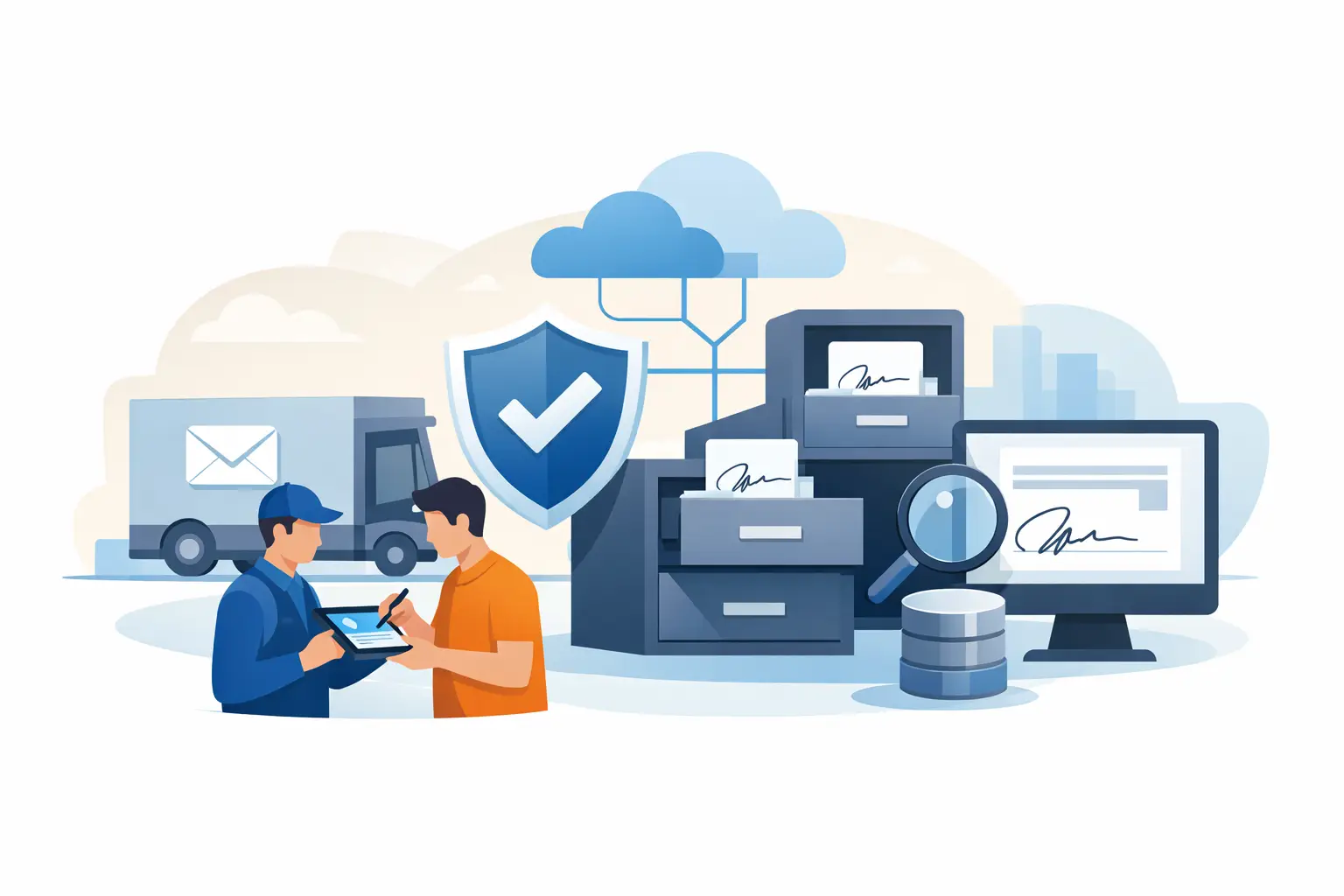
For organizations using Certified Mail Labels, mailing materials, USPS acceptance documentation, tracking, and Return Receipt Signatures are maintained in a secure online archive for 10 years. This approach gives teams a longer retrieval window than relying on temporary tracking visibility and keeps proof of delivery connected to the original mailing activity.
What a Complete Proof-of-Delivery Record Should Include
A signature by itself does not explain what was mailed or when the Postal Service accepted it. If a delivery record is ever reviewed by a court, regulator, customer, auditor, or internal compliance team, the surrounding documentation provides the context.
A complete file should tie together the recipient address, mailing date, Certified Mail tracking number, postage label, USPS acceptance evidence, delivery status, delivery date, and Return Receipt signature when one was requested. For batch mailings, it should also identify the relevant job, manifest, or acceptance SCAN form.
This does not mean every routine letter needs a custom legal file. It means the information should be retrievable from a consistent system. A property management office might search by tenant and unit number. A law office might search by matter number. An enterprise mailroom may need to search by department, account, batch date, or tracking range. The storage method should match how your team will need to find evidence later.
How Electronic Signatures Support the Chain of Custody
Electronic Return Receipt are especially useful because they reduce the gap between delivery and records access. Instead of waiting for a signed card to travel back through the mail, authorized users can retrieve the electronic proof from the record associated with the shipment.
That is a workflow improvement, but it is also a control improvement. The record is less likely to be misplaced, filed under the wrong name, or held on an employee's desk while a deadline approaches. For high-volume senders, electronic storage also makes it practical to keep evidence for every relevant item rather than preserving only the records that seem likely to be challenged.
Still, electronic storage is not a substitute for choosing the correct mailing service. If your policy, contract, governing rule, or attorney requires a signed Return Receipt, confirm that Return Receipt service is included before mailing. Adding a signature requirement after the item has been delivered is not an available remedy.
Setting a Retention Policy That Holds Up
The appropriate retention period depends on the type of communication and the exposure tied to it. A business may retain ordinary customer notices for a shorter period than notices involving collections, employment, insurance, regulated transactions, litigation, or government requirements. Legal counsel and records-management policies should determine the final schedule.
The operational goal is straightforward: retain proof long enough to answer foreseeable questions. A recipient may claim a notice was never received long after the mailing date. A staff member may leave the organization. A case file may be reopened. If the signature and mailing details are stored only in an inbox or on a public tracking page, retrieval becomes uncertain.
Use access controls as well as retention rules. Delivery signatures can contain personal information, and records may be tied to confidential matters. Limit editing rights, keep a clear audit trail, and ensure that staff can download or produce copies without altering the original record. If your organization uses a document-management system, establish a consistent method for associating the delivery record with the underlying file.
A Practical Retrieval Process
When someone asks for proof of delivery, start with the tracking number. It is the most precise identifier and should be included in the mailing record at the time the label is created. If the tracking number is unavailable, search using the recipient name, address, mailing date, account reference, or batch information.
Once the matching item is located, verify that the delivery date and address align with the correspondence at issue. Then retrieve the relevant signature or electronic Return Receipt along with the supporting mailing and acceptance records. Saving only a screenshot of a delivered status can create avoidable questions later, particularly when a signed receipt was purchased.
For a single item, this process may take minutes. For a large office, the difference is determined by preparation. Centralized label creation, standardized reference fields, and online reports make retrieval far more predictable than decentralized mailing from multiple post office locations.
Common Recordkeeping Gaps to Avoid
The most common gap is assuming that a delivered tracking event and a signature are the same thing. They are related but distinct records. Another is purchasing a physical Return Receipt without assigning responsibility for scanning and filing the returned card.
Organizations also run into trouble when staff create labels outside the normal workflow. A tracking number written on a sticky note or saved in one employee's email may work until that employee is unavailable. The same issue arises when batch mailings are not matched to the customer, case, tenant, or account records they support.
A final concern is retention by exception. If employees save only records connected to an active dispute, they may not have proof when a dispute appears later. Consistent retention is usually less burdensome than reconstructing a mailing history after the fact.
Choose Storage Based on the Evidence You May Need
Physical Return Receipt can still work for low-volume mailers that maintain disciplined paper files. Electronic Return Receipt and centralized online archives are generally more practical for recurring Certified Mail workflows, distributed teams, and organizations that must retrieve documentation on demand.
The best storage approach is the one that preserves the original delivery evidence, links it to the mailing record, protects sensitive information, and makes retrieval routine rather than urgent. Build that process before the next notice leaves your office, so proof of delivery is available when it is needed, not merely when it can still be found.