
12 U.S.C. §§ 3708 and 3758: When Certified Mail Is Mandatory for Notice of Default and Foreclosure Sale
Last reviewed: October 2026
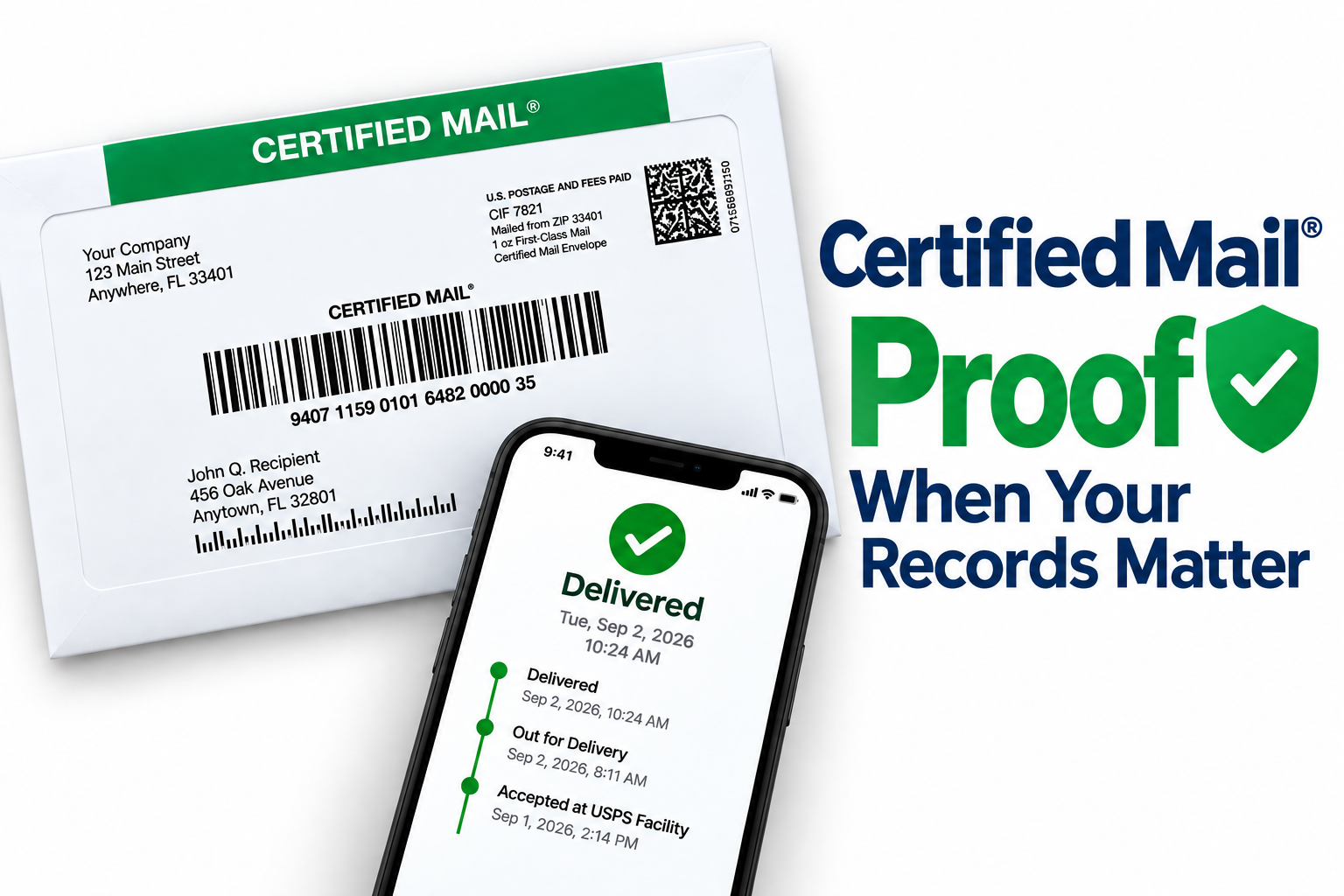
For covered federal foreclosure proceedings, 12 U.S.C. §§ 3708 and 3758 require notice to be sent by certified or registered mail, postage prepaid and return receipt requested. The statutes also state that notice is deemed duly given upon mailing, even if the recipient does not receive it, the return receipt is not returned, or the letter comes back. Your compliance file therefore needs to prove the mailing, not rely only on delivery. The practical workflow is to prepare the correct notice and recipient list, use the required USPS mail class, preserve the USPS acceptance record, and retain an affidavit and tracking history your counsel can review.
This article explains how to execute and prove the notice your statute requires. It is not legal advice. Confirm the applicable foreclosure, servicing, bankruptcy, and state-law requirements with your own counsel.
What Do 12 U.S.C. §§ 3708 and 3758 Require?
The statutes use specific language: “certified or registered mail, postage prepaid and return receipt requested.”
That wording matters. Ordinary First-Class Mail, a regular mailing certificate, or an email alone does not use the mail method stated in these federal provisions. If your proceeding falls within one of these statutes and your counsel directs certified mail, you need a mailing workflow that can show:
- The correct notice was prepared.
- Each required recipient was identified.
- The correct address was used.
- Postage was paid.
- The mailing was accepted by USPS.
- The mailing date was recorded.
- The return-receipt or electronic delivery information was retained.
- The entire record can be found later during a dispute, audit, bankruptcy matter, or foreclosure challenge.
Under 12 U.S.C. § 3708, the foreclosure commissioner must serve notice of default and foreclosure sale on several categories of people. Under 12 U.S.C. § 3758, the federal agency foreclosure process separately identifies the recipients and timing for notice of foreclosure sale.
These statutes also contain a powerful mailing rule: notice is deemed duly given upon mailing, whether or not it is received, whether or not a return receipt comes back, and whether or not the letter is returned. That makes your acceptance scan, mailing record, and affidavit especially important.
Who Must Receive Notice Under 12 U.S.C. § 3708?
Section 3708 identifies three main recipient groups for notice of default and foreclosure sale.
Who Receives The 21-Day Notice?
Notice must be mailed at least 21 days before the foreclosure sale to:
- The current security property owner of record.
- The original mortgagor.
- All subsequent mortgagors or persons of record liable on the mortgage debt.
- Other persons identified in the mortgage agreement as liable for all or part of the mortgage debt, subject to the statutory requirements.
The notice must be sent by certified or registered mail, postage prepaid and return receipt requested.
Who Receives The 10-Day Notice?
All persons holding liens of record must receive notice mailed at least 10 days before the foreclosure sale.
The statute includes address rules for these notices, including the address stated in the mortgage agreement, the property address when appropriate, or another address the foreclosure commissioner believes to be correct. Your recipient and address review should be documented before labels are produced.
Who Must Receive Notice Under 12 U.S.C. § 3758?
Section 3758 provides a parallel federal notice process for certain federal agency foreclosures. The notice of foreclosure sale must be sent by certified or registered mail, postage prepaid and return receipt requested, at least 21 days before the sale to the recipients specified by the statute, including:
- The current owner of record.
- Mortgagors of record and persons appearing liable for the mortgage debt.
- All dwelling units in the security property, as addressed by the statutory process.
- All lienholders of record.
If the names of occupants are unknown, the statute provides for posting notice at the property in the circumstances described there. Your foreclosure counsel should confirm how that requirement applies to the property, occupants, and proceeding.
The mailing rule is again important: service is deemed duly given upon mailing, even when the addressee does not receive the notice, a return receipt is not received, or the notice is returned. 24 CFR Part 27 provides the federal regulatory framework for nonjudicial foreclosure of covered multifamily and single-family mortgages.
When Must You Mail Each Notice?
Use this quick planning table as an operational checklist. It does not replace a case-specific legal review.
| Notice or Recipient | Minimum Timing | Required Mail Method |
|---|---|---|
| Current owner and mortgagors/persons liable under § 3708 | At least 21 days before sale | Certified or registered mail, postage prepaid, return receipt requested |
| Record lienholders under § 3708 | At least 10 days before sale | Certified or registered mail, postage prepaid, return receipt requested |
| Owner, liable mortgagors, dwelling units, and lienholders under § 3758 | At least 21 days before sale | Certified or registered mail, postage prepaid, return receipt requested |
| FHA reasonable-effort letter under § 203.604 | Before three full monthly installments are unpaid | At least one certified-mail letter plus at least one property visit, unless an exception applies |
| VA Secretary and certain liable parties under § 36.4280 | At least 30 days before certain actions | Certified mail |
Build an internal buffer. Do not wait until the final permissible mailing date to prepare notices, correct addresses, produce labels, and assemble proof.
Why Does Proof Of Mailing Matter More Than Delivery?
The statutes’ “deemed duly given upon mailing” language shifts the operational focus to the mailing event.
That does not mean delivery information is unimportant. Tracking and return-receipt records can help show what happened after acceptance. But the primary compliance artifact is evidence that the required notice was properly mailed through the required method on time.
A strong legal compliance mailing file should include:
- Final notice PDF or document version.
- Recipient name and address list.
- Date the mailing was submitted.
- USPS Certified Mail label or article number.
- Postage and service selection.
- USPS acceptance scan or stamped mailing receipt.
- Certified mail tracking history.
- Electronic Return Receipt or other delivery confirmation record, when selected.
- Notarized affidavit of mailing.
- Any returned-mail image, notation, or follow-up record.
- Internal approval or quality-control checklist.
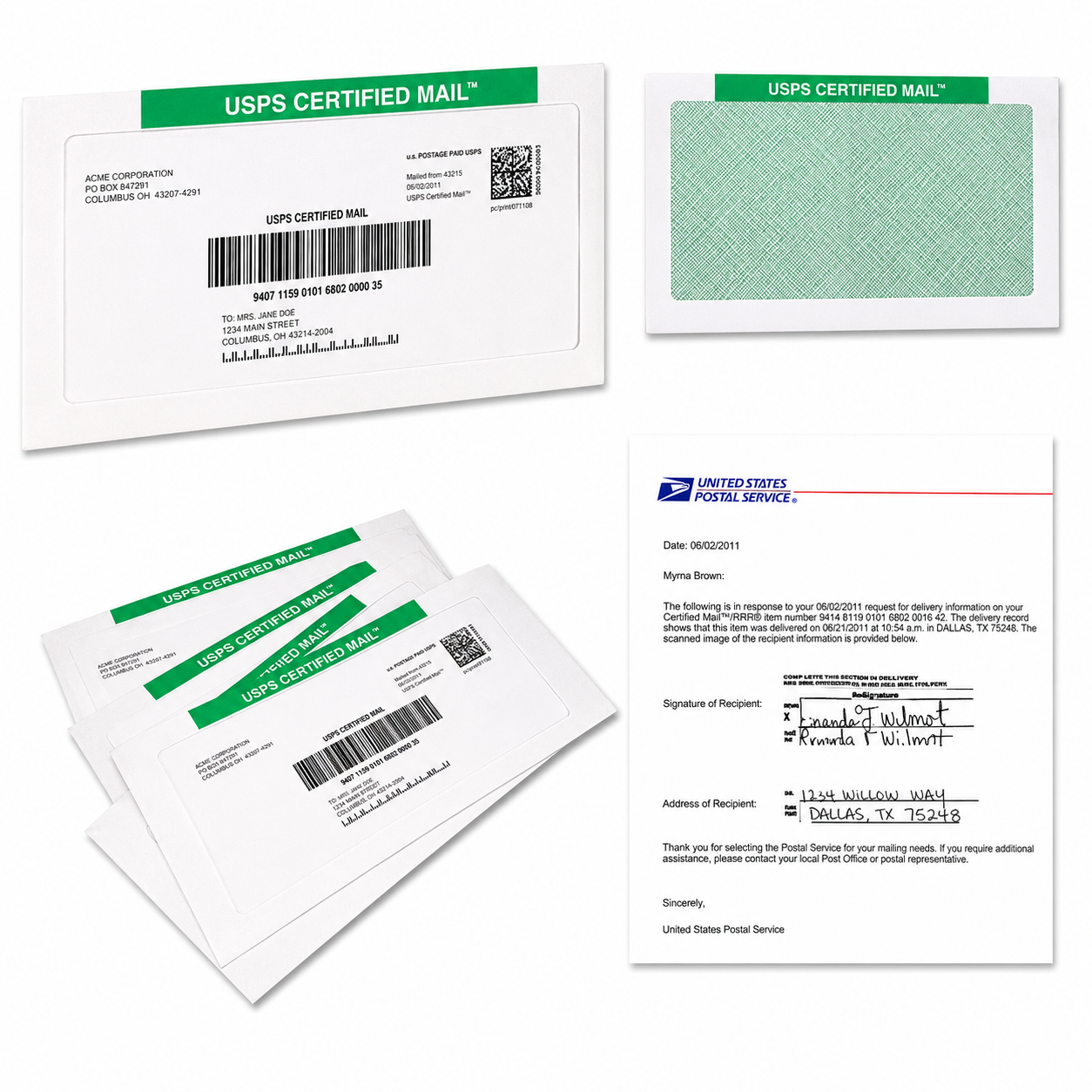
Certified Mail Labels’ Print & Mail service supports a documented workflow: upload your PDF and address list, then the mailing is printed, inserted, postage-applied, and mailed the same business day for orders received before 5:00 PM Eastern. Each mailing includes USPS proof of acceptance and a notarized affidavit of mailing.
That combination helps you preserve a clear record of what was mailed, where it was addressed, and when USPS accepted it. Your counsel can determine whether the resulting record satisfies the requirements of your specific matter.
How Can You Execute A Defensible Certified-Mailing Workflow?
Can You Start With A Recipient And Address Audit?
Before creating USPS Certified Mail labels online, organize the notice list by statutory category:
- Current owner of record.
- Original mortgagor.
- Subsequent mortgagors.
- Persons liable on the mortgage debt.
- Record lienholders.
- Occupants or dwelling units when required.
- VA or FHA recipients when applicable.
- Counsel, trustees, agencies, or other recipients required by the case plan.
Record the source of each address and the date it was verified. Separate 21-day recipients from 10-day lienholder recipients so the deadline is visible before mailing.
Should You Create And Print Labels In-House?
For smaller batches, you can create live-postage labels online and print them on a standard office printer or adhesive sheets. This gives your team a fast way to execute how to send certified mail without visiting the Post Office for every notice.
You’ll get:
- Live USPS postage.
- Certified Mail service selection.
- Address label generation.
- Tracking numbers.
- A repeatable mailing process.
- No monthly fees, contracts, or equipment leases.
Pricing can also be lower than counter service. The listed example rate is $7.28 for a 1-ounce Certified Mail letter with Electronic Delivery Confirmation, compared with $11.02 at the counter with a paper green card. Check current pricing and service availability before ordering.
What If You Have Dozens Or Thousands Of Notices?
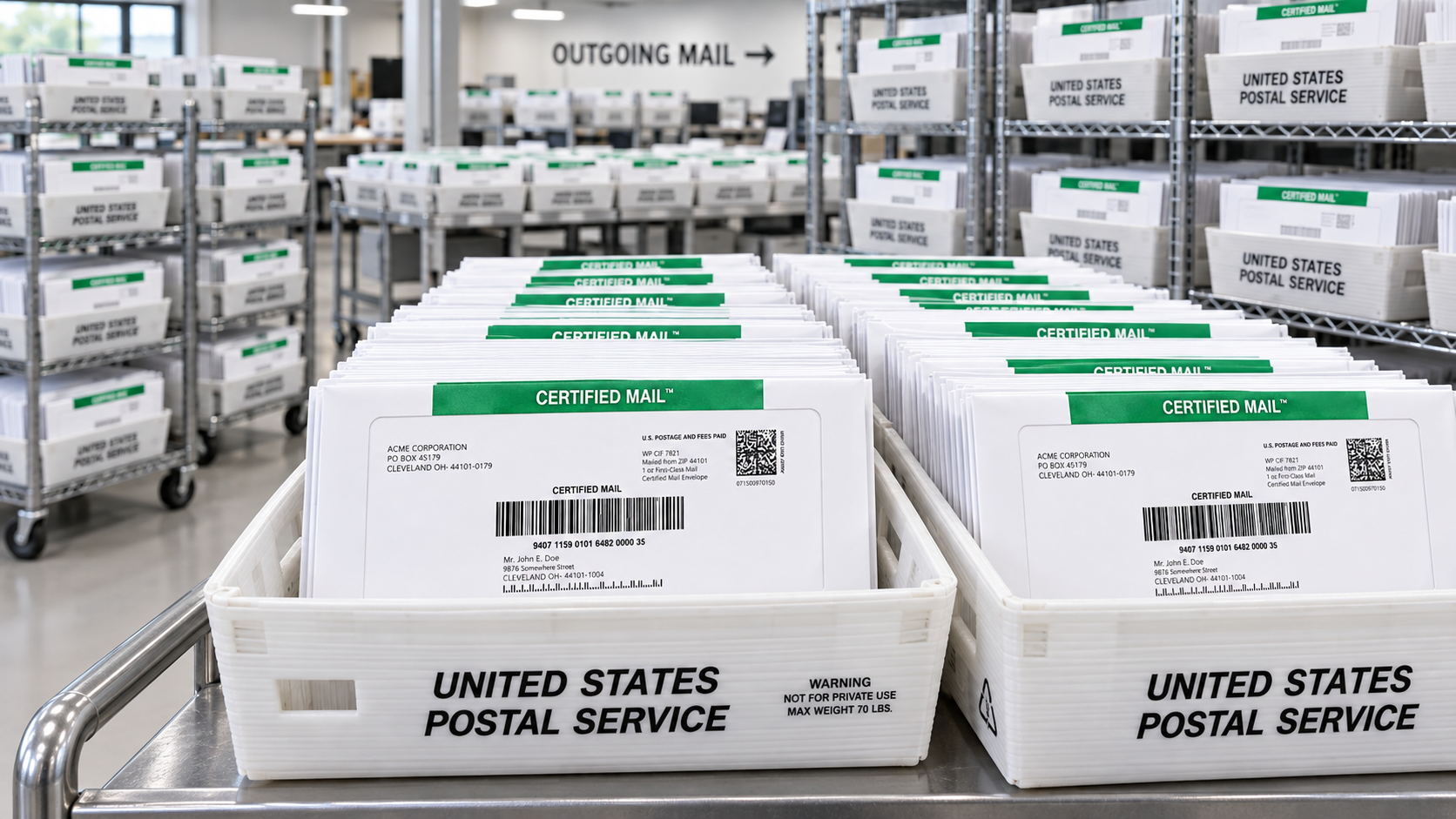
For bulk certified mail, upload an Excel or CSV address list, use an API integration, or transmit files through secure SFTP. The Excel batch mailing service also supports USPS SCAN forms for organized high-volume processing.
No manual retyping. No repeated counter visits. No sorting a large stack of labels by hand.
You’ll receive a more consistent process for foreclosure law firms, servicers, municipalities, property managers, creditor attorneys, and enterprise compliance teams.
What Do FHA And VA Servicing Rules Add?
Sections 3708 and 3758 address specific federal foreclosure notice procedures. Other federal rules may impose separate servicing or reporting obligations.
Under 24 CFR § 203.604, before three full monthly installments are unpaid, an FHA mortgagee generally must have a face-to-face interview with the mortgagor or make reasonable efforts to arrange one. A reasonable effort includes at least one letter sent by certified mail and at least one trip to the mortgaged property, unless a stated exception applies.
The broader FHA default-servicing framework also includes 24 CFR § 203.606 and 24 CFR § 203.608. These requirements should be reviewed separately from the foreclosure-sale mailing rules.
For VA-guaranteed loans, 38 CFR § 36.4280 addresses reporting defaults to the VA Secretary by certified mail at least 30 days before certain actions, such as commencing court proceedings or accelerating the loan. When the current owner is not the original veteran borrower, the holder may also need to notify the original borrower and other liable obligors by certified mail.
Federal notice rules can also involve 12 U.S.C. § 7701(a), which provides general background on service of notice by mail for federal agencies. Confirm the applicable rules for your loan type and proceeding.
How Long Should You Keep The Mailing Record?
Long-term retention matters because foreclosure, bankruptcy, title, and collection disputes can arise long after the original mailing.
Certified Mail Labels provides a searchable 10-year compliance archive for mailing records, acceptance scans, tracking events, delivery confirmations, and signature information. You’ll be able to search and retrieve the record instead of looking through paper folders, inboxes, spreadsheets, and disconnected tracking pages.
You can also use Electronic Return Receipt USPS options where appropriate. Electronic records are easier to search, share, and preserve than paper green cards. Confirm with your own counsel which return-receipt format is appropriate for your matter.
How Can You Start Your Next Notice Mailing?
Prepare the notice PDF and recipient list, identify the statutory deadline for each recipient group, and choose the workflow that matches your volume.
- For a small batch, create and print Certified Mail labels online.
- For full-service execution, upload your PDF and address list for Print & Mail.
- For high-volume work, use Excel, CSV, API, or SFTP bulk processing.
- For reporting and long-term records, use Certified Mail reports and the compliance archive.
You’ll save time, reduce manual errors, avoid unnecessary Post Office trips, and create a better record of the mailing your statute requires, without monthly fees, contracts, or equipment leases.
Frequently Asked Questions
Is Certified Mail Mandatory Under 12 U.S.C. §§ 3708 And 3758?
The statutes require notice to be sent by certified or registered mail, postage prepaid and return receipt requested for the covered federal foreclosure procedures. Confirm with counsel which statute and notice process applies to your matter.
What Is The Difference Between The 21-Day And 10-Day Deadlines?
Under § 3708, notice to the current owner, mortgagors, and persons liable on the mortgage debt must be mailed at least 21 days before the sale. Notice to record lienholders must be mailed at least 10 days before the sale. Section 3758 provides a 21-day mailing period for its listed recipients.
Does A Returned Letter Mean The Notice Was Not Given?
Under §§ 3708 and 3758, notice is deemed duly given upon mailing whether or not it is received, whether or not a return receipt is received, and whether or not the letter is returned. Preserve the USPS acceptance record and related mailing documentation.
Should You Keep The Paper Green Card?
A paper return receipt is not the only available record. Electronic Return Receipt and electronic delivery confirmation may provide searchable delivery or signature information. Confirm with counsel which record is appropriate for your proceeding, and retain the mailing proof.
Can You Send Bulk Certified Mail Without Visiting The Post Office?
Yes. You can create labels online or use Print & Mail for smaller batches. For high-volume certified mail, upload an Excel or CSV file, use an API, or send files through SFTP. USPS SCAN forms can support organized batch processing.