
Affidavit of Mailing, Notarized Affidavit, and the USPS SCAN Form
Last Updated: October 2026
What makes proof of mailing admissible? Admissibility depends on the governing rules, the facts of your matter, and how the records are authenticated. A credible proof package should connect the document mailed, the recipient and address, the mailing date, USPS acceptance evidence, tracking and delivery activity, and the witness or notary information supporting the records.
An affidavit of mailing, notarized affidavit, USPS Certified Mail receipt, USPS SCAN Form record, postmark date, barcode, tracking history, and delivery confirmation can each support your record. No single document guarantees that a court or agency will admit it. Your goal is to preserve contemporaneous, consistent records that tell the complete story.
Important: This article is general information, not legal advice. Requirements vary by jurisdiction, court, agency, claim, and notice type. Have counsel review your mailing procedure and proof package when the mailing affects legal rights, deadlines, or compliance.
Why Does The Form Of Your Proof Matter?
When a mailing becomes important, a simple statement that “we sent the letter” may not be enough. A reviewer may want to know:
- What document was mailed?
- Who was the intended recipient?
- What address was used?
- When was it mailed?
- Was it actually accepted by USPS?
- What tracking number or barcode identifies it?
- Was it delivered, refused, or returned?
- Who can explain the mailing process and records?
- Were the records created and kept in the regular course of business?
USPS DMM 503 explains extra services that provide evidence of mailing or a record of delivery. Under the Certified Mail standards, USPS provides the sender with a mailing receipt and maintains a delivery record. USPS also explains that delivery status and records may be available through its tracking and delivery-information systems.
The USPS DMM 503 rules and USPS Quick Service Guide 503 are the primary references for understanding Certified Mail, return receipts, certificates of mailing, tracking, and related extra services.
What Is An Affidavit Of Mailing?
An affidavit of mailing is a sworn statement describing when and how a document was mailed. Depending on the situation, the person signing may state that they:
- Personally prepared and mailed the document;
- Observed the document being mailed;
- Followed a regular office mailing procedure;
- Have knowledge of the company’s mailing records and process; or
- Reviewed contemporaneous records showing that the mailing was processed.
A useful affidavit should identify the mailing with enough detail to connect the statement to the underlying evidence. This can include:
- The sender’s name or organization;
- The recipient’s name and complete address;
- The document or notice mailed;
- The mailing date;
- The Certified Mail barcode or tracking number;
- The USPS acceptance or postmark information;
- The office procedure used; and
- The records reviewed by the affiant.
A bare affidavit that simply says “the letter was mailed” may leave important questions unanswered. Your affidavit should explain the facts and the process, not merely attach documents without foundation.
Does Notarization Make An Affidavit Automatically Admissible?
No. Notarization adds formality, verifies the affiant’s identity, and generally confirms that the statement was sworn. But notarization alone does not establish that the affiant had personal knowledge, that the mailing actually occurred, or that the attached records were created and maintained properly.
A notarized affidavit is stronger when the affiant can explain:
- Their role in the mailing process;
- Their familiarity with the organization’s standard procedures;
- How the specific letter was prepared and addressed;
- How the USPS service was selected;
- How the barcode and tracking information were recorded;
- When the records were created;
- How the records are stored; and
- Why the records accurately reflect the mailing.
In other words, a notarized affidavit can support authentication and provide sworn testimony, but it does not cure every defect. The applicable jurisdiction may also permit a declaration, business-record certification, testimony, or another form of proof. Ask counsel what your matter requires.
How Do USPS Certified Mail Records Support Your Proof Package?
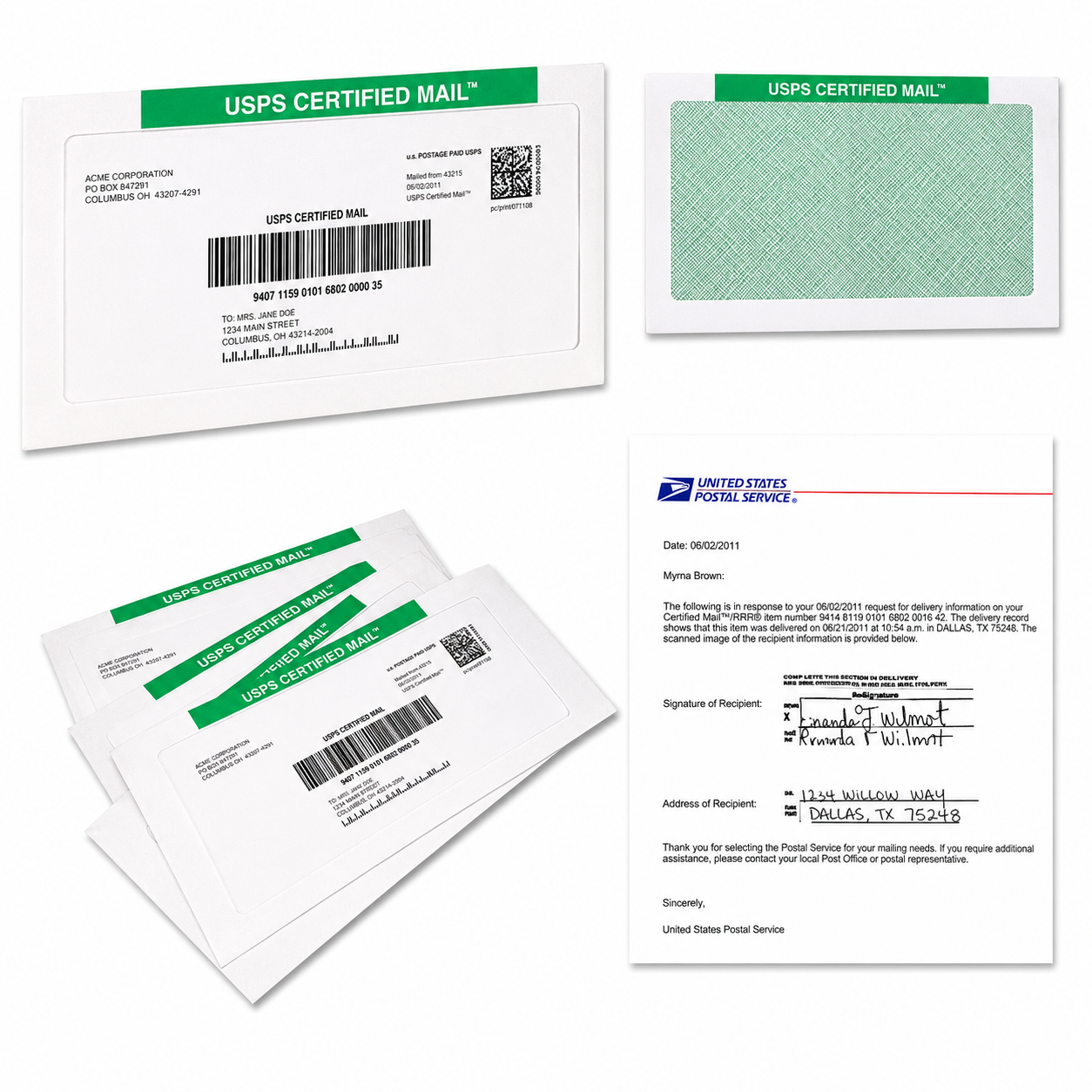
USPS Certified Mail is designed to provide a mailing receipt and delivery information. DMM 503 states that Certified Mail is available for eligible First-Class Mail and Priority Mail and that USPS maintains a delivery record. A return receipt may also provide evidence of delivery, including who received the item and the delivery date.
Your package may include:
- A Certified Mail receipt;
- The postmarked or round-dated receipt, when applicable;
- The USPS barcode or tracking number;
- A copy of the addressed envelope or label;
- USPS acceptance or entry-scan evidence;
- USPS tracking events;
- Delivery or attempted-delivery information;
- An electronic return receipt or signature record, if purchased;
- A copy of the letter or notice mailed; and
- An affidavit explaining the process.
The postmark date can help establish when USPS accepted the item. The barcode links the physical mailpiece to USPS tracking and delivery activity. The tracking record can show acceptance, processing, delivery, attempted delivery, or return events.
Do not confuse a postmark or acceptance scan with proof that the recipient read the document. These records generally address mailing and postal handling. Delivery and receipt questions may involve additional rules and facts.
What Is A USPS SCAN Form?
A USPS SCAN Form is commonly used in batch mailing workflows to consolidate multiple mailpieces under a single acceptance or shipment record. It may help connect a group of barcoded pieces to a mailing event and acceptance date.
However, the exact USPS SCAN Form mechanics and scan treatment were not fully verified in an accessible, current USPS page for this article. For that reason, describe the form cautiously. Do not assume that every SCAN Form proves every fact about every individual mailpiece.
Before relying on a SCAN Form, confirm:
- What information the form contains;
- Whether each individual barcode is linked to the form;
- What scan event the form represents;
- Whether the mailing received a physical acceptance scan;
- How USPS makes the underlying data available; and
- Whether your court, agency, contract, or statute recognizes the record for your specific purpose.
A SCAN Form can be useful as part of a larger package, especially for high-volume mailings. It should generally be matched with the individual barcode, mailing record, address, document record, and tracking history.
What Records Does Certified Mail Labels Provide?
Certified Mail Labels is designed to help you organize the records created during a Certified Mail workflow. Depending on your service and mailing selections, your account records may include:
- A notarized affidavit of mailing;
- USPS acceptance proof;
- USPS SCAN Form records for applicable batch mailings;
- Postmark or mailing-date information;
- The Certified Mail barcode;
- USPS tracking and delivery records;
- Electronic Delivery Confirmation;
- Electronic Return Receipt records;
- Recipient signature information when available; and
- A searchable digital archive retained for 10 years.
The goal is not to promise a legal result. The goal is to make your records easier to locate, connect, and present for review.
You can create and print Certified Mail labels online, or use a full-service workflow when you want documents printed, inserted, labeled, and presented to USPS. For organizations sending larger volumes, bulk mailing and API/SFTP automation can help standardize the process.
What Should Your Proof Package Include?
Here is a practical checklist to use before you need the records:
| Evidence Item | What It Helps Show | Review Point |
|---|---|---|
| Copy of the letter or notice | What was mailed | Confirm the version and date |
| Recipient address record | Where it was sent | Check formatting and accuracy |
| Certified Mail label | Service and barcode identity | Match the barcode to all records |
| Postmarked receipt | Mailing or acceptance date | Preserve the original or electronic copy |
| USPS acceptance evidence | USPS custody or entry event | Confirm the type of scan or receipt |
| SCAN Form record | Batch acceptance or consolidation | Verify how individual items are linked |
| USPS tracking history | Postal movement and delivery events | Save the complete record |
| Return receipt or signature record | Delivery details and signature, when available | Confirm the service purchased |
| Affidavit of mailing | Sworn explanation of the mailing | Identify knowledge and procedure |
| Internal mailing log | Business-process context | Preserve creation date and source |
| Archive record | Long-term retrieval | Keep records organized and searchable |
The strongest package is usually consistent from beginning to end. The address on the label should match the address in the mailing log. The barcode should match the USPS tracking history. The date in the affidavit should be consistent with the postmark or acceptance information.

How Can You Reduce Gaps In Your Mailing Records?
Use a repeatable process for every important mailing:
- Save the final document before mailing.
- Confirm the recipient’s complete address.
- Record the mailing date and internal reference number.
- Preserve the barcode and tracking number.
- Obtain USPS acceptance evidence when available.
- Save tracking and delivery activity.
- Retain return receipt or signature records.
- Document who prepared, reviewed, and mailed the item.
- Use the same procedure for similar mailings.
- Keep the records in a searchable archive.
If your team mails from multiple offices or handles thousands of notices, consistency matters even more. A centralized process can reduce misplaced receipts, missing spreadsheets, and uncertainty about which barcode belongs to which letter.
Is Electronic Return Receipt Useful?
An Electronic Return Receipt can provide a digital alternative to the paper green card, depending on the service selected and the mailing’s eligibility. USPS DMM 503 describes return receipt service as evidence of delivery, including the person to whom the mail was delivered and the delivery date. USPS also provides electronic options in eligible situations.
Certified Mail Labels can help you request and organize Electronic Return Receipt records, including delivery information and signature records when available.
Use electronic records as part of the complete package. Keep the tracking number, mailing information, document copy, and any affidavit together so the delivery record can be understood in context.

Frequently Asked Questions About Proof Of Mailing
Is A Notarized Affidavit Better Than A Regular Affidavit Of Mailing?
A notarized affidavit provides a formal sworn statement, but notarization does not automatically establish admissibility. The affiant should still have personal knowledge or explain their familiarity with the mailing procedure and records.
Does Certified Mail Prove That The Recipient Read The Letter?
No. Certified Mail records can help show mailing, USPS acceptance, delivery, attempted delivery, or a signature when the applicable service provides one. They do not necessarily prove that the recipient read or understood the contents.
Does A USPS SCAN Form Prove Every Piece In A Batch Was Mailed?
Not necessarily. Confirm how the SCAN Form links to individual barcodes and what event the scan represents. Preserve individual mailing, barcode, acceptance, and tracking records as well.
Is A Postmark The Same As A USPS Acceptance Record?
A postmark can show a date associated with USPS handling or acceptance, depending on the mailing method and record. Review the specific receipt and scan information rather than assuming every date proves the same fact.
How Long Should I Keep Proof Of Mailing?
Keep records for the period required by your statute, contract, retention policy, claim, or counsel. Certified Mail Labels provides a searchable 10-year compliance archive for applicable records, but your legal or regulatory retention obligation may be different.
Should An Attorney Review My Proof Package?
Yes, especially for court filings, statutory notices, foreclosure or collection activity, government compliance, employment actions, healthcare matters, and deadline-sensitive communications. Counsel can review the governing rule, required service method, affidavit language, and authentication requirements.
Build Your Proof Package Before You Need It
Proof of mailing is most useful when your records are complete, contemporaneous, connected, and easy to explain. Combine the document copy, address, postmark date, barcode, USPS acceptance evidence, tracking and delivery records, SCAN Form information when applicable, and a properly supported affidavit or notarized affidavit.
If you are ready to simplify the process, learn about Certified Mail Labels’ Print & Mail service. You can send your PDF and address list, have the mailing prepared for USPS, and receive organized records without a trip to the Post Office.
Start building a cleaner, more reliable proof package today, and have counsel review the process when admissibility matters.