
Certified Mail Requirements and Proof of Notice
Last reviewed: October 2026
This page is reviewed every January and again after any state legislative session or commission rulemaking that amends a utility termination notice rule.
Most states do not require certified mail for a residential utility shutoff notice. They require written notice by first-class mail or personal service with a fixed cure window before disconnection. A few make certified mail part of the record: Illinois requires a utility to give certified-mail prior notice of winter termination to the property owner or mortgagee on request, and New York requires a Final Termination Notice under N.Y. Pub. Serv. Law § 32 and 16 NYCRR § 11.4 at least 15 days before disconnection. The verified states below show the pattern, and cure windows range from about 5 to 15 days.
Important: This is a general informational guide, not legal advice. Utility termination rules change frequently. Municipal utilities, utility regulatory teams, property managers, and law firms should confirm current requirements with qualified regulatory counsel and the applicable state public utility commission.
Do Utility Shutoff Notices Have to Go by Certified Mail?
Usually, no.
Across the verified states in this guide, residential utility termination rules generally focus on:
- Written notice
- The number of days before disconnection
- The amount due and how the customer can avoid termination
- Required warnings, calls, postings, or personal service
- Special protections for occupants, medical conditions, disputes, and winter periods
- Records showing that the notice was sent or served correctly
Certified mail is a stronger documentation option, but it is not automatically required for every customer notice. The clearest certified-mail carve-out in the verified authorities is Illinois, where a utility must send prior notice by certified mail to an owner of record or mortgagee who requests it before certain winter terminations.
Which States Use Ordinary Written Notice With a Fixed Cure Window?
The verified examples below fall into two practical groups:
Written notice by ordinary mail, personal service, posting, or another approved method with a fixed cure window:
- California
- Wisconsin
- Illinois
- New York
Certified Mail carve-out:
- Illinois winter terminations, when the owner of record or mortgagee requests certified-mail notice
This list is not exhaustive. Most states set utility termination procedures through public utility commission regulations rather than a single statute. Always check your state utility commission’s current rules before creating a legal compliance mailing process.
What Are the Verified Notice Requirements by State?
| State | Minimum verified notice period | Notice method and certified-mail rule |
|---|---|---|
| New York | At least 15 days after the final notice is served or mailed | Final Termination Notice by mail or personal service under N.Y. Pub. Serv. Law § 32 and 16 NYCRR § 11.4; certified mail is not required by the cited rules |
| Illinois | 8 days by U.S. mail or 5 days by another method; separate rule requires at least 10 days after a disconnection notice | Certified mail required for requested notice to owner of record or mortgagee 24–48 hours before certain winter terminations |
| California | 10 days for specified master-metered or owner-paid occupant notice | Written and posted notice requirements; no certified-mail requirement in the cited provisions |
| Wisconsin | Written disconnection notice at least 8 calendar days before proposed disconnection | Commission-approved written notice; no blanket certified-mail requirement identified in the cited rule |
| North Carolina | Confirm current commission rule | Customer termination requirements are set through commission rules; no specific customer shutoff statute is cited here |
What Does New York Require for a Final Termination Notice?
New York’s statute is N.Y. Pub. Serv. Law art. 2 (HEFPA), §§ 30–53. The regulations are a separate layer: 16 NYCRR Part 11. For residential nonpayment terminations, the core citations here are N.Y. Pub. Serv. Law § 32 and 16 NYCRR § 11.4.
Under those authorities, a utility may disconnect residential service for nonpayment only after issuing a Final Termination Notice at least 15 days before disconnection.
The notice must:
- State the earliest date service may be disconnected
- Explain the reason for termination
- State the total amount due
- Explain how the customer can avoid disconnection
- Provide complaint procedures
- Prominently display: “THIS IS A FINAL TERMINATION NOTICE. PLEASE REFER TO THIS NOTICE WHEN PAYING THIS BILL.”
No final notice may be issued until at least 20 days after payment was due. Disconnection cannot occur until at least 15 days after the notice is personally served or mailed.
For delivery method, 16 NYCRR § 11.4(a)(3)(i)(b) requires the final notice to be mailed to the residential customer at the premises where service is rendered. There is no Certified Mail requirement in 16 NYCRR Part 11 for the customer’s termination notice. If a utility uses Certified Mail, it should be framed as a stronger proof-of-mailing practice, not a legal mandate.
If other New York nonpayment procedures are relevant, cite them separately, including 16 NYCRR § 11.5 for special procedures and 16 NYCRR § 11.12 for deposits. Utilities must also post notices in multi-unit buildings and mail separate notices to residents. For operational proof, utilities should preserve the final notice, the address used, the mailing date, any posting record, and related service documentation.
What Does Illinois Require Before a Utility Termination?
Illinois has both a statute and a detailed Illinois Commerce Commission rule.
Under 220 ILCS 5/8-202, before terminating gas or electric service during November through March, the utility must provide written notice at least:
- 8 days before termination when sent by U.S. mail
- 5 days before termination when delivered by another method
The utility must also notify the local public health department, township supervisor, or county sheriff.
The important certified-mail requirement applies to a specific recipient group. If the owner of record or mortgagee requests it, the utility must send prior notice of termination by certified mail to that owner or mortgagee 24 to 48 hours before termination.
The Illinois Commerce Commission rule, 83 Ill. Adm. Code 280.130, adds operational requirements:
- A disconnection notice must be sent separately from other mail
- Disconnection cannot occur until at least 10 days after the notice
- The notice is valid for 45 days
- Residential customers must receive a warning call at least 48 hours before disconnection
For Illinois utilities, this is the clearest reason to maintain a reliable Certified Mail online workflow for owner and mortgagee notices while separately managing customer notices, warning calls, and winter documentation.
What Does California Require Before Residential Service Termination?
Under Cal. Pub. Util. Code § 10010, before terminating residential service for nonpayment, the utility must give notice of delinquency and impending termination.
Termination is prohibited:
- While a dispute or investigation is pending
- While an approved extension to pay is in effect
- When a physician certifies that disconnection would be life-threatening and the customer is financially unable to pay
For master-metered or owner-paid accounts, Cal. Pub. Util. Code § 10009 requires the utility to inform residential occupants in writing when the account is in arrears. The written notice must explain that service will be terminated in 10 days and that occupants have the right to become customers without paying the delinquent amount.
These cited California provisions require written or posted notice, but they do not require certified mail as a blanket method for residential shutoff notices. Utilities and property managers should retain copies of occupant notices, posting records, mailing records, and account documentation showing the timing of the notice.
What Does Wisconsin Require Before Gas Disconnection?
Under Wis. Admin. Code PSC 134.062, a residential customer must be given at least 20 days from the bill issue or postmark date to pay before delinquency and notice of intent to disconnect.
The utility must then send written disconnection notice at least 8 calendar days before the proposed disconnection. If disconnection does not occur within 15 days after that notice, a second notice must be left 24 to 48 hours before disconnection.
The notices must use a commission-approved form and state:
- The reason for disconnection
- Payment options
- Available deferred payment arrangements
The cited Wisconsin rule does not establish a blanket certified-mail requirement. A utility’s proof-of-notice process should focus on the approved form, notice date, address, delivery or posting method, and any second notice left before disconnection.
What Should North Carolina Utilities Check?
Do not rely on a general statement that North Carolina requires or does not require certified mail for customer shutoff notices.
The verified point here is that North Carolina General Statutes chapter 62 defines “certified mail” as mail with return receipt requested, a term used in Commission process. Customer termination rules live in Commission rules, and this guide does not cite a specific North Carolina statute for customer shutoff notices.
North Carolina is a useful reminder that customer termination requirements are often found in public utility commission regulations. Utilities should review the current North Carolina Utilities Commission rules, applicable tariff provisions, and regulatory guidance before setting notice procedures.
How Much Notice Is Required Before a Disconnection?
The answer depends on the state, service type, notice method, and customer circumstances.
The verified examples show:
- New York: at least 15 days after service or mailing of the Final Termination Notice under N.Y. Pub. Serv. Law § 32 and 16 NYCRR § 11.4
- Illinois: 8 days by U.S. mail or 5 days by another method under 220 ILCS 5/8-202; 83 Ill. Adm. Code 280.130 separately requires at least 10 days after a disconnection notice
- California: 10 days for the specified master-metered or owner-paid occupant notice under Cal. Pub. Util. Code § 10009
- Wisconsin: at least 8 calendar days after written disconnection notice, following the initial payment period
- North Carolina: confirm the current commission rule before relying on a specific period
Do not calculate a shutoff deadline from the mailing date alone without checking the applicable rule. Some requirements run from service, mailing, postmark, delivery, posting, or another event.
What Rules Apply During Winter Moratoriums?
Winter protections can add recipients, shorter final-notice steps, warning calls, or limits on when service can be terminated.
Illinois is the verified example in this guide with an express winter-related certified-mail requirement. During November through March, 220 ILCS 5/8-202 requires written notice before termination and additional notice to public officials. When requested by the owner of record or mortgagee, prior notice must be sent by certified mail 24 to 48 hours before termination.
For regulated notice programs, keep winter termination records separate from ordinary billing records. Document:
- The customer and service address
- The owner or mortgagee recipient
- The notice version
- The date and method of mailing
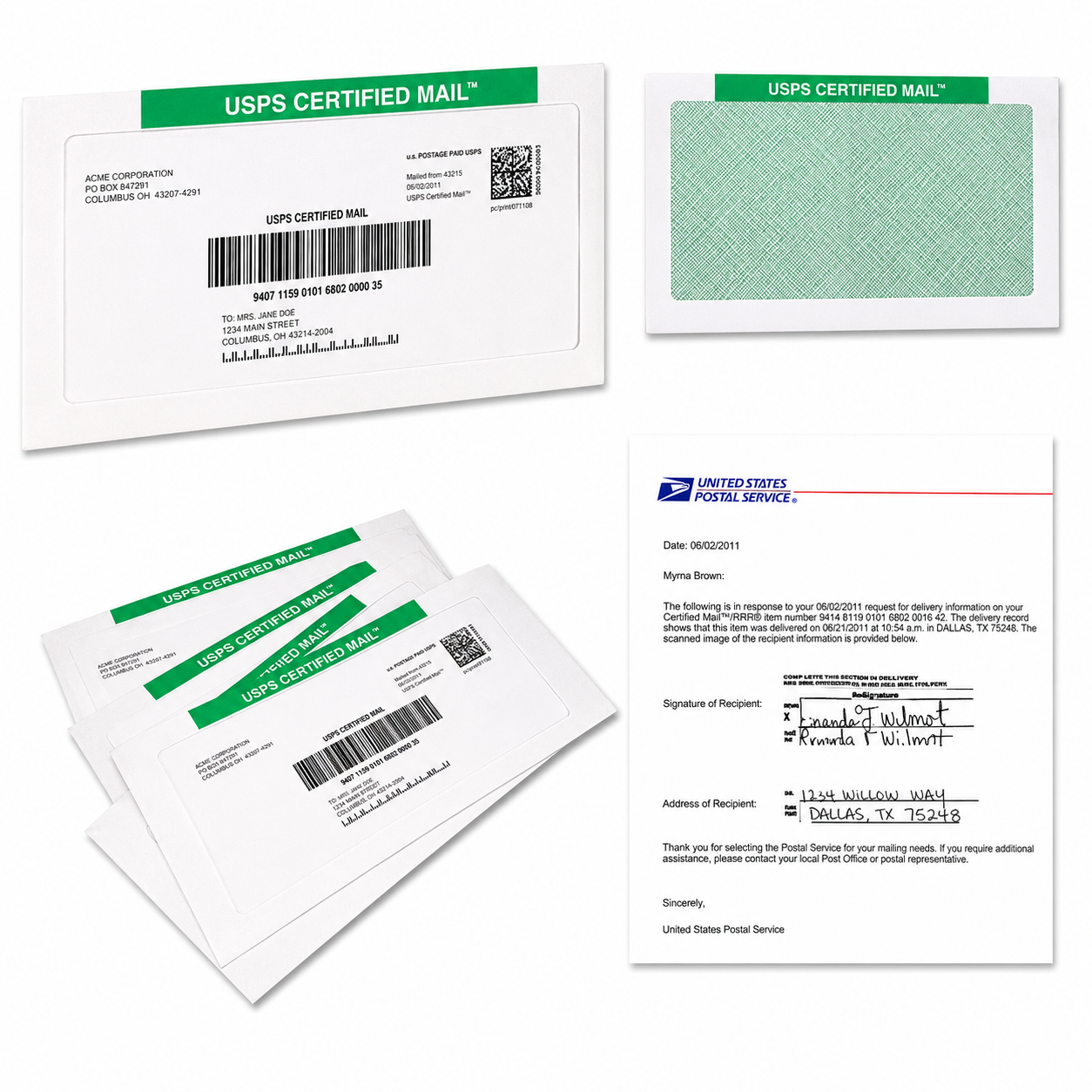
- USPS tracking and acceptance information, when certified mail is used
- Warning calls, postings, and follow-up notices
- The planned termination date
How Do Utilities Prove Notice Was Sent?
In the verified authorities, proof of notice generally means showing that the utility followed the required method and timing. A return receipt may strengthen the file, but the rule may not require proof that the recipient personally signed for or read the notice.
A defensible notice file can include:
- A PDF copy of the exact notice mailed
- The recipient name and full address
- Mailing date and internal reference number
- USPS Certified Mail tracking number, when used
- USPS acceptance and delivery activity
- A copy of the SCAN Form for a batch mailing
- Posting, personal-service, or door-notice documentation
- Warning-call records
- Payment, dispute, extension, or medical-certification records
- Delivery confirmation or electronic return receipt
Certified Mail Labels provides a 10-year searchable compliance archive for mailing records, tracking activity, delivery confirmation, and related proof documents.

How Can Utilities Send Certified Mail Efficiently?
If a rule, tariff, internal policy, or counsel requires certified mail, you do not need to make repeated trips to the Post Office.
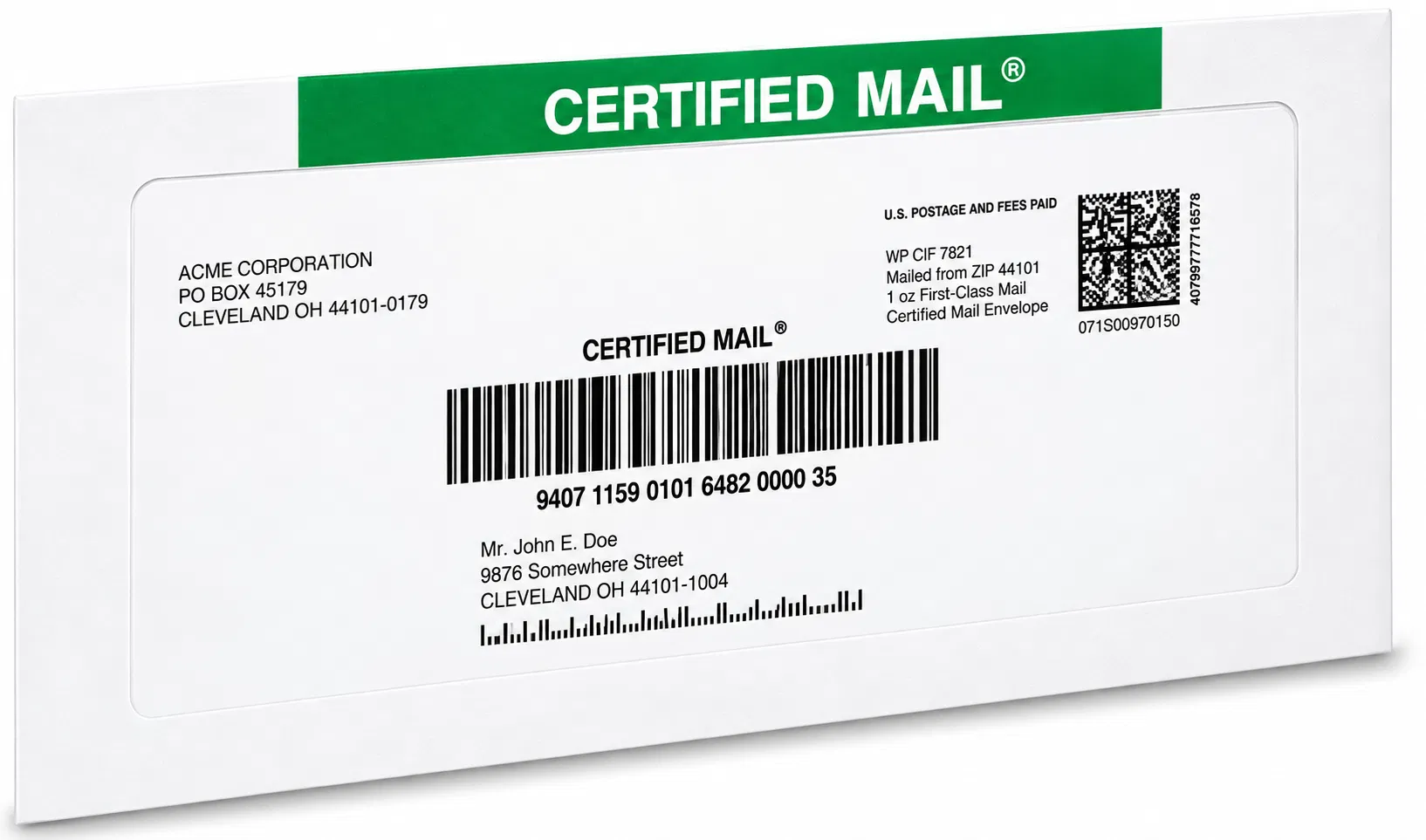
With Certified Mail Labels online, your team can create and print USPS Certified Mail labels from the office or home using a standard printer. You’ll receive tracking information and can maintain a consistent mailing record for owners, mortgagees, occupants, and other required recipients.
For outsourced mailings, use the Print & Mail workflow to upload a PDF letter and address list. Letters are printed, inserted, postage applied, and mailed the same business day, with a notarized affidavit of mailing. This can help utilities meet regulated notice deadlines without assigning every mailing step to internal staff.
For recurring shutoff or delinquency campaigns, API and SFTP automation supports Excel or CSV uploads, API integration, secure SFTP transfers, USPS SCAN Forms, and high-volume processing.
Electronic delivery records can also simplify retrieval. The electronic return receipt option is listed at $2.91, compared with $4.65 for a paper green card, saving $1.74 per piece and providing a PDF delivery record. Pricing context for a 1-ounce Certified Mail letter with Electronic Delivery Confirmation is $7.28 online versus $11.02 at the Post Office counter with a green card. Review current rates before mailing.
FAQ: Utility Termination Notices and Certified Mail
Does a utility have to send a shutoff notice by certified mail?
Usually, no. Most verified rules require written notice by ordinary mail, personal service, posting, or another approved method. Illinois requires certified-mail prior notice to an owner of record or mortgagee who requests it before certain winter terminations.
How many days’ notice must a utility provide before disconnection?
The verified examples range from about 5 to 15 days for the final notice, depending on the state and delivery method. New York requires at least 15 days after the Final Termination Notice. Illinois allows 8 days by U.S. mail or 5 days by another method under 220 ILCS 5/8-202, while 83 Ill. Adm. Code 280.130 requires at least 10 days after a disconnection notice.
What is a Final Termination Notice under New York HEFPA?
It is the final written notice issued before residential service termination for nonpayment under N.Y. Pub. Serv. Law art. 2 (HEFPA), §§ 30–53, specifically N.Y. Pub. Serv. Law § 32, with the separate implementing rule in 16 NYCRR § 11.4 under 16 NYCRR Part 11. It must state the earliest termination date, reason, amount due, ways to avoid termination, complaint procedures, and the required prominent warning language.
When can a utility not disconnect service in California?
Under Cal. Pub. Util. Code § 10010, termination is prohibited while a dispute or investigation is pending, while an approved payment extension is in effect, or when a physician certifies that disconnection would be life-threatening and the customer cannot financially pay.
Who else must be notified before a winter termination in Illinois?
Under 220 ILCS 5/8-202, the utility must notify the local public health department, township supervisor, or county sheriff. If the owner of record or mortgagee requests it, the utility must also send prior notice by certified mail 24 to 48 hours before termination.
Can utilities send certified mail from home or the office?
Yes. You can create USPS Certified Mail labels online, print them on a standard office printer, and maintain certified mail tracking and compliance records without a Post Office trip.
How Do You Start a Legal Compliance Mailing Process?
Start by confirming the current rule, identifying every required recipient, calculating the correct deadline, and preserving the exact notice and mailing record.
Then print Certified Mail Labels online for owners, mortgagees, occupants, or other recipients when certified mail is required or your compliance team wants stronger mailing documentation.
You’ll save time, avoid unnecessary counter visits, and keep a searchable record of every regulated mailing.