
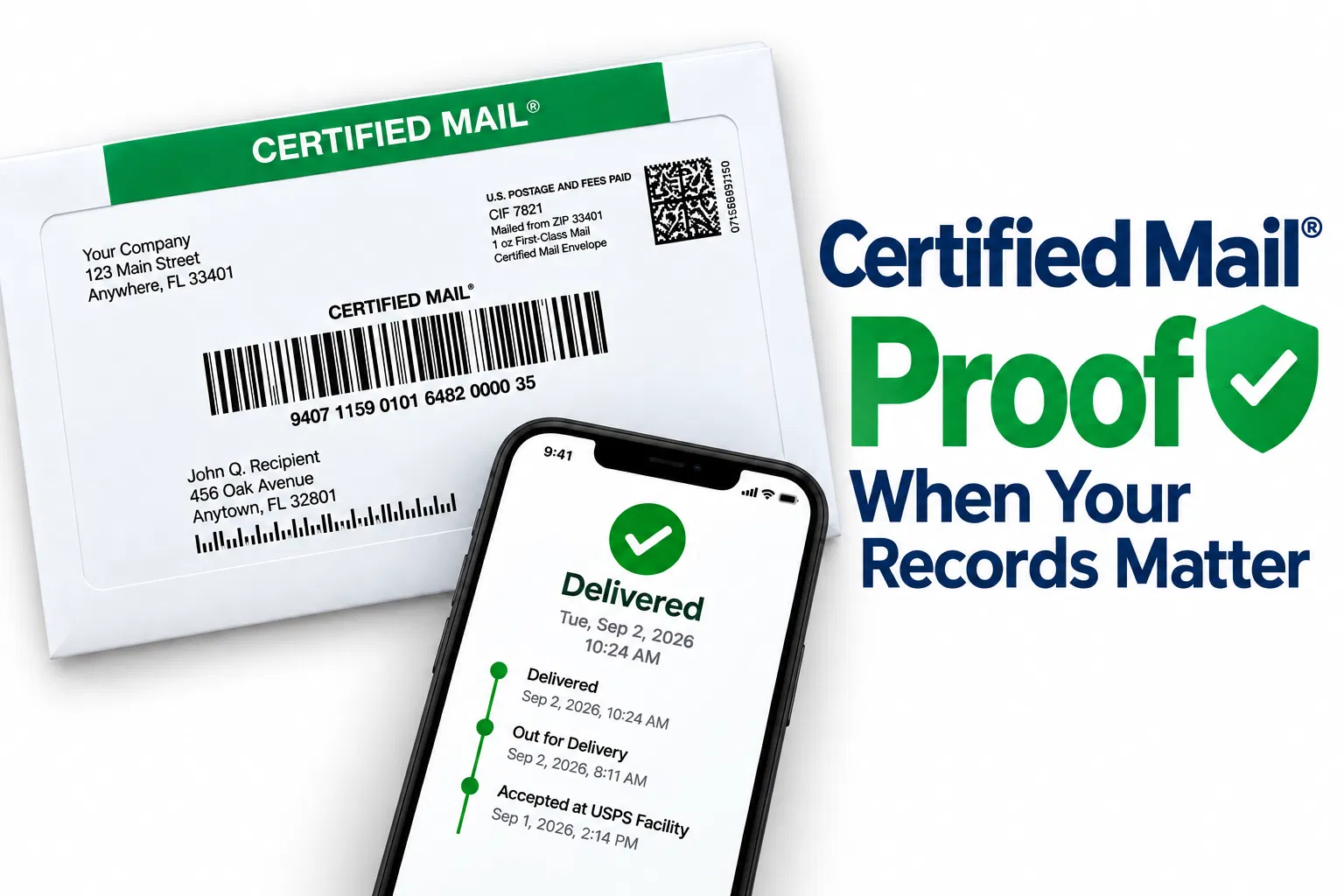
The new FSA rule does not abolish Certified Mail. The critical 90-day statutory threshold remains in place.
Beginning October 1, 2026, the Farm Service Agency will generally require Certified Mail for covered loan servicing notifications when the borrower has a payment 90 days or more past due. For borrowers who are less than 90 days past due, FSA will have flexibility to use other delivery methods that provide confirmation of receipt.
The practical compliance rule is simple:
Match the mailing method to the borrower’s delinquency status, then prove that you selected and completed the correct method.
That is the core change. It is a delivery-method update, not the elimination of proof, tracking, confirmation, or recordkeeping.
What Is The New FSA Certified Mail Rule?
The primary source is the FSA final rule, “Driving Efficiency in Farm Loan Delivery,” 91 FR 56741, published September 4, 2026.
- Docket No.: FSA-2026-0463
- RIN: 0560-AI89
- Effective date: October 1, 2026
- Amended regulation: 7 CFR 766.101
- Statutory authority: Section 331D of the Consolidated Farm and Rural Development Act, 7 U.S.C. 1981d
You can read the Federal Register rule directly.
Under 7 U.S.C. 1981d, FSA must provide loan servicing notifications by Certified Mail to borrowers who are at least 90 days past due on their installments.
Before this rule, 7 CFR 766.101 required Certified Mail for primary loan servicing notices sent to all delinquent borrowers, including borrowers who were less than 90 days past due.
The final rule revises the regulation so the Certified Mail requirement aligns with the statute.
Does The Rule Eliminate Certified Mail For FSA Notices?
No.
The rule does not eliminate Certified Mail for FSA loan servicing notices. For borrowers who are 90 days or more past due, Certified Mail remains the required method for the statutory notifications covered by 7 U.S.C. 1981d and 7 CFR 766.101.
At 90 days or more past due:
- You still need to use USPS Certified Mail.
- You should not substitute ordinary mail or another delivery method for the required Certified Mail mailing.
- You need reliable evidence showing what was mailed, when it was accepted, how it was tracked, and what happened at delivery.
- You should treat the 90-day status as a control point in your mailing workflow.
The high-stakes risk is on both sides of the threshold. Sending Certified Mail when it is not required may cost more and take additional processing time. Failing to use Certified Mail when the borrower is 90 days or more past due creates a much more serious statutory compliance concern.
What Changed In 7 CFR 766.101?
The amendment changes the regulation’s reference to delinquent borrowers and ties the Certified Mail requirement to borrowers with a payment at least 90 days past due.
FSA explains in 91 FR 56741 that Certified Mail is more costly and may require additional processing time compared with other delivery methods that also provide confirmation of receipt. The agency stated that limiting Certified Mail to situations where it is specifically required by statute will improve efficiency and reduce costs.
For borrowers who are less than 90 days past due, FSA will continue providing timely loan servicing notifications through delivery methods other than Certified Mail that also provide confirmation of receipt.
The final rule also makes clear that:
- No other loan servicing notification requirements are being changed.
- Appeal timelines and loan servicing provisions for delinquent borrowers remain unchanged.
- The borrower’s 60-day response window from the notice remains unchanged.
- Updates to FSA-2510 and FSA-2510-IA in Appendices A and B to Subpart C of 7 CFR Part 766 are clerical and administrative.
- The rule does not change the underlying borrower protections or servicing options.
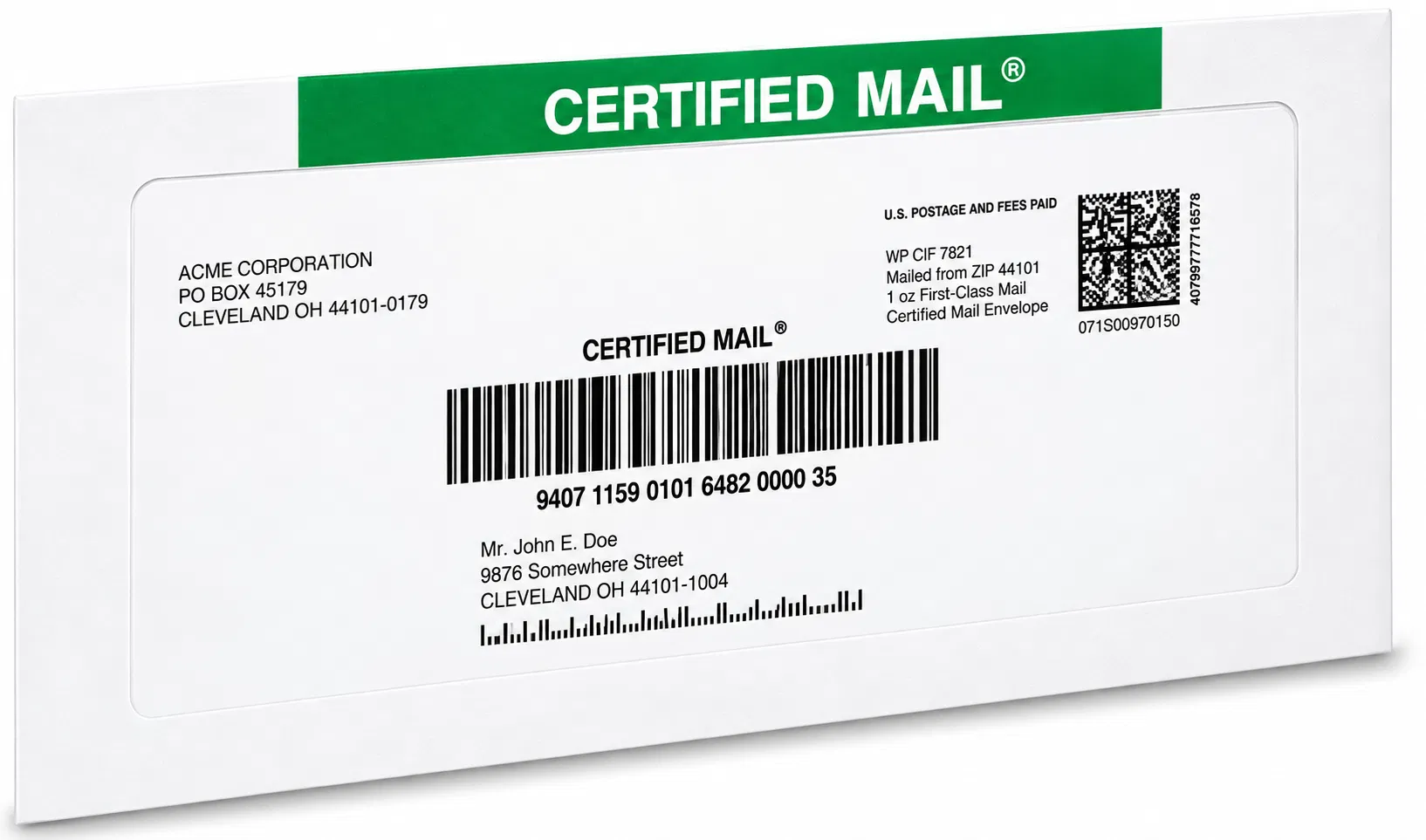
How Should You Choose The Correct Mailing Method?
The new compliance workflow should be status-based. Before you create a mailing, confirm the borrower’s delinquency status and record the decision.
Borrower Is Less Than 90 Days Past Due
For a borrower who is less than 90 days past due:
- Certified Mail is no longer required by the amended rule solely because the borrower is delinquent.
- You may have flexibility to use another delivery method that provides confirmation of receipt.
- You still need to send the required notice timely.
- You still need evidence showing the delivery method, mailing date, recipient, and confirmation of receipt.
- You should retain the records in a way that supports an audit or later review.
The rule does not mean that documentation is optional below 90 days. It changes the delivery method that may be used.
Borrower Is 90 Days Or More Past Due
For a borrower who is 90 days or more past due:
- Certified Mail remains mandatory for the covered loan servicing notification.
- Use USPS Certified Mail and maintain the associated tracking and acceptance records.
- Consider adding an electronic return receipt when a signature and delivery record are important to your file.
- Preserve the mailing evidence, including the notice, date, barcode, acceptance information, delivery status, and available signature record.
- Make the 90-day status and mailing decision easy to verify later.
The operating rule for your mailroom or compliance team is:
Confirm borrower status. Select the required method. Execute the mailing. Preserve evidence.
That is how you reduce the new audit risk created by the 90-day line.
How Can Electronic Return Receipt Support 90-Day FSA Mailings?
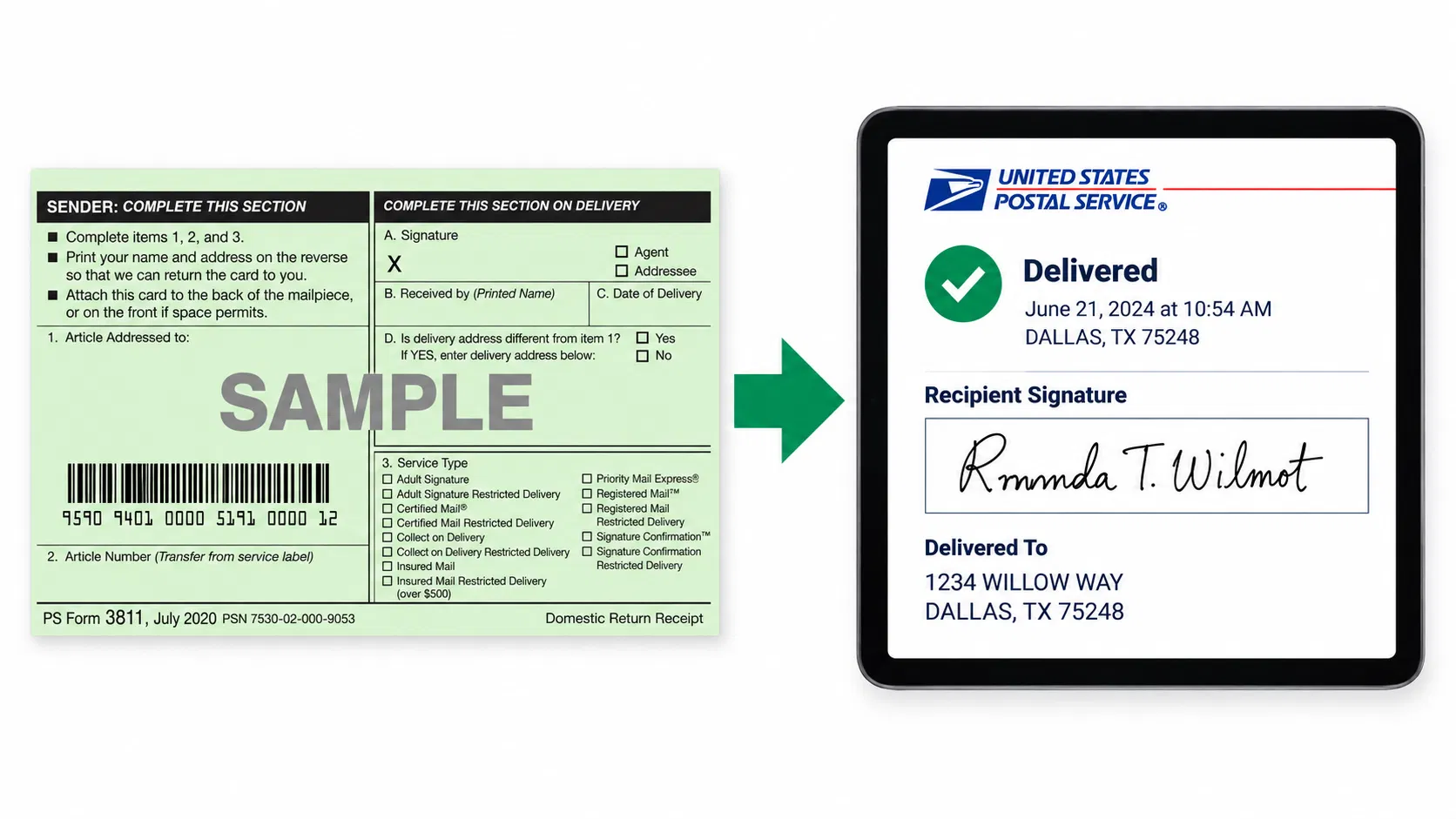
Certified Mail Labels provides an Electronic Return Receipt, the electronic version of the USPS paper green card, also known as PS Form 3811.
For a Certified Mail piece, the Electronic Return Receipt provides a PDF record of delivery and the available recipient signature electronically. Instead of waiting for a physical card to be mailed back, the record is posted directly into your Certified Mail Labels account.
The cost is:
- Electronic Return Receipt: $2.91 per piece
- Paper green card: $4.65 per piece
- Savings: $1.74 per piece
That is roughly a third less than the paper Return Receipt option at the counter.
For the highest-stakes mailings at the 90-day line, this gives you a faster, cleaner way to maintain a delivery and signature record with the Certified Mail documentation. Learn how Electronic Return Receipt works.
The final rule focuses on the required Certified Mail method. It does not state that a paper green card must be used in every case. Your team should follow applicable FSA procedures and internal controls when deciding whether to add Electronic Return Receipt or another confirmation service.
How Does The 10-Year Compliance Archive Help During An Audit?
The second unique compliance service is Certified Mail Labels’ 10-Year Compliance Archive, provided at no extra charge.
The searchable digital repository can retain:
- Proof of mailing
- Notarized affidavit of mailing
- USPS acceptance records
- USPS SCAN Form records
- Postmark date
- Intelligent Mail Postal Barcode
- Certified Mail tracking events
- Delivery or attempted-delivery information
- Electronic delivery confirmation
- Available Return Receipt signature records
This turns “we mailed it” into organized, audit-ready evidence.
When an FSA compliance reviewer, auditor, or court asks, “Show me the record,” you can search for the mailing and retrieve the supporting documentation instead of searching through paper files, email attachments, or disconnected tracking screens.
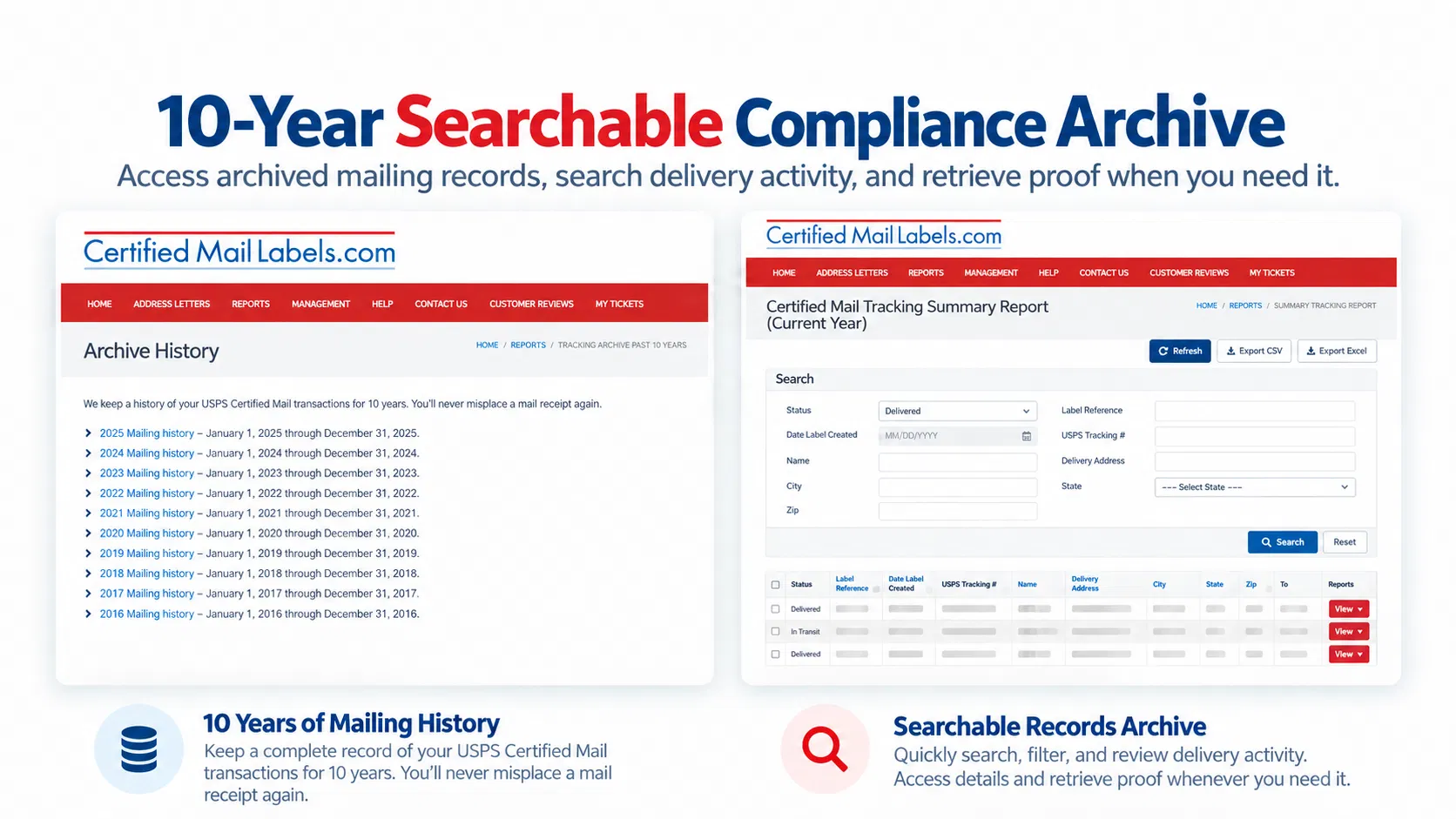
You can also review Certified Mail tracking and reports and use the Certified Mail tracking summary report to organize larger mailing programs.
How Can You Send Bulk Certified Mail Online?
You have two practical workflows.
Create And Print USPS Certified Mail Labels Yourself
Use the online label-printing workflow to create live-postage USPS Certified Mail labels and print them on a standard office printer or adhesive sheets.
You can:
- Enter or upload addresses.
- Select Certified Mail options.
- Add Electronic Return Receipt.
- Print Certified Mail online.
- Send certified mail from your home or office.
- Track the mailing through your account.
Upload PDFs For Print And Mail Service
If you do not want to print, stuff envelopes, apply postage, and make the USPS trip, upload your PDF letters and address list. Certified Mail Labels can print the documents, insert them into envelopes, apply postage, and hand them to USPS the same business day for orders received by 5:00 PM Eastern.
Every mailing includes a notarized affidavit of mailing.
For high-volume bulk certified mail, you can use:
- Excel or CSV batch uploads
- API integrations
- Secure SFTP transfers
- A single USPS SCAN Form for the mailing batch
Explore Excel batch processing, API and SFTP automation, and USPS SCAN Form support.
There are no monthly fees, no contracts, no equipment leases, and no postage meter.
FSA Certified Mail Rule FAQ
Does The New FSA Rule Eliminate Certified Mail?
No. Certified Mail remains required for covered loan servicing notifications to borrowers who are 90 days or more past due, under 7 U.S.C. 1981d and amended 7 CFR 766.101.
Which FSA Borrowers Still Require Certified Mail?
Borrowers with a payment 90 days or more past due still require Certified Mail for the applicable loan servicing notification.
What Changed On October 1, 2026?
The final rule changes the regulation so Certified Mail is required when specifically required by statute. Borrowers less than 90 days past due may receive timely notices through other delivery methods that provide confirmation of receipt.
How Do I Prove We Mailed The Right Way?
Document the borrower’s delinquency status, selected mailing method, mailing date, recipient information, USPS acceptance, tracking, delivery or attempted delivery, and available signature record. A 10-year searchable archive helps preserve this evidence.
Was The Appeal Process Changed?
No. The final rule does not change appeal timelines or other loan servicing provisions for delinquent borrowers. The 60-day borrower response window remains unchanged.
Is The Paper Green Card Still Required?
The rule does not state that a paper PS Form 3811 green card is required in every case. It continues to require Certified Mail for covered notices at 90 days or more past due. Follow current FSA procedures and your organization’s compliance controls when selecting Electronic Return Receipt or another confirmation service.
Start Using A Status-Based Mailing Process
The new FSA rule is not a reason to stop using Certified Mail. It is a reason to use the correct method for each borrower and preserve better records.
Starting October 1, 2026:
- Under 90 days past due: Select an allowed delivery method that provides confirmation of receipt.
- 90 days or more past due: Use Certified Mail as required by 7 U.S.C. 1981d and 7 CFR 766.101.
- Every mailing: Document the decision and retain the evidence.
Create your free Certified Mail Labels account, add Electronic Return Receipt when appropriate, and use the 10-year compliance archive to keep your FSA mailing records organized, searchable, and ready for review.
You can create Certified Mail labels online or start with the full-service Print & Mail workflow to save time, reduce mailing costs, and prove that every notice was sent the right way.
This article is an informational compliance update based on the FSA final rule, “Driving Efficiency in Farm Loan Delivery,” 91 FR 56741, Docket No. FSA-2026-0463, RIN 0560-AI89. Review the primary rule and applicable FSA procedures for your specific obligations.