
 Last reviewed: October 2026
If you need to serve small-claims papers or civil documents by mail, start with your state statute, court rule, and local clerk instructions. California, Texas, Ohio, and New York use different service patterns: some permit certified-mail service, some require a signed acknowledgment, and some treat service as complete on mailing, delivery, or acknowledgment. The return receipt, signed acknowledgment, acceptance record, and proof of service are often just as important as the mailing itself.
Important disclaimer: This is a general guide, not legal advice. Small-claims service rules are technical and change often, confirm the current requirements with your court clerk and your own counsel before mailing legal papers.
This page is reviewed every January and again after any state legislative session or rules change that amends the service rules.
Can You Serve Small Claims and Civil Papers by Mail?
The short answer is: sometimes, but not automatically and not the same way in every state.
Across the country, service by mail usually follows one of three patterns:
- Personal service is required. A sheriff, process server, clerk, or other authorized person must deliver the papers directly or by another approved method.
- Mail service is permitted. The statute or rule allows registered or certified mail, often with return receipt requested, and explains when service becomes complete.
- Mail plus acknowledgment is required. You mail the documents with a formal acknowledgment form. Service is completed only when the recipient signs and returns the acknowledgment.
That distinction changes your deadline calculations. If your state counts service on delivery, mailing on the last possible day may not work. If the rule counts service on mailing, delivery timing may work differently. If a signed acknowledgment is required, an unsigned envelope may not complete service at all.
What Are the Three Main Service Patterns?
1. When Is Personal Service Required?
Some courts require personal service for a summons, complaint, small-claims claim, or other initiating paper. The person serving the papers may need to file a return or affidavit stating when, where, and how service occurred.
In these situations, putting the papers in the mail yourself may not be enough, even if you use USPS Certified Mail. The clerk may need to send the papers, or an authorized process server may need to complete service.
2. When Is Certified-Mail Service Permitted?
Some statutes specifically authorize registered or certified mail, return receipt requested. The rule may identify:
- Who is allowed to mail the papers
- Whether restricted delivery is required
- Whether the receipt must show the addressee’s signature
- When service becomes complete
- What must be filed as proof of service
- How many days must pass before a hearing or response
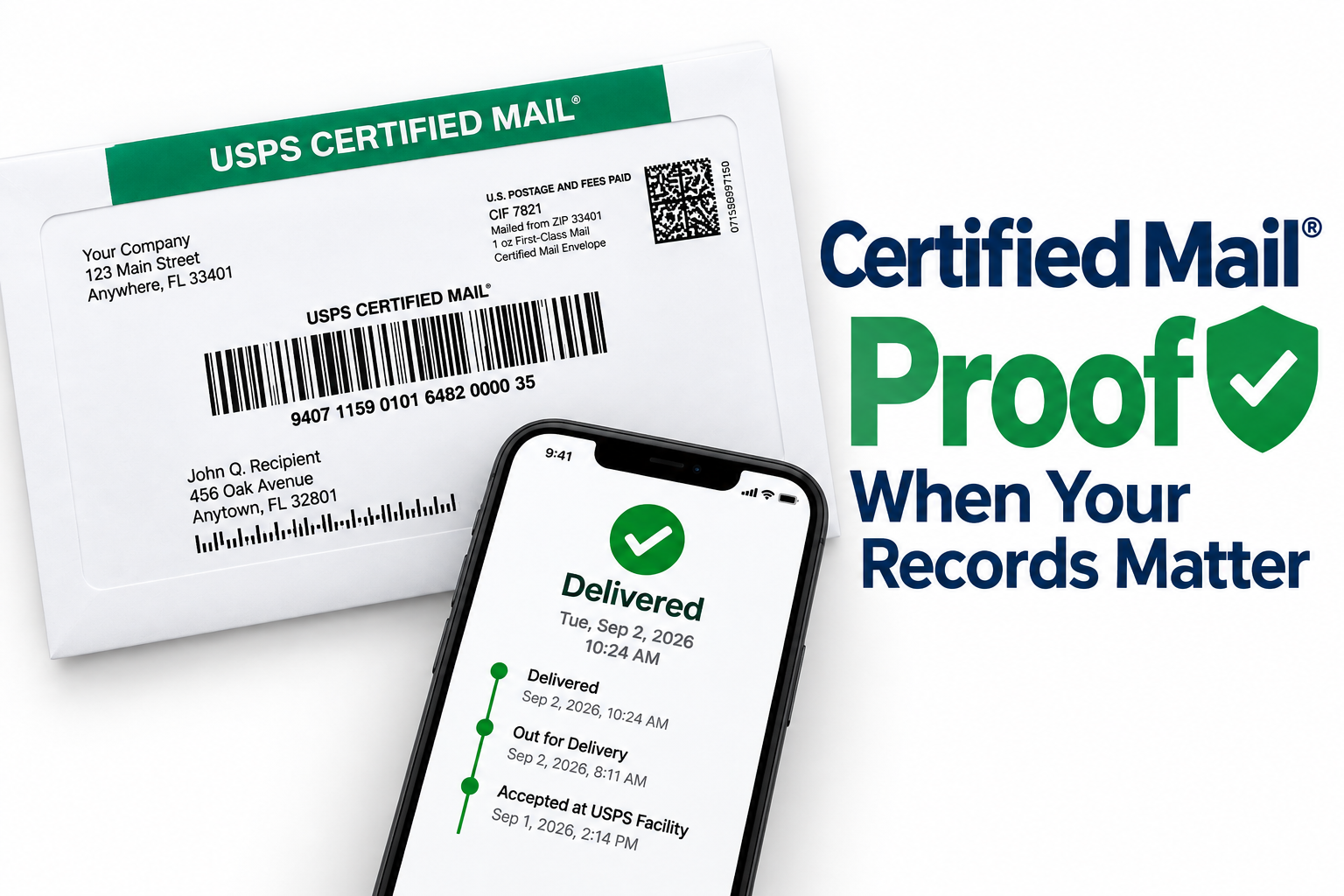
Certified mail gives you a USPS acceptance record, a tracking number, delivery events, and, when you purchase a return receipt, a record of the recipient’s signature or delivery information. It is a practical way to organize a legal compliance mailing, but it does not replace the state’s service requirements.
3. When Do You Need Mail Plus a Signed Acknowledgment?
Some states allow service by mail only when the recipient signs and returns a prescribed acknowledgment. In that system, the date of mailing is not necessarily the date of service.
For example, California Code of Civil Procedure § 415.30 permits service of a summons and complaint by mail with a Judicial Council acknowledgment form. Service is complete on the date the acknowledgment is executed. If the acknowledgment is not returned within 20 days, the serving party may recover the reasonable expense of serving by another authorized method.
New York’s CPLR 312-a follows a similar acknowledgment model. The papers are sent by first-class mail with two copies of a statement and acknowledgment of receipt, plus a return envelope. The recipient generally has 30 days from receipt to return the acknowledgment. Service is complete when the signed acknowledgment is mailed or delivered back to the sender, and the signed acknowledgment constitutes proof of service.
Which States Permit Certified Mail or Mail Acknowledgment?
The table below gives verified examples. It is not a complete 50-state service chart, and local court rules may add requirements.
| State | Verified rule or statute | What the rule shows | Proof and completion issue |
|---|---|---|---|
| California | CCP § 116.350 | In a small-claims case, the clerk may, in lieu of another method, mail a copy of the claim by any form of mail providing for a return receipt, receive proof of service, issue the hearing order, and mail the hearing order by return-receipt mail. | The clerk’s process and returned proof matter. California natural-person small-claims jurisdiction is generally up to $12,500 under CCP § 116.221. |
| California civil cases | CCP § 415.30 | Mail service may use a summons and complaint with a formal acknowledgment-of-receipt process. | Service is complete when the acknowledgment is executed, not simply when papers are dropped in the mailbox. |
| Texas | Tex. R. Civ. P. 106 | Citation may be served by registered or certified mail, return receipt requested, as an alternative to personal service. | The return receipt must show the addressee’s signature. |
| Texas | Tex. R. Civ. P. 107 | The return of service must include the return receipt bearing the addressee’s signature when registered or certified mail is used. | The signed receipt and verified return are central proof-of-service records. |
| Ohio | Ohio Rev. Code § 1923.06 | In eviction proceedings, the clerk may mail summons and related process by certified mail, return receipt requested. The statute addresses when service is complete if the mail is not returned, including refused or unclaimed mail. | Read the exact division that applies. Completion can depend on the mailing and whether the piece is returned. |
| Ohio | Ohio Rev. Code § 2716.04 | For certain garnishment written demands, proof may include the return receipt, an unclaimed letter, or a photographic/direct image copy. | The record filed with the court, not just the fact that you mailed something, is the proof. |
| New York | CPLR 312-a | Alternative personal service by mail uses first-class mail, two acknowledgment forms, and a return envelope. | Service is complete when the signed acknowledgment is mailed or delivered. The acknowledgment generally must be returned within 30 days. |
How Do Deadlines and Proof of Service Work?
The most important question is not only “When did I mail it?” It is also “When does this state consider service complete?”
Depending on the jurisdiction, the completion event may be:
- The date the clerk mails the papers
- The date USPS delivers the papers
- The date the recipient signs the return receipt
- The date an acknowledgment is signed and returned
- The date the mail is not returned
- The date the court receives and files the proof
That completion event controls your answer-date math, hearing notice, and other deadlines. Calendar from the correct event, and leave time for failed delivery, an unclaimed item, a wrong address, or a court rejection.
Here are practical records to keep:
- Your filed claim, summons, complaint, or notice
- A copy of everything placed in the envelope
- The USPS acceptance receipt
- The Certified Mail tracking number
- Delivery scans and attempted-delivery records
- The signed paper return receipt or electronic Return Receipt
- The envelope image, if available
- The filed proof or return of service
- Any returned, refused, or unclaimed mail
- Notes showing when you checked with the clerk
Texas is a clear example of why the receipt matters. Under Rule 106, certified mail is an authorized service method, but Rule 107 requires the return of service to include the return receipt with the addressee’s signature. A tracking page alone may not satisfy the rule.
Ohio provides another useful example. Under § 2716.04, a return receipt, unclaimed letter, or direct image copy may be required as proof for a written demand. The documentation depends on the statutory procedure being used.
Why Use Certified Mail When Ordinary Mail Is Allowed?
Ordinary first-class mail may be permitted for some notices or later documents. But ordinary mail generally gives you less evidence about what happened after mailing.
With certified mail, you can get:
- A USPS acceptance record
- A unique tracking number
- Delivery and attempted-delivery events
- A return receipt option
- A signature record when required
- A more organized legal compliance mailing file
Certified mail does not guarantee that a court will accept service. It does make your mailing easier to document and retrieve when the recipient says the papers never arrived or when an audit, hearing, or dispute requires a clear record.
You can print USPS Certified Mail labels online on any office printer using Certified Mail Labels. You can also review Certified Mail tracking and reports in one online account.
What Should You Check Before Mailing?
Before you send a legal document, use this checklist:
- Verify the address. Confirm the defendant’s current residence, business address, registered agent, or address required by the court.
- Confirm who must send it. Some states require the clerk, sheriff, constable, or authorized process server to mail the papers.
- Check restricted delivery. If only a particular person may accept the papers, the rule may require restricted delivery.
- Select the correct receipt. A signature may be required, or an electronic return receipt may be acceptable.
- Ask the clerk about local rules. County and municipal courts may use specific forms, service packets, or cutoff dates.
- Mail early. Do not wait until the last day before a hearing or response deadline.
- Track the completion event. Use the rule’s date, not your assumption, to calculate the next deadline.
- File proof on time. A receipt sitting in your office may not be enough if the court requires a filed return or acknowledgment.
- Plan for failure. If the mail is refused, unclaimed, returned, or unsigned, ask the clerk or your counsel what alternate service is permitted.
Need to send a plaintiff-side demand package or certified service copies quickly? Our Print & Mail full-service workflow lets you upload a PDF and address list. We handle printing, inserting, postage, and same-business-day USPS mailing for orders received by 5:00 PM Eastern, with mailing records for your file.

How Can Property Managers and Landlords Handle High Volume?
Property managers, landlords, HOA boards, collection agencies, and legal departments may send hundreds or thousands of notices, demands, and small-claims documents. Repeating the same manual steps creates address-entry errors, missed receipts, and scattered files.
A better workflow can include:
- Excel or CSV address uploads
- Batch creation of USPS Certified Mail labels
- API or secure SFTP automation
- USPS SCAN forms for grouped mailings
- Electronic Return Receipts instead of paper green cards
- Searchable tracking and delivery reports
- A 10-year compliance archive
You can start with Excel batch Certified Mail or connect recurring workflows through API and SFTP automation. The electronic return receipt is the digital version of the green card and is listed at $2.91 compared with $4.65 for the traditional paper option.
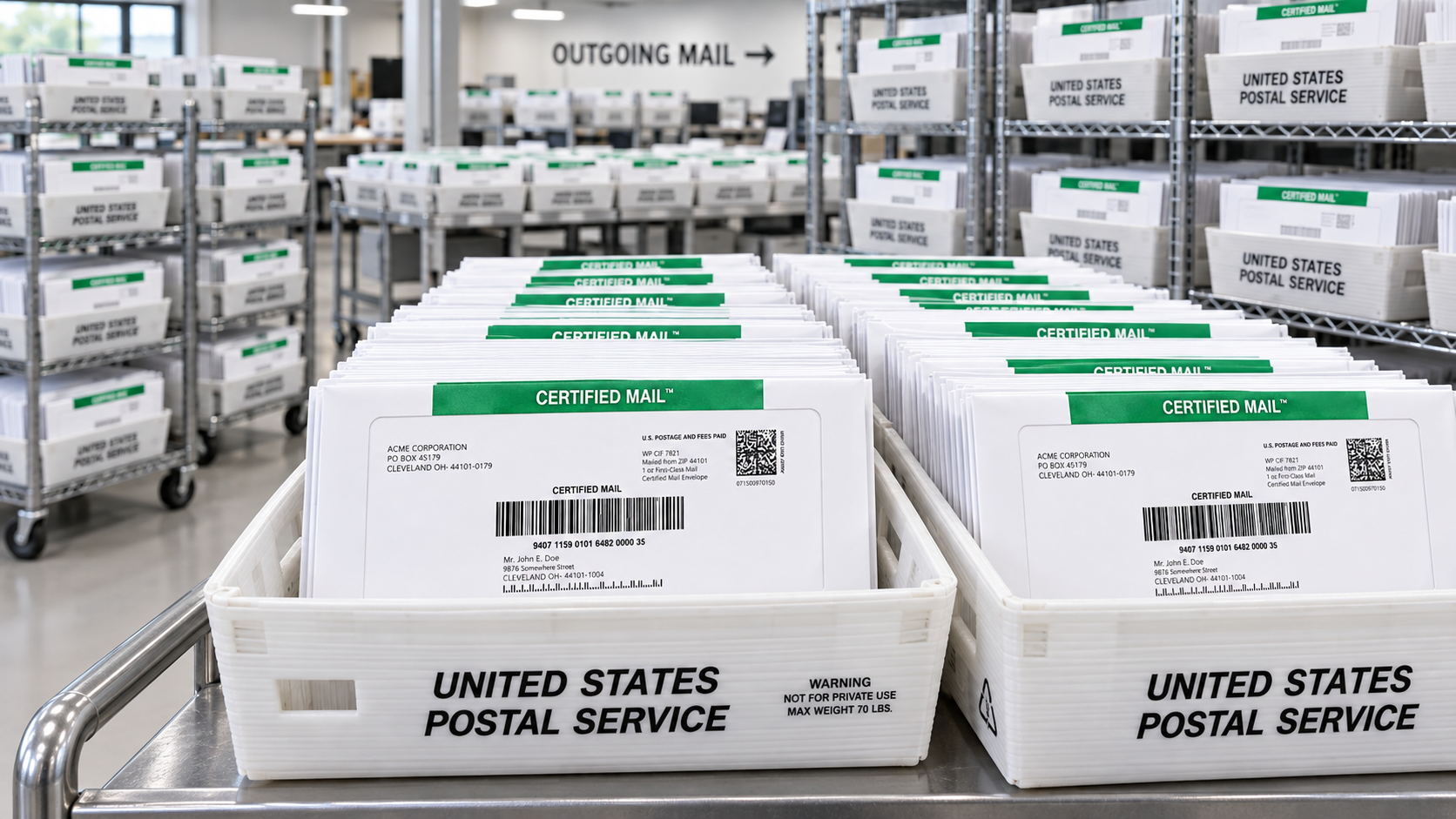 With bulk Certified Mail, electronic delivery records, tracking, and a searchable archive, you can keep each address, mailing date, USPS acceptance record, delivery event, and signature record together. That makes legal compliance mailing easier to manage across many properties and cases.
Frequently Asked Questions About Service by Mail
Can I serve small-claims papers by certified mail myself?
Not always. Some states allow the clerk or an authorized server to use certified mail, while others require personal service or a specific acknowledgment process. Confirm who must send the papers with the court clerk and your counsel.
Is USPS Certified Mail proof of service?
Certified Mail creates evidence of mailing, tracking, and delivery. Whether it qualifies as legal proof of service depends on the state rule, the case type, the person who mailed it, and the receipt or acknowledgment the court requires.
What is the difference between a return receipt and an acknowledgment?
A USPS return receipt documents delivery and may include a signature. A legal acknowledgment is a formal court-approved form that the recipient signs and returns. Some procedures require one specifically, so do not assume they are interchangeable.
Does service count on the mailing date or delivery date?
It depends on the rule. Ohio examples can treat certified-mail service as complete based on mailing and whether the mail is returned. Texas requires a signed return receipt for certified-mail service. California and New York acknowledgment procedures use the signed acknowledgment or receipt as the completion event.
What if certified mail is refused or unclaimed?
The result depends on the applicable statute or court rule. Some procedures recognize an unclaimed or refused item; others require successful delivery or a signed acknowledgment. Keep the returned envelope and ask the clerk what alternate service is required.
Can I use electronic return receipt USPS records for legal compliance?
An electronic return receipt can provide a digital delivery and signature record, but acceptance depends on the governing rule and court. Before relying on it, confirm that the court accepts the electronic record for your particular service method.

Ready to Make Your Mailing Process Easier?
Service rules remain state-specific, but your mailing workflow does not have to be difficult. Verify the rule, confirm the address, choose the correct USPS service, track the right completion event, and preserve the receipt and proof of service.
Use Certified Mail Labels to create certified mail online, add an electronic return receipt, print labels at your office, or send PDFs for full-service mailing. You’ll save time, reduce administrative work, and keep your certified mail tracking and compliance records searchable for the long term.