
When Certified Mail Is Required
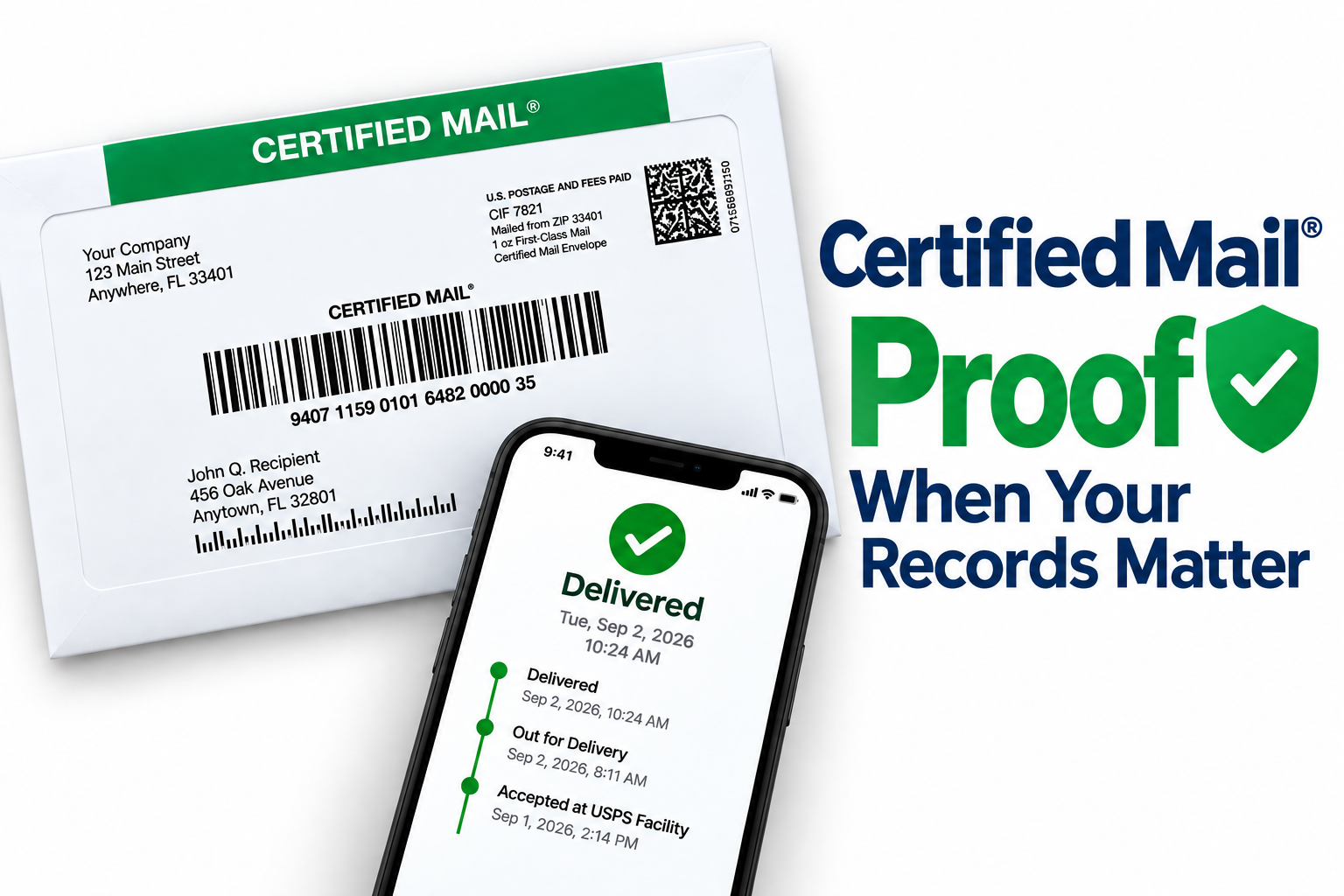
Last reviewed: October 2026
This page is reviewed every January and again after any state legislative session that amends a security deposit or landlord notice statute.
A handful of states still make certified mail part of the security deposit process. Florida is the clearest example, requiring the notice of intent to impose a claim on the deposit to be sent by certified mail (or email under § 83.505). Most other states require only an itemized statement by mail or personal delivery within a fixed deadline after move-out. The ten-state checklist below shows the pattern, and the deadlines range from 21 days to 60 days.
This is a general informational guide, not legal advice. Landlord-tenant laws change frequently. Confirm the current rule and your specific situation with your attorney before sending a security deposit disposition notice, termination notice, or other legal compliance mailing.
Which States Require Certified Mail for a Security Deposit Claim Notice?
Among the states covered here, Florida expressly requires certified mail for a landlord’s notice of intent to impose a claim on a security deposit, unless the parties have used email in accordance with the applicable statute.
Under Fla. Stat. § 83.49(3), within 30 days after termination, the landlord must give the tenant written notice of the intention to impose a claim on the security deposit and state the reason. The notice must be sent by certified mail to the tenant’s last known address, or by email in accordance with § 83.505.
The notice must also include the statutory form language telling the tenant to object in writing within 15 days after receipt. If the landlord fails to give the required notice, the landlord forfeits the right to impose a claim on the deposit.
The Fla. Stat. § 83.49(3) notice of intent to impose a claim is not limited by unit count and applies to covered residential tenancies generally. The five-unit threshold belongs to the separate § 83.49(2) move-in disclosure requirement about how the deposit is held, including the depository name and address, interest terms, and statutory disclosure language, so do not confuse the two. Also keep separate the different "five" in § 83.49(1)(c), which concerns a bond election for landlords engaged in the renting of dwelling units in five or more counties.
For tenants vacating before the end of the rental term, § 83.49(5) adds another genuine Certified Mail rule: the tenant must give at least 7 days' written notice by Certified Mail or personal delivery before vacating, as a condition tied to deposit notice rights.
For property managers, the practical lesson is straightforward: identify the applicable state rule, prepare the itemized disposition or claim notice, and create a mailing record that shows what was sent, where it was sent, and when USPS accepted it.
What Are the Security Deposit Deadlines and Required Mailing Methods by State?
The following list is not exhaustive. It covers the ten verified states discussed in this guide and separates security deposit disposition rules from other landlord notice and termination rules.
Florida: Certified Mail Is Expressly Required for the Claim Notice
- Deadline: Within 30 days after termination.
- Required method: Certified mail to the tenant’s last known address, or email in accordance with § 83.505.
- Required content: Written notice of the intention to impose a claim, the reason for the claim, and statutory language explaining the tenant’s 15-day written objection period.
- Consequence of missing the notice: The landlord forfeits the right to impose a claim on the deposit, though the landlord may still sue for damages after returning the deposit.
- Separate rule to keep distinct: The fewer-than-five-units exemption belongs to Fla. Stat. § 83.49(2), the move-in disclosure notice about how the deposit is held, not this claim-notice rule. A different "five" appears in § 83.49(1)(c) for landlords engaged in the renting of dwelling units in five or more counties.
- Additional Florida Certified Mail rule: For early vacates, § 83.49(5) requires at least 7 days' written notice by Certified Mail or personal delivery.
- Citation: Fla. Stat. § 83.49(3)
Florida is the clearest example of why a landlord may need more than ordinary mail. Your process should preserve the USPS acceptance event, certified mail tracking, the notice copy, and the address used.
California: First-Class Mail or Personal Delivery
- Deadline: Within 21 calendar days after the tenant vacates.
- Required method: Personal delivery, first-class mail, or another agreed method.
- Required content: An itemized statement of deductions, with copies of supporting documents.
- Citation: Civ. Code § 1950.5
California does not expressly require certified mail for the itemized security deposit statement under the fact reviewed here. Certified mail may still be useful when you want stronger evidence of mailing and delivery activity.
Illinois: Itemized Statement Within 30 Days
- Deadline: Within 30 days after the tenant vacates for the landlord to provide the itemized statement; if no statement is furnished, the full deposit must be returned within 45 days.
- Required method: Personal delivery, postmarked mail to the tenant’s last known address, or verified email.
- Required content: Itemized damages and estimated or actual repair costs, with paid receipts or copies attached.
- Consequence of bad-faith withholding: The tenant may be entitled to double the deposit plus attorney fees.
- Citation: 765 ILCS 710/1 (Security Deposit Return Act)
The Illinois rule focuses on the contents and timing of the statement. It does not make certified mail the required method in the verified fact provided here.
Minnesota: First-Class Mailing Satisfies the Deadline
- Deadline: Within three weeks after the tenancy ends and the tenant provides a forwarding address.
- Required method: First-class mailing to the tenant’s provided address satisfies the deadline.
- Required content: Return of the deposit with interest or a written statement explaining the reasons for withholding.
- Citation: Minn. Stat. § 504B.178
Minnesota property teams should confirm the forwarding address and retain evidence of the date the statement or refund was mailed.
North Carolina: Initial Accounting Within 30 Days
- Deadline: Within 30 days after termination of the tenancy and delivery of possession.
- Required method: Mail or delivery with the balance of the deposit.
- Required content: Written itemization of damage and the remaining balance. If the claim cannot be determined within 30 days, an interim accounting is due within 30 days and a final accounting within 60 days.
- Additional notice: The tenant must be notified within 30 days after the lease begins where the deposit is held.
- Citations: N.C. Gen. Stat. § 42-52 and N.C. Gen. Stat. § 42-50
North Carolina’s rule makes a complete move-out record especially important when repairs or damage claims cannot be finalized immediately.
Massachusetts: Sworn Itemized List Within 30 Days
- Deadline: Within 30 days after termination.
- Required method: The lessor must furnish the required itemized list and supporting evidence.
- Required content: An itemized list of damages sworn under penalties of perjury, with written evidence of estimated or actual costs.
- Deposit handling: The deposit must be held in a separate interest-bearing account with 5% interest or the lesser amount allowed.
- Consequence of missing the deadline: The lessor forfeits the right to retain any portion if the itemized list or the deposit with interest is not furnished within 30 days.
- Citation: Mass. Gen. Laws ch. 186, § 15B
For Massachusetts rentals, use a controlled workflow. The mailing record should be connected to the signed or sworn itemization, cost documentation, and deposit accounting.

Which States Focus on Refund Deadlines, Itemization, or Other Notice Service Rules?
Texas: Refund Within 60 Days After Surrender and Forwarding Address
- Deadline: The landlord must refund the security deposit within 60 days after surrender and receipt of the tenant’s forwarding address.
- Required content if withholding: A written description and itemized list of deductions.
- Method: The verified rule focuses on the refund deadline and written itemization; it does not state that certified mail is required for the deposit notice.
- Citations: Tex. Prop. Code § 93.005 and § 93.009
Texas also addresses the tenant’s forwarding address requirement and the bad-faith presumption. Maintain a record of when the forwarding address was received and when the refund or itemization was sent.
Virginia: Regular Mail or Hand Delivery for Covered Notices
- Notice method: Written notice by regular mail or hand delivery with proof of service.
- Nonpayment deadline: Fourteen-day written notice of nonpayment and intent to terminate before the landlord may terminate and regain possession.
- Citation: Va. Code § 55.1-1202 and § 55.1-1245
The verified Virginia facts above concern notice service and nonpayment termination. They do not establish a separate security deposit disposition deadline in this guide. Confirm the current deposit rule with Virginia counsel before relying on a particular timeline or mailing method.
Arizona: Thirty-Day Periodic Tenancy Notice and Five-Day Nonpayment Notice
- Month-to-month deadline: Written notice at least 30 days before the periodic rental date.
- Nonpayment deadline: Five days’ written notice before a special detainer action.
- Method: Written notice.
- Citations: A.R.S. § 33-1375 and A.R.S. § 33-1368
Arizona’s verified rules here address termination and nonpayment notices rather than a certified-mail requirement for a security deposit claim.
Iowa: Certified Mail Can Complete Service When Used
- Lease violation: Seven-day cure notice.
- Nonpayment: Three-day notice.
- Tenancy at will: Thirty days’ written notice terminates the tenancy.
- Certified mail rule: Notice served by certified mail is complete when mailed in a sealed, properly addressed envelope with postage.
- Citations: Iowa Code § 562A.27 and § 562.4 / § 562.7
Iowa demonstrates an important distinction: a state may define when certified-mail service is complete for a termination notice without requiring certified mail for every security deposit disposition notice.
What Is an Itemized Statement and What Must It Include?
An itemized statement explains each amount withheld from the security deposit. Depending on the state, it may need to include:
- The specific damage or charge.
- The estimated or actual repair cost.
- Paid receipts or copies of receipts.
- Supporting invoices or other cost documentation.
- The remaining balance of the deposit.
- Any required interest.
- A statutory objection statement or other required language.
- The tenant’s last known address or forwarding address used for mailing.
Do not use one generic template for every property. Create state-specific workflows and have your attorney review the language, attachments, deadlines, and delivery method.
How Do You Prove the Deposit Notice Was Mailed on Time?
Your file should show more than a copy of the letter. Build a complete mailing record with:
- The final notice sent.
- The tenant’s last known or forwarding address.
- The date the notice was prepared.
- The USPS tracking number.
- The USPS acceptance scan.
- Certified mail tracking and delivery activity.
- The itemized statement and receipts.
- Any return receipt or electronic delivery confirmation.
- The date the deposit refund was issued.
- Internal notes identifying the property, tenant, lease, and move-out date.
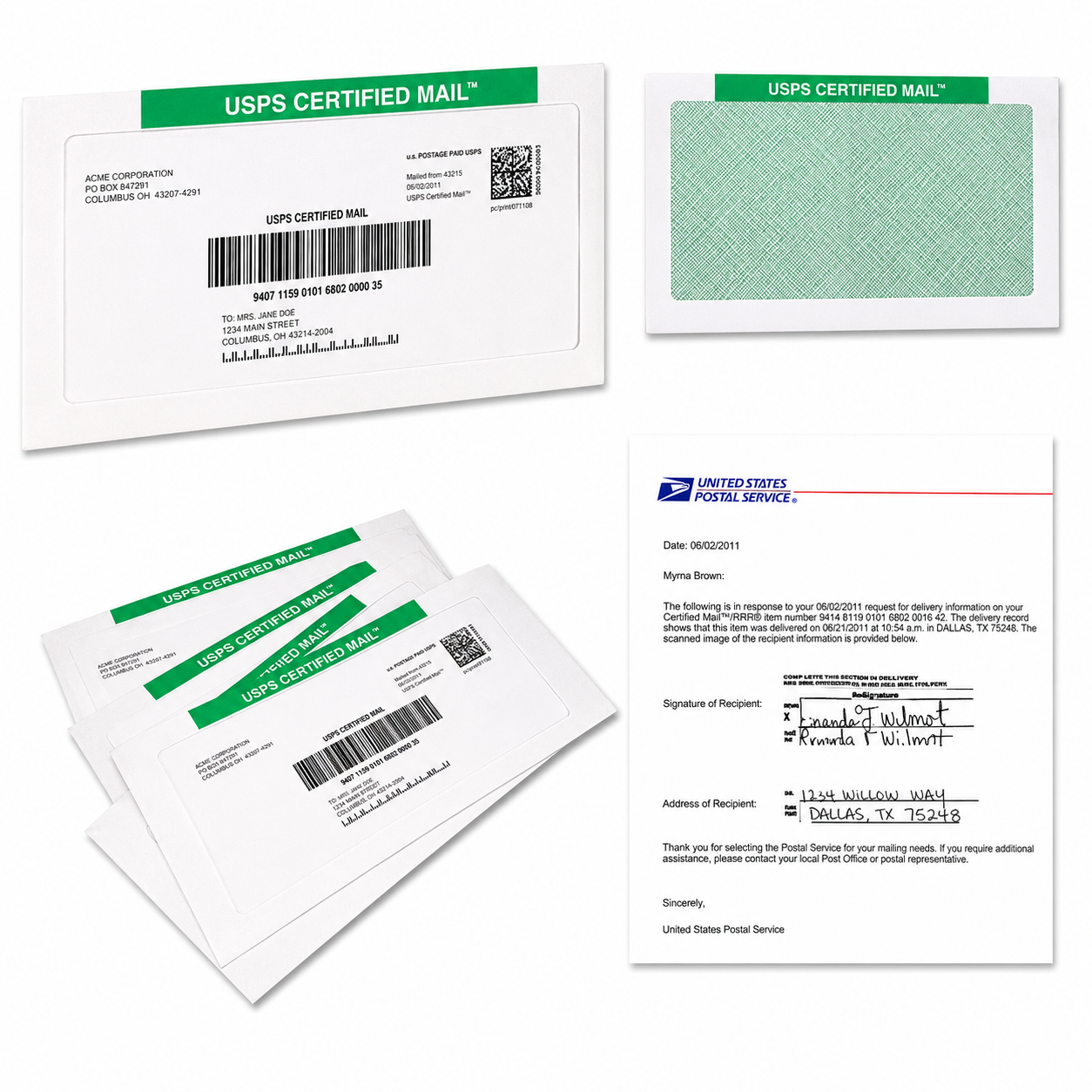
You can create and print USPS Certified Mail Labels online from a standard office printer. You receive a live-postage label, tracking number, and an easier way to organize legal compliance mailing records without making a trip to the Post Office.
For a fully managed process, use the Print & Mail service. Upload a PDF letter and address list, and the team handles printing, envelope insertion, postage application, and mailing. Orders submitted before 5:00 PM Eastern can be mailed the same business day with USPS proof of acceptance, tracking, and a notarized affidavit of mailing.
What Is the Difference Between First-Class and Certified Mail for Deposit Notices?
First-class mail is often an allowed delivery method for an itemized statement where the applicable statute says first-class mail, postmarked mail, or ordinary mailing is sufficient.
Certified mail adds a USPS tracking record and an acceptance event. It can make it easier to show that a particular notice entered the mail stream, where it was addressed, and what happened afterward. It does not replace the need to meet the deadline, use the correct address, include the required content, or comply with state-specific rules.
For Florida claim notices, certified mail is expressly required unless the permitted email option applies. For other states, use certified mail when it supports your risk-management process, but do not describe it as legally required unless the current statute says so.
How Much Does Certified Mail Cost for a Landlord Notice?
Pricing depends on postage, service options, weight, and whether you select electronic delivery or a signature record.
As a reference point, a 1-ounce certified mail letter with Electronic Delivery Confirmation is $7.28 online, compared with $11.02 at the Post Office counter with a paper green card. The online option can reduce certified mail cost while giving you digital delivery information and a searchable record.
If you need a recipient signature, Electronic Return Receipt is $2.91, compared with $4.65 for the paper green card. A $1.74 saving per piece. The electronic record can be stored with your other proof of mailing and delivery.
For property management portfolios, bulk automation supports Excel and CSV uploads, API integrations, secure SFTP transfers, USPS SCAN forms, and centralized tracking. This helps remote property teams send large batches of deposit notices without manually creating each label.
Frequently Asked Questions About Landlord Notices and Certified Mail
Does Florida still require certified mail for a security deposit claim notice in 2026?
Yes, under Fla. Stat. § 83.49(3), the notice of intent to impose a claim must be sent by certified mail to the tenant’s last known address, or by email in accordance with § 83.505. This claim-notice rule is not limited by unit count and applies to covered residential tenancies generally. The fewer-than-five-units exemption belongs to the separate § 83.49(2) move-in disclosure rule about how the deposit is held, and a different "five" appears in § 83.49(1)(c) for landlords engaged in the renting of dwelling units in five or more counties.
What happens if a Florida landlord misses the 30-day notice?
The landlord forfeits the right to impose a claim on the security deposit, though the landlord may still sue for damages after returning the deposit. The notice must also include the statutory language explaining the tenant’s 15-day written objection period.
How many days does California give to return a security deposit?
Under Civ. Code § 1950.5, the landlord must furnish an itemized statement of deductions within 21 calendar days after the tenant vacates. The statement must include copies of supporting documents as required.
What is the difference between first-class and certified mail for deposit notices?
First-class mail is an ordinary mailing method that may satisfy a statute requiring first-class or postmarked mail. Certified mail adds USPS acceptance and tracking records. Certified mail is expressly required for the Florida claim notice covered by this guide, but not automatically required in every state.
Does the itemized statement need receipts?
Some states specifically require paid receipts, copies, or written evidence of estimated or actual costs. Illinois and Massachusetts are examples in this guide. Review the exact rule that applies to your property before sending the statement.
Can a property management company send notices in bulk?
Yes. You can use Excel or CSV uploads for batch mailing, or use API and secure SFTP automation for recurring portfolios. USPS SCAN forms can help consolidate acceptance for eligible batches, while centralized reports and a 10-year archive make later retrieval easier.
How Can You Start a More Reliable Notice Process?
Your next move is simple: prepare the notice, verify the state deadline and address, and print Certified Mail Labels online.
You’ll save time, avoid unnecessary Post Office trips, receive certified mail tracking, and keep proof of mailing and delivery in one place. For high-volume property teams, you can also upload your address list, use same-business-day Print & Mail service, add Electronic Return Receipt, and maintain a searchable 10-year compliance archive.
Start with the correct notice, use the correct mailing method, and create the documentation your team may need later.