
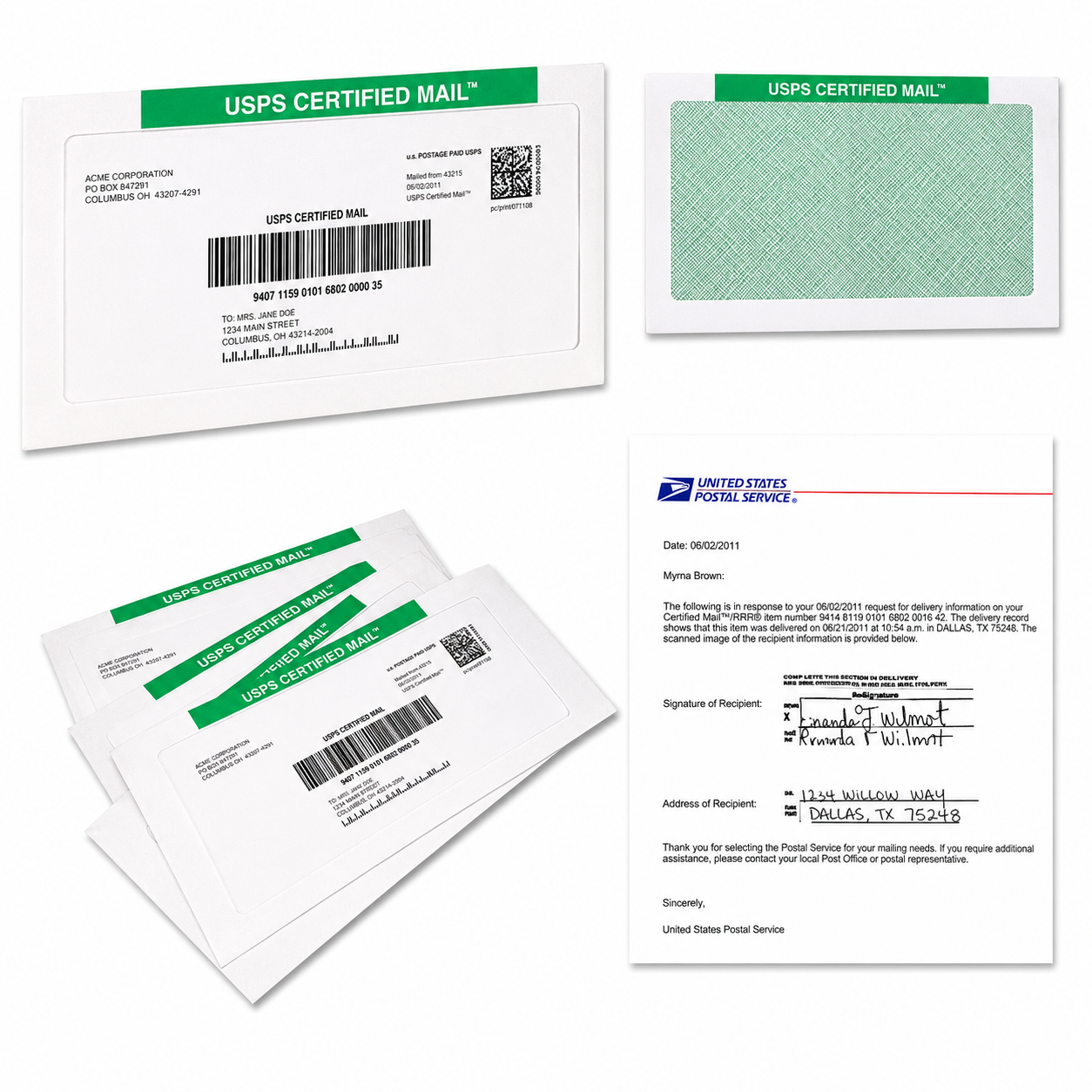
 If you need documented mailing and delivery, start with Certified Mail. Add Return Receipt when you need evidence of who received the mail and the date it was delivered. Choose Electronic Return Receipt when you want that evidence delivered and stored digitally. Add Certified Mail Restricted Delivery only when delivery must be limited to the named individual or that person’s authorized agent.
Restricted Delivery is now a verified, current USPS line item at $14.35 per piece, which is more than double the $5.55 Certified Mail fee itself and roughly five times the $2.91 Electronic Return Receipt fee. That cost difference matters. On a 1,000-piece mailing, adding Restricted Delivery alone costs $14,350. In most workflows, that is a line item worth paying only when a statute, court rule, contract, or agency instruction actually requires delivery to a named person or authorized agent.
There is no universal rule that every legal or compliance mailing requires Restricted Delivery or a Return Receipt. The requirement may come from a statute, regulation, contract, court rule, agency policy, or internal procedure. Confirm the exact requirement with qualified counsel or the governing authority before mailing.
What Is the Difference Between Certified Mail, Return Receipt, And Restricted Delivery?
These services solve different problems:
- Certified Mail gives you a USPS mailing receipt and a USPS delivery record. USPS explains that Certified Mail is available with First-Class Mail and Priority Mail and that USPS maintains a record of delivery. See USPS DMM 503, §3.1.1.
- Return Receipt gives you evidence of delivery, including to whom the item was delivered and the date of delivery. It may also provide the recipient’s actual delivery address if it differs from the address used by the sender. See USPS DMM 503, §6.1.1.
- Electronic Return Receipt provides the Return Receipt information electronically instead of sending back a paper PS Form 3811. USPS describes electronic delivery as an available Return Receipt format in DMM 503.6, and the details are also summarized in the USPS Quick Service Guide 503.
- Certified Mail Restricted Delivery controls who may receive the piece. Under USPS DMM 503.2.2, delivery is limited to the named addressee or the addressee’s authorized agent. The addressee must be an individual specified by name.
In simple terms, Certified Mail documents the mailing and delivery process. Return Receipt documents the delivery outcome. Restricted Delivery limits the eligible recipient.
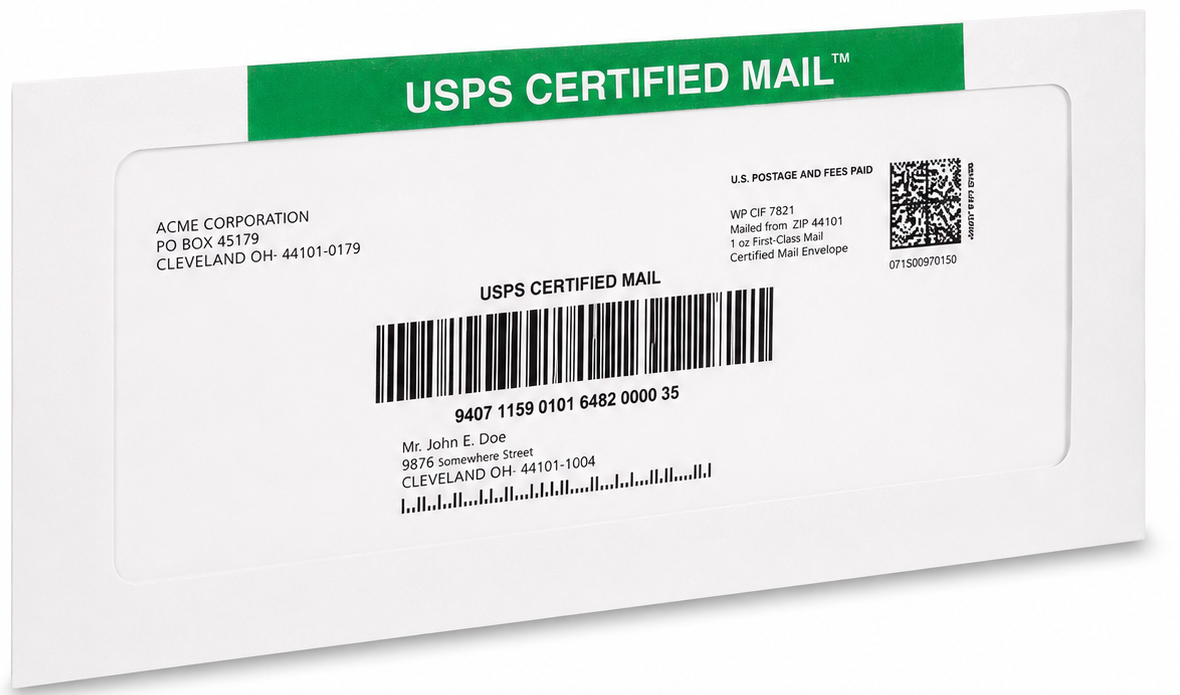
Decision Table: Which Service Do You Need?
| Your actual need | Recommended service | Why |
|---|---|---|
| You need a USPS receipt showing the item was mailed and tracking information | Certified Mail | Provides a mailing receipt and USPS delivery record |
| You need evidence of who received the item and the delivery date | Certified Mail + Return Receipt | Adds evidence of delivery and recipient information |
| You need the delivery evidence in a downloadable or searchable format | Certified Mail + Electronic Return Receipt | Provides the receipt electronically instead of relying on a paper card |
| You need delivery limited to a specific person | Certified Mail Restricted Delivery | Limits delivery to the named individual or authorized agent |
| You need both recipient control and delivery evidence | Certified Mail Restricted Delivery + Return Receipt or Electronic Return Receipt | Combines restricted delivery with proof of delivery |
| You only need to show that a notice was sent, and your governing rule does not require Certified Mail | Consider the lower-cost service permitted by the rule | Do not purchase extra services without confirming they are needed |
When Does Restricted Delivery Make Sense?
Restricted Delivery is about who can accept the mail, not simply whether the mail is important.
For example, a company may send a notice to a named person at a business address. If the sender must demonstrate that the specific person, or that person’s authorized agent, could receive the item, Restricted Delivery may be appropriate.
Under USPS DMM 503.2.2:
- The addressee must be an individual, or natural person, specified by name.
- Delivery is directed only to that addressee or the addressee’s authorized agent.
- The service must be requested at the time of mailing.
- The mailpiece must carry the required Restricted Delivery marking and applicable postage and fees.
- If Return Receipt is also requested, the applicable Restricted Delivery information must be indicated on the Return Receipt documentation as required by USPS.
Restricted Delivery may be unnecessary when delivery to any authorized employee, household member, office representative, or agent satisfies your legal or business requirement. It may also provide little value when your governing rule requires Certified Mail but does not require delivery to one particular person.
That is where many senders overpay. They see a serious notice and automatically select every available option. Instead, ask: Does the recipient identity matter, or do I only need a documented USPS delivery record?
Current USPS Fees That Matter For This Decision
| Service | USPS Fee |
|---|---|
| Certified Mail Restricted Delivery | $14.35 per piece |
| Certified Mail Adult Signature Required | $14.35 per piece |
| Certified Mail Adult Signature Restricted Delivery | $14.35 per piece |
| Restricted Delivery added to COD | $8.80 per piece |
| Restricted Delivery added to Insurance | $8.80 per piece* |
| Return Receipt requested at time of mailing (hard copy PS Form 3811) | $4.65 |
| Return Receipt Electronic | $2.91 |
| Signature Confirmation Restricted Delivery | $13.95 retail / $12.95 electronic |
*For articles insured for more than $500.
USPS Notice 123, Price List, effective July 12, 2026, p. 28, "Domestic—Extra Services and Fees" (pe.usps.com).
Why The Restricted Delivery Cost Changes The Decision
Restricted Delivery is not a small add-on. At $14.35 per piece, it costs:
- More than double the $5.55 Certified Mail fee itself
- Roughly five times the $2.91 Electronic Return Receipt fee
- $11.44 more per piece than Electronic Return Receipt alone
- $8.80 more per piece than the base Certified Mail fee alone
Here is what that Restricted Delivery line item looks like at volume:
| Mailing volume | Restricted Delivery cost at $14.35 per piece |
|---|---|
| 100 pieces | $1,435 |
| 500 pieces | $7,175 |
| 1,000 pieces | $14,350 |
| 5,000 pieces | $71,750 |
That arithmetic is the real reason to slow down before selecting it by default. If your rule really says delivery must be limited to the named individual or authorized agent, pay for it. If the rule only requires documented mailing, delivery confirmation, or proof of who signed, then adding Restricted Delivery to every piece can become a very expensive habit very quickly.
When Should You Add Return Receipt?
Return Receipt is useful when tracking alone is not enough.
USPS DMM 503.6 describes Return Receipt as evidence of delivery, including:
- To whom the item was delivered
- The date of delivery
- The recipient’s actual delivery address, when different from the sender’s address
- A delivery record associated with the Certified Mail article
You can choose a paper Return Receipt or an electronic format, where available. A paper receipt uses PS Form 3811 and is returned through the mail. An Electronic Return Receipt gives you a digital record that is easier to download, forward, organize, and retain.

You should consider Return Receipt when:
- Your counsel, contract, court rule, or agency policy calls for delivery evidence.
- You need to identify who signed or accepted the mail.
- You expect a dispute about whether a notice was delivered.
- Your organization needs a signature record for an audit or case file.
- You need a receipt that can be attached to an electronic matter-management or compliance record.
You may not need Return Receipt when the applicable rule requires only Certified Mail and your organization can rely on the USPS delivery record available through tracking or your mailing platform. Confirm that approach before removing the receipt service from a regulated workflow.
Electronic Return Receipt Or Paper Return Receipt?
The choice is usually administrative.
Choose Electronic Return Receipt When:
- You manage mail records digitally.
- You need to retrieve delivery evidence quickly.
- Multiple people need access to the same record.
- You send high volumes of notices.
- You want to reduce paper handling and manual filing.
- You need to connect delivery records with a searchable case, customer, property, employee, or account record.
Certified Mail Labels can associate electronic receipt records with your mailing history, making it easier to search for a tracking number, delivery status, and proof of delivery later. See the Electronic Return Receipt service page and Certified Mail Reports.
Choose Paper Return Receipt When:
- A specific recipient, court, agency, or internal policy expects a physical card.
- Your file-management process is paper-based.
- You need to preserve the original mailed receipt in a physical matter file.
- Electronic records are not accepted for your specific purpose.
USPS Publication 370, Domestic Return Receipt, provides additional information about domestic Return Receipt service and the paper receipt process.
Practical Examples: Choosing The Right Combination
Example 1: Routine Legal Notice
A law firm sends a notice and needs to show that it mailed the document and that USPS delivered it. The governing rule does not identify a particular signer.
Likely choice: Certified Mail. Add Electronic Return Receipt if the firm needs a signature record or a more complete delivery file.
Usually unnecessary: Restricted Delivery, unless the applicable rule specifically limits who may receive the notice.
Example 2: Notice Directed To A Named Individual
A sender must document delivery to Jane Smith, rather than simply delivery to an office or household.
Likely choice: Certified Mail Restricted Delivery plus Return Receipt or Electronic Return Receipt.
That choice should usually be driven by an actual requirement, because Restricted Delivery alone is $14.35 per piece. If the sender mails 100 such notices, that add-on totals $1,435. At 500 notices, it is $7,175. At 1,000 notices, it is $14,350. At 5,000 notices, it is $71,750. That can be justified when the rule or instruction really names the person who must receive it. It is usually wasted spend when the governing requirement does not.
The sender should address the piece to Jane Smith by name and confirm that the service is available for the mailpiece and destination.
Example 3: Property Management Notice
A property manager sends recurring notices to tenants and needs reliable delivery records for many addresses. The governing policy requires documented mailing but does not require the tenant alone to sign.
Likely choice: Certified Mail with Electronic Return Receipt when a signature record is needed. Use bulk processing if the notices are recurring or high volume.
Potential waste: Adding Restricted Delivery to every notice when authorized agents or other acceptance procedures are allowed.
Example 4: Large Government Or Compliance Mailing
An agency sends hundreds or thousands of notices and needs a report showing mailing status, delivery events, and receipt records.
Likely choice: Bulk Certified Mail with electronic delivery records, optional Electronic Return Receipt, and a USPS SCAN Form. Certified Mail Labels bulk automation supports Excel/CSV uploads, API workflows, and secure SFTP automation.
This is where the math matters most. Adding Restricted Delivery to a 1,000-piece compliance mailing costs $14,350 just for that one extra service. At 5,000 pieces, the Restricted Delivery line item alone becomes $71,750. That is why the service is best reserved for mailings where a statute, court rule, contract, or agency instruction actually names that level of recipient control.
Make The Process Easier
You do not have to prepare every label, form, envelope, and receipt manually.
With online Certified Mail label printing, you can create USPS Certified Mail labels and print them from your office. If you would rather skip printing and the Post Office, use the Certified Mail Labels Print & Mail workflow, where you can upload documents and address information for same-business-day processing when submitted before the applicable cutoff.
For recurring mailings, bulk automation can help reduce rekeying and organize tracking data. For digital proof, use Electronic Return Receipt. Your records can then remain searchable through Certified Mail tracking and reports.

Frequently Asked Questions
Is Restricted Delivery required for every Certified Mail notice?
No. Certified Mail and Restricted Delivery are different services. Restricted Delivery is appropriate only when delivery must be limited to the named addressee or authorized agent. Requirements vary by statute, regulation, contract, court rule, and policy.
Does Return Receipt prove that the recipient read the letter?
No. Return Receipt provides evidence of delivery, including information about the recipient and delivery date. It does not prove that the recipient read, understood, or agreed with the contents.
Is Electronic Return Receipt the same as the green card?
It serves a similar proof-of-delivery purpose, but the record is provided electronically rather than through a mailed paper PS Form 3811. Confirm that electronic records satisfy your specific legal or internal requirement.
Can Certified Mail, Restricted Delivery, and Return Receipt be combined?
Yes, USPS identifies Certified Mail Restricted Delivery and Return Receipt as eligible service combinations when applicable standards are met. Review USPS DMM 503 and make sure the address, forms, endorsements, and fees are correct.
Should I use Restricted Delivery when mailing to a business?
Be careful. Certified Mail Restricted Delivery requires a named individual addressee. A business name alone may not satisfy the service requirements. Confirm the correct addressee and your governing rule before selecting Restricted Delivery.
What should I do if I am unsure which service a statute requires?
Start with the exact language of the statute, regulation, court rule, contract, or policy. Then confirm the interpretation with qualified counsel or the responsible agency. USPS rules explain how the services operate; they do not determine what your particular legal matter requires. This article is not legal advice, and you should confirm the requirement with your own counsel when the consequence of getting it wrong is significant.
When you know the result you need, the choice becomes simpler: Certified Mail for documented mailing and delivery, Return Receipt for delivery evidence, Electronic Return Receipt for convenient digital records, and Restricted Delivery only when recipient control truly matters. At $14.35 per piece, Restricted Delivery is a service to buy because the rule requires it, not because the mailing feels important. Select the service that matches the requirement, avoid unnecessary fees, and start preparing your Certified Mail online.