
 Last reviewed: October 2026
If you are administering an estate, your goal is to execute and prove the creditor notice your probate code requires. Most states use some combination of publication and direct notice to known or reasonably ascertainable creditors. Certified mail is not required for every state or every probate notice, but it is often a practical way to create a documented mailing trail. New York requires certified mail for many creditor claims presented to a fiduciary, while Texas requires a qualified delivery method with proof of delivery for specified creditor notices.
This is a general guide for organizing and documenting probate creditor notice. State probate rules change frequently, and Certified Mail Labels does not provide legal advice. Confirm the current requirements, forms, deadlines, and service method for your estate with your own probate counsel.
This page is reviewed every January and again after any state legislative session that amends the notice statute.
What Should You Prove When Serving Probate Creditor Notice?
The important question is not simply, “Did someone mail a letter?” Your estate file should show:
- Which creditors were identified.
- How the estate determined that a creditor was known or reasonably ascertainable.
- What notice or claim form was sent.
- The address and service method used.
- The date the item was mailed or delivered.
- The USPS acceptance and tracking history.
- Whether delivery, attempted delivery, or a return was recorded.
- What affidavit, receipt, or court filing was required.
- When each relevant deadline began and when it expires.
Certified mail can help organize this evidence because it connects your mailing record with a USPS tracking number and delivery event. Depending on the statute and your counsel’s instructions, you may also need return receipt service, electronic delivery confirmation, a signature record, or another qualified proof of delivery.
Which States Require Certified Mail for Probate Creditor Notice?
The following table covers the verified states in this guide. It focuses on how to execute and prove the notice or claim service required by the cited statute. “Certified mail” does not mean the same thing in every row: in some states it is expressly required for creditor claim presentment; in others, the statute requires mail, service, or another delivery method without naming certified mail.
| State | What the Statute Requires | Deadline Mechanics | Proof of Service to Keep |
|---|---|---|---|
| Arizona | Under Ariz. Rev. Stat. § 14-3801, the personal representative must publish notice once a week for three successive weeks and give written notice by mail or other delivery to all known creditors. Certified mail is not specifically required. | A known creditor generally has the later of four months after publication or 60 days after mailing or other delivery. See § 14-3803 for claim limitations. | Keep the notice, creditor list, address source, mailing receipt, tracking history, delivery or attempted-delivery record, and any affidavit or court filing required by counsel. |
| California | California Probate Code § 9050 requires notice of administration to known or reasonably ascertainable creditors, as provided in § 1215. Section 9052 provides the notice form and tells creditors they are encouraged to file claims by certified mail, return receipt requested. That encouragement applies to creditor claim filing, not necessarily to the representative’s outgoing notice. | Use the current statutory notice form and applicable claim deadlines. The form should communicate what the creditor must file and when. | Keep the completed notice, proof of mailing or personal delivery, address research, tracking or delivery documentation, and the creditor’s claim-related records. |
| Florida | Fla. Stat. § 733.2121 requires publication once a week for two consecutive weeks and a diligent search for reasonably ascertainable creditors. The personal representative must promptly serve a copy of the notice on those creditors. The statute does not state that certified mail is required in every case. | Claim deadlines are tied to §§ 733.702 and 733.710. Confirm the service timing and method under the current probate rules. | Keep the diligent-search record, creditor list, notice copy, mailing or service receipt, delivery history, returns, and proof filed with the court. |
| Michigan | Mich. Comp. Laws § 700.3801 requires publication of notice to creditors. If known creditors are identified, a copy of the notice must be mailed or otherwise sent. Certified mail is not specifically required by the cited statute. | Claims are generally presented within four months after publication. If a creditor is discovered less than 28 days before that deadline, notice must be sent within 28 days after discovery. | Keep the investigation record, including relevant estate records and mail review; the notice; mailing receipt; tracking or delivery evidence; and any court form or affidavit. |
| Nebraska | Neb. Rev. Stat. § 30-2483 requires publication once per week for three consecutive weeks. § 25-520.01 requires a copy of the published notice to be sent by United States mail to each known party with a direct legal interest. Certified mail is not specifically required. | The mailed copy must be sent within five days after first publication. Proof by affidavit must be filed within 10 days after mailing. Claims are generally barred two months after first publication when the notice requirements are satisfied. | Keep the published notice, mailing list, postage or mailing receipts, address research, and the filed affidavit confirming mailing and diligent investigation. |
| Ohio | Ohio Rev. Code § 2117.06 generally requires claims to be presented in writing within six months after death. Under § 2117.07, an executor or administrator may send written notice to a potential claimant to accelerate the deadline. The cited provisions do not make certified mail a general requirement for that notice. | Without an acceleration notice, the general deadline is six months after death. With a compliant § 2117.07 notice, the claim must be presented by the earlier of 30 days after receipt or six months after death. | Keep the signed notice, address records, mailing receipt, tracking and delivery evidence, and proof of the date the potential claimant received the notice. |
| New York | N.Y. SCPA § 1803 requires a creditor’s claim to be in writing and presented to the fiduciary personally or by certified mail, return receipt requested, at the fiduciary’s designated address. This is a certified-mail requirement for the creditor’s claim presentment, not necessarily a general outgoing notice requirement imposed on the fiduciary. | A claim should be presented according to § 1803. SCPA § 1802 provides timing context regarding claims not presented within seven months after letters issue. | Keep the claim, certified mailing receipt, return receipt or electronic delivery record, tracking history, and the fiduciary’s designated address information. |
| Texas | Under Texas Estates Code § 308.052, notice to a person known to have an unsecured claim must generally be given within 120 days after receiving letters, using a qualified delivery method. Under § 308.053, notice to known secured creditors must generally be sent within two months after receiving letters. Certified or registered mail with return receipt is one qualified method, but the statute also recognizes other methods that create proof of delivery. | The secured-creditor deadline is two months after receiving letters. The unsecured-creditor notice deadline is generally 120 days after receiving letters. Confirm the current statutory text and estate-specific requirements. | File copies of notices, return receipts or other proof of delivery, and the personal representative’s affidavit stating that notice was sent as required. |
If your state is not in this table, do not assume that the same deadline or mailing method applies. Check your state’s current probate code, court rules, required forms, and local filing practices with your own counsel.
How Can You Execute And Prove Notice Efficiently?
A repeatable workflow helps prevent missed addresses, inconsistent records, and last-minute searches. Here are practical steps to organize the mailing:
- Build the creditor list. Review estate records, account statements, loan documents, insurance records, medical bills, tax records, contracts, and post-death mail as directed by counsel.
- Record the source for each creditor. Note whether the creditor was identified from a statement, a demand for payment, a credit report, a government notice, or another record.
- Confirm the address. Use the address required by the applicable statute or court form. Keep the source and date of the address search.
- Prepare the correct notice. Use the required statutory form, court form, or attorney-approved letter. Do not substitute a generic letter when the code requires specific content.
- Choose the required service method. If the statute requires certified mail, use it. If the code permits mail or other delivery, your counsel can help determine whether certified mail is the best evidence for your estate.
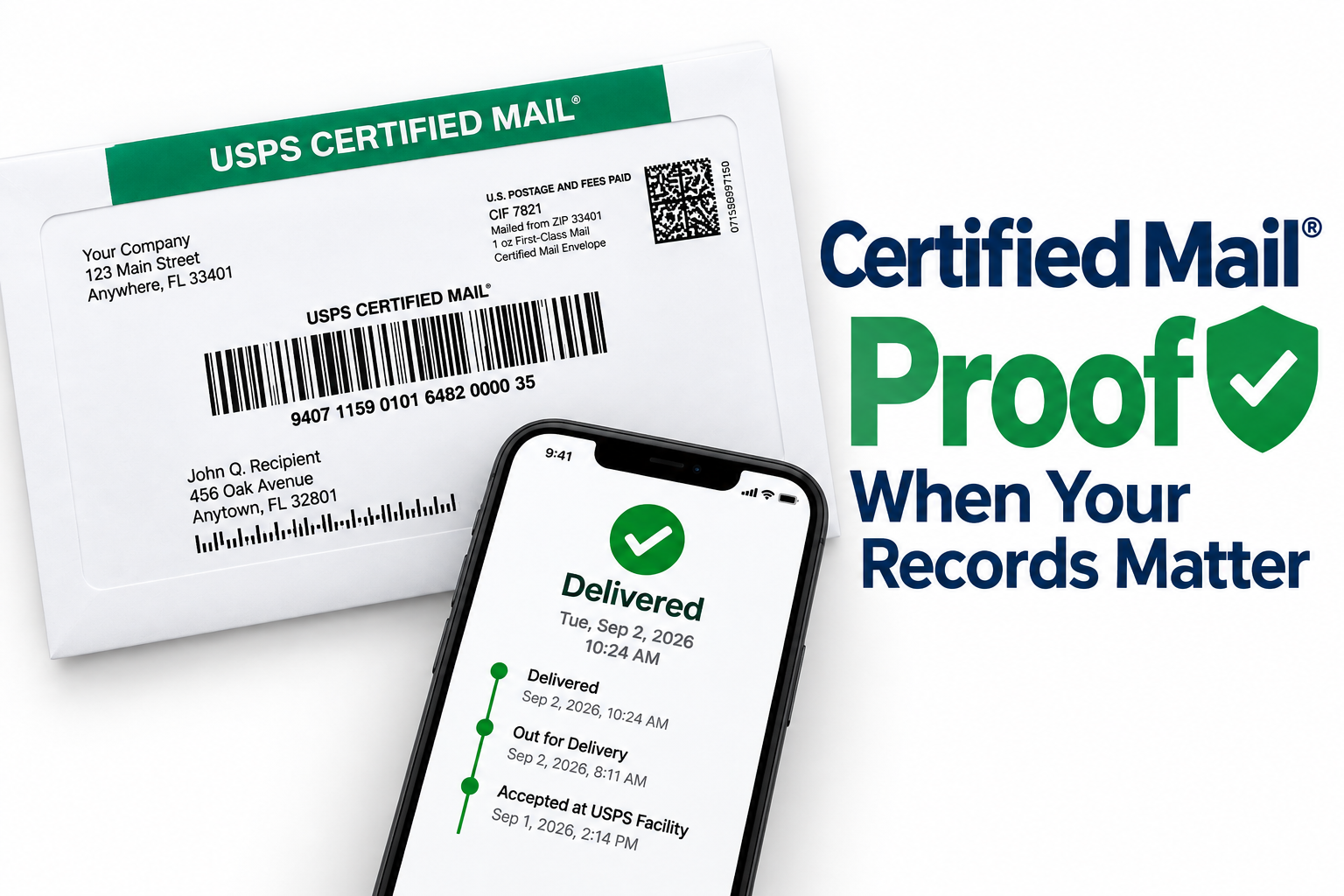
- Capture the acceptance record. Keep your mailing receipt and tracking number. USPS Certified Mail tracking can show the acceptance scan, processing events, delivery attempt, and delivery status.
- Capture delivery evidence. If a signature or return receipt is important, select the appropriate return receipt option or an electronic alternative.
- Reconcile every item. Match each creditor, notice, address, tracking number, and delivery result in one log.
- File what the court requires. Some states require an affidavit, receipt, notice copy, or proof of delivery to be filed by a specific deadline.
How Do USPS Certified Mail Labels Help With Estate Records?
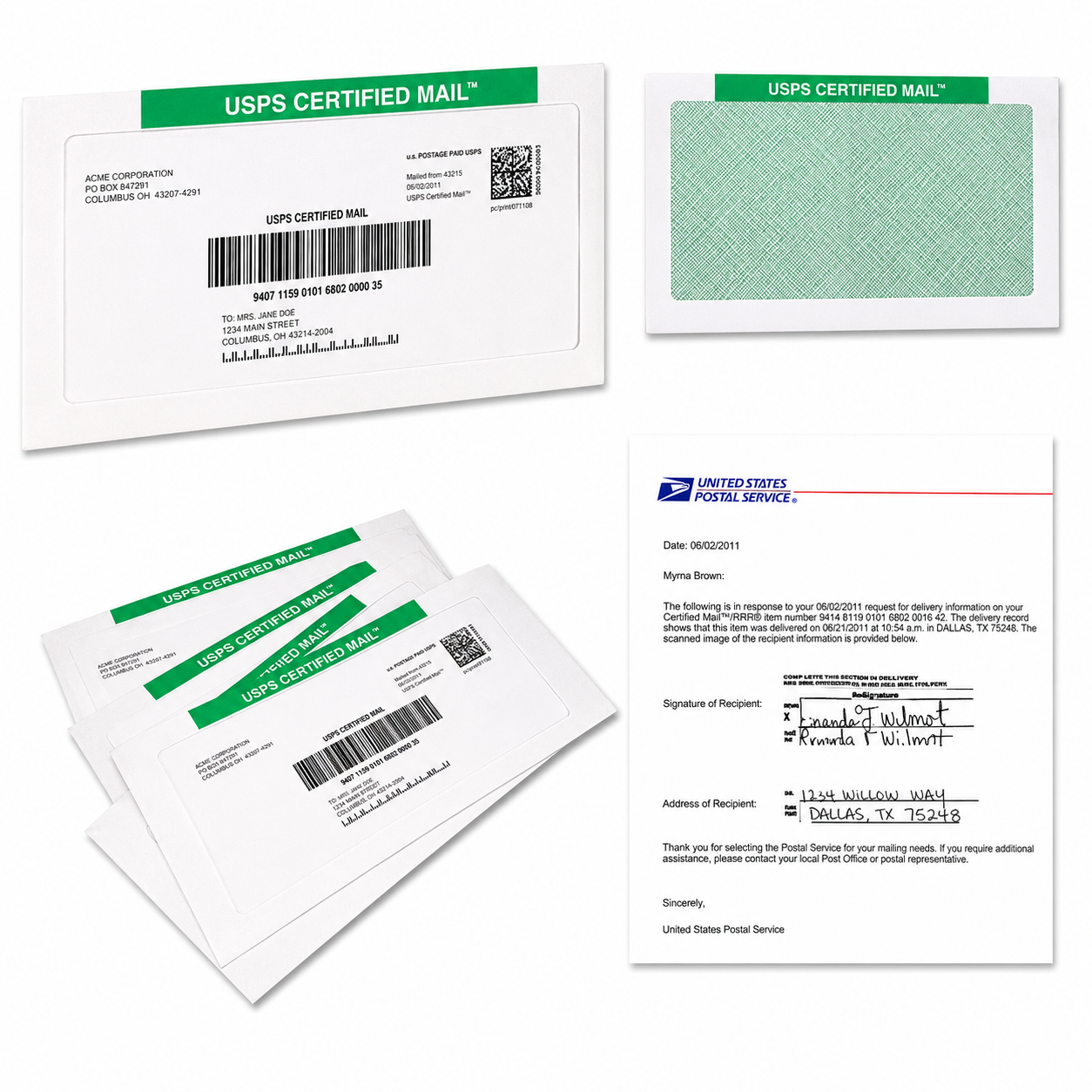
You can use our certified mail label printing flow to create USPS Certified Mail labels online and print them on a standard office printer or compatible adhesive sheets. This can make individual estate notices easier to prepare without a trip to the Post Office.
For a PDF notice that needs to go out quickly, our Print & Mail full-service workflow lets you upload a PDF and address information so we can print, insert, apply postage and tracking, and mail eligible orders the same business day when submitted before the 5:00 PM Eastern cutoff.
For law firms, fiduciaries, and collection agencies handling many estates, Excel batch certified mail and API/SFTP automation can reduce repetitive entry. These options support bulk certified mail workflows, tracking, and USPS SCAN forms.
You can also consider an Electronic Return Receipt when your approved process calls for digital delivery or signature evidence. Review the actual statutory requirement with counsel before selecting a service option.
What Should You Retain After The Mailing?
Your final probate file should be usable months or years later. Keep:
- The approved notice and attachments.
- The final creditor spreadsheet or service log.
- Address research and diligent-search notes.
- USPS Certified Mail labels and mailing receipts.
- Certified mail tracking history.
- Return receipts, electronic delivery confirmations, or other proof of delivery.
- Undeliverable-mail records and follow-up steps.
- Affidavits, certificates, and court filing confirmations.
- Any claim received from the creditor.
- Notes showing how deadlines were calculated.
A searchable digital archive can make this much easier during an audit, court filing, dispute, or later estate inquiry. Our Certified Mail reports provide a central place to review mailing activity and delivery records.
Probate Creditor Notice FAQ
 Is Certified Mail Required For Every Probate Creditor Notice?
No. The requirement depends on the state, the type of notice, and whether you are sending notice or presenting a creditor claim. New York requires certified mail for many creditor claims served on the fiduciary. Arizona, Michigan, Nebraska, and Florida use language involving mail, service, or other delivery without universally requiring certified mail in the cited provisions.
Does Certified Mail Prove That The Notice Was Legally Valid?
Not by itself. Certified mail can document mailing and delivery, but legal validity may also depend on the correct recipient, address, notice content, deadline, statutory form, publication, affidavit, and court filing. Use certified mail to support the compliance file, not as a substitute for reviewing the probate code.
What Is The Best Way To Send Certified Mail From An Office?
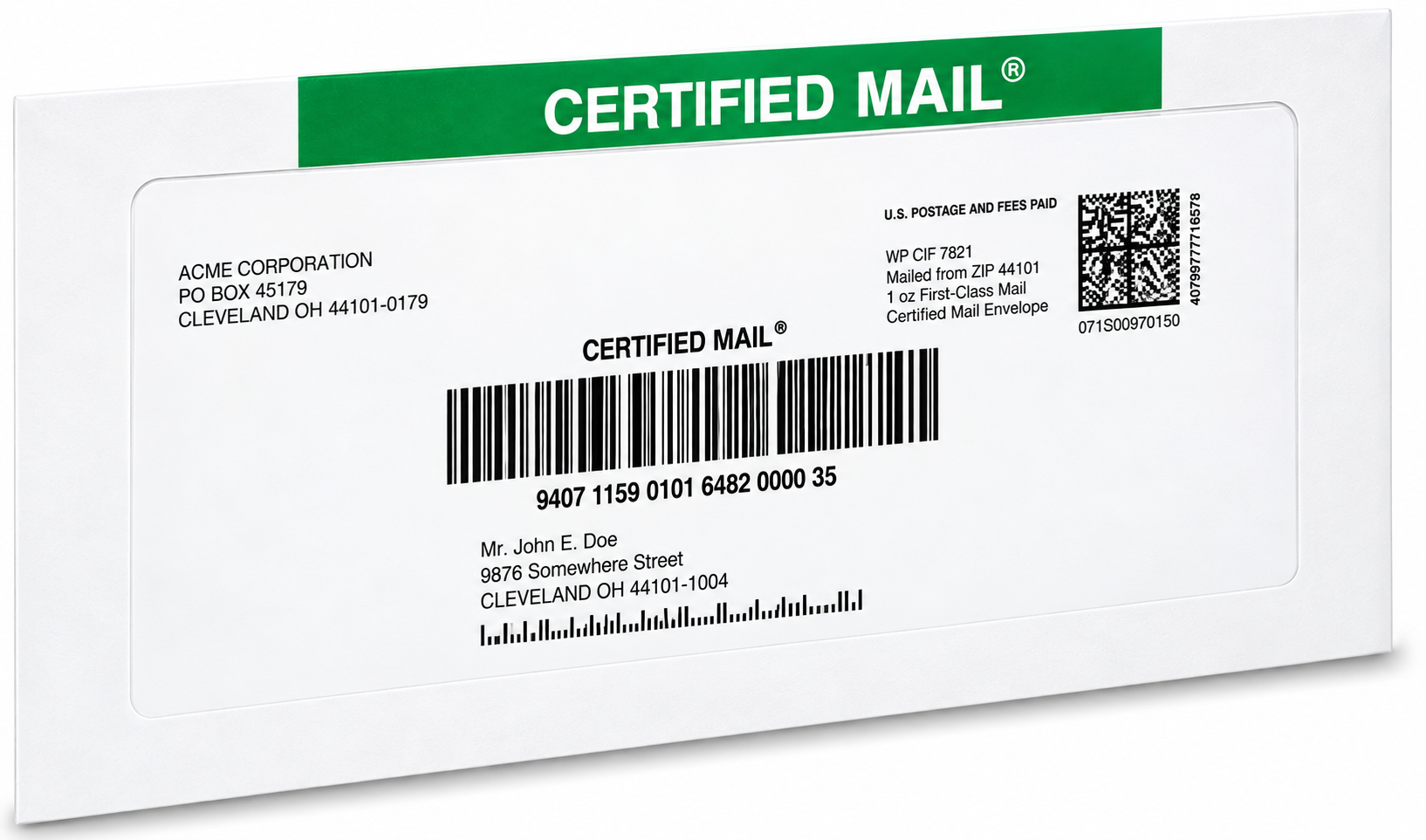
Prepare the approved notice, confirm the address, create USPS Certified Mail Labels online, retain the receipt and tracking number, and monitor delivery. If your process requires a signature or return receipt, select that option before mailing.
Can I Use Certified Mail Online For Multiple Estates?
Yes. Firms managing repeated mailings can use Excel or CSV uploads for batch label creation. Larger operations may benefit from bulk Certified Mail automation, API integration, or secure SFTP processing.
How Much Does Certified Mail Cost For Probate Notices?
Certified mail cost depends on the postage, service class, piece weight, label workflow, and optional delivery or return receipt services. Compare the total cost of printing, labor, postage, tracking, and record retrieval, not only the counter price for one mailing.
How Long Should The Estate Keep Mailing Proof?
The retention period depends on your counsel’s instructions, the estate, court rules, tax and compliance requirements, and possible disputes. Keep the complete notice and delivery file for the period your counsel recommends. A searchable archive can help you retrieve proof of mailing, acceptance, tracking, delivery, and signature records when needed.