
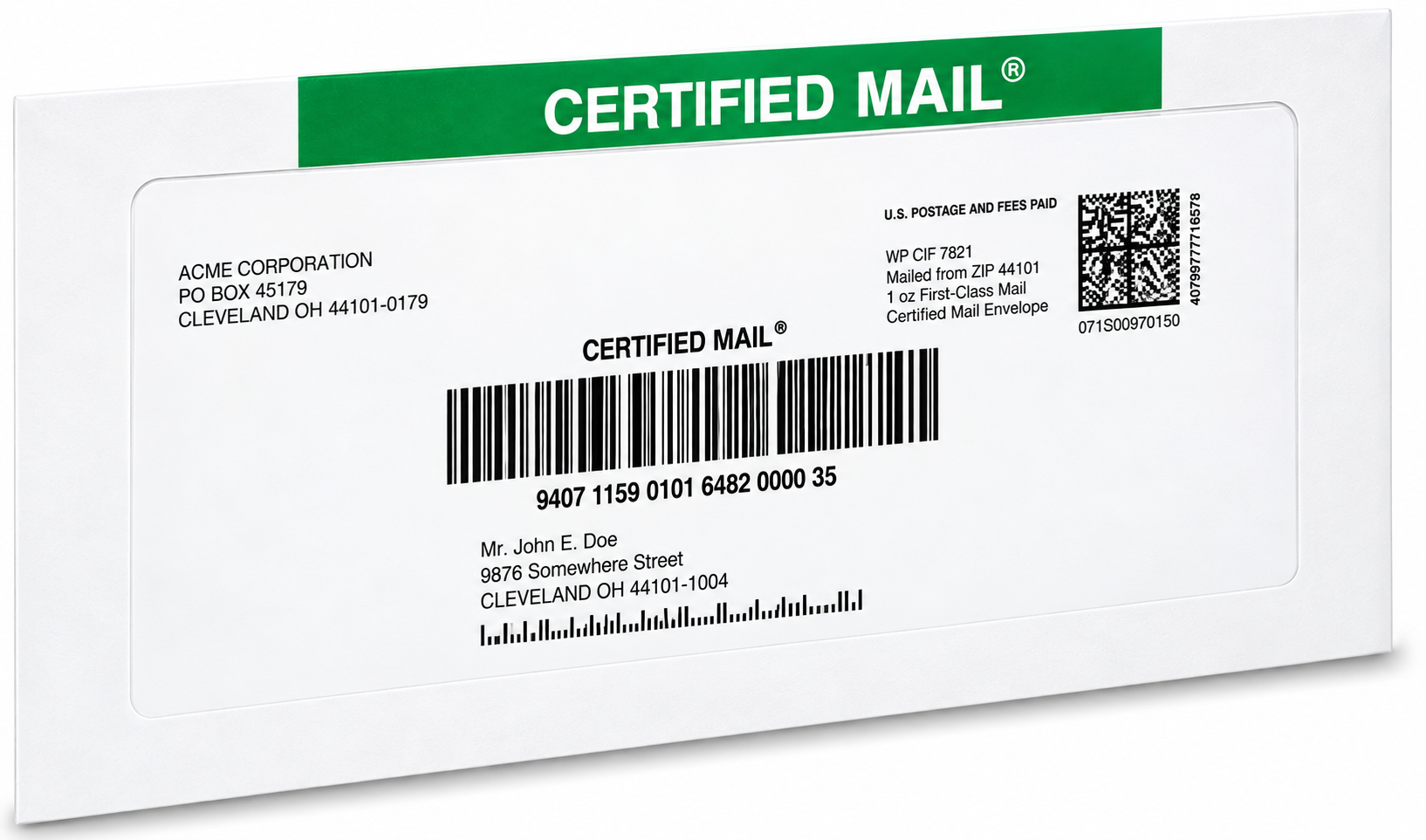
The IRS uses certified or registered mail for several high-stakes tax notices, including Collection Due Process notices connected to federal tax liens and levies. The mailing method, last-known-address rule, and mailing date can affect whether a taxpayer has 30, 90, or another limited period to act, so your legal compliance mailing process must capture and preserve proof at every step.
Which IRS Notices Must Go Out by Certified Mail?
If you handle tax controversy matters, collections, lien disputes, or wrongful levy claims, the goal is not simply to place a letter in the mail. Your goal is to execute and prove the notice the statute requires.
That means your process should document:
- The exact notice type.
- The recipient’s last known address.
- The date the notice was prepared.
- The date it was mailed.
- The USPS tracking number.
- The acceptance scan.
- Delivery activity or attempted delivery.
- Any signature or electronic return receipt.
- A permanent record of the mailing and supporting documents.
The phrase “certified mail” does not mean every IRS notice follows the same legal rule. For example, 26 U.S.C. § 6212 requires the IRS to mail a notice of deficiency to the taxpayer’s last known address. The express certified-or-registered-mail language appears in the lien, levy, and third-party recordkeeper summons provisions discussed below.
That distinction matters. Your mailing workflow should follow the specific statute, regulation, notice, and instructions involved, not rely on a general assumption that every tax letter has the same deadline.
What Is the Deadline for an IRS Notice of Deficiency?
A statutory notice of deficiency is commonly called a “90-day letter.” It gives the taxpayer a limited opportunity to petition the U.S. Tax Court before the IRS assesses the deficiency and proceeds with collection.
Under 26 U.S.C. § 6212, the IRS mails the notice to the taxpayer’s last known address. Under 26 U.S.C. § 6213(a), the taxpayer generally has:
- 90 days from the mailing date to file a Tax Court petition.
- 150 days if the notice is addressed to a taxpayer outside the United States.
- An adjusted final day if the last day falls on a Saturday, Sunday, or District of Columbia holiday.
For execution and proof purposes, the mailing date is critical. Do not build your file around the date the recipient opens the envelope. Preserve the actual mailing record, USPS acceptance record, tracking history, and a copy of the notice as mailed.
A defensible process should also confirm that the address used was the taxpayer’s last known address. [26 U.S.C. § 7701(a)(1)] provides that when the revenue laws require service of a notice, mailing to the last known address is sufficient.
How Should You Prove a Notice of Deficiency Was Mailed?
Here are just a few records your firm should retain:
- A final PDF of the notice and enclosures.
- The address source and date it was verified.
- The USPS Certified Mail tracking number.
- The mailing date and USPS acceptance scan.
- Delivery, attempted delivery, or return activity.
- The electronic delivery confirmation or signature report.
- An internal mailing affidavit or declaration.
- Any client-facing instructions showing when the deadline was calculated.
This is where an organized certified mail workflow can save substantial time. With Certified Mail Labels’ online label creator, you can create and print live-postage USPS Certified Mail labels on a standard office printer or adhesive sheet.
When Must an IRS Federal Tax Lien Notice Be Sent by Certified Mail?
When the IRS files a Notice of Federal Tax Lien, 26 U.S.C. § 6320 requires written notice and an opportunity for a Collection Due Process hearing.
The notice must generally be provided:
- Within five business days after the filing of the notice of federal tax lien.
- By certified or registered mail to the taxpayer’s last known address.
- With an opportunity to request a Collection Due Process hearing.
- Within a 30-day period stated by the statute and notice.
26 CFR § 301.6320-1 provides regulations concerning the five-business-day notice requirement and the 30-day period for requesting a hearing.
For a law firm or collection agency, the operational question is simple: can you show what was sent, where it was sent, when it entered the USPS system, and what happened after acceptance?
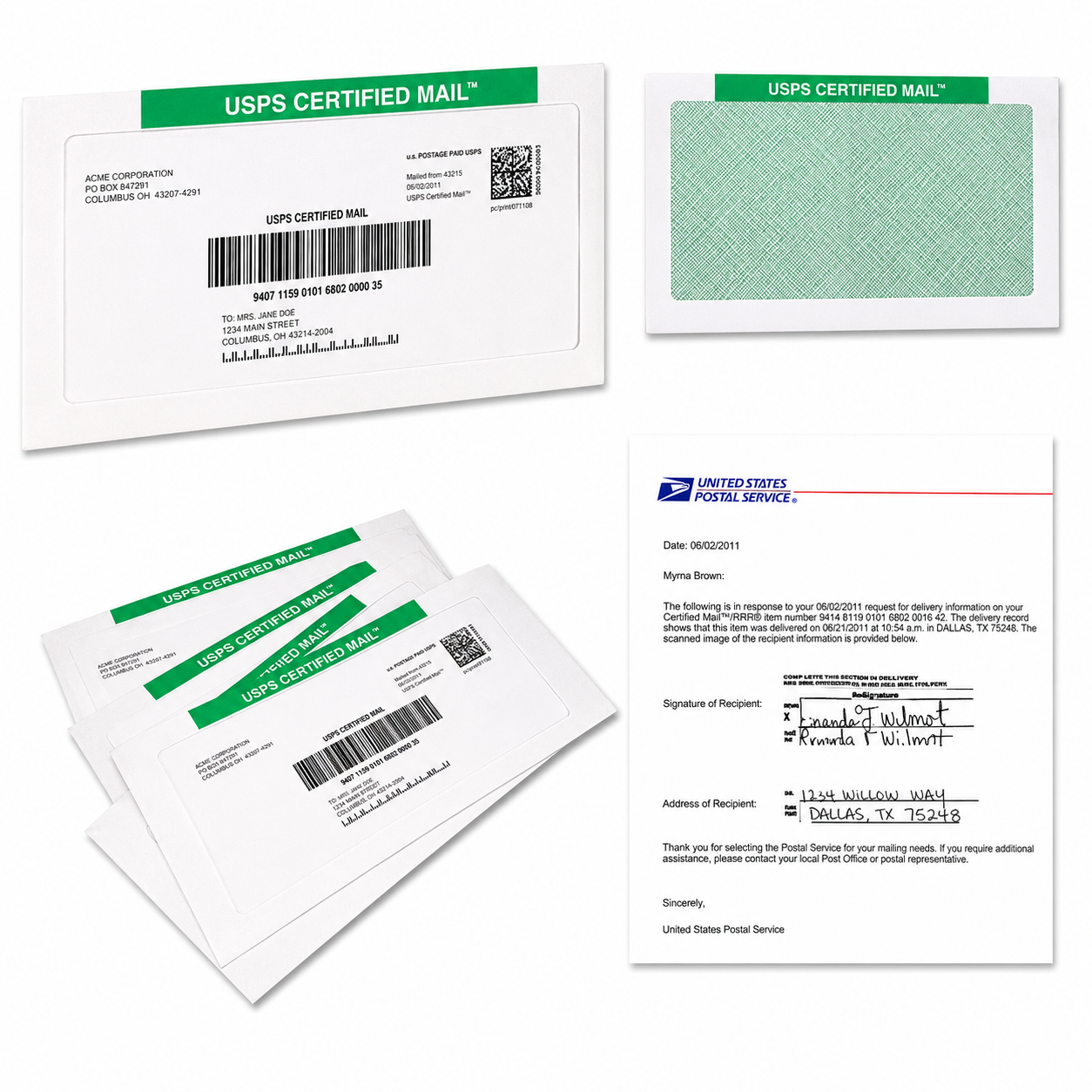
A postage receipt by itself may not give your team the complete record needed later. You should be able to retrieve the mailing event, tracking history, delivery confirmation, and supporting documents without searching through paper files or old email threads.
What Certified Mail Rule Applies Before an IRS Levy?
Before the IRS makes its first levy on a particular tax period, 26 U.S.C. § 6330(a)(2)(C) requires the notice to be sent by certified or registered mail, return receipt requested, to the person’s last known address.
The notice must be sent:
- Not less than 30 days before the first levy.
- By certified or registered mail.
- With return receipt requested.
- To the person’s last known address.
Under 26 U.S.C. § 6331(a), the notice required under § 6330 satisfies the notice-of-intent-to-levy requirement.
The 30-day period is not an administrative detail to handle casually. A missed mailing date, incorrect address, missing return receipt, or incomplete internal record can create questions about whether the required notice was properly executed.
Your legal compliance mailing process should therefore include a final review before mailing:
- Is the correct taxpayer or authorized recipient listed?
- Is the last known address documented?
- Is the notice complete and matched to the correct tax period?
- Is certified or registered mail selected as required?
- Is return receipt requested where required?
- Is the mailing date tracked against the planned levy timeline?
- Is the proof stored where the legal team can retrieve it?
Can an IRS Third-Party Summons Be Served by Certified Mail?
For a summons to a third-party recordkeeper (such as a bank, broker, attorney, accountant, or other custodian) [26 U.S.C. § 7603(b)] permits service by certified or registered mail to the last known address.
The statute says “may,” so this is an important distinction. Certified mail is an authorized service method in the circumstances covered by the provision, but the specific summons, recipient, and service requirements should be reviewed carefully.
The mailing record still matters. If service is later questioned, your file should show:
- The exact summons served.
- The recordkeeper’s address.
- The certified or registered tracking number.
- The date of mailing and USPS acceptance.
- Delivery or attempted delivery information.
- Any return receipt or signature report.
- The person or department responsible for monitoring the response.
Do not assume USPS tracking alone answers every legal question. Tracking proves postal events. Your counsel must determine whether the service method and timing satisfy the applicable summons requirements.
How Are Wrongful Levy Notices Documented?
Wrongful levy matters require careful separation between the notice itself, the administrative claim, the IRS response, and any later court action.
Under 26 CFR § 301.6343-2 and [26 U.S.C. § 7426(b)], a claimant may have a path to challenge a wrongful levy after an administrative claim is disallowed. The claimant is notified in writing and may sue the United States.
IRS practice sends the disallowance notice, identified as Letter 3973 or Letter 3974, by certified mail under IRS Internal Revenue Manual 5.11.2 (irs.gov).
For these files, preserve the complete sequence:
- The original levy or seizure information.
- The administrative claim.
- The date the claim was submitted.
- The IRS disallowance notice.
- The certified mail tracking and delivery record.
- The date the claimant received or was deemed to receive the notice.
- Internal deadline calculations.
- Counsel’s instructions for any judicial action.
Do not treat a wrongful levy mailing as a routine outbound letter. It may become a key exhibit in a dispute about notice, timing, or the opportunity to pursue the next step.
What Is the Best Way to Execute and Prove IRS Certified Mail?
You have two practical options: create and print USPS Certified Mail labels yourself, or use a full-service print-and-mail process.
With Certified Mail Labels, you can upload PDF letters and address lists. The service handles printing, envelope inserting, postage application, and same-business-day mailing for orders submitted before 5:00 p.m. Eastern. Each mailing includes a notarized affidavit of mailing.
You’ll receive:
- USPS Certified Mail tracking.
- Acceptance documentation.
- Electronic delivery confirmation.
- Electronic Return Receipt signature reporting when selected.
- A searchable compliance record retained for 10 years.
- A notarized affidavit of mailing for the file.

For individual matters, you can print Certified Mail online without a monthly fee, contract, or equipment lease. For repeated notices, bulk certified mail supports Excel and CSV uploads, API connections, and secure SFTP transfers.
This makes it easier to standardize a legal compliance mailing process across attorneys, paralegals, remote teams, and outside vendors.
How Much Does IRS Certified Mail Cost?
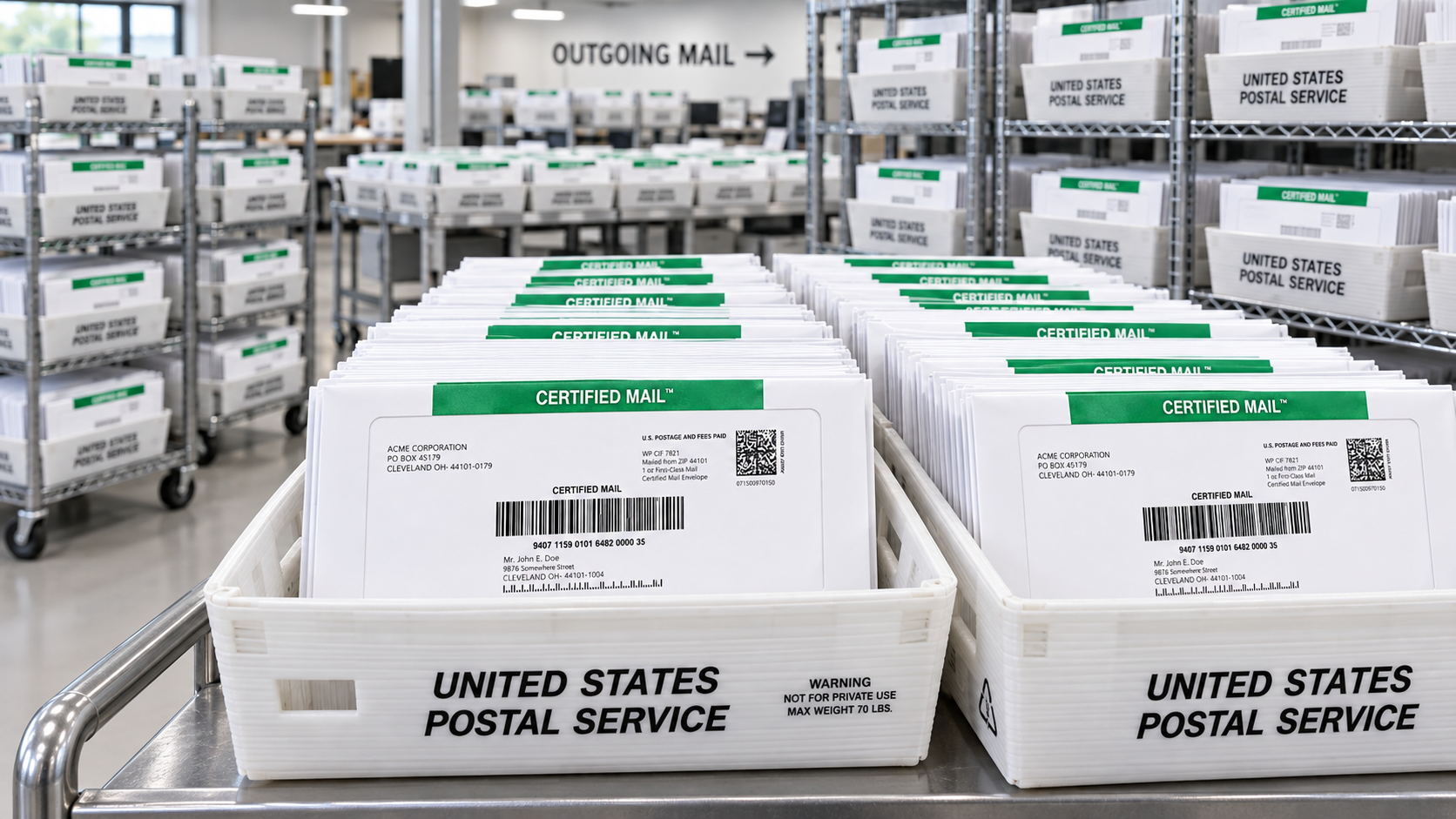 Your certified mail cost depends on the service level, postage, weight, and whether you add a paper or electronic return receipt.
As an example of our current rates, a 1-ounce Certified Mail letter with Electronic Delivery Confirmation is $7.28, compared with $11.02 at the Post Office counter with a paper green-card Return Receipt.
You’ll also get:
- No monthly fees.
- No contracts.
- No equipment leases.
- No trip to the Post Office.
- Faster label preparation.
- Centralized tracking and reporting.
- 10-year archive access.
- Electronic signature reporting.
The savings become more meaningful when your firm sends dozens, hundreds, or thousands of notices each month.
IRS Certified Mail Deadlines at a Glance
| Notice or Mailing | Required or Authorized Mailing Method | Key Deadline or Timing |
|---|---|---|
| Notice of deficiency | Mailed to the taxpayer’s last known address under 26 U.S.C. § 6212 | 90 days from mailing; 150 days if addressed abroad under 26 U.S.C. § 6213(a) |
| Federal tax lien notice | Certified or registered mail to the last known address under 26 U.S.C. § 6320 | Written notice within five business days of filing; 30-day CDP hearing request period |
| Pre-levy CDP notice | Certified or registered mail, return receipt requested, under 26 U.S.C. § 6330(a)(2)(C) | Sent at least 30 days before the first levy |
| Third-party recordkeeper summons | May be served by certified or registered mail under 26 U.S.C. § 7603(b) | Calendar the response or challenge period stated in the summons and applicable law |
| Wrongful levy disallowance notice | IRS practice sends Letter 3973 or Letter 3974 by certified mail under IRS Internal Revenue Manual 5.11.2 | Preserve the disallowance date and have counsel calculate the next filing deadline |
Certified Mail Labels helps you execute and document the mailing. We do not provide legal advice or determine which notice, deadline, address, or service method applies to your matter. Confirm the requirements and deadline with your own counsel.
How Can Your Firm Start Sending IRS Notices?
Start by gathering the notice, address list, mailing date, and required service method. Then create your USPS Certified Mail labels online, or upload your letters for same-business-day Print & Mail service.
You’ll save time, reduce manual mailing work, and receive the tracking and documentation your file may need later. Start the process today and keep every legally important mailing organized, searchable, and ready to prove.
Frequently Asked Questions About IRS Certified Mail
Which IRS notices must be sent by certified mail?
Federal tax lien notices under 26 U.S.C. § 6320 and pre-levy notices under 26 U.S.C. § 6330(a)(2)(C) include certified or registered mail requirements. A third-party recordkeeper summons may be served by certified or registered mail under 26 U.S.C. § 7603(b). The notice of deficiency rule under 26 U.S.C. § 6212 focuses on mailing to the taxpayer’s last known address, so do not treat every notice as having identical requirements.
How long does a taxpayer have to respond to an IRS notice of deficiency?
Under 26 U.S.C. § 6213(a), the taxpayer generally has 90 days from the mailing date to petition the U.S. Tax Court, or 150 days if the notice is addressed abroad. The final day is adjusted if it falls on a Saturday, Sunday, or District of Columbia holiday.
How soon must the IRS send a federal tax lien notice?
Under 26 U.S.C. § 6320 and 26 CFR § 301.6320-1, the IRS must provide written notice within five business days after filing the notice of federal tax lien. The notice includes a 30-day period for requesting a Collection Due Process hearing.
How much notice is required before the first IRS levy?
Under 26 U.S.C. § 6330(a)(2)(C), the pre-levy notice must be sent by certified or registered mail, return receipt requested, to the last known address not less than 30 days before the first levy.
Does Certified Mail Labels provide legal advice about IRS deadlines?
No. Certified Mail Labels provides mailing, tracking, delivery confirmation, signature reporting, and archival tools. Confirm the applicable notice, address, service method, and deadline with your own counsel.
How long are certified mail records archived?
Every mailing is tracked and archived for 10 years, including delivery activity and the Electronic Return Receipt signature report when selected. You can retrieve records through the searchable Certified Mail reports platform.