
Last reviewed: October 2026
This page is reviewed every January and again after any state legislative session that amends an insurance notice statute.
Insurance cancellation and non-renewal disputes usually turn on one question: can the insurer prove the notice went out on time? Several states make that proof specific: Texas ties cancellation to the date the notice was mailed, Florida accepts certified or registered mail or other USPS proof of mailing, New York requires insurers to keep copies of the notice and the certificate of mailing as conclusive proof for auto policies, and California requires the notice to be mailed to the named insured at the policy address. The verified states below show the pattern.
This is a general informational guide for insurance compliance teams, carriers, MGAs, and insurance defense counsel. It is not legal advice. Insurance notice rules change frequently, so confirm the current statutory text and your specific obligations with qualified compliance counsel.
Why Does Proof of Mailing Matter in Insurance Notice Disputes?
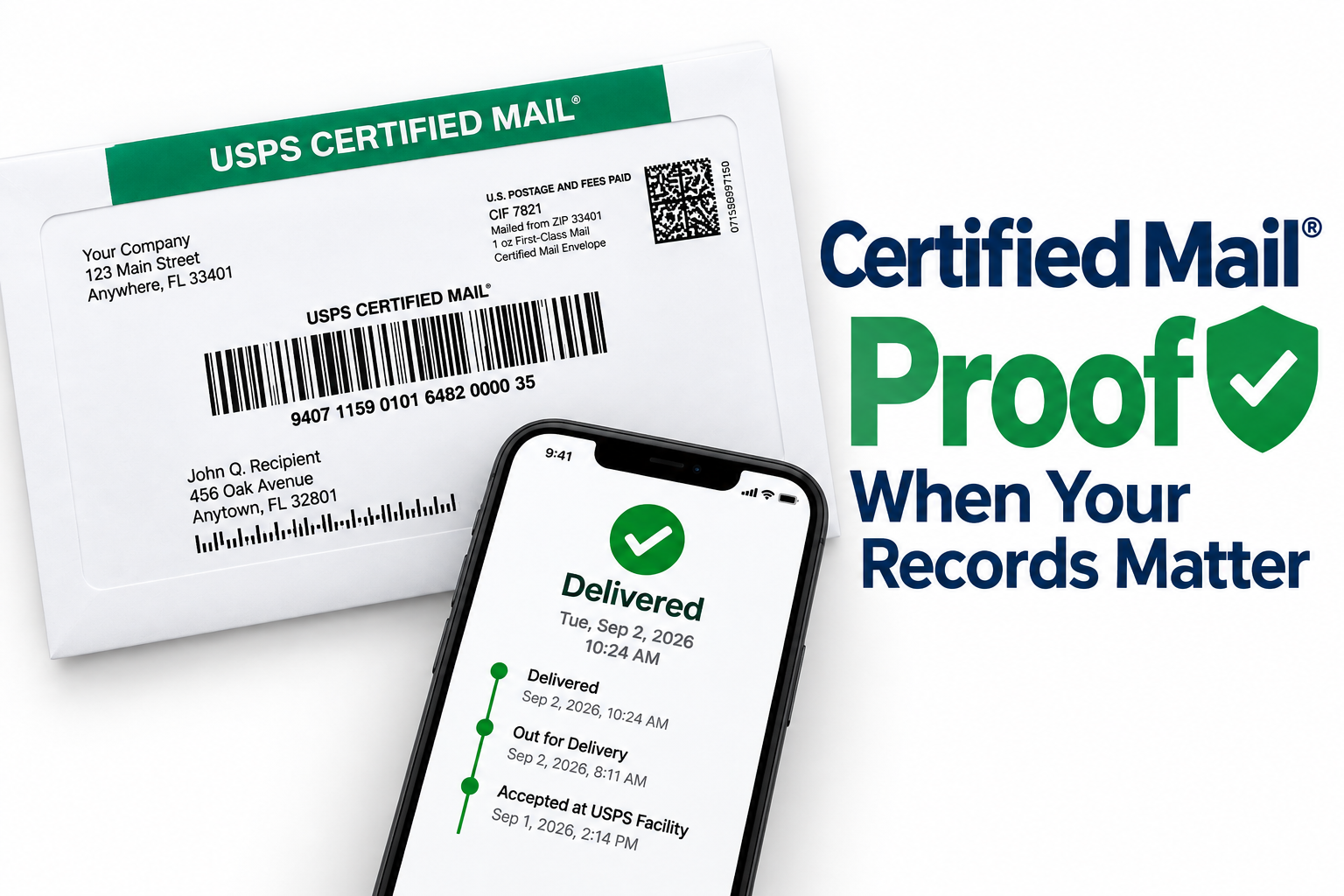 A cancellation or non-renewal notice may be accurate, timely, and properly addressed, but still become difficult to defend if the insurer cannot show when and how it was mailed.
Your mailing record should help answer several practical questions:
- When was the notice sent?
- Which policyholder received it?
- Which address was used?
- Was the notice mailed to the named insured, agent, producer, or more than one recipient?
- What service was selected?
- Can you show USPS acceptance, tracking, delivery, or attempted delivery?
- Can you retrieve the notice and mailing record years later?
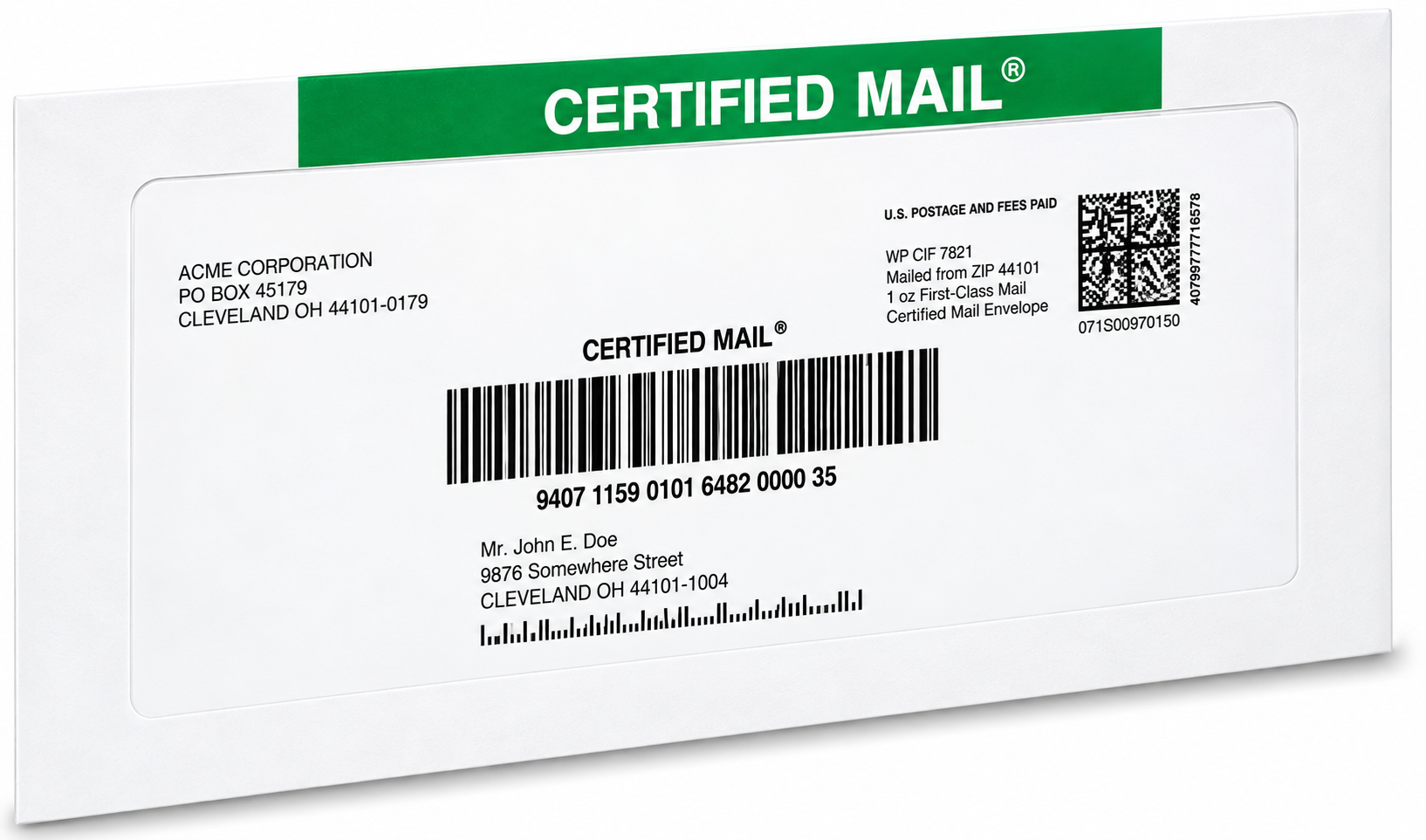
That is why legal compliance mailing is more than printing a letter. It is the creation of a repeatable record that connects the notice, address, mailing date, USPS tracking number, and delivery history.
Which States Accept Certified Mail or Proof of Mailing as Notice?
The following table groups the six verified state or insurance-line entries covered in this guide. The list is not exhaustive. Every state has its own notice statutes, timing requirements, permitted grounds, and evidence rules. Verify the current text before sending a cancellation or non-renewal notice.
| State or Line | Minimum Notice Period in the Verified Rule | Accepted or Relevant Proof of Mailing |
|---|---|---|
| Texas personal auto | Cancellation does not take effect until the 10th day after the date the insurer mails the notice; a notice mailed at least 60 days before a 12-month anniversary supports cancellation on that anniversary. | The mailing date drives the timeline. Keep reliable evidence showing when the notice was mailed. |
| Florida motor vehicle | At least 45 days before cancellation or non-renewal; 10 days for nonpayment when the reason is included. | Certified or registered mail, Intelligent Mail barcode proof, or other approved USPS tracking can establish proof of notice. |
| New York motor vehicle | At least 20 days before cancellation; 15 days for nonpayment. Non-renewal generally requires 45 to 60 days for qualifying personal-use policies and at least 20 days for others. | Regular mail with a certificate of mailing. The insurer must retain the notice and certificate, which serve as conclusive proof of compliance. |
| New York property/casualty | Covered personal policies generally require 45 to 60 days’ advance written non-renewal notice; cancellation is restricted after 60 days in force. Commercial lines have separate requirements. | Keep the notice, mailing evidence, policy address, and applicable reason for cancellation or non-renewal. |
| California | At least 20 days before cancellation; 10 days for nonpayment. Commercial property non-renewal notices generally go 60 to 120 days before the policy end date. | Written notice must be mailed to the named insured at the policy or last known address. Commercial property non-renewal also involves the producer of record. |
| South Carolina | Auto cancellation or non-renewal: at least 15 days after mailing or delivery. Property/casualty cancellation: 10 or 30 days depending on the ground; non-renewal: at least 60 days. | Proof of mailing is sufficient under the cited property/casualty provisions. Keep evidence for the insured and agent notices. |
How Does Texas Count the Days After Mailing?
For personal auto policies, Tex. Ins. Code § 551.103(e) provides that cancellation under subsections (b), (c), or (d) does not take effect until the 10th day after the date the insurer mails the notice of cancellation to the insured. Tex. Ins. Code § 551.103(f) provides that a notice mailed at least 60 days before a 12-month anniversary supports cancellation on that anniversary.
Under Tex. Ins. Code § 551.054, a non-renewal notice must be delivered or mailed to the first-named insured at the address shown on the policy.
The operational point is simple: the mailing date, not the delivery date, drives the timeline. Your compliance process should therefore capture the actual mailing event and preserve it with the notice copy and policy record.
Does Florida Accept Certified Mail as Proof of Insurance Cancellation Notice?
Yes, the verified Florida rule expressly identifies USPS proof options. Under Fla. Stat. § 627.728, motor vehicle liability insurers must mail or deliver notice of cancellation or non-renewal to the first-named insured and the insured’s agent at least 45 days before the effective date. For nonpayment of premium, the period is 10 days when the notice includes the reason.
The statute recognizes proof of mailing through the United States Postal Service, including:
- Certified mail
- Registered mail
- Proof using the Intelligent Mail barcode
- Other approved USPS tracking
Cancellation notices, except nonpayment notices, must also prominently state the insured’s right to appeal.
For insurers, this makes certified mail online workflows especially useful when the notice process must produce a clear tracking record without requiring staff to make repeated Post Office visits.
What Does New York’s Certificate of Mailing Rule Mean?
For motor vehicle liability insurance, N.Y. Veh. & Traf. Law § 313 requires termination or non-renewal notices to be sent by regular mail with a certificate of mailing.
The insurer must retain copies of:
- The notice sent to the insured
- The certificate of mailing
- The applicable mailing record
Those copies serve as conclusive proof of compliance with the mailing requirement for the covered auto notice process. The notice must also include a statement in at least 12-point type about maintaining continuous proof of financial security.
For New York property and casualty policies, N.Y. Ins. Law § 3425 governs covered personal policies. Policies may be canceled only on specified grounds after 60 days in force, and non-renewal generally requires 45 to 60 days’ advance written notice with the reasons.
For commercial lines, N.Y. Ins. Law § 3426 governs written notice mailed or delivered to the first-named insured at the policy address.
The practical lesson is to retain the notice and mailing evidence together. Do not rely only on an internal spreadsheet showing that a letter was scheduled or marked “sent.”
What Should the Notice Contain and Who Gets a Copy?
The answer depends on the state, policy type, cancellation ground, and whether the notice is for cancellation or non-renewal. Still, your mailing checklist should confirm the following before the envelope is prepared:
- The correct named insured
- The correct policy address or last known address
- The policy number and effective dates
- The effective date of cancellation or non-renewal
- The specific reason when required
- Appeal or review language when required
- The agent or producer recipient when required
- Any required font, statement, or consumer-rights language
- The correct USPS service and tracking option
- A retained copy of the final notice
What Does California Require for Mailed Insurance Notices?
Under Cal. Ins. Code § 677, cancellation notices must be in writing and mailed to the named insured at the policy address or the insured’s last known address. The notice must state the grounds relied upon.
Under Cal. Ins. Code § 662, a cancellation notice must be mailed or delivered to the named insured at least 20 days before cancellation becomes effective, or 10 days for nonpayment of premium.
For commercial property policies, Cal. Ins. Code § 678.1 requires non-renewal notices to go to the producer of record and the named insured 60 to 120 days before the policy end date.
California’s requirements make address control important. A notice workflow should pull the policy address from the correct source, flag missing or outdated address information, and preserve evidence that the final notice was mailed.
What Does South Carolina Require for Insurance Notice Mailing?
For automobile insurance, S.C. Code § 38-77-120 requires written notice delivered or mailed to the named insured at the policy address. The notice must state an effective date at least 15 days after mailing or delivery, identify the specific reason, and explain the insured’s right to request director review within 15 days of receipt.
For property and casualty policies, S.C. Code § 38-75-730 provides cancellation notice periods of at least 10 or 30 days before the proposed cancellation date, depending on the ground. The notice must be delivered or mailed to the insured and agent of record, and proof of mailing suffices as proof of notice.
Under S.C. Code § 38-75-740, non-renewal notices must go to the insured and agent at least 60 days before expiration. Proof of mailing suffices here as well.
How Can You Build a Defensible Mailing Record?
A reliable workflow should make each step easy to verify:
- Finalize the approved notice.
- Confirm the recipient address against the policy record.
- Confirm whether the agent, producer, or other party must receive a copy.
- Select the required USPS mailing service.
- Record the mailing date and tracking number.
- Preserve the USPS acceptance or mailing record.
- Monitor delivery or attempted delivery.
- Store the notice, tracking history, and delivery record together.
- Retain the file according to your organization’s compliance policy.
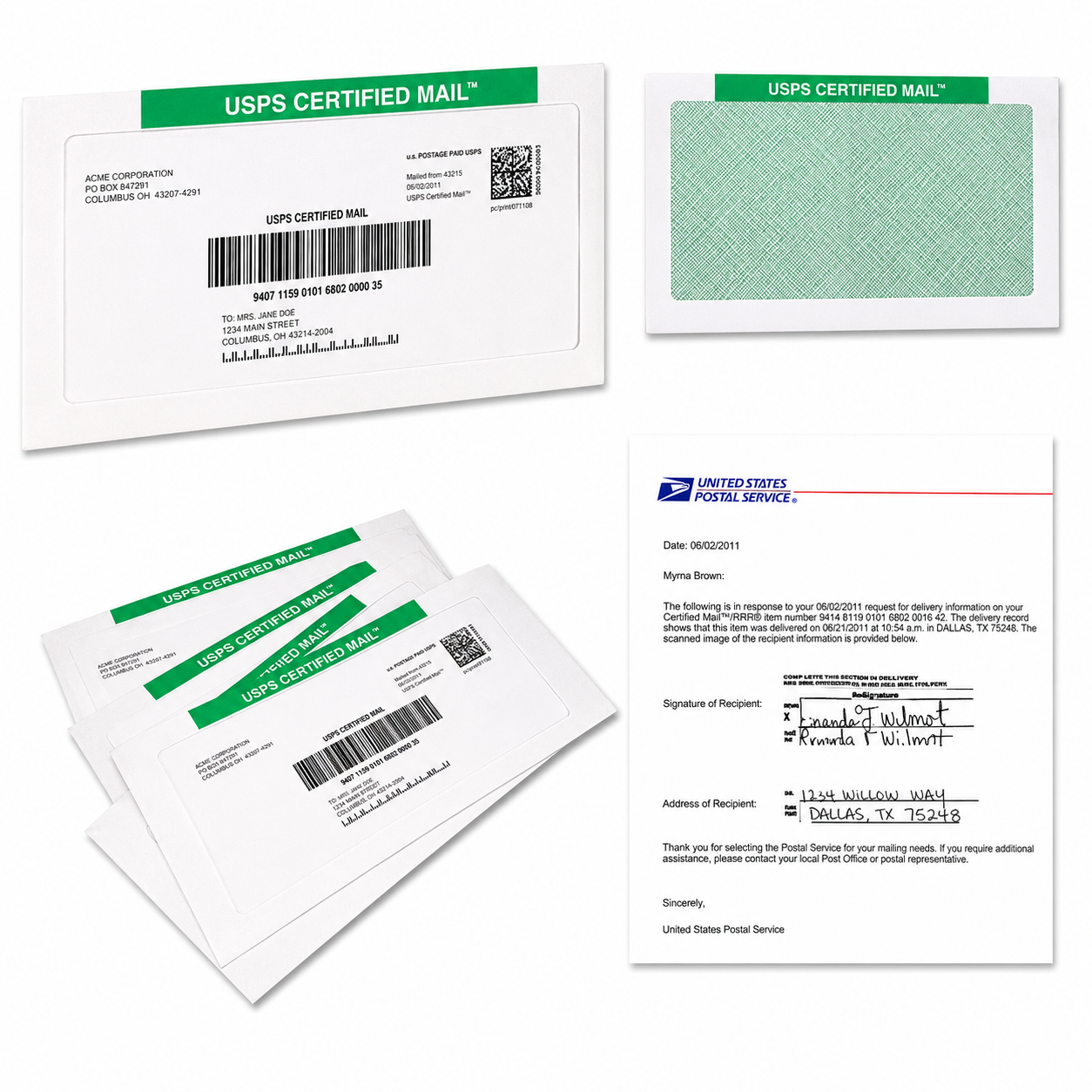
You can create and print USPS Certified Mail labels online using a standard office printer. The platform produces USPS Certified Mail labels with live postage, tracking, and electronic delivery confirmation, helping your team skip manual forms and reduce certified mail cost.
For a 1-ounce Certified Mail letter with Electronic Delivery Confirmation, the listed online price is $7.28, compared with $11.02 at the Post Office counter with a green card return receipt. Pricing can change, so confirm current rates before ordering.
If your team does not want to print, stuff, and mail notices internally, use the Print & Mail full-service option. Upload a PDF letter and address list, and the mailing service can print the notice, insert it into an envelope, apply postage, and mail it the same business day for orders submitted before 5:00 PM Eastern. Each mailing includes USPS proof of acceptance and a notarized affidavit of mailing.
For signature records, Electronic Return Receipt is listed at $2.91, compared with $4.65 for the paper green card, a $1.74 saving per piece. You receive a PDF delivery and signature record for files that require more than basic tracking.
The platform’s certified mail tracking and reports also help your team retrieve acceptance, tracking, delivery, and signature records. Records can remain searchable in the digital compliance archive for up to 10 years.
How Do Carriers and MGAs Handle Bulk Notice Campaigns?
High-volume notice programs need more than a stack of labels. They need consistent data, repeatable processing, and batch-level reporting.
With bulk certified mail automation, carriers and MGAs can use:
- Excel or CSV address uploads
- API integrations
- Secure SFTP transfers
- USPS SCAN forms
- Tracking and delivery reporting
- Internal reference fields for policy or claim numbers
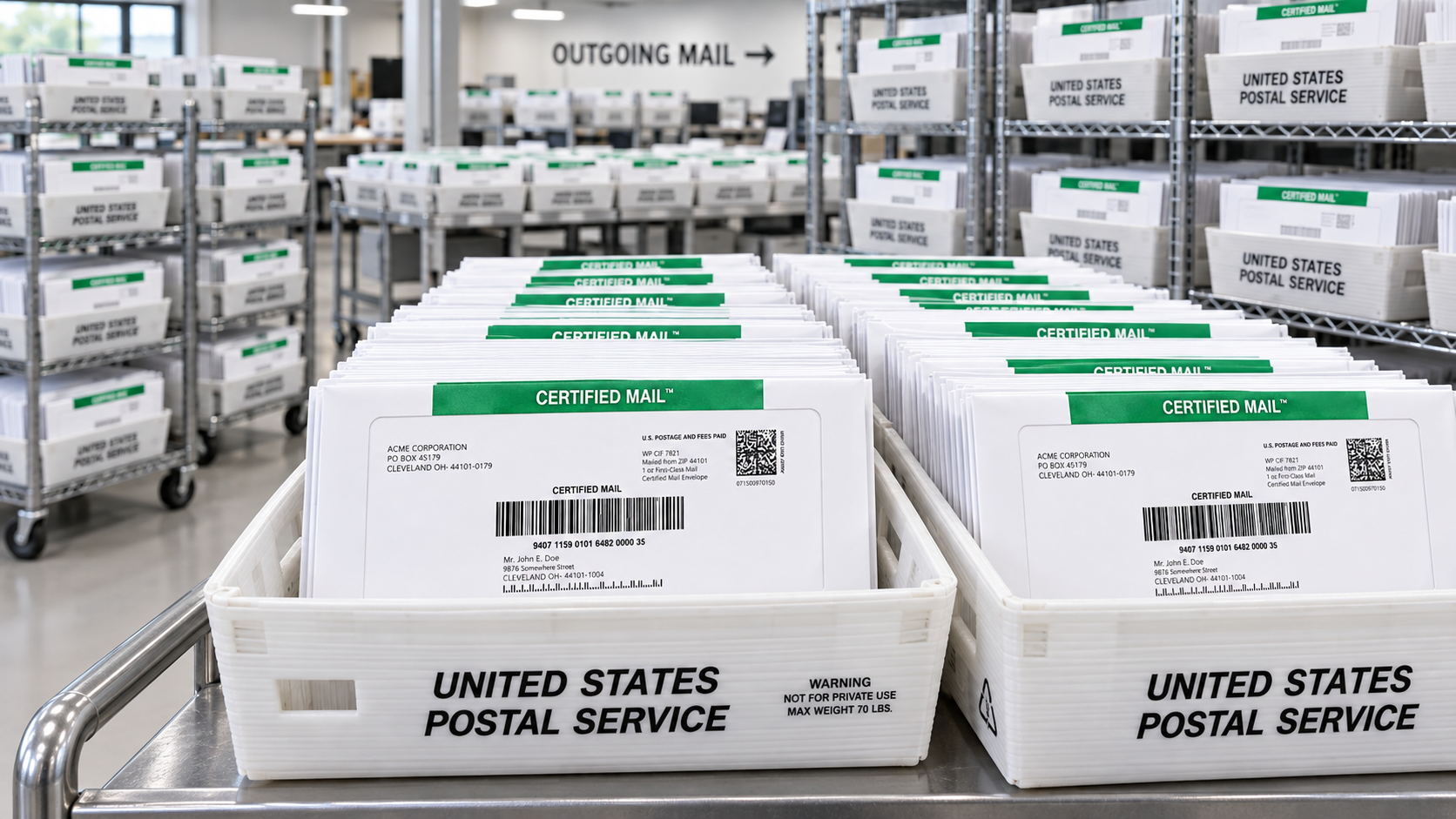
This can reduce re-keying and help connect each notice to the correct policy record. It is especially useful for non-renewal campaigns, premium notices, claims correspondence, regulatory mailings, and recurring compliance programs.
What Is the Best Way to Archive Notice Evidence?
A mailing record is most useful when your team can find it quickly during an audit, customer dispute, regulatory inquiry, or litigation request.
Store the following together:
- Final notice PDF
- Recipient and policy address
- Mailing date
- USPS tracking number
- Acceptance record
- Delivery or attempted-delivery history
- Electronic Return Receipt, when purchased
- Agent or producer copy
- Internal policy or claim reference
- Affidavit of mailing, when using a full-service mailing workflow

A searchable archive can be more practical than paper files or disconnected email attachments. It gives your team a central place to retrieve proof when the notice was sent months or years earlier.
Frequently Asked Questions About Insurance Notice Mailing
Does Florida accept certified mail as proof of insurance cancellation notice?
Yes. Fla. Stat. § 627.728 recognizes USPS proof of mailing through certified or registered mail, Intelligent Mail barcode proof, or other approved USPS tracking. The statute also sets separate notice periods for most cancellations and nonpayment cancellations.
How many days’ notice does Texas require for auto policy cancellation?
Under Tex. Ins. Code § 551.103(e), personal auto cancellation under subsections (b), (c), or (d) does not take effect until the 10th day after the date the insurer mails the notice to the insured. Under Tex. Ins. Code § 551.103(f), a notice mailed at least 60 days before a 12-month anniversary can support cancellation on that anniversary. Confirm the specific facts and current statutory text with compliance counsel.
What is a certificate of mailing and why does New York require it?
A certificate of mailing is a postal record showing that an item was presented for mailing. Under N.Y. Veh. & Traf. Law § 313, New York auto insurers must send certain termination or non-renewal notices by regular mail with a certificate of mailing and retain copies of the notice and certificate as conclusive proof of compliance.
Is cancellation effective on the mailing date or the delivery date?
It depends on the statute and policy line. Texas expressly ties the personal auto cancellation timeline to the mailing date. Other states may require delivery or recognize proof of mailing as sufficient proof of notice. Do not assume one state’s timing rule applies in another state.
Does the notice need to go to the agent too?
Sometimes. Florida requires notice to the first-named insured and the insured’s agent. South Carolina’s property/casualty provisions require notice to the insured and agent of record. California commercial property non-renewal notices must go to the producer of record and named insured. Confirm the applicable rule before mailing.
Is Certified Mail Labels a substitute for legal or compliance advice?
No. Certified Mail Labels provides mailing tools, USPS Certified Mail labels, tracking, delivery records, and related services. It does not determine which notice statute applies or whether your notice content is legally sufficient. Have your compliance counsel confirm the requirements for each state and policy type.
Ready to Prove You Mailed the Notice?
Your next notice mailing can be faster, easier, and better documented. Print USPS Certified Mail labels online, choose the tracking and receipt options your process requires, and keep your mailing evidence organized from the start.
You’ll save time, reduce manual work, and create a stronger record of when your insurance cancellation or non-renewal notice went out, without a trip to the Post Office.