
Getting the Mailing Method Right
Last reviewed: October 2026
This page is reviewed every January and again after any state legislative session that amends a common-interest community notice statute.
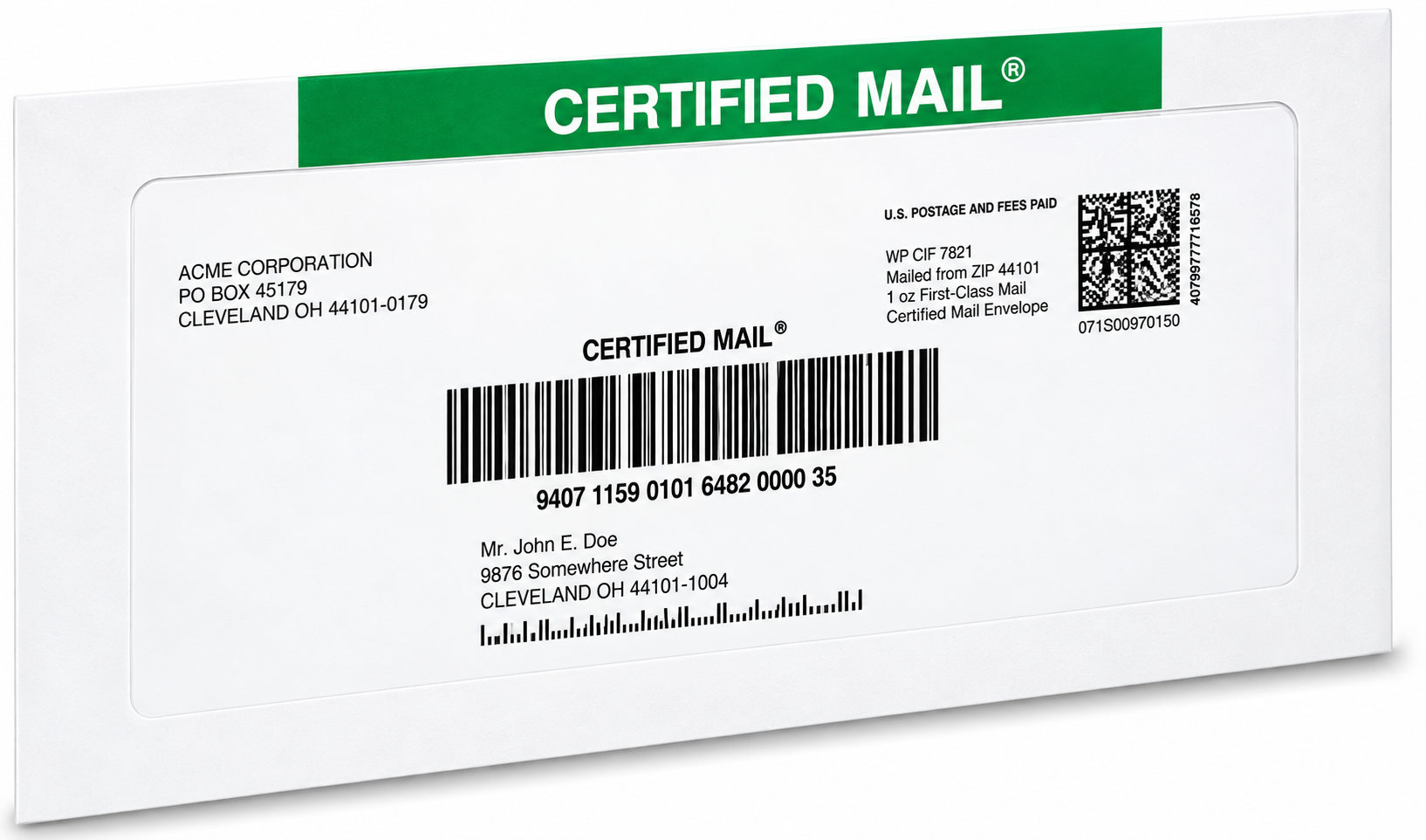
Some states require an association's delinquency or lien notice to go out by certified mail, return receipt requested. Arizona's is the clearest example, applying to both planned communities and condominiums. Texas requires certified mail with return receipt requested before an association can hold an owner liable for collection-agent fees, and North Carolina requires certified mail before suit on a non-collection matter. The verified states below show the pattern, and the cure windows range from 30 to 45 days.
This is a general informational guide for community association managers, HOA boards, attorneys, and collection agencies. It is not legal advice, and Certified Mail Labels does not determine which notice your association must send. State rules change. Confirm the current statute, governing documents, and mailing method with your association counsel before sending a lien, delinquency, violation, or fine notice.
Which States Require an HOA Delinquency Notice by Certified Mail?
The verified rules in this guide show that mailing method matters just as much as notice language and timing.
State-by-State Notice Requirements
| State and Community Type | Verified Rule |
|---|---|
| Arizona Planned Communities: A.R.S. § 33-1807 | At least 30 days before authorizing an attorney or outside collection agency to begin collection activity, the association must send written notice of the delinquent account. The notice must be in boldfaced type or all capital letters, include payment contact information, and be sent by certified mail, return receipt requested. |
| Arizona Condominiums: A.R.S. § 33-1256 | The same basic 30-day notice rule applies to condominium unit owners. The written notice must be bold or all caps, include contact information for discussing payment, and be sent by certified mail with return receipt requested. |
| Texas, Tex. Prop. Code § 209.0064 | Before a property owners’ association can hold an owner liable for collection-agent fees, written notice must be sent by certified mail with return receipt requested or an equivalent signature-confirmation service. The notice must itemize delinquent amounts, explain available options, and provide at least 45 days to cure. |
| Texas, Tex. Prop. Code § 215.016 | Before filing suit for a matter other than collecting regular or special assessments or judicial foreclosure, the association must send written notice by certified mail, return receipt requested. The notice must describe the violation or charge, provide a cure period, and explain the owner’s right to request a hearing under § 215.017. |
| North Carolina | Association notice methods are set by statute and should be verified against the current text. Chapter 47F governs planned communities and Chapter 47C governs condominiums. Do not confuse North Carolina’s mechanics lien statute, N.C. Gen. Stat. § 44A-8, with HOA assessment or condominium notice requirements. |
This list is not exhaustive. Many states have their own common-interest community statutes, notice deadlines, hearing procedures, lien rules, and service requirements. Always check the current text before beginning a legal compliance mailing.
What Does Arizona’s 30-Day Notice Require?
Arizona provides one of the clearest examples of a required certified mail process for association delinquencies.
How Does A.R.S. § 33-1807 Apply to Planned Communities?
Under A.R.S. § 33-1807, when a member’s account for common expenses is delinquent, the planned community association must provide written notice at least 30 days before it authorizes an attorney or a collection agency that is not acting as the association’s managing agent to begin collection activity.
The notice must state that:
- The account is delinquent.
- The owner has 30 days to bring the account current or make payment arrangements approved by the association.
- Failure to do so may result in further collection proceedings, including foreclosure.
The notice must also:
- Use boldfaced type or all capital letters.
- Include contact information for discussing payment.
- Be sent by certified mail, return receipt requested.
- Go to the member’s address provided to the association.
The notice may be included with other correspondence about the delinquent account, but the required language and mailing method still matter.
How Does A.R.S. § 33-1256 Apply to Condominiums?
Under A.R.S. § 33-1256, condominium associations follow the same basic process for a delinquent condominium unit account.
The association must send written notice to the owner’s address on file at least 30 days before authorizing collection activity by an attorney or outside collection agency. The notice must be in bold or all capital letters, provide payment contact information, and be sent by certified mail with return receipt requested.
For both planned communities and condominiums, the key operational point is simple: do not treat a routine first-class letter as a substitute for the required certified mailing.
What Is Texas’s Notice Before Collection-Agent Fees Rule?
Texas uses a different notice structure. Under Tex. Prop. Code § 209.0064, a property owners’ association must send written notice before holding an owner liable for any fee charged by a collection agent.
The notice must:
- Be sent by certified mail with return receipt requested or an equivalent signature-confirmation service.
- Go to the owner’s address in the most recent management certificate filed under § 209.004.
- Specify each delinquent amount.
- State the total amount required to bring the account current.
- Describe available options, including payment plans when applicable.
- Provide at least 45 days for the owner to cure the delinquency before further collection action.
This rule is especially important for management companies and collection agencies. A notice that does not clearly itemize the balance, explain the cure opportunity, or use the required mailing method can create avoidable process problems.
What Is Texas’s Notice Before Filing Suit Rule?
Under Tex. Prop. Code § 215.016, before filing suit for a matter other than collecting regular or special assessments or judicial foreclosure, the association must send written notice by certified mail, return receipt requested.
The notice must describe the violation or charge, provide a cure period, and inform the owner of the right to request a hearing under § 215.017.
This creates an important distinction for HOA fine notices and other enforcement matters. Do not assume that the same letter, deadline, and service method apply to every type of association action. Identify the action first, then verify the statute and governing documents that control it.
What Should the Notice Contain?
Before you prepare a legal compliance mailing, review both the substance and the delivery record.
Here are just a few items to confirm:
- You’ll identify the correct recipient and address. Use the address required by the applicable statute and the association’s current records.
- You’ll describe the delinquency, charge, or violation clearly.
- You’ll itemize amounts when the statute requires it.
- You’ll state the cure period in plain language.
- You’ll explain payment arrangements or hearing rights when required.
- You’ll include the correct association contact information.
- You’ll use boldfaced or all-capital language when required.
- You’ll select certified mail and the appropriate receipt service.
- You’ll keep the USPS acceptance, tracking, delivery, and signature records.
You won’t want to rely on a mailing spreadsheet alone. A complete record should connect the final notice, recipient address, tracking number, USPS acceptance event, delivery status, and receipt or signature record.
How Can You Make HOA Notice Mailing Faster and Easier?
You have several practical options depending on volume and staffing.
Can You Create and Print Certified Mail Labels Online?
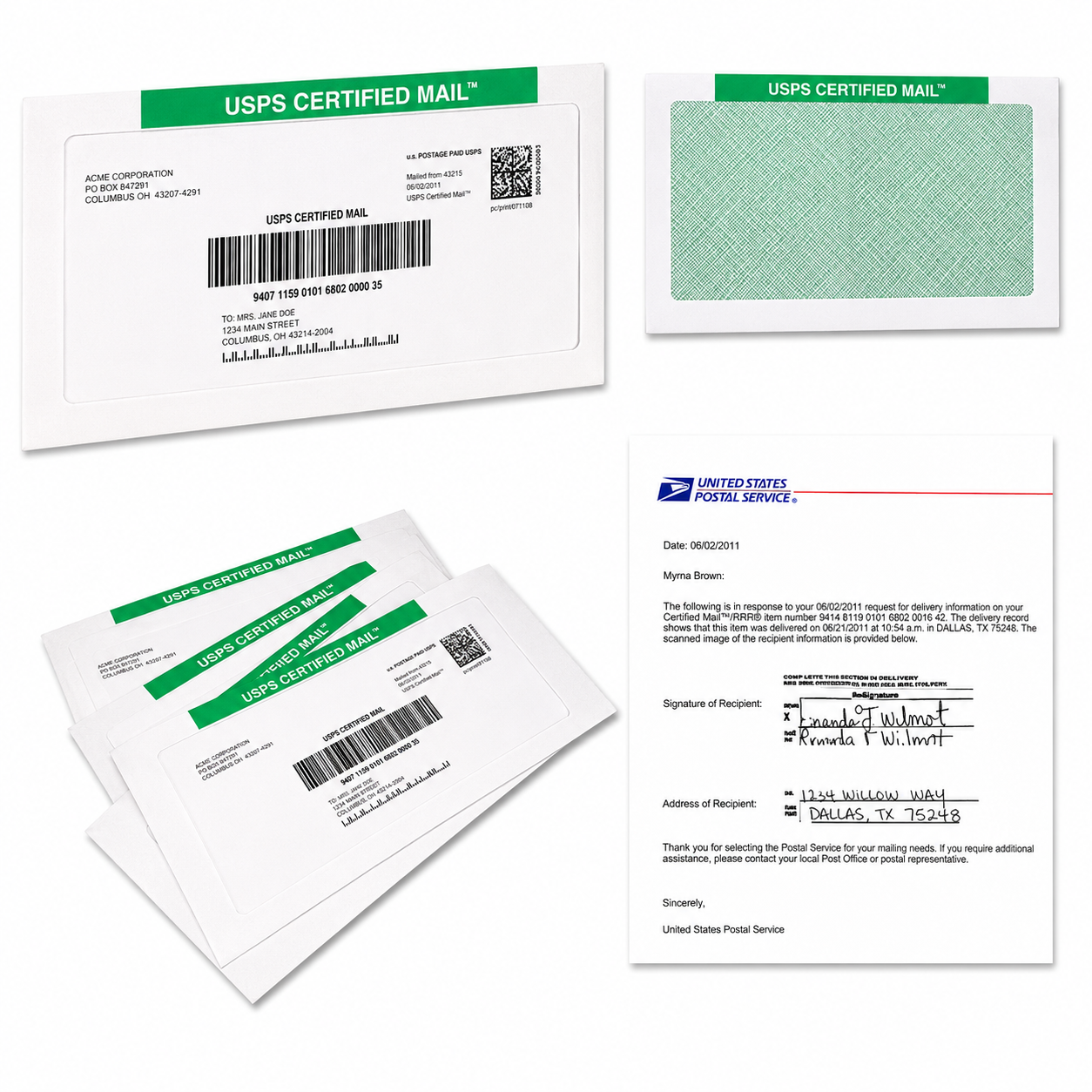
Yes. With Certified Mail Labels’ online label printing flow, you can create and print USPS Certified Mail labels online using a standard office printer or adhesive sheets.
This is useful when your team already prints notices in-house and wants to:
- Skip the Post Office trip.
- Create USPS certified mail labels online.
- Add electronic delivery confirmation.
- Organize tracking numbers by mailing campaign.
- Keep the mailing process consistent across staff.
- Reduce counter costs and manual entry.
A 1-ounce certified mail letter with Electronic Delivery Confirmation is priced at $7.28 online versus $11.02 at the Post Office counter, according to the pricing context provided by Certified Mail Labels.
When Should You Use Print & Mail?
If you do not want to print, fold, stuff, label, and mail every notice yourself, use the Print & Mail full-service option.
You upload:
- A PDF letter.
- An address list.
- Your selected mailing options.
The service handles printing, envelope insertion, postage application, and USPS mailing. Orders submitted before 5:00 PM Eastern can be mailed the same business day, and each mailing includes a notarized affidavit of mailing.
This is ideal for an association notice campaign when you need reliable execution without adding temporary staff, equipment, or administrative work.
How Does Bulk Certified Mail Work for Management Companies?
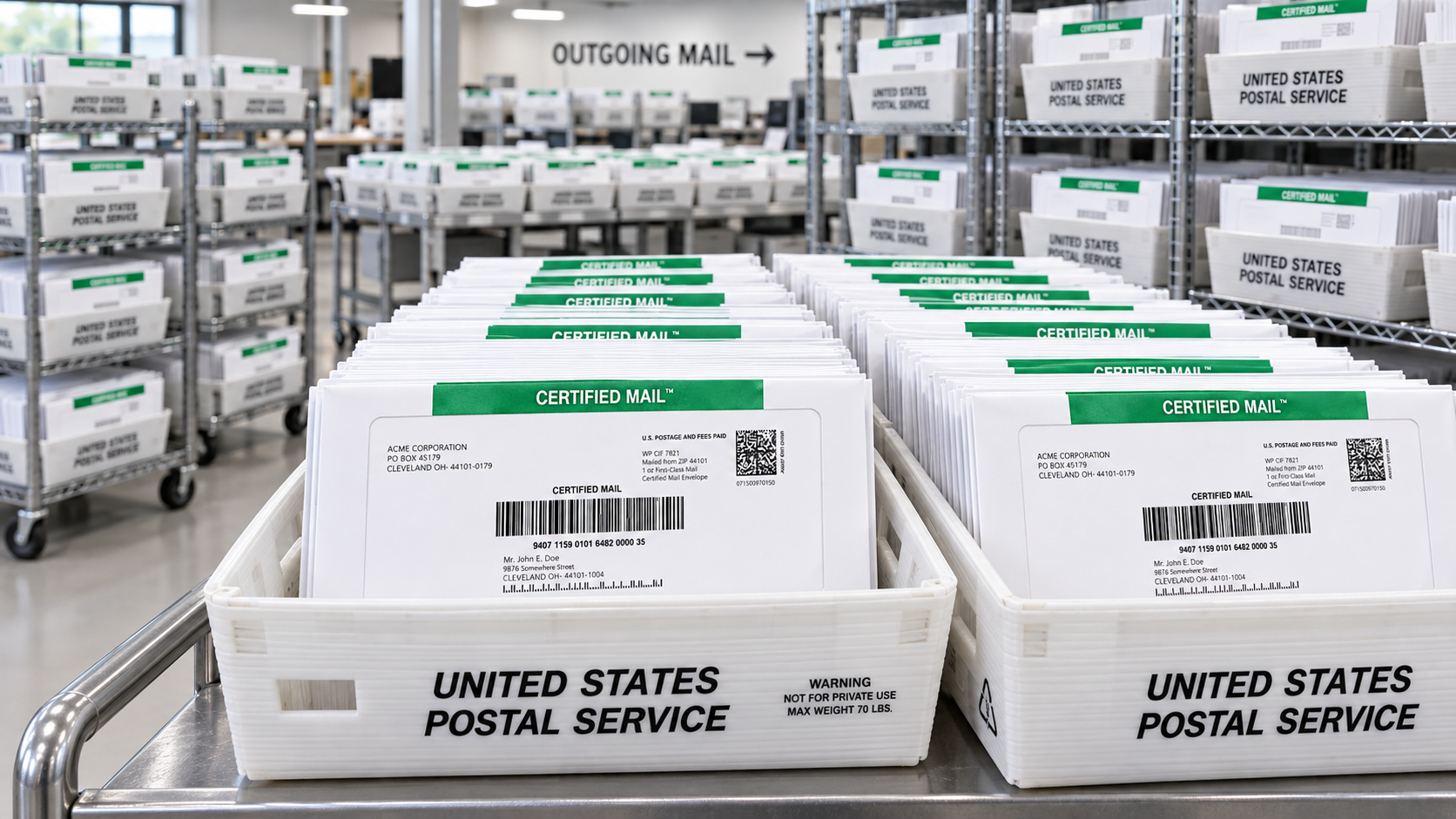
For hundreds of delinquency or violation notices, bulk Certified Mail automation can help management companies and collection agencies move faster.
Available workflows include:
- Excel or CSV address-list uploads.
- API integrations.
- Secure SFTP transfers.
- USPS SCAN forms for high-volume acceptance.
- Batch tracking and mailing records.
You’ll get a repeatable workflow for recurring assessment notices, payment-plan letters, and other association correspondence. No monthly fees, no long-term contracts, and no equipment lease are required for a pay-as-you-go process.
What Is the Best Receipt Option for Association Notices?
Return receipt requirements should be matched to the applicable statute and your counsel’s instructions.
An Electronic Return Receipt can provide a PDF record with delivery information and a recipient signature. The Electronic Return Receipt option is listed at $2.91, compared with $4.65 for the traditional paper green card, a $1.74 saving per piece.
You’ll receive a digital record that is easier to download, store, search, and share with counsel. Instead of managing physical green cards, your team can organize the receipt with the notice and tracking history.
Certified Mail Labels also provides a Certified Mail tracking workflow and long-term digital records for mailing activity. A searchable archive can help you locate acceptance scans, tracking events, delivery confirmations, and signature records when an owner dispute, audit, or litigation request arises.

What Should an Association Do Before Sending the Notice?
Use this short process before every campaign:
- Identify the action. Is it an assessment delinquency, collection-agent fee issue, lien-related notice, violation, fine, or non-assessment lawsuit?
- Confirm the controlling rule. Review the current statute, declaration, bylaws, collection policy, and counsel’s instructions.
- Verify the address. Confirm the mailing address required by law and association records.
- Prepare the notice language. Include amounts, deadlines, payment options, cure rights, hearing rights, and contact details when required.
- Choose the delivery method. Select certified mail, return receipt requested, or another permitted signature-confirmation service.
- Save every record. Retain the final letter, address file, label, USPS acceptance, tracking, delivery result, and receipt.
- Review exceptions. If mail is refused, returned, or not picked up, ask counsel what the applicable rule requires next.
Frequently Asked Questions About HOA Certified Mail Notices
Does Arizona Require Certified Mail for HOA Delinquency Notices?
Yes. Under A.R.S. § 33-1807, planned communities must send the required delinquent common-expense notice by certified mail, return receipt requested. Under A.R.S. § 33-1256, Arizona condominiums follow the same basic certified mailing requirement.
What Does Return Receipt Requested Mean for an Association Notice?
It means the mailing includes a USPS receipt service designed to document delivery or the recipient’s signature, depending on the option selected. It creates an additional record that can support your legal compliance mailing file. Confirm with counsel which receipt option is appropriate for your notice.
How Long Does a Texas Owner Have to Cure a Delinquency Before Collection Fees?
Under Tex. Prop. Code § 209.0064, the notice must provide at least 45 days for the owner to cure the delinquency before further collection action related to collection-agent fees.
Can an HOA File a Lien Without Notice?
The answer depends on the state, community type, governing documents, and specific action. The verified rules in this guide address notice before certain collection activity, collection-agent fees, and non-assessment lawsuits. They should not be read as a complete statement of every lien procedure. Ask association counsel before filing or enforcing a lien.
What If the Owner Never Picks Up the Certified Mail?
Do not assume that an unclaimed mailing automatically satisfies every legal requirement. Preserve the mailing record and ask counsel what the applicable statute, governing documents, and service rules require next.
Is This List of States Exhaustive?
No. Arizona, Texas, and North Carolina are the verified examples covered here. Many other states have separate HOA and condominium statutes. Check the current statutory text and obtain advice from association counsel before sending notices.
Start Your Certified Mail Notice Process Online
Your association notices are important. You need the right language, the right deadline, the right mailing method, and a reliable record of what happened after the letter left your office.
Create and print USPS Certified Mail labels online, use a standard office printer, or upload your PDF and address list for same-business-day Print & Mail service. For recurring campaigns, move to bulk automation and keep your tracking and receipt records organized.
Start the process today to save time, reduce mailing costs, and print certified mail labels online without a trip to the Post Office.