
 Last reviewed: October 2026
Review cadence: Reviewed each January and again after any state legislative session, state Medicaid manual update, or CMS rule change affecting notice requirements.
If you manage Medicaid, HCBS, or healthcare termination notices, the short answer is this: federal rules generally require advance written notice, specific notice content, appeal rights, and sometimes continuation of services, but they do not generally require certified mail by name. Certified Mail is required when your state Medicaid manual, HCBS waiver operating agreement, provider agreement, managed-care contract, housing rule, or other controlling policy says it is. Where no rule names a delivery method, certified mail with Electronic Delivery Confirmation or an Electronic Return Receipt is simply the smart, defensible standard for documenting what you sent, when you sent it, and whether it reached the recipient.
What Is The Federal Floor For Medicaid And HCBS Notices?
Federal Medicaid and HCBS rules create a protections floor. That floor focuses on notice, timing, content, person-centered planning, and appeal rights.
For a standard Medicaid action involving termination, suspension, or reduction of services, the agency must provide advance written notice and explain the action, effective date, reasons, supporting regulations, hearing rights, and continuation-of-benefits rules. The general framework appears in 42 CFR part 431, subpart E (§§ 431.211–431.244), including 42 CFR § 431.210 and § 431.211.
For state plan HCBS, the state must provide individuals advance notice and the right to appeal when Medicaid eligibility or covered services are terminated, suspended, or reduced, as described in 42 CFR § 441.745. For 1915(c) waiver services, the person-centered service plan must reflect the individual’s needs, preferences, goals, supports, and chosen setting. Any modification to certain setting conditions must be supported by a specific assessed need, justified in the plan, and reviewed within established time limits under 42 CFR § 441.301.
Managed-care plans have an additional notice and appeal framework. Under 42 CFR §§ 438.404–438.408, a plan must provide timely and adequate written notice of an adverse benefit determination, explain appeal rights, and describe continuation of benefits when applicable. Termination, suspension, or reduction of an ongoing service may require continuation while a timely appeal is pending.
A whole-waiver termination has its own rule. Under 42 CFR § 441.307, beneficiaries generally must receive notice 30 days before waiver services are terminated, with notice content tied to 42 CFR § 431.210.
Nursing-facility transfer and discharge situations can involve additional protections, including the 30-day written notice requirement described in 42 U.S.C. § 1396r-5(b)(2).
None of these federal citations, by themselves, says that the notice must be sent by USPS Certified Mail.

Where Is Certified Mail Required And Where Is It Simply Smart?
Use this two-layer framework before sending an important notice:
| Certified Mail Required (Federal Floor) | Certified Mail Simply Smart (State/Policy Layer) |
|---|---|
| Federal HCBS and Medicaid rules require advance written notice, required content, appeal information, and applicable continuation-of-benefits rights. | A state Medicaid manual, waiver manual, provider agreement, MCO contract, housing rule, or internal policy may require certified mail. |
| Federal rules generally do not name certified mail as the delivery method for individual HCBS termination notices. | If the state manual or contract says “certified mail,” “certified mail return receipt requested,” or similar language, follow that requirement. |
| A whole-waiver termination generally requires beneficiary notice 30 days before services end under 42 CFR § 441.307. | Certified mail is a defensible delivery method when no specific method is stated and the matter could lead to an appeal, audit, dispute, or housing-related review. |
| Managed-care adverse benefit notices must be written and timely under 42 CFR §§ 438.404–438.408. | Electronic Delivery Confirmation or an Electronic Return Receipt can document mailing, tracking, delivery, and, when selected, recipient signature information. |
| HIPAA governs PHI privacy and security. HIPAA does not mandate certified mail. | Certified mail can support a documented administrative-safeguard process for notices containing limited PHI. |
The practical answer is direct: mandatory where named; smart where not named.
Why Do State Manuals And Contracts Matter So Much?
State Medicaid programs operate within the federal protections floor, but they frequently add operational requirements. Those requirements may appear in places your team does not review every day:
- State Medicaid provider manuals
- HCBS waiver manuals and operating agreements
- Managed-care organization contracts
- Provider participation agreements
- Case-management procedures
- Nursing-facility transfer and discharge policies
- Supportive-housing or residential program rules
- Internal compliance policies incorporated into a contract
A state policy may require certified mail with return receipt for a provider-initiated discharge, an involuntary service termination, a housing-related adverse action, or a notice to an authorized representative. A managed-care contract may also require a particular delivery method even when the federal regulation does not.
Before sending a notice, search the current state manual and contract for terms such as certified mail, return receipt, proof of delivery, last known address, authorized representative, advance notice, and appeal.
If the document says certified mail, do not substitute ordinary first-class mail just because federal law does not independently require certified mail. The state or contract language may still be binding on your organization.
Does HIPAA Require Certified Mail For Termination Notices?
No. HIPAA does not itself mandate certified mail for Medicaid, HCBS, provider termination, housing, or patient notices.
45 CFR parts 160 and 164, including 45 CFR § 164.502 and § 164.512, address permitted and required uses and disclosures of protected health information, including disclosures required by law. The Privacy and Security Rules also call for reasonable administrative, physical, and technical safeguards.
Certified mail can support that administrative-safeguard logic because it creates a stronger record of the mailing process. But it does not replace good privacy practices. You should still:
- Use the minimum necessary PHI.
- Verify the recipient’s current address.
- Follow any confidential-communications request.
- Address authorized representatives correctly.
- Use a secure workflow for uploading and storing notices.
- Follow your organization’s HIPAA policies and business-associate requirements.
The correct statement is: HIPAA may support careful, documented mailing practices, but HIPAA does not require USPS Certified Mail.

What Records Should You Keep For An Appeal Or Audit?
A notice process is only as strong as the records you can retrieve later. For each termination, reduction, suspension, transfer, discharge, or housing-related adverse action, keep a complete mailing file:
- Final notice PDF
- Address and recipient record used
- Date and time the notice was prepared
- Date the item entered the USPS system
- USPS tracking number
- Acceptance scan
- Delivery or attempted-delivery event
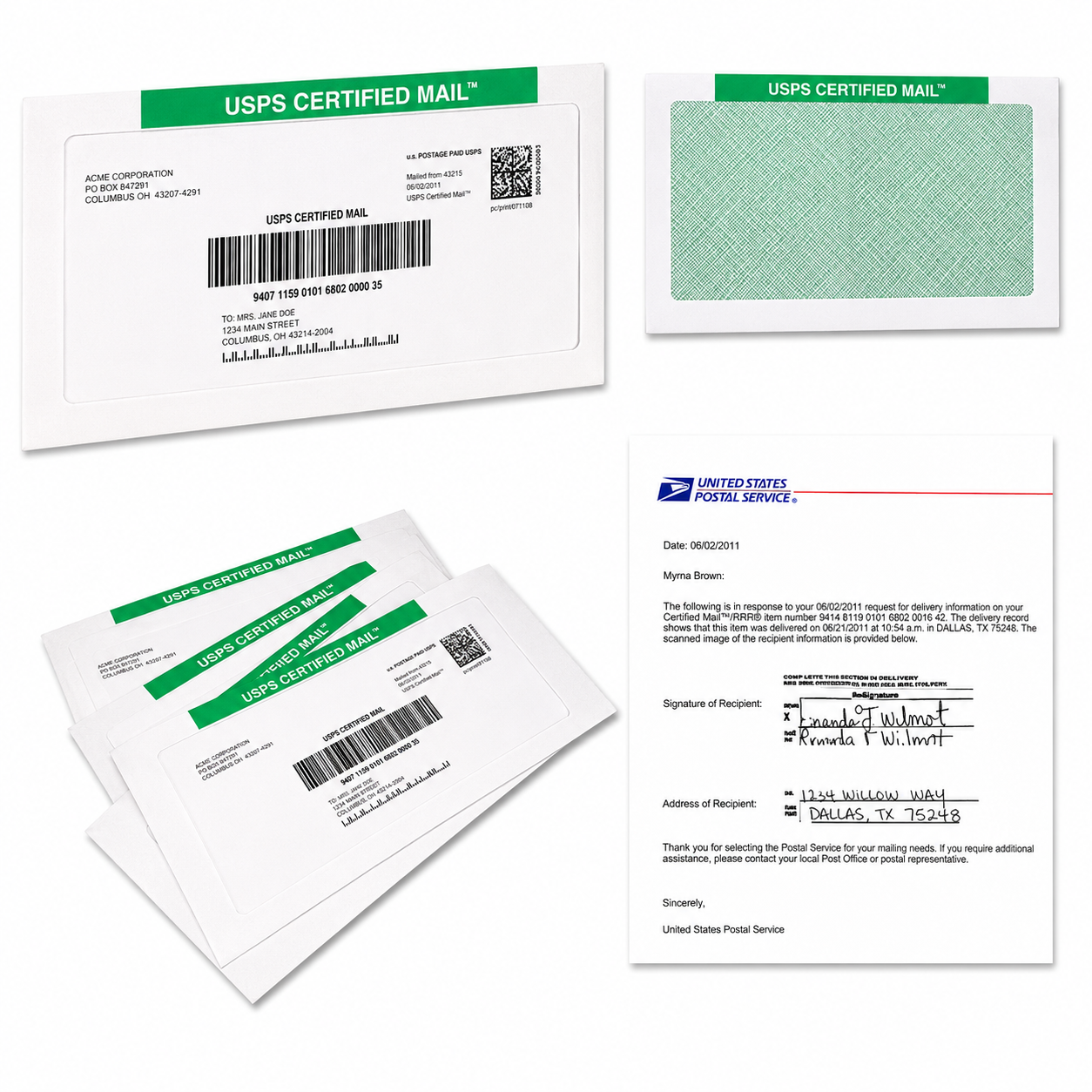
- Electronic Return Receipt or signature record, if selected
- Returned-mail image or explanation, if delivery failed
- Proof of mailing or affidavit of mailing
- Internal approval and review notes
- Appeal request and related correspondence
Certified Mail Labels provides a searchable 10-year compliance archive for mailing history, USPS acceptance scans, tracking events, delivery confirmations, and signature records at no extra charge. That can make a significant difference when a case resurfaces long after the original notice was sent.
How Can You Send These Notices Without A Post-Office Trip?
You have several practical options.
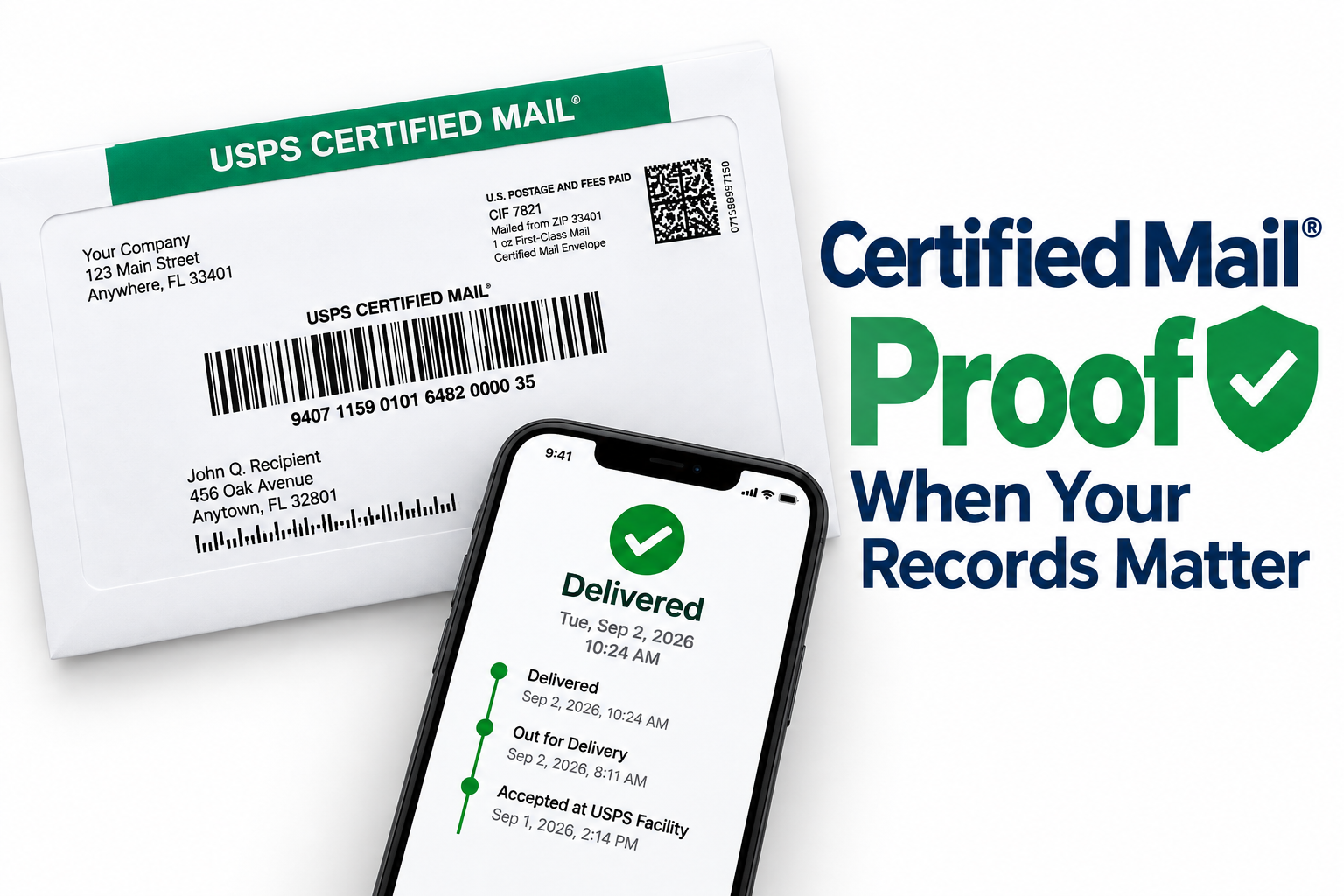
Create and print your own USPS Certified Mail labels. Use the online Certified Mail label creator to create live-postage USPS Certified Mail labels. Print them from your office or home on a standard printer or adhesive sheets.
Use Print & Mail when staff time is limited. Upload your notice PDF and address list through the Print & Mail workflow. Certified Mail Labels can print the letters, insert them into envelopes, apply postage, and mail qualifying orders the same business day when received before 5:00 p.m. Eastern. Orders include USPS proof of acceptance and a notarized affidavit of mailing.
Automate recurring or high-volume notices. For large waiver populations, annual reductions, provider lists, or multi-site housing operations, use Excel or CSV batch processing, API integration, or secure SFTP transfers.
Choose electronic proof based on what your policy requires. Electronic Delivery Confirmation can provide delivery status and tracking. An Electronic Return Receipt can provide electronic signature information when a signature record is needed. Review your state policy or contract to confirm which option satisfies your requirement.
The listed rate for a 1-ounce Certified Mail letter with Electronic Delivery Confirmation is $7.28, compared with $11.02 at the Post Office counter. Print & Mail is listed at $8.43 for a one-page letter. There are no monthly fees, contracts, or equipment leases, and the compliance archive is included.
What Should Your Notice Workflow Include?
Build a simple checklist your team can use every time:
- Identify the action: termination, suspension, reduction, transfer, discharge, or waiver termination.
- Confirm the controlling authority: federal rule, state manual, waiver agreement, provider contract, MCO contract, or housing rule.
- Confirm the required notice period.
- Include the reason, effective date, supporting authority, appeal instructions, and continuation-of-benefits information when applicable.
- Check accessibility, language, representative, and disability-accommodation requirements.
- Confirm whether certified mail is mandatory under the state or contract.
- Select Electronic Delivery Confirmation or Electronic Return Receipt based on the proof required.
- Mail early enough to account for processing and delivery time.
- Save the mailing record, tracking, delivery information, and final notice in the designated archive.
- Review the policy after state or federal changes.
Frequently Asked Questions
Does Federal Medicaid Law Require Certified Mail For HCBS Termination Notices?
Generally, no. Federal Medicaid and HCBS rules require timely written notice and appeal rights, but they generally do not specify USPS Certified Mail as the delivery method. Certified mail becomes mandatory when a state manual, provider agreement, waiver operating agreement, managed-care contract, or other controlling policy requires it.
Does HIPAA Require Certified Mail?
No. HIPAA does not require certified mail. It governs protected health information, privacy, security, and permitted disclosures. Certified mail may be a reasonable documented safeguard for important notices containing limited PHI, but the mailing method should be confirmed with your privacy and compliance teams.
When Should A Medicaid Program Use Certified Mail Even If It Is Not Required?
Use it when the notice could lead to an appeal, audit, dispute, transfer, discharge, housing consequence, or question about whether the recipient received the document. Certified mail creates a stronger record of mailing, tracking, delivery, and signature information.
What Is The Difference Between Electronic Delivery Confirmation And Electronic Return Receipt?
Electronic Delivery Confirmation generally documents delivery status and tracking. Electronic Return Receipt is used when electronic signature or recipient-receipt information is needed. Confirm the required proof under your current state manual, contract, or policy.
Can Certified Mail Labels Give Legal Advice About My Notice?
No. Certified Mail Labels provides mailing tools and records, not legal advice. Confirm the notice language, timing, delivery method, PHI handling, and appeal procedure with your own counsel and your state Medicaid agency’s current manual.
Final Takeaway: Follow The Rule, Then Build The Record
Federal HCBS rules establish a protections floor: advance written notice, clear reasons, appeal rights, person-centered planning, and continuation protections where applicable. They do not automatically make certified mail mandatory.
Your state manual, provider agreement, waiver operating agreement, managed-care contract, or housing rule may go further. When it names certified mail, follow it. When it does not, certified mail with the right electronic proof is simply the smart, defensible choice.
Start by reviewing your current policy, confirming the delivery requirement with counsel and your state Medicaid agency, and then use Certified Mail Labels to send, track, and retain the complete record online, without a Post Office trip.