
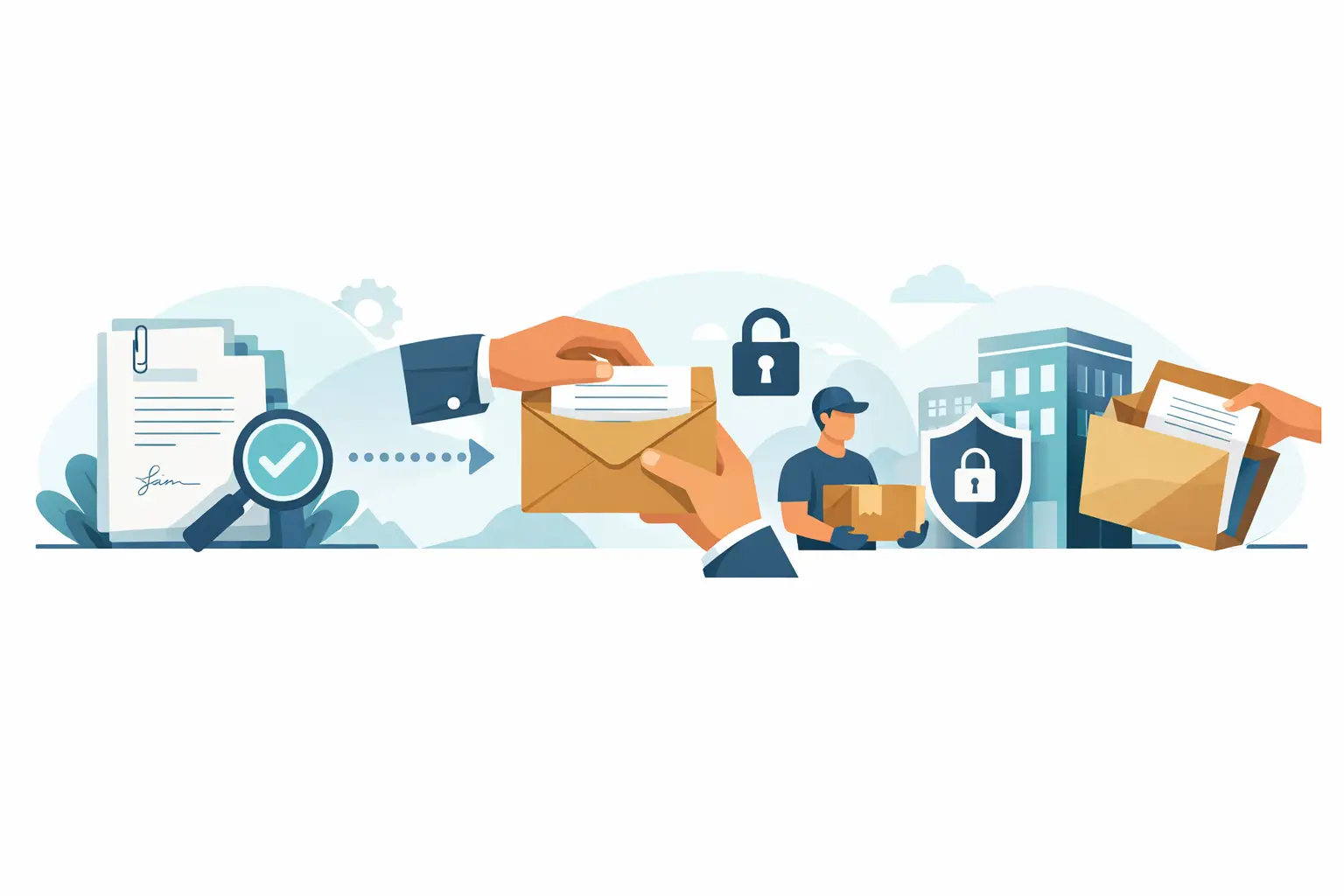
A missed signature, an unreadable receipt, or a tracking record that cannot be matched to the right letter can turn a routine mailing into a documentation problem. That is why document chain of custody mailing matters in legal, financial, regulatory, and administrative workflows. The goal is not just to send a letter. The goal is to prove what was sent, when it entered USPS custody, how it moved, and whether it was delivered or delivery was attempted.
For many organizations, that proof has to stand up later under scrutiny. A law office may need to show that a notice was mailed on a specific date. A property manager may need to document tenant correspondence. A compliance team may need a record trail that connects the recipient, mailing date, USPS acceptance, and final delivery status. In those cases, mailing is part of a controlled process, not a clerical afterthought.
What document chain of custody mailing actually means
In practice, document chain of custody mailing is the process of maintaining an auditable record from mail preparation through delivery outcome. That record should connect the document or envelope to the recipient address, the mailing class or service used, the USPS tracking number, proof that USPS accepted the piece, and the delivery result.
The strongest chain of custody is created when those records are generated in a consistent workflow instead of assembled later from paper scraps, screenshots, and memory. Manual methods can work at very low volume, but they often break down when multiple staff members prepare mail, when several letters go out at once, or when records need to be retrieved months or years later.
A useful chain of custody should answer five basic questions without guesswork. What was mailed? To whom? When was it accepted by USPS? What happened in transit? What was the final delivery event or attempted delivery event?
Why ordinary mailing records often fall short
A common mistake is assuming that a postage receipt alone proves enough. Usually it does not. A counter receipt may show that something was mailed, but it may not clearly tie that transaction to a specific document or intended recipient. Likewise, a standalone tracking number is less useful if it is not connected to the corresponding address label, mailing date, and internal case or account reference.
Paper-based processes also introduce avoidable gaps. Certified Mail forms can be handwritten incorrectly. Receipts can fade or be misplaced. Staff can forget to scan a signed green card into a file. If the office later needs a complete history, those weak points become expensive to fix.
This is where process discipline matters. Good mailing controls reduce the chance that an important notice becomes difficult to prove later.
Building a defensible document chain of custody mailing process
A defensible process starts before the envelope is sealed. The sender should establish a consistent method for associating each mailpiece with the underlying business record. That may be a case number, account number, tenant file, customer file, or internal reference ID. Without that connection, the mailing record exists, but it is harder to use.
Next, the address label and mailing service data should be created in a system that preserves legibility and traceability. Typed labels are easier to audit than handwritten forms. They also reduce addressing errors that can lead to delays, returns, or disputes over whether the item was prepared correctly.
USPS acceptance is the next key checkpoint. This is where many informal processes become weak. If there is no clear acceptance evidence, the sender may only be able to show that a label was created, not that USPS actually took possession of the item. Acceptance documentation closes that gap.
From there, tracking events should remain accessible as part of the same record. Final delivery information, attempted delivery, or return activity should be stored in a way that can be retrieved later without depending on someone to manually check status updates and save them one by one.
Document chain of custody mailing with Certified Mail
For organizations that need documented mailing evidence, Certified Mail is often a practical fit because it adds USPS tracking and mailing verification to First-Class Mail. When combined with Return Receipt services, it can also provide recipient signature evidence or electronic proof tied to delivery.
That does not mean Certified Mail solves every recordkeeping issue by itself. The service creates important USPS events, but the sender still needs a process for connecting those events to the right document and preserving the records. The strength of the chain depends on both the mail service and the workflow around it.
For example, if your office sends ten compliance notices in one batch, each piece needs to be traceable back to the correct file. The USPS tracking number cannot live in isolation. It should be tied to the recipient, the date prepared, the date accepted, and the final delivery result. When records are stored together, retrieval is faster and disputes are easier to address.
Where online preparation improves control
Online mailing tools are valuable because they reduce the number of manual handoffs. Instead of filling out forms at the post office counter, staff can create compliant labels, print mailpieces, and generate acceptance documentation within a controlled workflow. That improves speed, but more importantly, it improves consistency.
Consistency is what makes chain-of-custody records useful. If every mailpiece is prepared the same way, accepted under the same process, and stored in the same system, your office is less exposed to missing evidence. This matters even more for firms and departments that send recurring notices and need standardized reports.
Certified Mail Labels is built around that operational need. The platform supports online label creation, USPS acceptance documentation, tracking, proof of delivery records, and long-term record retention so users can maintain an audit-ready mailing trail without relying on paper files or post office counter preparation.
The records you should keep
A complete chain-of-custody file does not have to be complicated, but it should be complete. At a minimum, retain the sender reference, recipient name and address, mail date, USPS tracking number, acceptance evidence, and final delivery or attempted delivery result. If a signature service is used, preserve the proof of delivery record as part of the file.
Some organizations should go further. Law firms, government offices, and compliance-heavy businesses often benefit from storing the exact version of the mailed document or at least an internal identifier that points to the final approved version. That helps address a common challenge: proving not just that something was mailed, but which specific notice or communication it was.
Retention period depends on the business purpose and record policy. If your office handles disputes, audits, regulated notices, or contractual deadlines, short retention windows may create unnecessary risk. Long-term storage is often the safer operational choice.
Common failure points in mailing custody records
Most chain-of-custody problems come from small process breaks, not major system failures. A label gets printed but never mailed. Mail is dropped off, but no acceptance scan is preserved. A Return Receipt is received, but it is filed separately from the case record. Tracking is checked once, but no final proof is retained.
Volume adds pressure. What works for two mailpieces a month often fails at fifty or five hundred. At that point, batch processing, manifests, acceptance reports, and centralized record storage become less of a convenience and more of a control requirement.
There is also a trade-off between flexibility and standardization. Allowing each employee to prepare Certified Mail their own way may feel efficient in the moment, but it usually produces inconsistent records. A defined workflow takes slightly more structure upfront and saves much more time when retrieval, reporting, or proof is needed later.
When chain of custody matters most
Not every letter requires this level of documentation. But when deadlines, legal rights, payment disputes, compliance notices, account actions, or customer claims are involved, documented mailing evidence becomes much more than administrative support. It becomes part of risk management.
That is especially true when the sender may need to demonstrate reasonable notice, prove mailing dates, or show delivery attempts. In those scenarios, document chain of custody mailing helps reduce ambiguity. It gives your team something concrete to produce instead of asking staff to reconstruct events from incomplete files.
The best time to build that process is before a dispute happens. Once a mailing is challenged, missing records are hard to recreate and impossible to strengthen retroactively.
A controlled mailing workflow does not need to be complicated. It needs to be consistent, traceable, and easy to retrieve when someone asks for proof six months or six years later. That is what turns a mailed letter into a record you can actually rely on.