
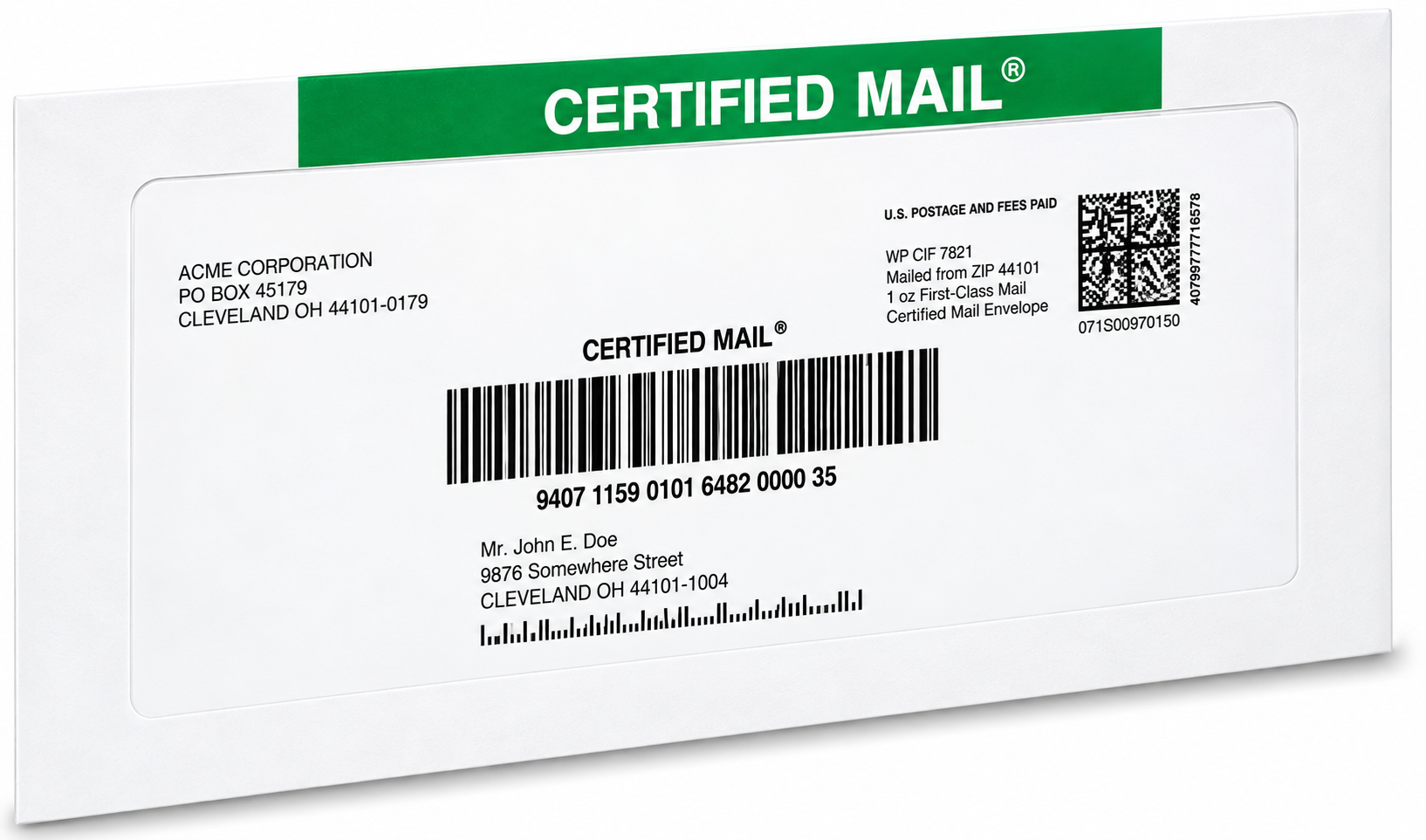
 Yes, a defective USPS Form 3877 can remove the normal presumption that a mailing was properly completed, but it does not always prevent the sender from proving mailing through other evidence. In Lindsey v. Commissioner, T.C. Memo. 2026-94 (U.S. Tax Court, September 24, 2026), the IRS overcame an incomplete Form 3877 with internal database records, USPS tracking data, and employee habit testimony. The practical lesson is direct: the record, not the label, wins. Your legal compliance mailing process should preserve acceptance, tracking, delivery, signature, and retention evidence together, so you can prove service when the mailing itself becomes disputed.
What Happened In Lindsey v. Commissioner?
The IRS mailed a notice of deficiency to the taxpayer. Under 26 U.S.C. § 6212, a notice of deficiency is mailed to the taxpayer’s last known address. Under 26 U.S.C. § 6213(a), the taxpayer generally has 90 days from the mailing of the notice to file a Tax Court petition.
The IRS relied on a USPS Form 3877, also called the Firm Mailing Book for Accountable Mail. But the form was incomplete. It did not show:
- A postmark
- The accepting employee’s signature
- The total number of pieces listed
Because of those defects, the IRS could not rely on the usual presumption of mailing or presumption of regularity that can attach to a properly completed Form 3877.
The IRS still prevailed on the mailing question. The Tax Court considered the evidence as a whole, including:
- Internal IRS records from the Appeals Centralized Database System, or ACDS
- USPS Postal Tracking & Reporting, or PTR, data
- Employee testimony about regular mailing practices
The court concluded that the IRS had proven the notice was mailed to the taxpayer’s last known address on the relevant date. Because the petition was filed after the 90-day deadline, the case was dismissed for lack of jurisdiction. The court also could not apply equitable tolling under binding Seventh Circuit precedent.
The complete decision is *Lindsey v. Commissioner, T.C. Memo. 2026-94.
Why Does Lindsey Matter To Your Mailing Records?
The case does not mean Form 3877 is unimportant. It means a defective form creates risk without necessarily ending the dispute.
A complete mailing record can give you a clear, organized way to prove:
- What document was mailed
- Who received it
- Which address was used
- When USPS accepted the piece
- What tracking number was assigned
- Whether delivery was completed or attempted
- Whether a recipient signed
- Who prepared and released the mailing
- Where the proof is stored today
A defective or incomplete record forces everyone to reconstruct events later. That may require employee testimony, system records, postal reports, and circumstantial evidence. Even when reconstruction succeeds, it can consume significant time and create avoidable litigation risk.
For IRS practitioners, tax controversy attorneys, CPAs, Enrolled Agents, and mailroom managers, the operational takeaway is simple: build the record at the time of mailing instead of trying to recreate it after a deadline is challenged.
What Must Form 3877 Show, And What Must Your Records Show?
The USPS PS Form 3877, Firm Mailing Book for Accountable Mail, is designed to document accountable mail presented to USPS. It includes entries for the sender, tracking or article number, addressee, postage, extra-service fees, and related mailing information.
The form also provides spaces for postal acceptance information, including the postmark, receiving employee information, and piece counts.
What Form 3877 Must Show
- Sender name and address
- A complete return address on each article
- USPS tracking or article number
- Addressee name and address
- Postage and applicable extra-service fees
- Total number of pieces listed by the sender
- Total number of pieces received at the Post Office
- Postal acceptance information
- Postmark or date-of-receipt information
- Receiving employee or postmaster information
What Your Records Must Show
- The final document or document identifier that was mailed
- The exact recipient and address used
- The USPS tracking number linked to that document
- Acceptance evidence showing USPS possession
- Intelligent Mail Postal Barcode information
- Scan-by-scan certified mail tracking events
- Delivery or attempted-delivery records
- Electronic delivery confirmation
- Electronic Return Receipt signature PDF, when selected and available
- A mailing affidavit or other internal declaration of mailing
- The date, time, and employee or system responsible for the mailing
- Searchable retention for the period your organization requires
A Form 3877 is one record. A modern mailing archive should connect every record associated with the mailing.
Why Is A USPS Postmark No Longer Enough By Itself?
Postmarks remain important, but they should not be the only evidence in a time-sensitive mailing file.
USPS Domestic Mail Manual § 608.11, effective December 24, 2025, explains the relationship between postmarks and postal possession. Machine postmarks can reflect the date an item is processed through automated equipment, which may not be the same as the date USPS first took possession of the mail.
That distinction matters when your file involves a statutory deadline.
Under 26 U.S.C. § 7502(a), timely mailing may be treated as timely filing under applicable postmark and regulatory rules. 26 U.S.C. § 7502(b) provides a specific rule for registered mail, including the registration date as prima facie evidence. 26 CFR § 301.7502-1 addresses proof of mailing and reliance on postal receipts, postmarks, and certification.
For your legal compliance mailing process, the safer approach is to preserve multiple independent data points:
- USPS acceptance scan
- Acceptance or postmark date
- Tracking history
- Recipient address
- Delivery outcome
- Signature or electronic return receipt
- Internal mailing affidavit
- Searchable archive record
The more complete the record, the less you must rely on one potentially incomplete form or one later recollection.
How Do Service Rules And Mailing Proof Work Together?
Certain tax notices expressly require specific service methods. For example, 26 U.S.C. § 6330(a)(2)(C) refers to notice by certified or registered mail, return receipt requested. 26 U.S.C. § 6320 also identifies certified or registered mail, return receipt requested, as an available method for lien notices.
The requirement has two parts:
- Use the required mailing method.
- Keep a complete record proving that method was used.
Lindsey is a reminder that selecting certified mail is not the end of the process. You must be able to connect the certified mail label, tracking number, document, address, acceptance event, and delivery evidence.
The IRS Internal Revenue Manual also references certified mail procedures in collection matters, including wrongful levy disallowance notices such as Letter 3973 and Letter 3974. See IRS Internal Revenue Manual 5.11.2.
What Does IRS CAMS Teach Private Senders About Recordkeeping?
IRS interim guidance shows that the IRS itself is moving away from manual certified-mail books in many workflows.
IRS interim guidance SBSE-04-0625-0048 and SBSE-04-0725-0047 direct covered IRS personnel to use the Certified Automated Mailing Solution, or CAMS. The guidance states that IRS mailrooms no longer accept certain manual USPS forms, including PS Form 3877, for the covered certified-mail workflows.
This is an IRS internal directive about how the IRS mails. It is not a rule that automatically governs private senders. But it demonstrates the direction of modern mailing operations: automated labels, accurate barcodes, electronic tracking, and centralized records.
Private senders face the same practical need. A law firm, agency, healthcare provider, financial institution, or tax practice should not have to search through paper binders and separate postal websites to answer basic questions about a critical mailing.
How Can You Build A Stronger Certified Mail Record?
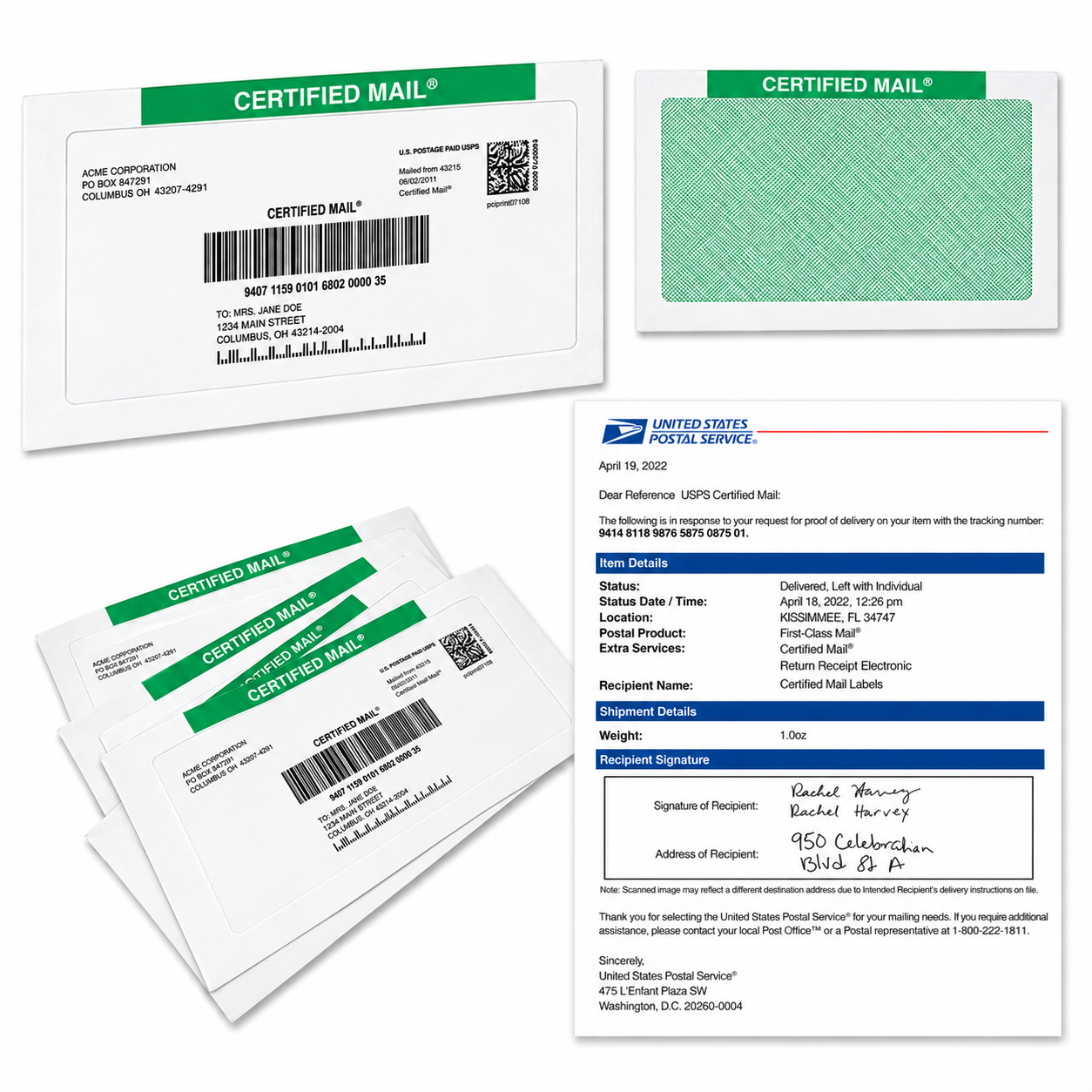
You can create USPS Certified Mail labels online and connect each mailing to a digital record from the beginning. With Certified Mail Labels’ online label creator, you can print live-postage USPS Certified Mail labels on a standard office printer or compatible adhesive sheets.
For full-service mailing, Print & Mail allows you to upload PDF letters and address lists. We handle printing, envelope inserting, postage, and same-business-day mailing for orders received before 5:00 PM Eastern. Each mailing includes USPS proof of acceptance and a notarized affidavit of mailing.
Your record can include:
- Notarized affidavit of mailing
- USPS acceptance scan and postmark date
- Intelligent Mail Postal Barcode
- Certified mail tracking events
- Delivery and attempted-delivery records
- Electronic delivery confirmation
- Electronic Return Receipt signature PDF
- Searchable mailing reports
- Ten-year digital retention
For high-volume work, bulk Certified Mail tools support Excel and CSV uploads, API integrations, SFTP transfers, and USPS SCAN forms. This helps your mailroom standardize the process across notices, demands, lien-related correspondence, collection letters, and other time-sensitive documents.
Why Is A Searchable Ten-Year Archive Important?
A mailing record is most valuable when you can retrieve it quickly.
Certified Mail Labels provides a free, searchable 10-year archive for mailing records, USPS acceptance scans, tracking events, delivery confirmations, and signature information. You can use the reports and archive tools to locate records by recipient, tracking number, date, or other available details.
You’ll get a central record instead of scattered receipts.
You won’t need to rely on one employee’s memory.
You’ll have supporting evidence ready for an audit, internal review, client request, or dispute.
You won’t need monthly fees, contracts, or equipment leases to create a more organized mailing process.

What Should You Do After Lindsey?
Review your current mailing record before the next deadline arrives.
Ask:
- Does every document have a matching tracking number?
- Can you prove when USPS accepted the mailing?
- Do you retain delivery and attempted-delivery scans?
- Can you retrieve the electronic return receipt?
- Is the address used clearly preserved?
- Do you keep an affidavit or comparable internal proof?
- Can your team find the record years later?
- Are bulk mailings tied to a SCAN form or batch record?
Lindsey shows that a sender may be able to prove mailing through cumulative evidence even when a central form is defective. But that is not the standard you should aim for. Your goal should be a complete, third-party-corroborated mailing record created automatically and retained from the start.
Certified Mail Labels helps you print certified mail online, send bulk certified mail, use electronic return receipt USPS services, and preserve the supporting record in one place. Start by creating your labels online, upload your documents for full-service mailing, or review the archive and reports available for your organization.
Please confirm the mailing method, proof requirements, retention period, and legal effect of your records with your own counsel or compliance advisor. Certified Mail Labels provides mailing tools and records. It does not provide legal advice.
FAQ: Defective USPS Form 3877 And Mailing Proof
Can A Defective USPS Form 3877 Still Support Proof Of Mailing?
Yes. A defective Form 3877 may weaken the usual presumption of mailing, but it does not automatically destroy proof. As Lindsey v. Commissioner, T.C. Memo. 2026-94 shows, a sender may still prove mailing with other records such as tracking data, internal system records, acceptance evidence, and employee testimony.
What Are The Most Important Records To Keep With Certified Mail?
You should keep the document mailed, the recipient address used, the USPS tracking number, acceptance evidence, tracking history, delivery or attempted-delivery records, and signature records when available. Keeping those items together in one searchable file makes your record much easier to prove later.
Is A USPS Postmark Enough By Itself For A Time-Sensitive Mailing?
Not always. A postmark still matters, but it should not be your only proof. For stronger protection, you should also retain the USPS acceptance scan, tracking history, recipient address, delivery status, and any electronic return receipt or internal affidavit tied to the mailing.
Why Does A Searchable Archive Matter For Compliance Mail?
A searchable archive helps you find proof fast when a notice, deadline, audit, dispute, or legal challenge comes up. You’ll save time, reduce confusion, and avoid chasing paper receipts or old employee memories years after the mailing date.
How Can You Strengthen Your Certified Mail Process Going Forward?
You can strengthen your process by creating certified mail labels online, linking each mailing to tracking and acceptance records, retaining delivery and signature evidence, and storing everything in one place. That gives you a more complete record from the start and makes future proof much easier to retrieve.