
 Last reviewed: October 2026
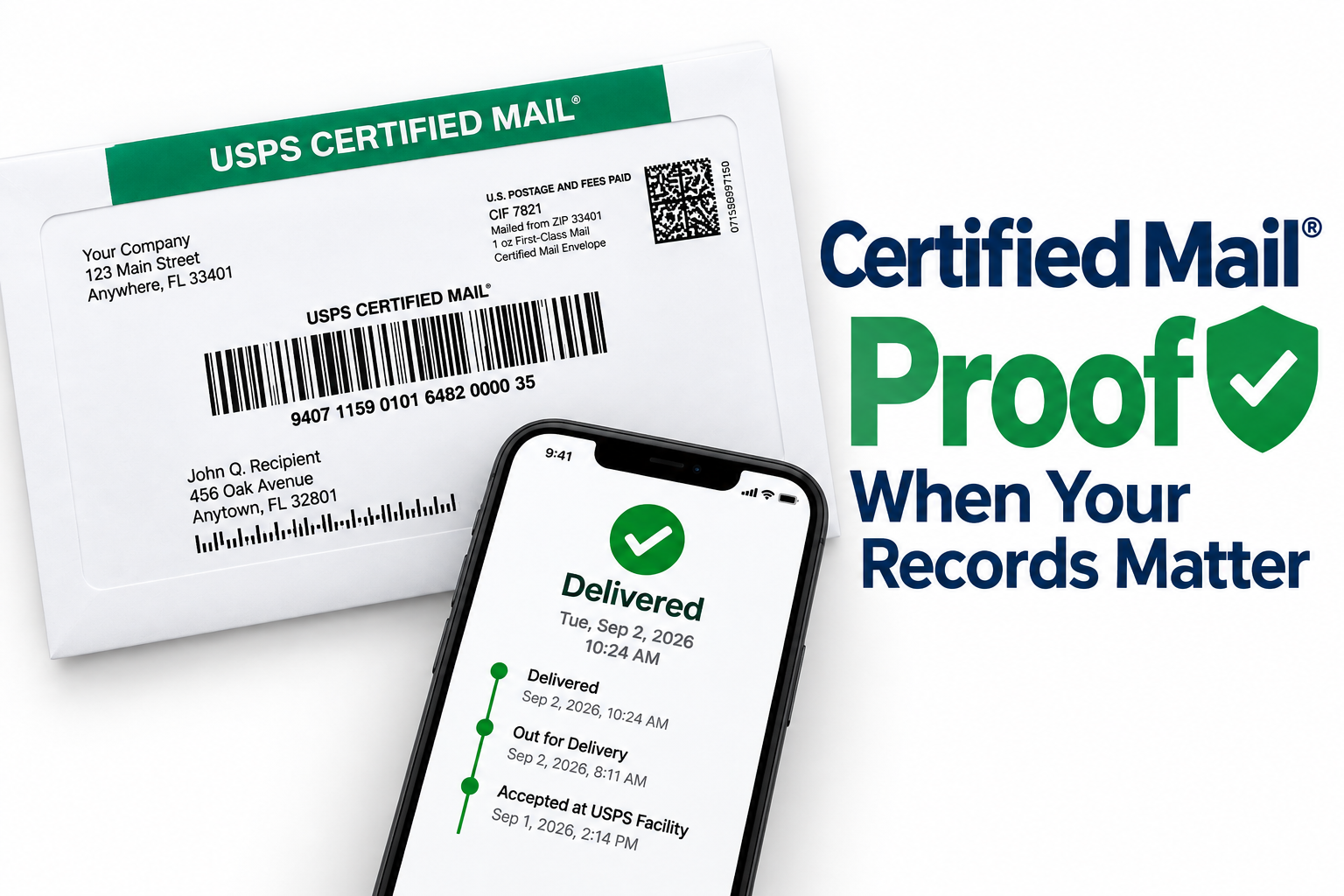
Certified Mail is not strictly mandated for every COBRA notice. First-Class Mail remains an allowed delivery method when used consistently with ERISA’s disclosure rules. However, after the USPS postmark change effective December 24, 2025, a deadline-day First-Class mailing can receive a machine postmark dated after the day you deposited it. For HR departments, benefits administrators, TPAs, and compliance officers, that makes First-Class-only mailing a weak and increasingly difficult-to-defend process. Certified Mail provides a stronger evidence trail through USPS acceptance records, certified mail tracking, electronic return receipt USPS records, and long-term digital retention.
Why Is First-Class Mail Riskier for COBRA Notices in 2026?
For years, many plan administrators treated First-Class Mail as the practical compliance floor for COBRA and ERISA notices. The process was familiar:
- Prepare the notice.
- Place it in an envelope.
- Apply postage.
- Deposit it with USPS.
- Retain a copy of the notice.
The problem is proving exactly when USPS took possession of that notice.
Under USPS DMM § 608.11, effective December 24, 2025, a machine-stamped postmark reflects the date of the first automated processing operation. That date may be later than the day USPS first received the mailpiece. USPS described the change in Postal Bulletin 22694, “DMM Revision: Postmarks and Postal Possession”. The DMM revision was published in the Federal Register at 90 FR 38716 (August 12, 2025).
This does not change the COBRA deadlines. It changes what a postmark can prove.
A notice mailed on the last permissible day may not receive a postmark until the next business day, or later. If the notice is challenged, your organization may need to show more than the date printed on the envelope. You may need to demonstrate when the mailing entered USPS possession, which notice was sent, where it was sent, and whether the process was completed consistently.
That is why the defensible 2026 standard is not necessarily “certified mail is legally required.” The stronger position is: use a mailing method that creates clear, date-specific evidence of mailing and delivery for deadline-sensitive notices.
What COBRA Notice Deadlines Should Your Process Track?
COBRA compliance depends on multiple notices, events, and responsible parties. Your workflow should identify the event date, the date your organization received notice, the applicable deadline, and the evidence retained.
A COBRA Notice Window Checklist
-
Within 30 days: The employer generally must notify the plan administrator of a qualifying event within 30 days of the qualifying event or the date of determination of the qualifying event. See 29 CFR § 2590.606-2.
-
Within 60 days: A qualified beneficiary must notify the plan administrator of certain events, such as divorce or a dependent ceasing to be a dependent, within 60 days of the event or loss of coverage. See 29 CFR § 2590.606-3.
-
Within 14 days: The plan administrator’s election notice is generally due not later than 14 days after receipt of the qualifying-event notice. See 29 CFR § 2590.606-4.
-
Within 44 days: If the employer is also the plan administrator, the election notice is generally due not later than 44 days after the qualifying event or — under plans that so provide — 44 days after the date of loss of coverage, per § 2590.606-4(b)(2). Which date applies depends on your plan's terms, so confirm with your benefits counsel.
-
Multiemployer plans: The applicable timing can depend on the later of the regulatory period or the plan’s stated period under § 2590.606-4.
These deadlines should be reviewed with your benefits counsel and matched to your plan documents, administrative agreements, and notice procedures. This article is general information from Certified Mail Labels, not legal advice.
The underlying COBRA notice obligations arise under ERISA § 606 / 29 U.S.C. § 1166. The regulations specify who must act, what notice must be provided, and when.
Does COBRA Require Certified Mail?
No. COBRA does not strictly require every notice to be sent by Certified Mail.
29 CFR § 2520.104b-1, which is referenced by § 2590.606-4, addresses ERISA delivery methods, including First-Class Mail and permitted electronic delivery. Section 2590.606-4 also provides for delivery under § 2520.104b-1(c), including electronic media when the applicable requirements are satisfied.
Required vs. Defensible
What COBRA actually requires of the mailing: nothing about Certified Mail. The regulations at 29 CFR § 2590.606-4 incorporate the ERISA delivery methods in 29 CFR § 2520.104b-1, which permit First-Class Mail and, where the applicable conditions are met, electronic delivery.
What COBRA practice requires of your file: a record that shows which notice was sent, to whom, from what address, on what date it entered USPS possession, and what happened at delivery. Certified Mail is how most administrators close that gap — not because a rule names it, but because it produces the evidence a reviewer will ask for.
Confirm your procedures with your benefits counsel. This article is general information from Certified Mail Labels, not legal advice.
So why move beyond First-Class-only mailing?
Because the practical question during an audit, dispute, or investigation is often not only, “Was First-Class Mail allowed?” It is also:
- What date did the notice enter USPS possession?
- Which exact document was mailed?
- Was it sent to the correct address?
- Can you show the tracking history?
- Can you show delivery or attempted delivery?
- Can you produce the records years later?
- Can you demonstrate that your organization followed a consistent procedure?
Certified Mail helps answer those questions with a documented chain of mailing activity.
Is There an Alternative to Certified Mail for COBRA Notices?
If your plan's delivery rules permit First-Class Mail, and your governing documents, plan terms or counsel do not require Certified Mail specifically, then what you actually need is not a particular mail class — it is a defensible record that the notice was mailed, to whom, from what address, and on what date. Certified Mail produces that record one way. A First-Class mailing documented with an affidavit of mailing produces it another way, at a lower cost per piece.
First-Class Mail with an Affidavit of Mailing — submitted through Certified Mail Labels — is an alternative to a Certified Mail envelope for notices where your rules do not require Certified Mail specifically. It gives you:
- Proof of same-day mailing. The mailing is executed and documented on the same business day for orders submitted before 5:00 PM Eastern.
- A notarized affidavit of mailing covering the mailing event.
- The 10-Year Compliance Archive, so the mailing record remains searchable and retrievable long after the six-year ERISA recordkeeping baseline.
- An image of the actual letter or notice sent. You get back a record of the notice as it was actually mailed — not just a tracking number and a date, but evidence of the specific document that went out.
The single most common gap in a disputed COBRA notice file is not proof that something was mailed — it is proof of what was mailed. A tracking number establishes that an envelope moved. An image of the actual notice, retained with the affidavit and the mailing date, establishes what that envelope contained. For a compliance officer building a file that has to survive a DOL inquiry or a dispute years later, that distinction is the whole game.
Here is a simple decision guide:
- Use Certified Mail when a statute, regulation, plan document, court rule, agency instruction, or your own counsel requires it, or when you need a recipient signature or delivery confirmation on the record.
- Use First-Class Mail with an affidavit of mailing when your rules permit First-Class delivery and what you need is documented proof of a timely, same-day mailing plus a record of the notice itself — at a lower per-piece cost than a Certified Mail envelope.
- Either way, keep the record. Both paths feed the same 10-Year Compliance Archive, so the file stays searchable regardless of which method you choose.
This section describes a mailing and documentation service, not a legal determination — confirm with your own counsel whether your plan, your notice type and your jurisdiction permit First-Class delivery. Certified Mail Labels provides mailing services and general educational information. We do not provide legal advice.
What Evidence Does Certified Mail Add?
Certified Mail creates a more complete record than an ordinary envelope and a postage imprint. Depending on the service selected, your file can include:
- USPS acceptance information.
- A unique tracking number.
- Certified Mail tracking events.
- Delivery confirmation.
- Electronic Return Receipt USPS records.
- Recipient signature information when available.
- Copies of the notice and mailing address.
- A searchable digital archive.

This evidence does not eliminate every legal question, and it does not guarantee that a notice satisfies every COBRA requirement. It does give your team a stronger operational record that does not depend solely on the later ink postmark.
That distinction matters under the 2026 USPS policy. A machine postmark can reflect the date USPS automation first processed the mailpiece, not necessarily the date USPS first took possession. A Certified Mail acceptance record, tracking history, and electronic return receipt provide additional evidence for your legal compliance mailing file.
What Is the Penalty and Recordkeeping Exposure?
COBRA requirements are part of the continuation coverage rules under 26 U.S.C. § 4980B. Failure to satisfy applicable group health plan requirements can create significant financial and administrative exposure.
For IRS excise tax exposure, 26 U.S.C. § 4980D(b) provides an excise tax of $100 per day per affected individual for a failure during the noncompliance period. This amount is not adjusted for inflation.
ERISA also provides civil penalty authority under 29 U.S.C. § 1132(c)(1), implemented at 29 CFR § 2575.502c-1, which provides for a penalty of up to $110 per day per participant or beneficiary. That $110 figure is current for 2026 for a specific and verifiable reason: the Department of Labor made no inflation adjustment to its civil monetary penalties for 2026. See Department of Labor Federal Civil Penalties Inflation Adjustment Act Annual Adjustments for 2026, 91 FR 31358 (May 27, 2026, effective May 27, 2026), which states that because the Bureau of Labor Statistics could not produce October 2025 CPI-U data during the lapse in appropriations, and the statute allows no alternative calculation, the 2026 adjustment was cancelled and agencies were instructed to continue applying the 2025 penalty levels. The Department has stated it will undertake a full review of its civil penalties in 2027.
In practical terms, whether the exposure is the $100 per day per affected individual excise tax under 26 U.S.C. § 4980D(b) or the up to $110 per day ERISA penalty under 29 U.S.C. § 1132(c)(1), every day of a missed or unprovable notice period compounds — which is precisely why the mailing record, and not just the mailing method, is the control that matters.
Your records also need to last. The ERISA recordkeeping baseline is six years under 29 CFR § 2520.103-3, measured from the applicable record creation date or the latest date to which the records apply, as applicable.
A 10-year searchable compliance archive gives your organization room beyond that six-year horizon. You can locate notice copies, USPS acceptance scans, tracking events, delivery confirmations, and signature records without searching through paper files or disconnected systems.
How Can You Modernize COBRA Mailing Without Adding More Work?
You do not need a monthly software commitment, equipment lease, or complicated mailing setup.
With Certified Mail Labels, your team can create and print live-postage USPS Certified Mail labels online using a standard office printer or adhesive sheets. This is a practical option when your department prepares its own COBRA notices and wants a more consistent mailing record.
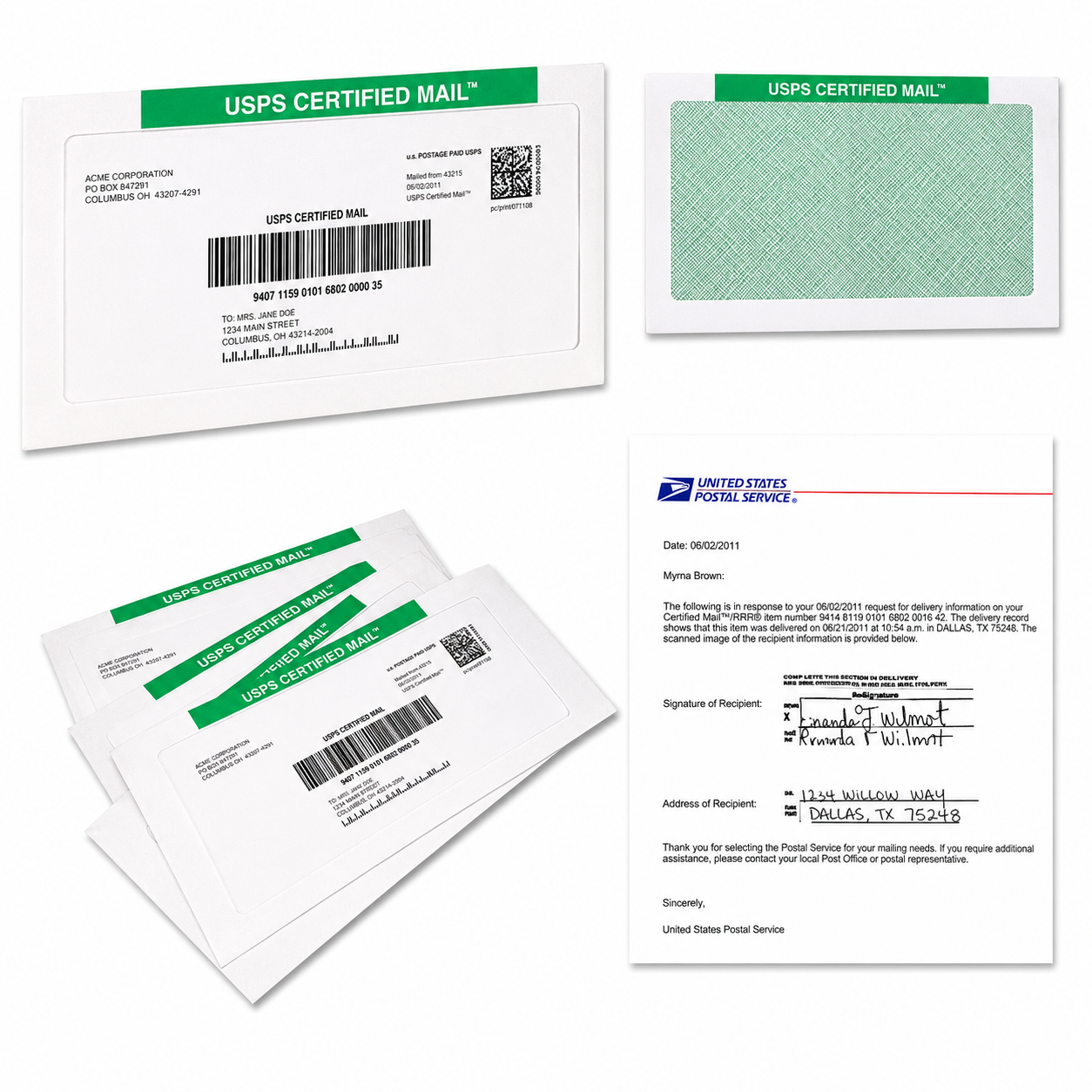 If you want to remove printing and fulfillment from your internal workload, Print & Mail lets you upload a PDF and address list. Certified Mail Labels handles printing, envelope insertion, postage, and same-business-day mailing for orders received before 5:00 p.m. Eastern. Each mailing includes a notarized affidavit of mailing.
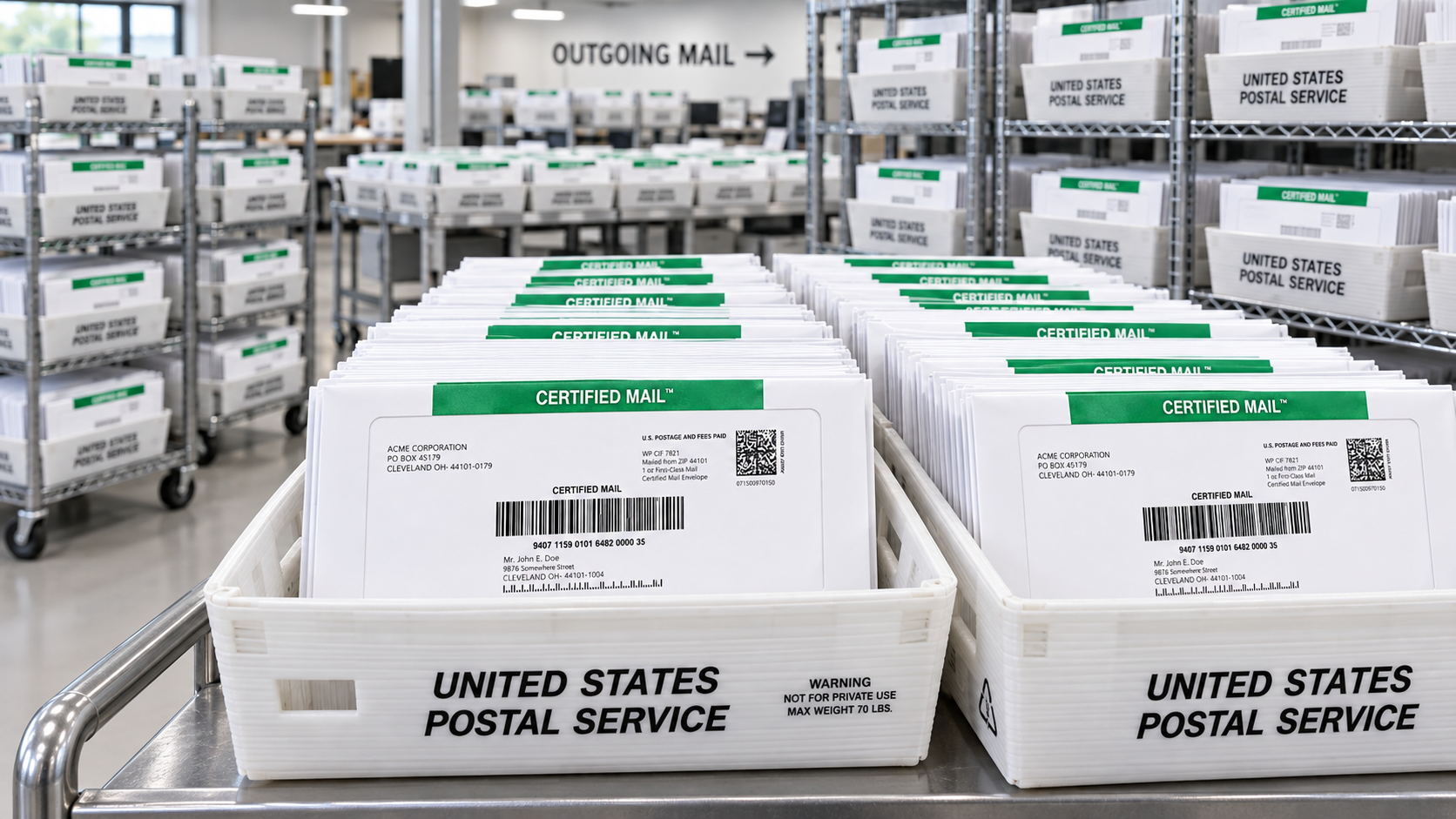
For recurring or high-volume notice programs, bulk Certified Mail supports Excel or CSV uploads, API integrations, and secure SFTP transfers. That can help TPAs, insurers, and enterprise HR teams standardize large notice batches and produce USPS SCAN forms.
Rates are also designed to reduce the cost of a documented mailing process:
- $7.28 for a 1-ounce Certified Mail letter with Electronic Delivery Confirmation.
- $11.02 at the Post Office counter for the comparable mailing.
- $8.43 for Print & Mail of a one-page letter.
- No monthly fees.
- No contracts.
- No equipment leases.
- Free 10-year compliance archive.
What Should Your 2026 COBRA Mailing Procedure Include?
Here are practical steps you can take now:
- You’ll identify every COBRA notice deadline in your plan administration workflow.
- You’ll avoid relying on deadline-day drop-offs in collection boxes or local office deposit slots.
- You’ll create certified mail online when you need a verifiable mailing record.
- You’ll retain the notice PDF, address, tracking number, acceptance record, and delivery information together.
- You’ll use electronic delivery only when permitted and properly documented.
- You’ll review your TPA and insurer procedures to confirm who prepares, mails, and archives each notice.
- You’ll preserve records beyond the applicable retention period when your organization’s risk policy calls for longer retention.
- You’ll ask your own counsel whether Certified Mail, electronic delivery, hand-stamped postmarks, or another method best fits your plan and notice process.
 FAQ: What Does the 2026 Postmark Change Mean for COBRA?
Is Certified Mail legally required for COBRA notices?
No. Certified Mail is not strictly mandated for every COBRA notice. First-Class Mail and permitted electronic delivery remain available under the applicable ERISA delivery rules. Certified Mail is a more defensible standard because it creates stronger evidence of acceptance, tracking, delivery, and retention.
What changed under the 2026 USPS postmark rule?
Under USPS DMM § 608.11, a machine postmark can reflect the date of the first automated processing operation rather than the date USPS first took possession of the mailpiece. This creates risk for deadline-day First-Class mailings.
Does a Certified Mail postmark solve every COBRA compliance issue?
No. Certified Mail does not replace accurate notice content, correct addresses, timely preparation, or proper plan administration. It adds a stronger mailing and recordkeeping trail that can support your compliance process.
How long should COBRA mailing records be retained?
Use the applicable ERISA recordkeeping requirements and your organization’s retention policy. The baseline referenced here is six years under 29 CFR § 2520.103-3. Certified Mail Labels provides a 10-year searchable archive.
Can Certified Mail Labels handle bulk COBRA notices?
Yes. You can upload Excel or CSV address lists, use API or SFTP integrations, and manage recurring bulk certified mail workflows. You can also upload a PDF and address list for full-service Print & Mail.
Where can I learn how to send certified mail online?
Start with Create and Print Certified Mail Labels Online. You can prepare USPS Certified Mail labels from your office without a trip to the Post Office.
Is there an alternative to Certified Mail for COBRA notices?
Yes, when your plan's delivery rules permit First-Class Mail. Certified Mail Labels offers a First-Class mailing documented with a notarized affidavit of mailing, which includes proof of same-day mailing, an image of the actual letter or notice sent, and a 10-Year Compliance Archive. Confirm with your own counsel which method your plan and notice type require.
What does the affidavit-of-mailing option include?
Proof of same-day mailing, a notarized affidavit of mailing, the 10-Year Compliance Archive, and an image of the actual letter or notice that was sent. It is an alternative to a Certified Mail envelope where your rules do not require Certified Mail specifically.
The bottom line: Certified Mail is not a universal COBRA mandate, but First-Class-only mailing is no longer the strongest defensible process for deadline-sensitive notices in 2026. Create a documented mailing trail, add certified mail tracking and electronic return receipt records, and keep the evidence available for the long term.
Create your Certified Mail labels online or learn how Print & Mail works to save time, reduce administrative work, and strengthen your legal compliance mailing process.
Certified Mail Labels provides mailing services and general educational information. We do not provide legal advice. Confirm your COBRA, ERISA, delivery, and recordkeeping procedures with your own counsel.