
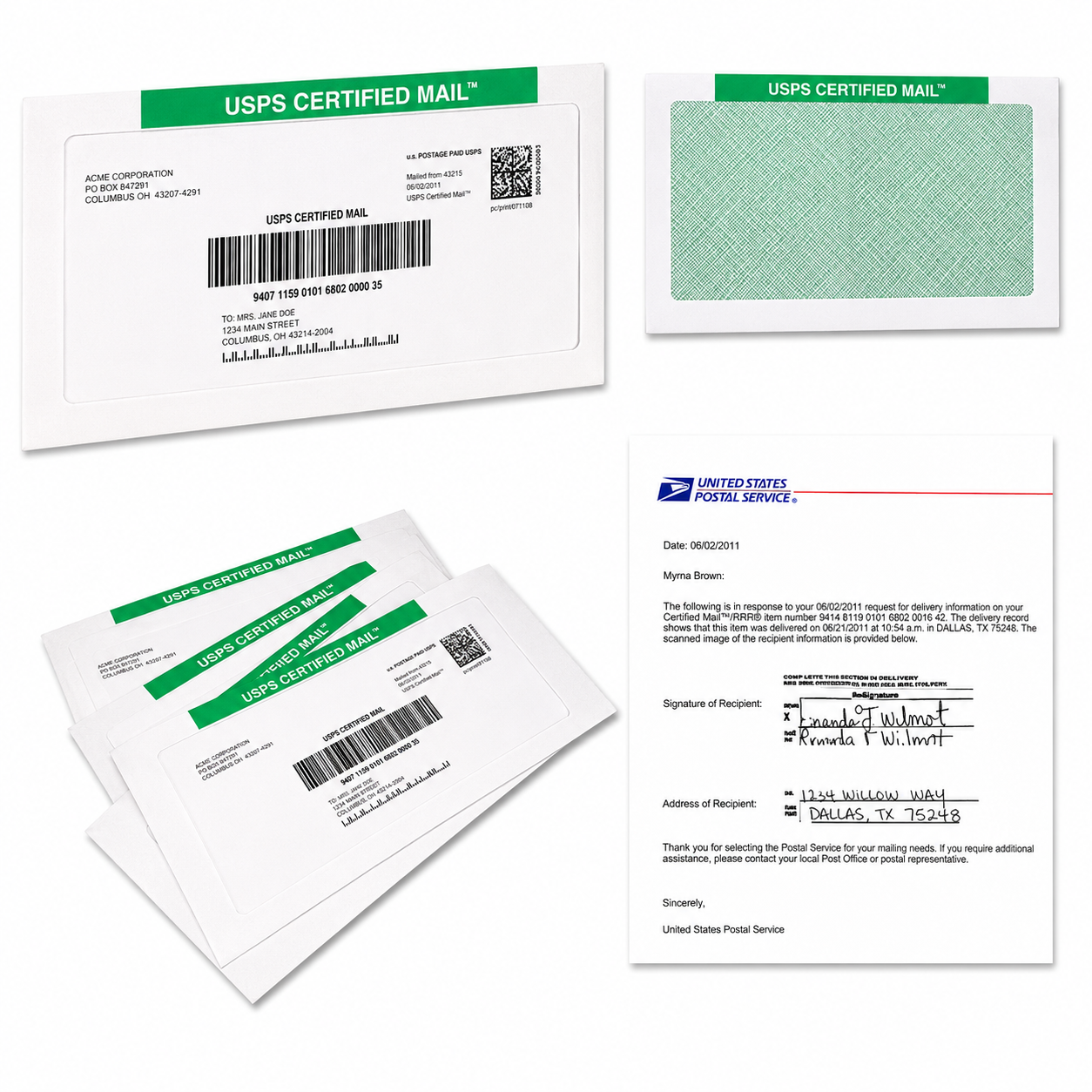
The right choice depends on the proof your statute, contract, court rule, or internal policy actually requires. Certified Mail fits when you need a mailing receipt plus delivery or attempted-delivery verification, with optional signature proof. Registered Mail fits when maximum USPS security, insurance, and a statutory registration date matter. A Certificate of Mailing fits when you only need evidence that USPS received the mailpiece for mailing, not delivery, tracking, or a recipient signature. Always confirm the required method with your own counsel or compliance team.
What Does Each Mailing Service Actually Prove?
The easiest way to choose is to identify the question your records must answer:
- Certified Mail: Did the notice go out, and did USPS record delivery or an attempted delivery?
- Registered Mail: Was the item accepted into USPS Registered Mail with maximum security, insurance options, and a registration date that may carry special legal significance?
- Certificate of Mailing: Did the sender present the mailpiece to USPS for mailing on a specific date?
These services are not interchangeable in every situation. Matching the proof to the exact statutory language is the most important step in legal compliance mailing.
| Proof Requirement | Certified Mail | Registered Mail | Certificate of Mailing |
|---|---|---|---|
| What proof it creates | Mailing receipt and electronic verification that the article was delivered or delivery was attempted | Mailing receipt, registration record, movement monitored through a system of receipts, and delivery verification when requested | Evidence that individual mailpieces were presented to USPS for mailing |
| Delivery record: yes or no? | Yes. USPS provides delivery or attempted-delivery information; a delivery record can be obtained | Yes. USPS provides delivery or attempted-delivery information; a delivery record can be obtained | No. It does not provide a record of delivery |
| Signature capture | Optional through PS Form 3811 or Electronic Return Receipt | Optional through Return Receipt service | No signature capture from the recipient |
| Typical statute language | “Certified mail”; “certified or registered mail”; “return receipt requested” | “Registered mail”; “certified or registered mail”; statutes treating registration as proof of delivery or the filing date | “Mailed”; “presented to USPS”; “proof of mailing” |
| Best use | Notices, service, compliance records, disputes, and delivery verification | High-security or high-value mail and statutes that specifically recognize registration | Proof of mailing date when delivery proof is not required |
The governing USPS standards are found in USPS Domestic Mail Manual §503. USPS states that extra-service fees are charged in addition to postage. The DMM describes Certified Mail, Registered Mail, Certificates of Mailing, and Return Receipt as separate services with different proof functions.
When Is Certified Mail the Better Match?
Certified Mail is usually the practical fit when your statute or policy focuses on documented notice and delivery status.
Under USPS DMM §503, Certified Mail provides the sender with a mailing receipt and, upon request, electronic verification that an article was delivered or that a delivery attempt was made. USPS maintains a delivery record, which includes the recipient’s signature when available.
Certified Mail can be paired with a Return Receipt when you need a more complete delivery record. The traditional option is the paper green card, PS Form 3811, Domestic Return Receipt. The electronic option, commonly called the Electronic Return Receipt USPS service or eRR, returns a PDF record of delivery with the recipient’s signature image.
Where the statute says “return receipt requested,” your counsel may determine that either the paper form or electronic return receipt is appropriate. The electronic option costs less than the paper green card and is easier to store, search, and share with an auditor, court, client, or opposing party.
Here are just a few situations where statutory language points toward Certified Mail or Registered Mail with return receipt:
- Foreclosure notices: 12 U.S.C. §3708 requires notice to be sent by “certified or registered mail, postage prepaid and return receipt requested.”
- Foreclosure sale notices: 12 U.S.C. §3758 uses the same “certified or registered mail” and “return receipt requested” language.
- IRS levy notices: 26 U.S.C. §6330(a)(2)(C) permits notice to be sent by “certified or registered mail, return receipt requested.”
- Federal service of process: FRCP 4(i) allows copies for service on the United States to be sent by registered or certified mail.
- Bankruptcy service: Bankruptcy Rule 7004(h) specifically names certified mail addressed to an officer of an insured depository institution.
For many legal departments, property managers, collection agencies, and government offices, Certified Mail provides the right balance of proof, convenience, speed, and certified mail cost.
When Does Registered Mail Make More Sense?
Registered Mail is not simply “stronger Certified Mail.” It is a separate USPS service designed for maximum security and additional handling controls.
The USPS DMM §503 Registered Mail standards describe Registered Mail as the most secure service USPS offers. It uses a system of receipts to monitor movement from acceptance through delivery. Registered Mail also provides a mailing receipt and, upon request, electronic verification of delivery or attempted delivery. A Return Receipt can provide the recipient’s signature.
Registered Mail is particularly important when the law uses registration as a legal trigger. For example, 26 U.S.C. §7502(b) provides that, for certain IRS filings, the date of registration is treated as the postmark date, and registration is prima facie evidence that the document was delivered to the IRS.
The related regulation, 26 CFR §301.7502-1, explains how proof of registered or certified mailing can establish the mailing date and provide prima facie evidence of delivery for qualifying documents. It also addresses the use of a postmarked certified mail receipt.
Choose Registered Mail when:
- You need the highest USPS security for the contents.
- The item has significant value and insurance is relevant.
- Your statute or contract specifically names Registered Mail.
- The registration date may affect a filing deadline.
- Your counsel or compliance policy requires a stronger chain of custody.
Do not choose Registered Mail simply because it sounds more official. Read the actual statute or contract and confirm what your organization must prove.
Is a Certificate of Mailing Enough When Delivery Matters?
Usually, no.
A Certificate of Mailing answers one narrow question: Did the sender present the mailpiece to USPS for mailing?
The USPS DMM Certificate of Mailing standards, including the standards associated with PS Form 3610, PS Form 3817, and PS Form 3665, state that a Certificate of Mailing provides evidence that individual mailpieces were presented to USPS for mailing. The certificate does not provide a record of delivery, and USPS does not retain copies of the certificate forms. The applicable fee is charged per piece in addition to postage.
That means a Certificate of Mailing does not provide:
- USPS tracking.
- A delivery scan.
- A delivery attempt record.
- A recipient signature.
- A paper green card.
- An Electronic Return Receipt.
- Proof that the recipient accepted or received the item.
A Certificate of Mailing may be appropriate when a policy says “mail the notice” or requires proof that the notice was mailed by a particular date. However, it is generally not the right choice when the language requires “certified mail,” “registered mail,” “return receipt requested,” or proof of delivery.
This distinction matters for legal departments, municipal clerks, insurance compliance teams, healthcare administrators, and property managers. A postmarked certificate can prove possession or mailing. It cannot independently prove delivery.

What Does the IRS Example Tell You About Mailing Proof?
The IRS rules provide a clear example of why the wording matters.
Under 26 U.S.C. §7502(b), registered mail receives specific treatment: the date of registration is treated as the postmark date, and registration is prima facie evidence of delivery. The regulation at 26 CFR §301.7502-1 also explains the use of certified mail when the sender’s receipt is properly postmarked.
Another example appears in 26 U.S.C. §7603(b), which states that a summons for certain third-party recordkeepers may be served by certified or registered mail.
These examples show why you should not select a service based only on a general belief that one option is “better.” Instead, match the proof to the words used by the governing authority.
How Can You Simplify Certified Mail Online?
Once you know Certified Mail is the required method, you do not need to make a trip to the Post Office for every notice.
With Certified Mail Labels, you can create and print live-postage USPS Certified Mail labels online using a standard office printer or adhesive label sheets. You can prepare your mailing from your office, home, or remote location and keep the process consistent across your team.
You can also use our Certified Mail Reports to receive electronic delivery documentation, including the lower-cost Electronic Return Receipt option. Your PDF delivery record and signature image can be stored in a searchable archive for 10 years.
For organizations asking how to send certified mail at scale, you can upload Excel or CSV files, use API integrations, or transfer files through SFTP with bulk mailing automation. That helps legal departments, municipalities, collection agencies, healthcare providers, and property management companies reduce manual entry and improve record consistency.
If you prefer not to print, stuff envelopes, or manage postage, Print & Mail lets you upload a PDF and address list. We handle printing, envelope inserting, postage, and same-business-day mailing for orders received before 5:00 p.m. Eastern. Each mailing includes USPS proof of acceptance and a notarized affidavit of mailing.
Our pricing example is $7.28 for a 1-ounce Certified Mail letter with Electronic Delivery Confirmation, compared with $11.02 at the Post Office counter with a paper green card Return Receipt. The Electronic Return Receipt is the $1.74-savings alternative to the $4.65 paper green card. There are no monthly fees, no contracts, and no equipment leases.

What Should You Check Before You Mail?
Before sending an important notice, ask these questions:
- Does the statute name Certified Mail, Registered Mail, or either one?
- Does it require return receipt requested?
- Do you need proof of delivery, or only proof of mailing?
- Is a recipient signature required?
- Does the statute give special treatment to the registration date?
- Does your policy require a paper record, an electronic PDF, or both?
- Do you need an archive that can be searched years later?
- Have you confirmed the method with your own counsel?
Certified Mail Labels can help you execute the mailing and organize the documentation. We cannot determine which method your statute requires, and this article is not legal advice. Confirm the required proof with your attorney, court, regulator, contract administrator, or internal compliance team.
Frequently Asked Questions About Certified, Registered, and Certificate of Mailing
Is Certified Mail the same as Registered Mail?
No. Certified Mail provides a mailing receipt and delivery or attempted-delivery verification. Registered Mail adds USPS’s highest-security handling system and insurance features. Some statutes allow either service, while others specify one method.
Does a Certificate of Mailing include tracking?
No. A Certificate of Mailing proves that the mailpiece was presented to USPS for mailing. It does not provide tracking, delivery confirmation, attempted-delivery information, or a recipient signature.
Can an Electronic Return Receipt replace the green card?
The Electronic Return Receipt is the electronic version of the paper PS Form 3811 Return Receipt. Where the applicable statute or policy permits a return receipt with the selected mailing service, your counsel may determine whether the electronic option satisfies the requirement. Confirm before mailing.
Which service is best for foreclosure or levy notices?
Many federal notice provisions use language such as “certified or registered mail, return receipt requested.” Examples include 12 U.S.C. §§3708 and 3758 and 26 U.S.C. §6330(a)(2)(C). Match the exact statutory language and confirm the procedure with counsel.
What is the most economical way to send Certified Mail?
For many routine notices, online Certified Mail with electronic delivery documentation can reduce the certified mail cost compared with Post Office counter service. You can print USPS Certified Mail labels online, select electronic proof, and avoid monthly fees, contracts, and equipment leases.
Can Certified Mail Labels tell me which service my statute requires?
No. We provide tools to create, mail, track, and archive Certified Mail. Your legal or compliance team must determine whether Certified Mail, Registered Mail, a Certificate of Mailing, or another method is required.
How Do You Match the Proof to the Requirement?
Use the simplest service that creates the proof your statute or policy actually requires:
- Choose Certified Mail for mailing and delivery verification.
- Add PS Form 3811 or Electronic Return Receipt when signature or return-receipt proof is required.
- Choose Registered Mail when maximum security, insurance, or a legally recognized registration date matters.
- Choose a Certificate of Mailing only when proof of USPS possession or mailing is enough and delivery proof is not required.
Then make the process easier with Certified Mail online, electronic delivery records, bulk upload tools, same-business-day Print & Mail service, and a 10-year compliance archive. Match the proof first, then use the most efficient way to create and preserve it.