
California Construction Claims Now Require Certified Mail Under SB 440
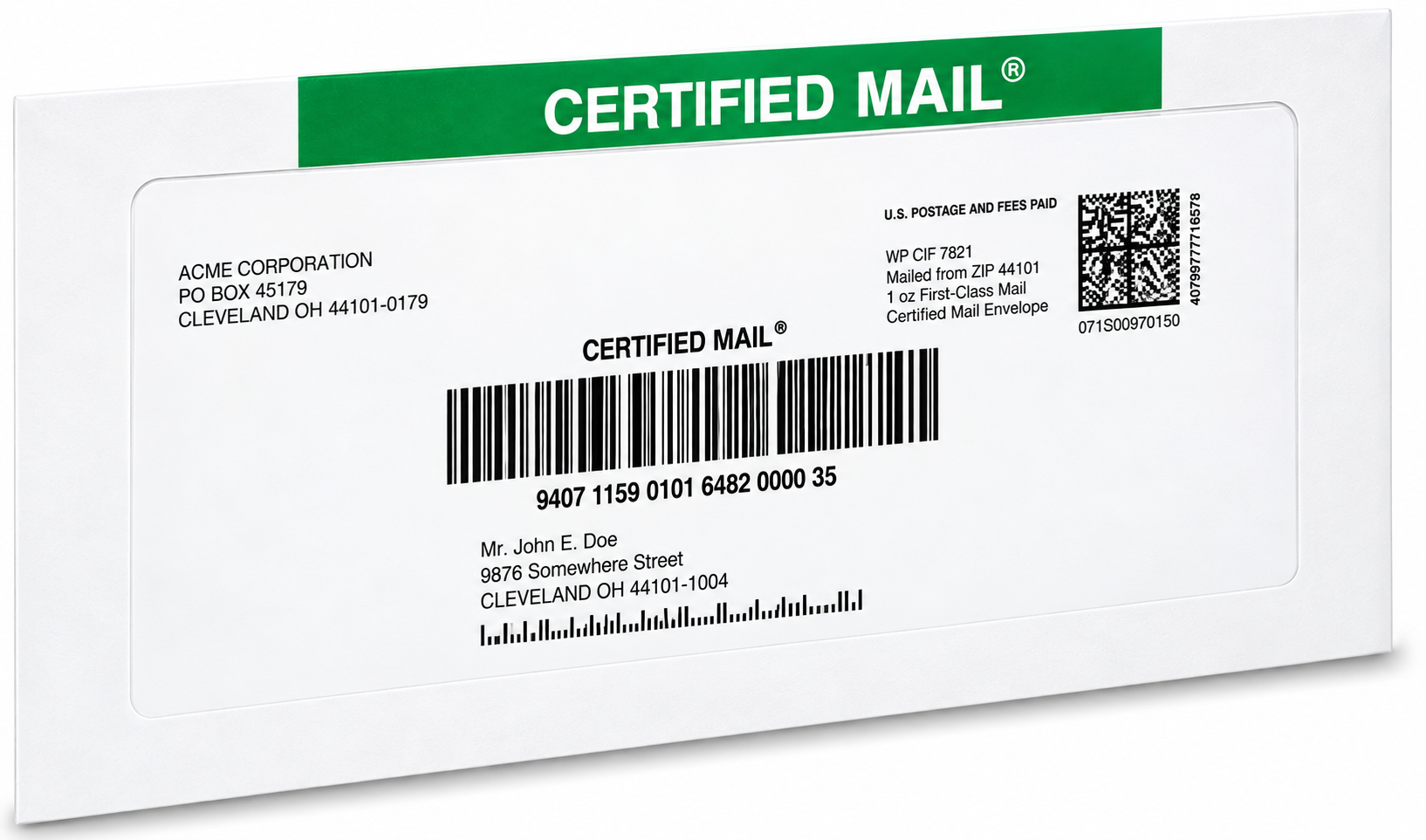 California contractors working under private construction contracts entered into in 2026 may now encounter a new mailing requirement when submitting certain claims.
California Senate Bill 440 (see the full bill text for exact statutory language) established the Private Works Change Order Fair Payment Act, now codified at California Civil Code § 8850. The law applies to covered contracts entered into on or after January 1, 2026 and creates a structured process for resolving certain claims involving payment, disputed amounts and time extensions.
One detail is especially important for contractors and their administrative teams: the law specifically calls for registered mail or Certified Mail with Return Receipt Requested at several stages of the claims process.
As 2026 construction projects progress, these requirements are becoming more relevant. Contractors, subcontractors, owners, project managers and construction law professionals should understand both the deadlines established by the law and the mailing records associated with them.
What Is California SB 440?
SB 440 was signed into law in October 2025 and took effect January 1, 2026. The law created California Civil Code § 8850 and established a claims-resolution process for covered private works projects.
The California Legislature stated that delays in payment for completed construction work can create significant financial hardship for contractors and that unclear change-order dispute procedures can lead to costly litigation. The new process is intended to establish clearer procedures for reviewing and resolving these disputes.
Under § 8850, a “claim” is a separate demand by a contractor or, where authorized, a subcontractor, for one or more of the following:
- A time extension, including relief from delay damages or penalties assessed by an owner.
- Payment for certain work performed by or on behalf of the contractor.
- Payment of an amount disputed by the owner.
But the subject of the demand is only part of the definition.
The statute also specifies how that claim must be sent: by registered mail or Certified Mail with Return Receipt Requested.
That makes the mailing process an important part of a contractor's compliance workflow.
Where Does California Civil Code § 8850 Require Certified Mail?
Certified Mail with Return Receipt Requested appears at multiple stages of the statutory process.
|
Stage |
Requirement Under § 8850 |
|
Initial qualifying claim |
Separate demand sent by registered mail or Certified Mail with Return Receipt Requested |
|
Demand for meet-and-confer conference |
Written demand sent by registered mail or Certified Mail, Return Receipt Requested |
|
Notice that payment is due before suspending work |
Owner informed by registered mail or Certified Mail, Return Receipt Requested |
|
10-day notice of intent to stop work |
Sent to owner by registered mail or Certified Mail, Return Receipt Requested |
These are not merely recommended mailing practices. They appear directly in the statutory language.
For contractors, this means a claims procedure should account for more than drafting the right notice. Teams also need to confirm the correct mailing service and maintain organized records associated with each notice.
Step 1: Submitting the Construction Claim
The process begins with the claim itself.
California Civil Code § 8850 defines a claim as a separate demand sent by registered mail or Certified Mail with Return Receipt Requested.
That distinction matters.
A routine email, standard First-Class Mail letter or informal change-order request does not match the statutory mailing language used in the definition of a claim under § 8850.
Once the owner receives a qualifying claim, the owner generally has no more than 30 days to perform a reasonable review and provide a written statement identifying the portions that are disputed and undisputed. The claimant must also provide reasonable documentation supporting the claim.
The parties may mutually agree in writing to extend that 30-day period.
What happens to an undisputed amount?
When the owner identifies an undisputed portion of the claim, payment must generally be processed and made within 60 days after the owner issues its written statement.
This makes documentation important on both sides.
Contractors should be able to connect the claim, recipient, mailing method, tracking number, delivery information and project file so the history of the claim can be reconstructed later.
Step 2: Requesting a Meet-and-Confer Conference
If the contractor disputes the owner's response—or if the owner does not respond within the required timeframe—the claimant may demand an informal conference to meet and confer.
The statute again addresses the mailing method.
The written demand must be sent by registered mail or Certified Mail, Return Receipt Requested. After receipt, the owner must schedule the meet-and-confer conference within 30 days.
Within 10 business days after that conference concludes, if any part of the claim remains disputed, the owner must provide another written statement identifying the disputed and undisputed portions.
Any undisputed portion is then generally subject to another 60-day payment period following the owner's written statement.
Step 3: Mediation of Remaining Disputes
If part of the claim remains disputed following the informal conference, § 8850 provides for nonbinding mediation, with the owner and claimant sharing the associated costs equally.
The parties generally have 10 business days after the disputed portion has been identified in writing to agree on a mediator.
If they cannot agree during that period, the contractor may select the mediator. If mediation does not resolve the matter, the remaining dispute proceeds under the dispute-resolution procedure selected in the parties' contract or, where applicable, through final judgment or operation of law.
The parties may mutually agree in writing to waive the informal conference and mediation provisions and proceed directly to civil litigation or binding arbitration, as applicable.
However, § 8850 states that a waiver of the rights granted by the section is otherwise void and contrary to public policy.
Unpaid Amounts Can Carry Significant Interest
SB 440 also creates a financial incentive for timely payment.
Under § 8850, undisputed amounts that are not paid on time as required by the statute bear interest at 2% per month.
Disputed amounts that are later determined to be owed can also bear interest at 2% per month, beginning from the date those amounts would have been due had they not been disputed.
For a significant construction claim, that interest can become substantial.
It also makes accurate documentation of claims, responses and payment timelines particularly important.
Certified Mail Is Required Again Before Certain Work Can Be Suspended
One of the most important provisions of SB 440 concerns a contractor's or subcontractor's right to suspend performance for nonpayment when the statutory procedure is followed.
The mailing requirements return here.
Under § 8850(k), the contractor or subcontractor must first inform the owner by registered mail or Certified Mail, Return Receipt Requested, that payment is due under the section or that the claim has been deemed denied.
Thirty days after that notice is sent, the contractor or subcontractor must send the owner a 10-day written notice of intent to stop work, again by registered mail or Certified Mail, Return Receipt Requested.
Because these notices can be associated with the right to suspend work without penalty, organizations should treat their mailing documentation as part of the project record rather than as routine mailroom paperwork.
A California SB 440 Mailing Timeline
A simplified workflow looks like this:
1. Contractor submits qualifying claim
Send the separate demand using registered mail or Certified Mail with Return Receipt Requested.
2. Owner reviews the claim
The owner generally has up to 30 days to provide a written response identifying disputed and undisputed portions.
3. Undisputed amount becomes payable
Payment must generally be processed and made within 60 days after the owner's written statement.
4. Contractor challenges the response
If appropriate, the claimant can demand a meet-and-confer conference. That written demand is sent by registered mail or Certified Mail, Return Receipt Requested.
5. Meet-and-confer conference occurs
The owner must schedule the conference within 30 days after receiving the demand.
6. Remaining dispute moves toward mediation
If the dispute remains unresolved, the statute provides for nonbinding mediation.
7. Payment remains unpaid or statutory conditions are met
The owner is notified that payment is due using registered mail or Certified Mail, Return Receipt Requested.
8. Thirty days later
If the applicable conditions remain, a 10-day written notice of intent to stop work is sent using registered mail or Certified Mail, Return Receipt Requested.
This timeline is a general overview. Contractors should review the complete statute, their contract and legal advice applicable to the particular project before acting on a claim or suspending work.
Why Proof of Mailing and Delivery Matter
When a statute specifies a mailing method, organizations should maintain records showing how the notice was handled.
For an SB 440 mailing, a useful project file may include:
- A copy of the claim or notice that was sent
- Recipient name and mailing address
- USPS Certified Mail tracking number
- Date the mail piece was presented to USPS
- USPS acceptance information
- USPS tracking history
- Delivery or attempted-delivery information
- Electronic Return Receipt and available signature information
- Internal project, contract or claim reference
It is also important to distinguish creating a label from USPS accepting the mailpiece.
Printing a Certified Mail label creates the tracking identifier and prepares the piece for mailing. An available USPS acceptance SCAN or related acceptance documentation records the handoff into the USPS mailstream.
For time-sensitive legal and compliance mail, that distinction can make a much stronger internal record.
Using an Electronic Return Receipt for SB 440 Mailings
California Civil Code § 8850 specifically calls for Return Receipt Requested in its Certified Mail provisions.
Certified Mail Labels offers the USPS Electronic Return Receipt option, which provides electronic delivery information and available recipient signature information supplied by USPS. These records can be accessed with the associated mailing information rather than relying on a physical green Return Receipt card.
For a construction company handling multiple projects, electronic records can also make it easier to associate the return receipt with the correct:
- Project
- Owner
- Contract
- Claim
- Change order
- Tracking number
- Mailing date
The legal sufficiency of a particular mailing or Return Receipt should always be evaluated based on the applicable statute, contract and circumstances.
Don't Overlook the USPS Acceptance Scan
Return Receipt documentation addresses the delivery side of the mailing.
There is another important part of the record: USPS acceptance.
A Certified Mail label by itself does not establish that USPS received the envelope. For that reason, contractors should use a mailing procedure that captures available USPS acceptance information.
For individual mail pieces, that can mean presenting the Certified Mail piece for an acceptance scan rather than simply placing the envelope in a collection box.
For larger batches, Certified Mail Labels allows users to generate a USPS SCAN Form. The form uses a master barcode associated with the eligible mail pieces in the batch, allowing the sender to document the USPS acceptance event without relying on a collection of disconnected paper records.
The acceptance record does not replace the Return Receipt or delivery documentation required for the individual mailing. Each serves a different role in the mailing record.
Build a Repeatable SB 440 Mailing Process
Construction claims can involve project managers, accounting teams, executives, attorneys and administrative staff. If Certified Mail is prepared differently each time, important records can become scattered across desks, email accounts and project folders.
A more consistent process is to establish a standard SB 440 mailing workflow.
Before sending a notice, verify the recipient and mailing address. Confirm that the notice is associated with the correct project and contract. Select Certified Mail with Return Receipt Requested where required by § 8850. Then connect the tracking number to the underlying claim or notice.
At USPS acceptance, preserve the applicable acceptance record. Continue monitoring the individual tracking number through delivery, attempted delivery, refusal, return or other final disposition.
Finally, save the delivery and Return Receipt information with the rest of the claim documentation.
The objective is not merely to send a letter. It is to create an organized record connecting the document, recipient, tracking number, USPS acceptance and delivery history.
How Certified Mail Labels Supports Construction Compliance Mail
Certified Mail Labels allows contractors, construction companies, law firms and administrative teams to create USPS Certified Mail labels online and add Electronic Return Receipt when needed.
Users can also access USPS tracking information and maintain mailing records in a searchable 10-year online archive. For organizations sending multiple notices, batch processing and USPS SCAN Forms can help organize acceptance documentation across larger mailings.
This can be particularly useful when a construction claim remains active for months or when records need to be retrieved long after the original project staff prepared the mailing.
The goal is a repeatable process: prepare the correct service, obtain USPS acceptance documentation, track the mail piece and retain the applicable delivery and Return Receipt records.
Who Is Covered by California Civil Code § 8850?
The law does not apply to every California construction project.
Section 8850 applies to qualifying contracts entered into on or after January 1, 2026. It concerns private works rather than public entities listed in the statute's definition of “owner.”
The statute also states that it does not apply to construction of a residential project when the project is not mixed use and does not exceed four stories.
SB 440's provisions are currently scheduled to remain in effect until January 1, 2030, when the article is repealed unless California changes the law before then.
Because applicability can depend on the project, contract and circumstances, contractors should not assume that every California construction claim follows this process.
Frequently Asked Questions About California SB 440 and Certified Mail
Does California SB 440 require Certified Mail?
For the notices identified in California Civil Code § 8850, the statute provides for registered mail or Certified Mail with Return Receipt Requested. This includes the initial statutory claim, a written meet-and-confer demand and certain notices connected with the right to suspend work.
Is ordinary First-Class Mail enough for an SB 440 claim?
The statutory definition of a claim specifies registered mail or Certified Mail with Return Receipt Requested. Ordinary First-Class Mail does not match that mailing language.
Does SB 440 apply to contracts signed before January 1, 2026?
No. Section 8850 states that it applies to contracts entered into on or after January 1, 2026.
How long does an owner have to respond to a claim?
The owner generally must conduct a reasonable review and provide its written statement within a period not exceeding 30 days, although the owner and contractor can mutually agree in writing to extend that period.
When must an undisputed amount be paid?
Payment of an undisputed portion of a claim generally must be processed and made within 60 days after the owner issues the applicable written statement.
What happens if an owner fails to respond?
Under § 8850, failure to respond within the statutory time periods or otherwise meet the section's requirements results in the claim being deemed denied in its entirety. The statute also states that such a deemed denial does not constitute an adverse finding regarding the merits of the claim.
Can a contractor stop work if it has not been paid?
Section 8850 establishes a procedure under which contractors and subcontractors can have a right to suspend performance without penalty until payment is received. The procedure includes specific timing requirements and notices sent by registered or Certified Mail, Return Receipt Requested. Contractors should carefully review § 8850(k) and obtain appropriate legal advice before suspending work.
Does SB 440 apply to small residential construction projects?
Not in every case. The statute excludes construction of a residential project if the project is not mixed use and does not exceed four stories.
Prepare for California's New Construction Claim Process
California SB 440 changes more than the timeline for resolving certain private construction claims. It establishes a documented process in which the method used to send important claims and notices matters.
For contractors working under covered contracts entered into on or after January 1, 2026, Certified Mail with Return Receipt Requested is specifically identified throughout California Civil Code § 8850.
That makes a consistent mailing process valuable.
Verify the address. Select the required mailing service. Preserve USPS acceptance information. Track delivery. Retain the Electronic Return Receipt when applicable. Keep the records connected to the underlying project and claim.
Certified Mail Labels helps businesses create Certified Mail labels online, obtain tracking information, use Electronic Return Receipt services, organize batch mailings with USPS SCAN Forms and maintain applicable mailing records in a searchable 10-year archive.
Schedule a Live Demo with a member of our Customer Support Team today to see how Certified Mail Labels can help your team manage compliance-sensitive Certified Mail.
This article is provided for educational and informational purposes only and is not legal advice. Construction laws, contract requirements and individual circumstances vary. Consult qualified legal counsel regarding the requirements applicable to a specific project, contract, claim or notice.