
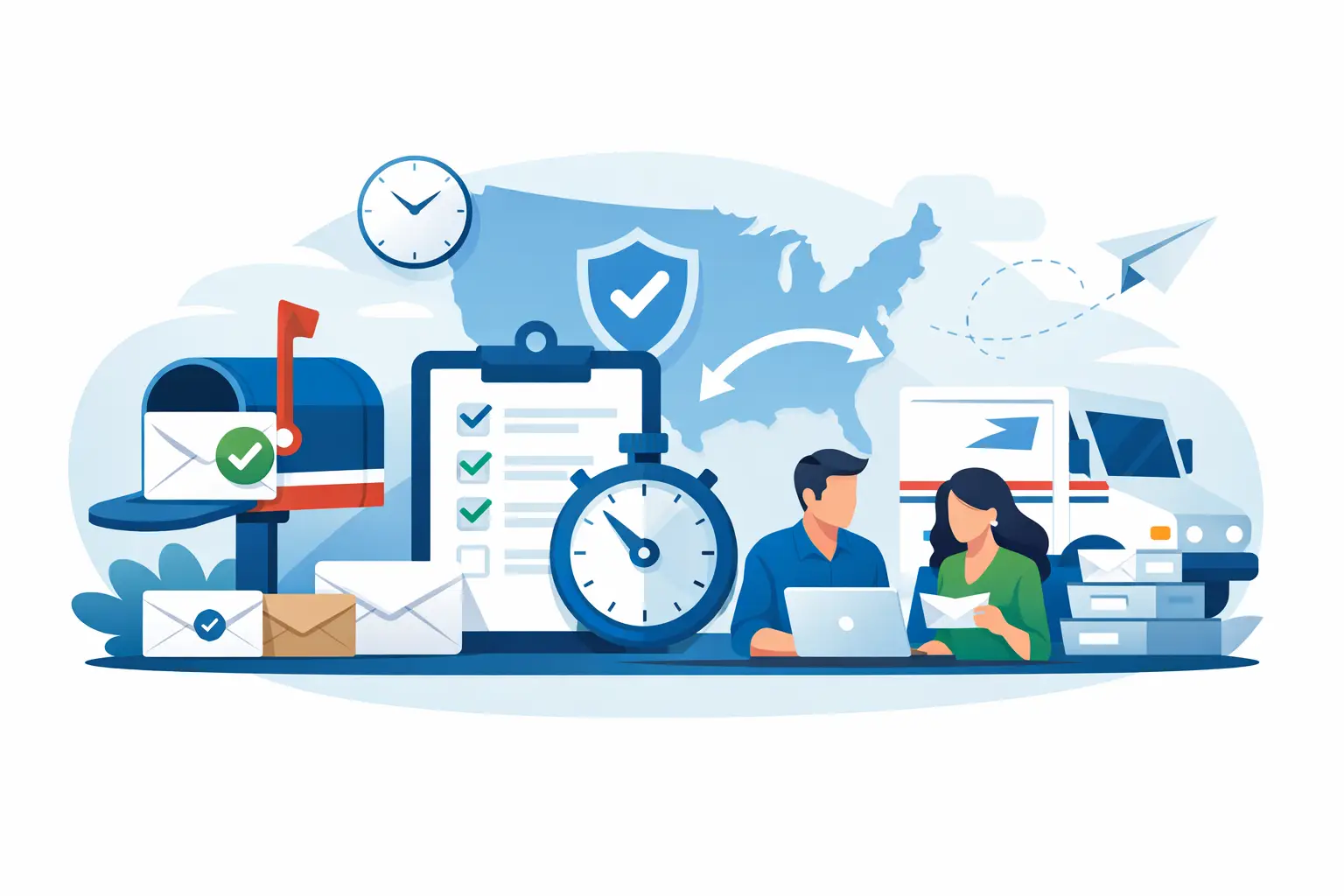
 If your staff is still filling out green cards by hand, matching tracking numbers manually, and waiting at the post office for acceptance, the US Certified Mail workflow is doing more work than it should. For law offices, property managers, finance teams, and administrative departments, Certified Mail is usually not a mailing problem. It is a process-control problem.
A workable process has to do three things at once. It has to prepare USPS Certified Mail correctly, create a clean record of what was sent and when, and make retrieval easy when someone asks for proof months or years later. When any one of those pieces breaks, the cost shows up as wasted labor, missing records, disputed timelines, or avoidable compliance risk.
What a good us Certified Mail workflow actually needs
The most reliable workflows are built around documentation, not just postage. That means every mailing event should have a clear beginning, a traceable acceptance point, tracking visibility, and a retained delivery record. If your office can print a label but cannot easily prove acceptance or produce a signed delivery record later, the workflow is incomplete.
In practice, the strongest process usually includes address creation, label generation with the correct USPS Certified Mail components, postage funding, print controls, acceptance documentation, tracking updates, and long-term record storage. The goal is not simply to get mail out the door. The goal is to preserve an audit-ready chain of custody without creating extra administrative work.
That is where many manual processes start to fail. The mailing itself may still happen, but the supporting record depends on paper files, screenshots, inbox searches, or whoever happened to process the letter that day. That can work at very low volume, but it becomes unreliable quickly once multiple users, departments, or recurring notices are involved.
Where manual Certified Mail workflows break down
The old counter-based process asks staff to handle too many small steps by hand. They prepare the article number, complete forms, apply postage, request Return Receipt service when needed, present mail for acceptance, and then manage records across separate systems or paper files. None of these tasks is especially hard on its own. Together, they create friction.
The first issue is time. A mailing that should take a few minutes can stretch into a longer task once form preparation, printing, supply management, and post office travel are included. The second issue is consistency. Different employees often prepare Certified Mail slightly differently, which creates avoidable variation in records and internal procedures.
The third issue is retrieval. Many organizations do not realize the weakness in their process until they need proof of mailing for a hearing, dispute, audit, tenant matter, collections timeline, or compliance review. At that point, locating the tracking number is only part of the job. You may also need proof that USPS accepted the mailing, confirmation that it was delivered, and a retained signature record.
A practical Certified Mail workflow for modern offices
A better approach is to build the process around a single preparation and recordkeeping path. The ideal workflow starts before printing. Staff should enter or import the delivery address, select the required mailing services, and generate a USPS-compliant Certified Mail label with postage already applied. That removes handwritten inconsistency and cuts down on preparation errors.
From there, the workflow should support standard printing and packaging using the supplies your office already relies on, whether that means envelopes for occasional use or higher-volume runs prepared in batches. If your team sends repeat notices, account statements, legal correspondence, or compliance letters, batch tools matter because they reduce repetitive entry and create a more controlled release process.
Acceptance is the next control point. This is where many offices need more than a receipt from a single piece handed over at a counter. For multi-piece mailings, USPS acceptance documentation such as a SCAN form or manifest-based acceptance record makes the process easier to manage and easier to defend later. Instead of tracking acceptance piecemeal, you retain a documented event that covers the mailing release.
Once accepted, tracking should remain tied to the original record automatically. Staff should not have to maintain separate spreadsheets just to know whether an item is in transit, delivered, or awaiting a signature event. The workflow works best when the mailpiece, mailing date, tracking number, acceptance data, and delivery outcome stay connected in one place.
Why chain-of-custody matters more than mailing speed
Some organizations focus first on how quickly they can generate Certified Mail. Speed matters, but chain-of-custody matters more. In documentation-sensitive environments, the ability to prove what happened is often the real business requirement.
Take a property management office sending notices, or a law firm mailing time-sensitive correspondence. If delivery is disputed, they need more than a memory of mailing day. They need evidence that the item was prepared correctly, accepted by USPS, tracked through delivery, and preserved in a way that can be retrieved later. The same logic applies to accounting notices, government communications, claims documentation, and regulated customer correspondence.
A strong workflow supports that record from start to finish. Return Receipt Signature records, shipment confirmation, acceptance reporting, and long-term storage are not optional extras for these use cases. They are the documentation layer that gives Certified Mail its operational value.
The right workflow depends on volume and risk
Not every office needs the same setup. A small practice mailing a few important letters per week may only need online label creation, print capability, tracking, and stored proof of delivery. That alone can remove post office counter prep and greatly simplify recordkeeping.
A larger operation has different pressure points. Enterprise mailrooms, servicing departments, collection teams, and compliance programs often need batch processing, account controls, department-level reporting, and system automation. At that scale, the challenge is less about how to send one certified letter and more about how to maintain process integrity across hundreds or thousands of mailpieces.
That is why the best US Certified Mail workflow is rarely the most complicated one. It is the one that matches your mailing volume, documentation standard, and staffing reality. Overbuilding the process can create unnecessary steps. Underbuilding it can leave gaps in acceptance records, delivery proof, or accountability.
What to look for in a workflow platform
If you are evaluating tools, focus on operational fit. Can your team create compliant labels online without post office counter preparation? Can postage and Certified Mail fees be applied accurately during setup? Can users print what they need with minimal training? Can the system preserve records for the long term?
The answer should also include reporting. Mail history should be easy to search by date, recipient, tracking number, or status. This matters as much for front-office responsiveness as it does for audits and disputes. When someone asks whether a notice was sent or delivered, the answer should come from the system, not from a folder hunt.
For higher-volume users, automation options become more important. API or SFTP-based workflows can reduce manual entry and support recurring operational mail. That is particularly useful when Certified Mail is generated from another line-of-business system, such as case management, billing, claims processing, or resident communications.
One reason organizations use Certified Mail Labels is that the platform aligns those pieces in one operational path: label creation, postage, acceptance documentation, tracking, proof of delivery, and long-term record retention.
The workflow should reduce exceptions, not just steps
A useful process does more than save a trip to the post office. It reduces exceptions. Exceptions are what consume time later - unreadable handwriting, missing article numbers, absent delivery records, mismatched addresses, incomplete acceptance proof, or records saved in the wrong place.
When the workflow is standardized, those issues drop. Staff follow the same preparation path, management has better visibility, and documentation becomes easier to trust. That consistency is especially important when multiple team members touch the process or when mailings may later be reviewed outside your organization.
For offices that depend on Certified Mail as a formal communication method, that consistency is the real efficiency gain. It lowers administrative drag while strengthening the record behind every mailing.
The best next step is usually not a dramatic system overhaul. It is a practical review of how your current Certified Mail process handles preparation, acceptance, tracking, and retrieval. If any of those stages still depend on manual workarounds, that is where improvement will pay off first.