
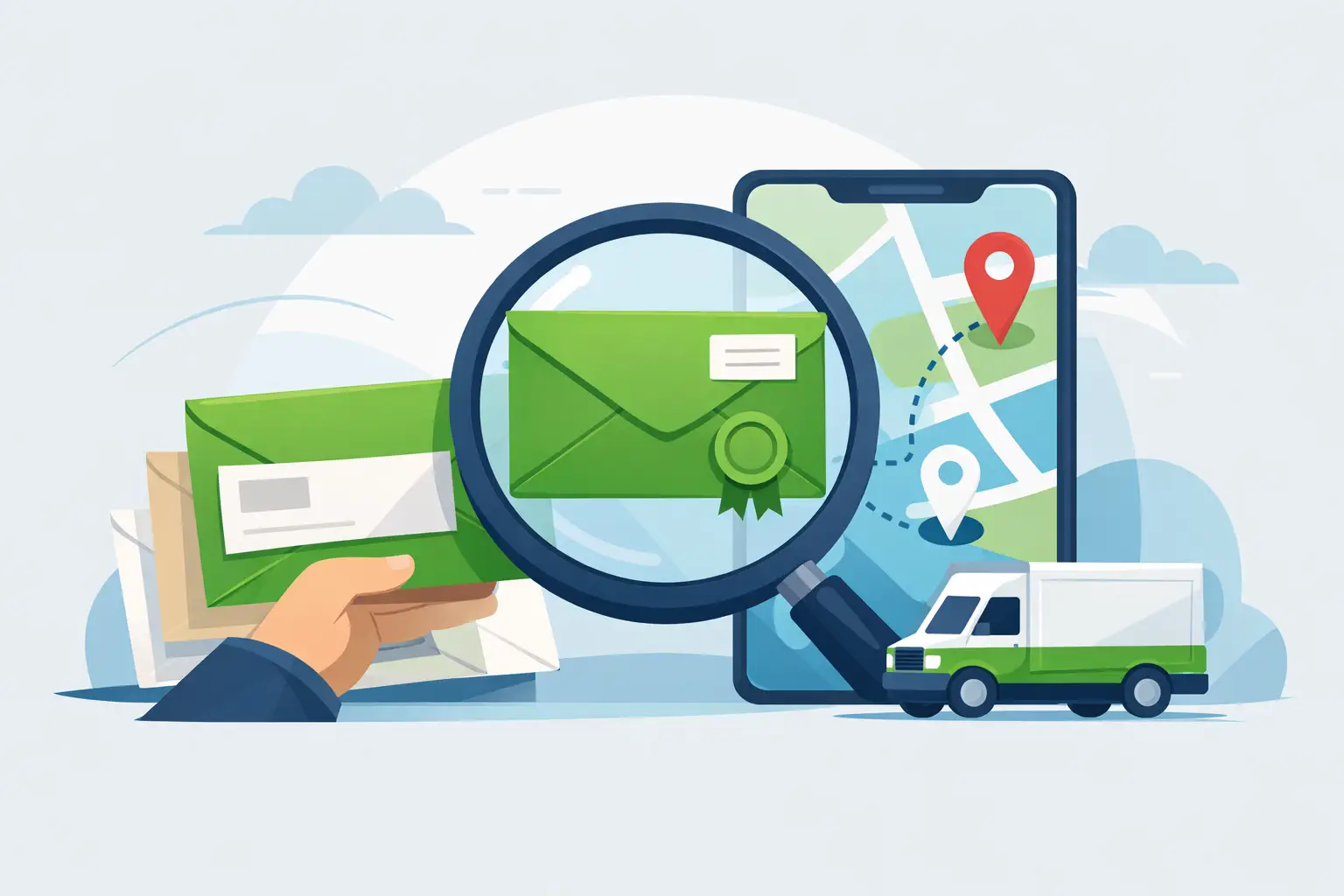
 If you are sending a notice, demand letter, tax document, payment reminder, or other time-sensitive correspondence, a basic question matters right away: does Certified Mail include tracking? Yes. USPS Certified Mail includes tracking that lets you monitor when the item is accepted, when it moves through the mailstream, and when delivery is attempted or completed.
That said, tracking is only part of the record. For many offices, the bigger issue is whether the mailing file will stand up later - during an audit, a dispute, a tenant matter, a client file review, or internal compliance check. Certified Mail gives you USPS tracking and proof of mailing, but the level of delivery evidence depends on which extra services you add.
Does Certified Mail include tracking by default?
Yes. USPS Certified Mail includes a tracking number as part of the service. When the mailpiece enters the USPS system, that tracking number can be used to review status updates tied to acceptance, transit, and delivery activity.
For many senders, that answers the immediate question. If the goal is to confirm that a letter was mailed and follow its progress, Certified Mail already covers that need better than ordinary First-Class Mail.
Where people get confused is the difference between tracking, proof of delivery, and signature records. Those are related, but they are not identical.
What the tracking on Certified Mail actually shows
Certified Mail tracking is designed to document the handling path of the mailpiece. In practical terms, that usually means you can see when USPS accepts the item, when it is processed through the network, and whether delivery was completed or attempted.
For an office that sends legal notices, collections letters, compliance notifications, or account documentation, this visibility helps establish a mailing timeline. You are not relying on the recipient to confirm receipt, and you are not left wondering whether the item disappeared in transit.
Tracking is especially useful when a recipient claims they never received a document. Even before you get into signatures or return receipts, tracking can help show that the item entered the USPS mailstream and reached a delivery event.
What Certified Mail tracking does not include on its own
Tracking alone does not always give you a complete chain-of-custody record for every business purpose. It tells you where the mailpiece is in the USPS process, but if you need a stored recipient signature or a formal proof-of-delivery document, you may need an additional service.
This is the key trade-off. Certified Mail gives you documented mailing and tracking, but some workflows require more than status scans. Law firms, property managers, government offices, and accounting teams often need a stronger delivery record than tracking updates by themselves.
If your internal policy, legal process, or customer dispute standard requires evidence of who signed or when the recipient accepted delivery, adding Return Receipt is often the better fit.
Tracking vs. Return Receipt
A lot of senders use these terms interchangeably, but they serve different functions.
Tracking gives you visibility into the mailpiece as it moves through USPS. It helps answer questions such as whether the item was accepted, whether delivery was attempted, and whether delivery was completed.
Return Receipt adds proof of delivery tied to the delivery event. Depending on the format used, that may include an electronic delivery record and signature record. If you need to produce evidence later for a file, claim, hearing, or audit, Return Receipt creates a more complete documentation package.
This distinction matters in compliance-driven environments. A collections department may be satisfied with tracking and proof of mailing for some notices, while a legal office sending statutory notices may require a delivery signature record every time. The right setup depends on what your organization has to prove later, not just what it needs to mail today.
When tracking alone is usually enough
There are plenty of situations where Certified Mail tracking without added services may be sufficient. Internal notices, account correspondence, routine customer communications, and lower-risk business letters often only require confirmation that the item was mailed and moved through USPS.
If your concern is operational control - knowing that the letter was prepared correctly, entered into the mailstream, and monitored through delivery scans - Certified Mail tracking may cover the requirement without adding extra cost.
For occasional senders, this can be a practical choice. For recurring mail programs, though, the decision should come from policy. If different staff members are deciding service levels case by case, record quality becomes inconsistent, which can create problems later.
When you should add more than tracking
Tracking alone may not be enough when the mailing has legal, regulatory, lease, financial, or disciplinary significance. In those cases, the question is not simply whether the letter was mailed. The question is whether you can retrieve a defensible delivery record months or years later.
That is where additional USPS services and stronger record retention become important. If your office has ever had to reconstruct mailing proof from paper receipts, screenshots, or manually filed green cards, you already know the administrative burden.
For repeat senders, the issue is less about one letter and more about process reliability. A documented workflow with stored tracking, acceptance records, and proof of delivery reduces the risk of missing evidence when you need it most.
Why professionals ask this question in the first place
People rarely ask whether Certified Mail includes tracking out of curiosity. They ask because a specific document matters. A landlord needs proof a notice was sent. A law office needs to show a demand letter was mailed on time. An accounting practice needs a record of delivery attempts. An administrator needs to avoid another trip to the post office.
In all of those cases, the mailing service is part of a larger business process. The real goal is not just sending mail. It is creating a reliable record with less manual handling.
That is why tracking should be evaluated as one component of a documentation workflow. If the mailing event needs to be verified later, you want acceptance data, delivery updates, and accessible records that are easy to retrieve without chasing paper files.
Operational issues to watch for
Even though Certified Mail includes tracking, the quality of your internal process still matters. If labels are filled out by hand, receipts are misplaced, or mailing logs are inconsistent, the existence of a tracking number does not solve the underlying recordkeeping problem.
This is where many offices lose time. Staff print one form in one place, keep the receipt somewhere else, and check tracking manually later. That may work for a few letters a month, but it becomes inefficient fast.
For higher-volume or recurring mail, centralized preparation and stored mailing records are usually more dependable. A system that captures label data, USPS acceptance details, tracking activity, and delivery records in one place gives teams better control and fewer gaps.
A more practical way to manage Certified Mail tracking
If your organization sends Certified Mail regularly, the goal should be to standardize how tracking and mailing evidence are created and stored. That means preparing compliant labels correctly, keeping USPS acceptance documentation, and making delivery records easy to retrieve.
Certified Mail Labels is built around that operational need. Instead of treating Certified Mail as a one-off counter transaction, it supports online label creation, printing, USPS acceptance documentation, tracking visibility, and long-term record storage for a more complete audit trail.
That approach is often more useful than simply asking whether tracking exists. It shifts the focus to whether your mailing process produces records your team can actually use later.
So, does Certified Mail include tracking?
Yes, it does. USPS Certified Mail includes tracking as part of the service, and that tracking helps document acceptance, movement through the mailstream, and delivery activity.
But whether that is enough depends on the role the mailing plays in your business process. If you only need visibility, tracking may be sufficient. If you need proof of delivery, a signature record, or a stronger compliance file, you should evaluate added services and how those records are stored.
The best mailing workflow is the one that answers tomorrow's questions before they get asked.