
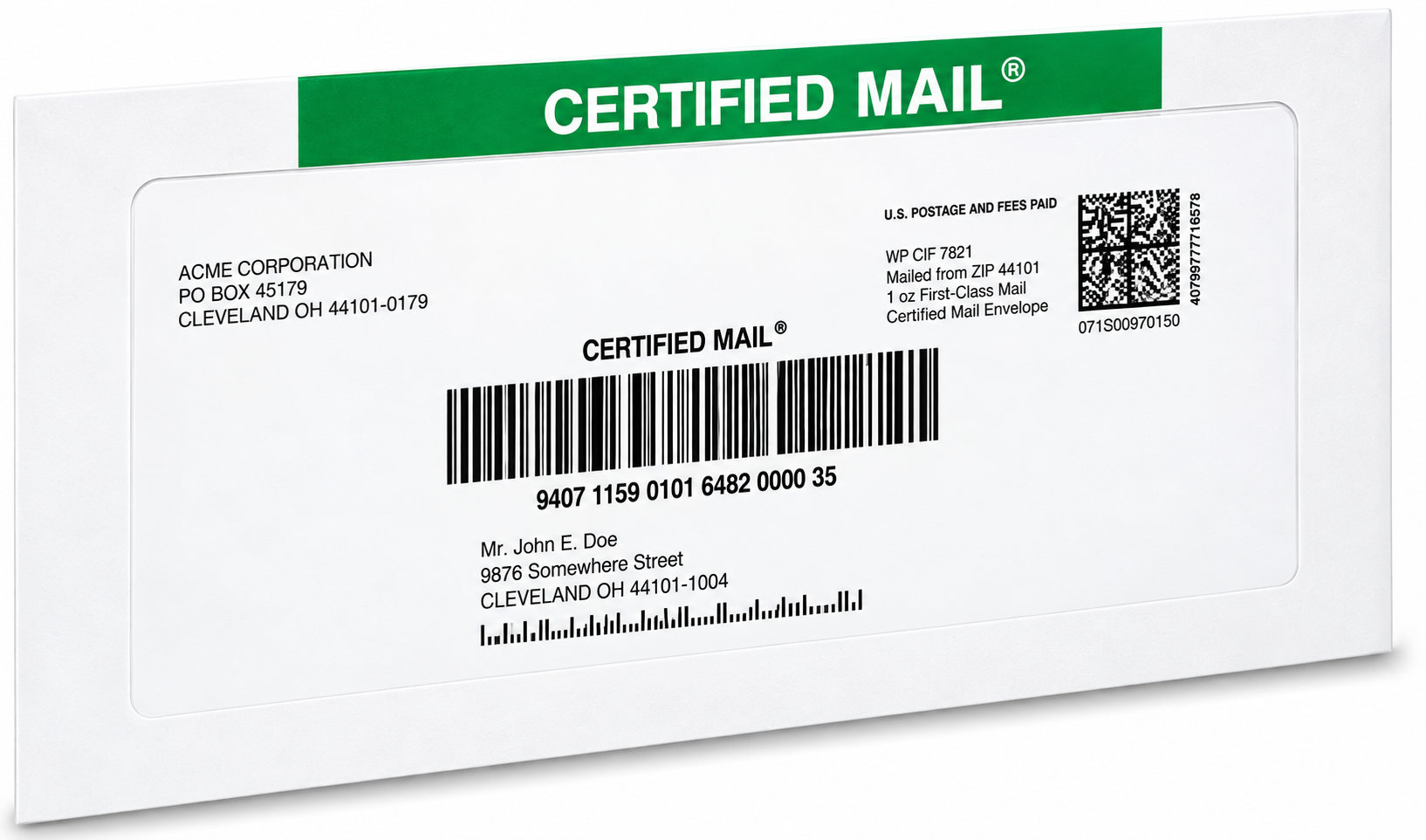
 Return Receipt Requested is the add-on you select when Certified Mail alone is not enough evidence. Certified Mail proves you mailed the item and that it was delivered; Return Receipt Requested adds the signature record showing who received it and when. If your letter could ever end up in a dispute, an audit, or a court filing, that signature record is what you will wish you had. Here is what the add-on actually provides, how the paper and electronic versions differ, and a simple test for when you need it.
What Does "Return Receipt Requested" Mean?
When you prepare a Certified Mail piece, you choose which extra services ride along. Marking it Return Receipt Requested tells USPS you want a copy of the delivery signature returned to you after delivery. That returned record, historically the green PS Form 3811 card, is the Return Receipt. Today it comes in two formats:
- Paper Return Receipt (the green card). The recipient signs the card at delivery and USPS mails it back to you. It is tangible and familiar, but it travels by mail, it can be lost in a drawer or an office move, and it costs more.
- Electronic Return Receipt. The signature record arrives digitally, usually by email, right after delivery, and a copy is stored in your online account. Faster, cheaper, and searchable.
Both formats capture the same core evidence: the recipient's signature, the delivery date, and the address where the item was delivered. Our Electronic Return Receipt page covers the electronic service in detail.
What Certified Mail Alone Gives You (and What It Doesn't)
This is the distinction that prevents overpaying and under-evidencing at the same time:
| Evidence | Certified Mail alone | With Return Receipt Requested |
|---|---|---|
| Proof of mailing (acceptance scan and receipt) | Yes | Yes |
| Tracking events from acceptance to delivery | Yes | Yes |
| Confirmation the item was delivered or an attempt was made | Yes | Yes |
| A copy of the recipient's signature | No | Yes |
| Named evidence of who received the item | No | Yes |
Certified Mail requires a signature at delivery, but the standard service does not send you a copy of that signature. If your file only needs to show the piece was sent and delivered, Certified Mail alone does the job. If your file needs to show who received it, that is exactly the gap Return Receipt Requested closes.
When You Actually Need Return Receipt Requested
Use this checklist. If any line is true for your mailing, add the receipt:
- You'll rely on the mailing in a legal dispute: eviction notices, demand letters, contract terminations, cease-and-desist letters.
- You'll face an audit or regulator who asks for delivery evidence, not just mailing evidence: tax notices, insurance and benefits correspondence, licensing filings.
- You'll need to show service on a specific party: court-adjacent correspondence, foreclosure-related notices, lien filings, HOA and tenant communications.
- You'll want to close the loop on high-stakes financial mail: collections, mortgage servicing, account closures.
- You'll sleep better knowing the signature came back, even when no rule strictly requires it.
And when a rule does apply, the receipt is how you execute and document exactly what your rule requires. Where a statute, court rule, or contract specifies proof of service, confirm the specifics with your counsel; your role as the sender is to produce clean evidence that satisfies it.
Paper or Electronic: Choosing Your Receipt Format
Once you know you need the receipt, choose the format deliberately:
- Does your process require a physical original? Some court and agency workflows still ask for the signed card; if yours does, the paper Return Receipt is the safe choice.
- Does your timeline matter? The electronic record arrives right after delivery; the green card arrives whenever the mail delivers it back.
- Who stores the evidence? Electronic records live in a searchable archive you can pull from years later. Paper cards live wherever the last person to touch them left them.
For most teams, electronic wins on speed, cost, and retrievability, and the paper card remains the choice when a physical original is formally required.
Frequently Asked Questions
What is Return Receipt Requested on Certified Mail?
It is the optional add-on service that sends you a copy of the delivery signature after your Certified Mail piece is delivered. The record includes the recipient's signature, the delivery date, and the delivery address.
Does Certified Mail include a signature record by itself?
No. Certified Mail requires a signature at delivery, but the standard service does not provide you a copy of that signature. You need Return Receipt Requested, paper or electronic, to receive the signature record.
What is the difference between the green card and the Electronic Return Receipt?
Both capture the same signature evidence. The green card (PS Form 3811) is a paper card the recipient signs and USPS mails back to you; the Electronic Return Receipt delivers the same record digitally, faster and at a lower price, and stores it in your online account.
When do I need Return Receipt Requested?
Whenever your mailing may need to prove who received it: legal notices, audit-facing correspondence, foreclosure or eviction-related mail, collections, and any filing where a rule or counterparty requires signature evidence. If you only need proof of mailing and delivery, Certified Mail alone is enough.
Is the Electronic Return Receipt valid proof like the green card?
Yes. The electronic format records the same delivery signature information as the paper card and is stored with your mailing records, which makes it straightforward to produce when a dispute or audit asks for it.
Do I have to buy Return Receipt at the time of mailing?
Yes, the Return Receipt option is selected when you prepare the Certified Mail piece. You cannot add it after the item has been mailed, so decide based on the checklist before you send.