
Certified Mail for Collections: Demand Letters, Tracking & Mailing Records
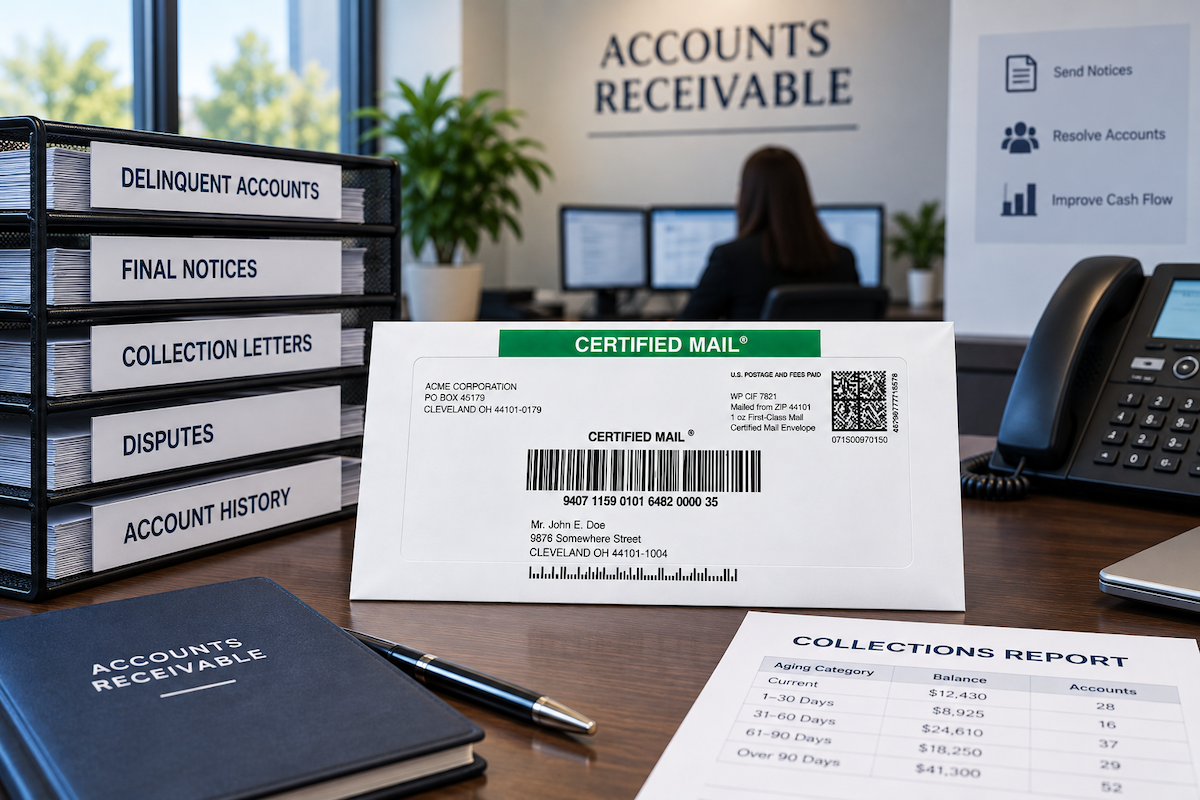 Collection correspondence can involve money, deadlines, disputes, regulatory requirements and legal escalation.
A demand letter, account notice, delinquency communication, settlement letter or other collection-related mailing may later raise questions that go beyond whether a letter was printed:
- What communication was sent?
- Which account was involved?
- Which address was used?
- When did USPS record the mailpiece?
- Was delivery completed or attempted?
- Was the item refused or unclaimed?
- Was a Return Receipt requested?
- Can the organization retrieve the record later?
Certified Mail Labels helps collection agencies, creditors, law firms, financial organizations, healthcare billing teams and other collections operations create, track and manage USPS Certified Mail online while keeping available mailing, delivery and Return Receipt records connected to the account.
Teams can create one label, process large account files through Excel or CSV, or automate recurring mail through API or secure SFTP.
Create a Certified Mail Label Schedule a Live Demo
Why Do Collections Organizations Use Certified Mail?
Collections organizations may use USPS Certified Mail when a contract, state law, court procedure, creditor policy, legal strategy or internal process calls for a documented mailing method.
Certified Mail provides:
- A unique USPS tracking number
- A mailing record
- USPS tracking
- Delivery or attempted-delivery information
- The option to add Return Receipt when needed
Certified Mail is not universally required for debt collection communications.
For covered debt collectors, the Fair Debt Collection Practices Act and CFPB Regulation F create specific rules governing consumer communications, disclosures, validation information and other collection practices. The required delivery method should be determined from the law and procedure governing the particular communication.
Important distinction: Certified Mail can help document a postal mailing. It does not by itself establish FDCPA, Regulation F, state-law or other legal compliance.
Common Certified Mail Uses in Collections
When Certified Mail is appropriate for the workflow, collections teams may use it for correspondence such as:
Demand Letters
Formal demands where the organization wants the mailing and delivery record connected to the account.
Account Notices
Delinquency, balance, default or account-related correspondence when documented mail is appropriate.
Settlement Correspondence
Settlement offers, confirmations and other formal communications tied to an account or legal matter.
Legal Collection Mail
Attorney correspondence, pre-litigation notices and other collection communications where the selected mailing method matters.
Commercial Collections
Business-to-business demands, past-due account notices and contractual correspondence.
Healthcare Accounts
Formal billing and account communications when the organization's approved process calls for documented mail.
Financial Services
Account-default, recovery and other financial correspondence tied to a documented communication history.
Government Collections
Tax, utility, fee and other public-sector collection notices when the governing procedure uses Certified Mail.
Certified Mail and Regulation F: Keep the Roles Separate
Third-party consumer debt collectors may be subject to the FDCPA and CFPB Regulation F.
Regulation F includes detailed requirements regarding collection communications and validation information. Covered debt collectors generally must provide required validation information either in the initial communication or within the applicable period after that communication, subject to the rule's requirements and exceptions.
The regulation also requires written or electronic disclosures required by the FDCPA and Regulation F to be sent in a manner reasonably expected to provide actual notice and in a form the consumer can keep and access later.
Those rules do not create a universal requirement to use Certified Mail.
The collections workflow should therefore separate two questions:
| Question | What Determines the Answer? |
|---|---|
| What must the communication say? | Applicable federal, state and local collection laws, contracts and legal requirements. |
| How should this particular communication be delivered? | The law, procedure, account circumstances and organization's approved collection workflow. |
When Certified Mail is selected for that second step, Certified Mail Labels helps create and retain the associated postal record.
Keep the Mailing Record Connected to the Account
For a collections operation, a USPS tracking number without an account reference can create more work instead of less.
A stronger mailing record may include:
| Record | Why It Matters |
|---|---|
| Final correspondence | Shows what the organization says was actually mailed. |
| Consumer, customer or business | Identifies the intended recipient. |
| Account reference | Connects the postal record to the underlying collection file. |
| Mailing address | Documents where the communication was sent. |
| Certified Mail tracking number | Identifies the individual USPS mailpiece. |
| USPS acceptance activity | Helps document USPS entry into the mailstream. |
| Tracking history | Shows delivery, attempts and postal exceptions. |
| Electronic Delivery Confirmation | Creates a downloadable record of available mailing and delivery information. |
| Return Receipt | Adds the USPS return-receipt record when purchased and appropriate. |
A Better Certified Mail Workflow for Collections
1 Confirm
Determine which communication and delivery requirements apply.
2 Prepare
Save the final letter, recipient, account reference and required deadline.
3 Create
Generate the Certified Mail label and any required USPS extra services.
4 Track
Monitor USPS acceptance, delivery attempts, delivery and exceptions.
5 Route Exceptions
Send refused, unclaimed or returned mail into the approved account workflow.
6 Archive
Keep the mailing evidence connected to the account record.
Validation Notices and Certified Mail Are Not the Same Requirement
For debt collectors subject to Regulation F, validation information is a regulatory disclosure requirement.
The rule specifies required information, timing and delivery standards. It does not mean every validation notice must be sent by Certified Mail.
That distinction matters for workflow design.
Before selecting Certified Mail for a validation notice, the organization should confirm:
- Whether the FDCPA and Regulation F apply
- Which validation information is required
- When the information must be provided
- Which delivery method is approved for the account and jurisdiction
- Whether another federal or state requirement also applies
Certified Mail Labels supports the postal documentation when Certified Mail is the delivery method your approved process uses.
Debt Disputes and Follow-Up Correspondence
Disputed accounts can create additional documentation needs.
For FDCPA-covered debts, a timely written dispute can trigger specific collection obligations, including verification requirements before certain collection activity resumes.
The collections file should therefore keep communications organized by:
- Account
- Consumer or customer
- Communication date
- Notice type
- Delivery method
- Tracking number when applicable
- Follow-up action
Certified Mail can document the postal history of a letter. It does not determine whether the underlying dispute response satisfies federal or state law.
When Collection Mail Needs Return Receipt
Certified Mail and Return Receipt are separate USPS services.
Certified Mail provides the numbered mailpiece, tracking and delivery or attempted-delivery information.
Return Receipt adds an additional USPS delivery record and can include available recipient or authorized-agent signature information.
If a court rule, contract, statute, legal procedure or approved collections workflow specifically calls for Return Receipt Requested, standard Certified Mail alone should not automatically be treated as equivalent.
Certified Mail Labels supports Return Receipt Electronic for eligible mailings when the additional USPS return-receipt record is appropriate.
Learn About Return Receipt Electronic
Electronic Delivery Confirmation for Collection Files
The Certified Mail Labels Electronic Delivery Confirmation can organize available mailing, USPS tracking and delivery information into a downloadable PDF.
For collection teams, that makes the postal record easier to associate with an account than relying only on a public USPS tracking page or temporary screenshot.
Depending on the mailing, the report can include:
- Return address
- Delivery address
- Certified Mail tracking number
- Internal reference
- Available USPS acceptance activity
- Tracking history
- Delivery information
See the Electronic Delivery Confirmation
Bulk Certified Mail for Collection Agencies
Collection agencies and enterprise creditors may need to create hundreds or thousands of account letters at a time.
At that scale, manually preparing each Certified Mail piece can create:
- Repetitive address entry
- Mismatched tracking numbers
- Disconnected account references
- Inconsistent service selections
- Extra reconciliation work
Certified Mail Labels supports Excel and CSV batch processing so organizations can generate larger groups of Certified Mail labels from structured account data.
Useful reference fields can include:
- Account number
- Client number
- Portfolio
- Agency reference
- Creditor code
- Notice type
- Collection stage
- Legal matter number
Sending Collection Letters in Batches?
Upload structured account data and keep each recipient, tracking number and internal reference connected.
Use USPS SCAN Forms for Eligible Collection Batches
For eligible tracked batches, a USPS Shipment Confirmation Acceptance Notice can streamline USPS acceptance.
The SCAN Form groups associated tracked mailpieces under one master barcode.
For a collection agency mailing a large batch of notices, that can create a more organized USPS handoff than processing each eligible piece separately at the counter.
Keep the SCAN Form connected to:
- The mailing file
- Individual tracking numbers
- Client or portfolio reference
- Batch date
- Notice project
Automate Certified Mail From Your Collections System
Higher-volume collections operations often generate correspondence from account-management, servicing, legal or collections platforms.
Certified Mail Labels supports API and secure SFTP workflows for qualifying recurring and system-generated mailings.
Automation can help connect:
- Account data
- Consumer or business recipient
- Client or creditor
- Notice type
- Certified Mail tracking number
- USPS status information
- Delivery records
- Return Receipt information when selected
This allows mailing activity to remain part of the account workflow rather than becoming a separate manual mailroom process.
Certified Mail Labels already supports collections use cases such as demand notices, account letters and legal correspondence through automated workflows.
Collection Mail Needs an Exception-Handling Process
A strong tracking workflow does more than identify successful deliveries.
Statuses that may require review include:
- Notice Left
- Available for Pickup
- Forwarded
- Insufficient Address
- Refused
- Unclaimed
- Returned to Sender
The correct next step depends on the account, legal requirements and organization's approved process.
Possible actions may include:
- Address research
- Updating account information
- Another approved communication method
- Legal review
- Client escalation
- No additional action where the applicable procedure does not require it
Do not treat a postal status alone as a legal conclusion.
Certified Mail Reports for Collections Teams
| Report | Collections Workflow Use |
|---|---|
| Summary Tracking Report | Search account mailings, review USPS status and identify exceptions. |
| Electronic Delivery Confirmation | Store available mailing and delivery information with the account file. |
| Return Receipt Electronic | Retrieve the USPS return-receipt record when purchased. |
| USPS SCAN Form | Support USPS acceptance of qualifying tracked batches. |
| Mail Manifest | Review recipient, address, tracking and mailing information for larger account projects. |
Explore Certified Mail Reports.
Record Retention Matters in Collections
Collections files may later be reviewed during:
- Consumer disputes
- Client audits
- Regulatory examinations
- Litigation
- Complaint investigations
- Account transfers
- Legal review
- Internal compliance testing
Certified Mail Labels keeps available mailing, tracking and delivery information searchable in the account for up to 10 years.
That can make postal records easier to retrieve without relying on paper receipts or former employees' inboxes.
Collections organizations must still follow the retention requirements that apply to their business. Regulation F itself contains record-retention requirements for covered debt collectors, and state or client obligations may impose additional requirements.
Common Collections Certified Mail Mistakes
1. Assuming Certified Mail Is Required by the FDCPA
It is not a universal FDCPA requirement. Determine the appropriate delivery method for the specific communication.
2. Treating Certified Mail as Regulatory Compliance by Itself
Certified Mail documents postal activity. It does not determine whether the letter's content, timing or collection practice satisfies applicable law.
3. Saving the Tracking Number Without the Letter
USPS tracks the mailpiece. Keep the final correspondence connected to the account.
4. Treating Label Creation as USPS Acceptance
Creating postage and USPS recording possession of the physical envelope are separate events.
5. Confusing Certified Mail With Return Receipt
Return Receipt is a separate USPS service.
6. Manually Typing High-Volume Account Lists
Batch and automated workflows can reduce repetitive entry and mismatched records.
7. Ignoring Returned or Unclaimed Mail
Define the approved exception process before large mailings are sent.
8. Exposing Sensitive Account Information on the Envelope
Use internal references carefully and avoid unnecessarily displaying information that could reveal the purpose or nature of the collection communication.
Why Collections Teams Use Certified Mail Labels
Certified Mail Labels supports individual account letters as well as recurring enterprise collection mail.
Available tools include:
- Individual USPS Certified Mail labels online
- Excel and CSV batch processing
- Custom account, client and portfolio references
- USPS tracking
- Electronic Delivery Confirmation
- Return Receipt Electronic
- USPS SCAN Forms for qualifying batches
- Certified Mail reports
- API integration
- Secure SFTP automation
- Full-service Print & Mail options
- Multi-user workflows
- Searchable mailing and delivery records for up to 10 years
- U.S.-based Customer Support
- No monthly fee or long-term contract for a standard account
Choose the Collections Mailing Workflow That Fits Your Operation
A business sending one demand letter should not need the same workflow as a collection agency processing thousands of account notices.
Send a Batch
Upload Excel or CSV data for larger account or client mailing projects.
Automate
Connect recurring Certified Mail to collections or account-management systems.
Review the Workflow
Talk through volume, account references, reporting and automation.
Frequently Asked Questions About Certified Mail for Collections
Why do collection agencies use Certified Mail?
Collection agencies may use Certified Mail when a contract, state law, court procedure, creditor requirement or approved workflow calls for documented USPS mailing. Certified Mail provides a mailing record, tracking number and delivery or attempted-delivery information.
Does the FDCPA require collection letters to be sent by Certified Mail?
No universal FDCPA rule requires all collection letters to be sent by Certified Mail. Covered collectors should follow the FDCPA, Regulation F and any applicable state or account-specific requirements when choosing the communication method.
Does a validation notice have to be sent by Certified Mail?
Regulation F establishes requirements for validation information and how required disclosures are sent, but it does not impose a universal Certified Mail requirement for every validation notice.
Does Certified Mail prove what was inside a collection letter?
No. Certified Mail documents the mailpiece and USPS activity. The organization should retain the final correspondence with the account file.
Does Certified Mail automatically include Return Receipt?
No. Return Receipt is a separate USPS service that should be selected when the governing requirement or approved process calls for an additional return-receipt record.
Can collection agencies send Certified Mail in bulk?
Yes. Certified Mail Labels supports Excel and CSV batch processing, USPS SCAN Forms for eligible mailings and API or SFTP automation for higher-volume operations.
Can Certified Mail integrate with collection software?
Certified Mail Labels supports API and secure SFTP workflows for qualifying integrations with account, collections, servicing, legal and custom systems.
What is Electronic Delivery Confirmation?
Electronic Delivery Confirmation is a downloadable record that organizes available mailing, USPS tracking and delivery information associated with the Certified Mail transaction.
How long does Certified Mail Labels keep collections mailing records?
Certified Mail Labels keeps available mailing, tracking and delivery information searchable for up to 10 years. Collection organizations should separately follow all legal, regulatory, client and internal retention requirements.
Can Certified Mail Labels print and mail collection letters?
Full-service Print & Mail options are available for organizations that want documents printed, prepared and entered into USPS without handling the physical mailing process internally.
Collections & Certified Mail Resources
- Certified Mail Solutions by Industry
- Certified Mail Tracking Summary Report
- Electronic Delivery Confirmation
- Return Receipt Electronic
- USPS SCAN Form
- Excel Batch Labels
- API & SFTP Automation
- Certified Mail Reports
- CFPB Regulation F — Validation of Debts
- CFPB Regulation F — Sending Required Disclosures
Make Mailing Documentation Part of the Collections Workflow
 When an account letter is questioned months or years later, the organization should not have to reconstruct the mailing history from handwritten receipts, tracking screenshots and employee inboxes.
Certified Mail Labels helps collections teams build the postal record while the mailing is happening: recipient, account reference, tracking number, USPS activity, delivery information, Return Receipt when selected and long-term searchable records.
Create your next Certified Mail label online, or schedule a Live Demo with a member of our Customer Support Team to review your collections mailing workflow.
Create a Certified Mail Label Schedule a Live Demo
Certified Mail Labels provides mailing technology and services and does not provide legal or debt-collection compliance advice. Collection requirements vary by federal law, state law, account type, creditor, communication and circumstance. Review the applicable requirements before selecting a delivery method.