
Which Is Safer: Certified Mail or Registered Mail?
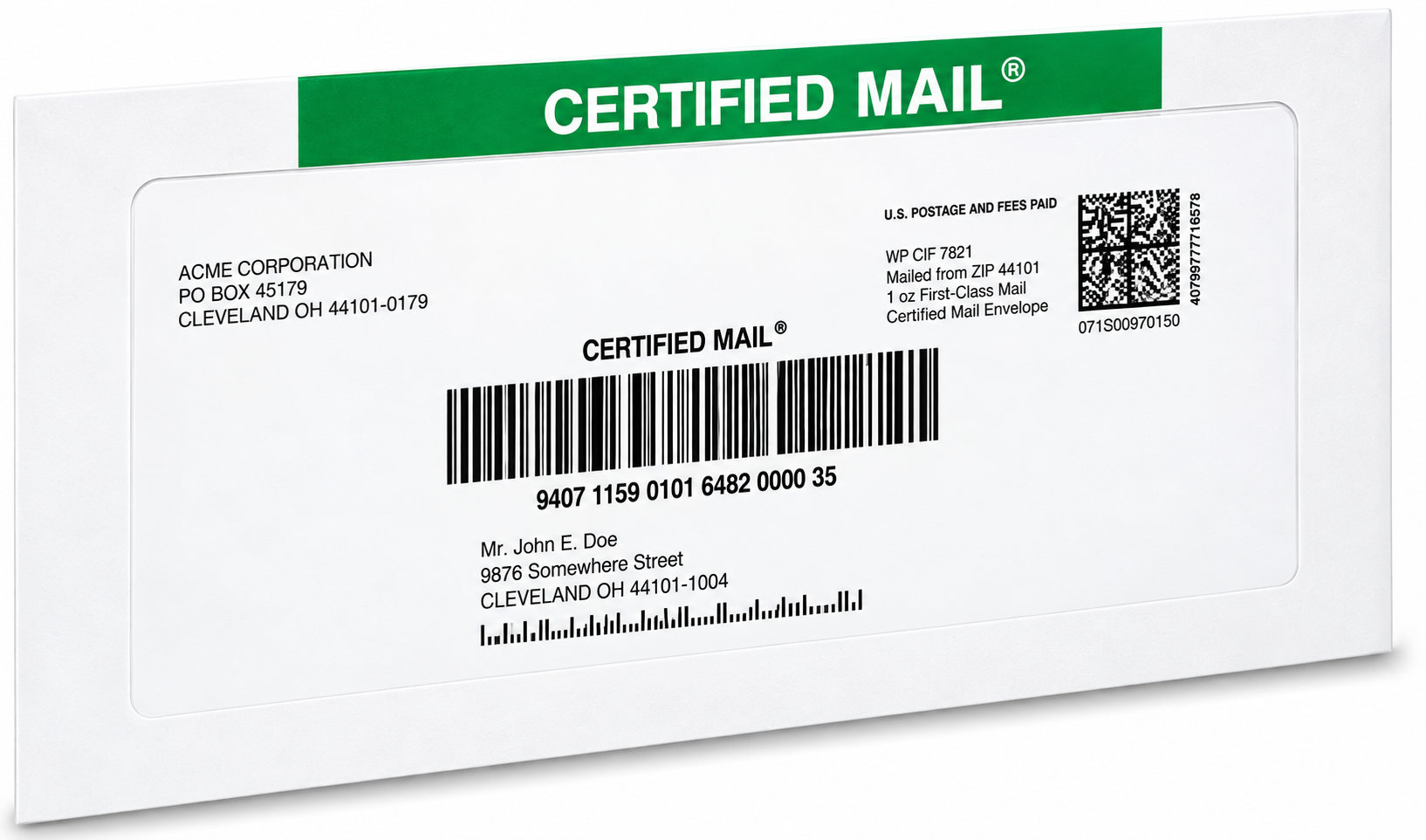 Registered Mail is the safer service if safety means physical security: it is USPS's most secure option, with chain-of-custody handling recorded at every step and higher insurance limits. Certified Mail is the safer choice if safety means provable delivery: a mailing receipt, tracking, and a recorded recipient signature, at lower cost and faster speed. The right answer depends on what you are protecting.
This page compares both services on handling, tracking, insurance, speed, and cost, then maps each to the situations where it wins.
Understanding Certified Mail
Certified Mail is a USPS add-on service that provides proof of mailing and proof of delivery. You receive a mailing receipt when you send it, the item carries a tracking number with scan events at each checkpoint, and the recipient's signature is recorded at delivery. An optional Return Receipt returns a copy of that signature to you, paper or electronic.
Key Features of Certified Mail
- Proof of mailing: a receipt documenting the date the item entered the USPS system.
- Tracking: scan events from acceptance through delivery attempts to final delivery.
- Delivery signature: recorded at the destination, the record that makes Certified Mail legally useful.
- Typical uses: legal notices, contracts, tax documents, compliance correspondence.
Understanding Registered Mail
Registered Mail is USPS's maximum-security service. Each item is processed manually rather than automatically, and every USPS employee who handles it must account for it, with handoffs logged from acceptance through delivery. Items are held in secure, locked storage at each stage. Insurance is available for declared value at higher coverage limits than standard services.
Key Features of Registered Mail
- Maximum security: manual handling with logged accountability at every stage.
- Chain of custody: a documented trail of who touched the item and when.
- Higher insurance: coverage available for valuable declared contents.
- Typical uses: jewelry and collectibles, irreplaceable documents, sensitive materials.
Security Compared: How the Services Actually Differ
Handling Procedures
Certified Mail travels through the standard mail stream with tracking and delivery confirmation added; it is handled carefully but not specially segregated. Registered Mail moves through a separate, secured process: locked and supervised storage between stages, and a signature from every person who handles it. If your risk is theft, loss, or tampering in transit, Registered Mail's handling is the meaningful difference.
Tracking and Monitoring
Both services are trackable. Certified Mail logs scan events at key checkpoints; Registered Mail documents every point of the journey in detail. If you want granular visibility into each handoff, Registered Mail provides it. If you want confirmation that the item was accepted, moved, and delivered, Certified Mail provides that at lower cost.
Insurance and Liability
Certified Mail does not include insurance as part of the service; insurance is a separate USPS add-on with its own limits. Registered Mail offers insurance for declared value with higher coverage limits, which is central to its role for high-value shipments. For anything of significant value, Registered Mail's combination of security handling and insurance makes it the safer instrument.
| Consideration | Certified Mail | Registered Mail |
|---|---|---|
| Security handling | Standard mail stream with tracking | Secured, logged chain of custody |
| Insurance | Separate add-on | Higher-limit coverage for declared value |
| Speed | Faster (automated processing) | Slower (manual security handling) |
| Cost | Lower | Higher |
| Proof of delivery | Signature recorded at delivery | Signature recorded, plus handling log |
For current pricing on both services, see our USPS postal rates page, updated after every USPS price change.
Which Should You Choose?
Choose Certified Mail when:
- You need proof that a document was mailed and delivered.
- The contents are documents, not valuables.
- Cost and speed matter, and the delivery signature is the protection you need.
Choose Registered Mail when:
- You are shipping high-value or irreplaceable items.
- The contents require a documented chain of custody.
- You need higher insurance coverage for declared value.
Where a statute, court rule, or business policy specifies how something must be sent, use the service that satisfies that requirement and confirm the specifics with your counsel or compliance officer.
Other Questions People Ask
Where do you get a Certified Mail receipt?
If you send at the Post Office counter, you receive the receipt there, date-stamped; keep it, because it holds your tracking number. If you create labels online with Certified Mail Labels, the receipt is generated automatically in your account, along with the tracking number and full delivery record, stored for 10 years at no extra charge.
Can Certified Mail be sent to a PO Box?
Yes. USPS places a delivery notice in the recipient's PO Box, and the recipient signs for the item at the Post Office counter. The signature and pickup details are recorded, so the proof of delivery works the same as for a street address.
How Certified Mail Labels Helps
Certified Mail Labels is the industry leader in online Certified Mail services. You can prepare, send, and track Certified Mail without ever visiting the Post Office: create live-postage labels in a few clicks, monitor every scan event, and access your mailing receipts, delivery confirmations, and Return Receipt signatures from a free 10-year compliance archive. There are no monthly fees, no contracts, and no postage meter to lease, and you pay less per letter than retail counter rates.
Bulk senders can automate with Excel batch labels or API and SFTP automation with USPS SCAN Forms.
Get Started Today
So which is safer? Registered Mail wins on physical security and insurance; Certified Mail wins on provable, affordable delivery documentation. Match the service to what you are protecting. If your mail needs proof of delivery, create and print your Certified Mail labels online with Certified Mail Labels and see how much time and money you save on every piece.
FAQ: Certified Mail vs Registered Mail Safety
Which is safer, Certified Mail or Registered Mail?
Registered Mail is safer in physical security terms: it is USPS's most secure service, with chain-of-custody handling logged at every stage and higher insurance limits. Certified Mail is safer for proving delivery, since it provides a mailing receipt, tracking, and a recorded signature at lower cost and higher speed.
Why is Registered Mail more secure than Certified Mail?
Registered Mail is processed manually rather than automatically, held in secure locked storage between stages, and signed for by every USPS employee who handles it, creating a documented chain of custody from acceptance to delivery.
Does Registered Mail include insurance?
Yes. Registered Mail offers insurance for declared-value contents at higher coverage limits than standard services, which is one of its main advantages for shipping valuable items.
Does Certified Mail include insurance?
No. Insurance is a separate USPS add-on with its own limits, not part of the Certified Mail service itself. Certified Mail's protection is the proof of mailing, tracking, and recorded delivery signature.
Which service delivers faster, Certified Mail or Registered Mail?
Certified Mail delivers faster because it moves through the automated mail stream. Registered Mail is slower because each item is handled and logged manually at every secure stage.
Can I send either service to a PO Box?
Yes. For both services, USPS places a delivery notice in the recipient's PO Box and the recipient signs for the item at the Post Office counter, with the signature and pickup details recorded as proof of delivery.