
What Happens If Certified Mail Is Not Signed For?
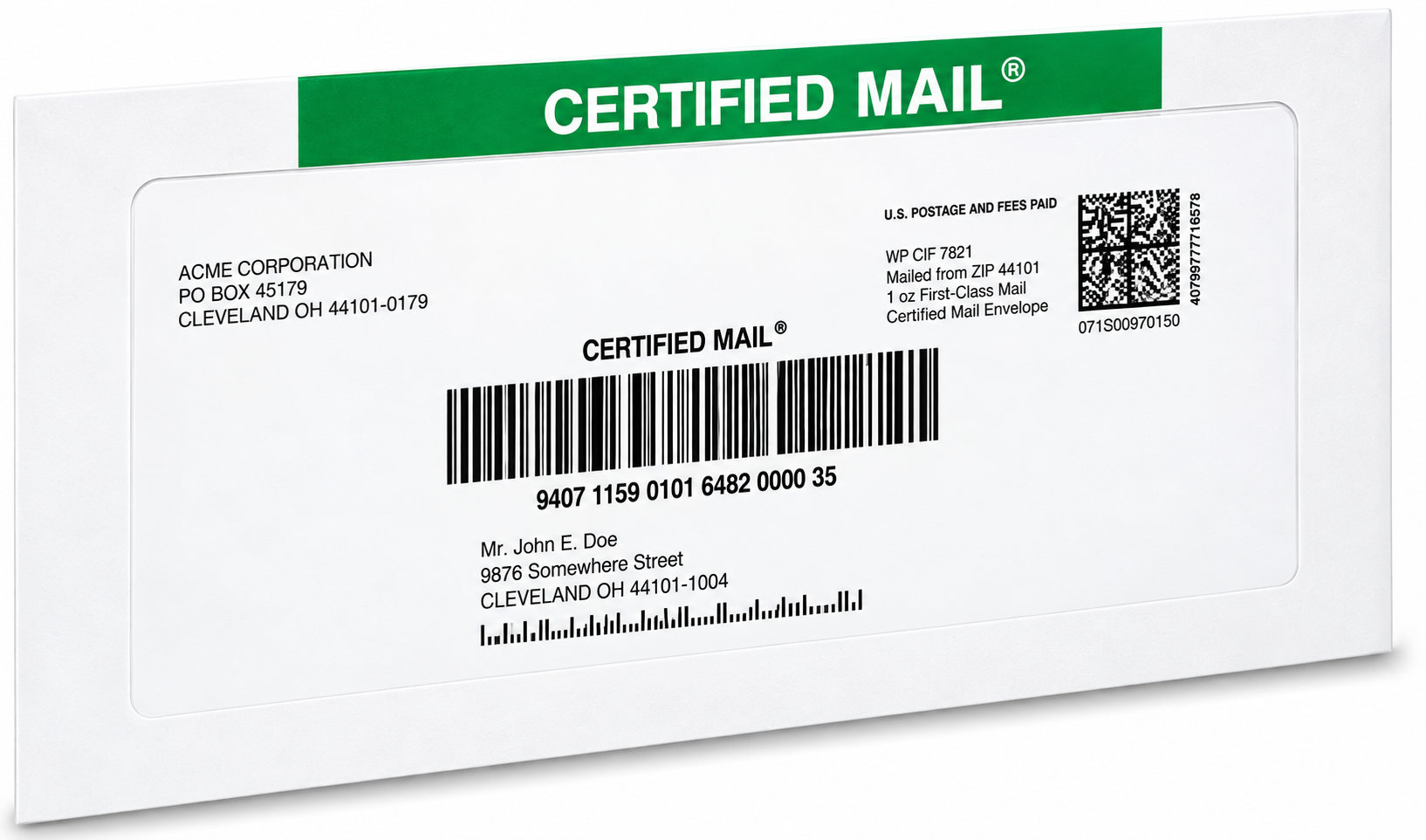 If Certified Mail is not signed for, USPS cannot complete delivery: the carrier leaves a notice at the address telling the recipient that a piece requiring a signature is being held, and the piece waits at the local Post Office, typically for 15 days, so the recipient can sign for it with photo ID. If nobody picks it up in that window, USPS marks it unclaimed and returns it to the sender, with every attempt visible in the tracking record. For the sender, that record still counts: a documented delivery attempt, refusal, or return is proof the notice process was executed, even though the piece never landed in anyone's hands.
Why Certified Mail Requires a Signature
Certified Mail is a USPS add-on service that documents two things: that the item was mailed, and that it was delivered. The signature is the delivery half. When the carrier obtains a signature, the sender has a record that a person at the address received the piece, which is why Certified Mail is the default for legal contracts, financial statements, and other sensitive documents. Without a signature, that proof does not exist yet, so USPS follows the notice-and-hold process instead of leaving the piece behind.
What Happens When Nobody Signs: The Full Sequence
- First delivery attempt. The carrier arrives and needs a signature. If no one can sign, the piece does not get left in the mailbox or at the door.
- Notice left. The carrier leaves a notice informing the recipient that the Certified letter is waiting at the local Post Office.
- Hold period. The piece is held at the Post Office, typically for 15 days. The recipient can sign for it at the counter, presenting the notice and photo ID. Redelivery can often be scheduled instead of pickup.
- Unclaimed status. If the piece is not claimed in the hold window, USPS marks it unclaimed.
- Return to sender. The piece goes back to the sender, and the tracking report shows the attempts and the return. A purchased Return Receipt documents the attempted delivery.
There is a second path to the same outcome: the recipient is home, sees the Certified letter, and refuses it. The refusal is documented with the recipient's endorsement, and the piece is returned to the sender. Both paths, unclaimed and refused, end in a documented return.
What a Non-Delivery Means for the Sender
An unsigned piece is not a failed mailing; it is an incomplete one. The implications depend on what you were trying to prove:
- Legal and compliance notices. If a statute, rule, or contract measures notice by mailing or by documented attempt, the tracking record may satisfy it. If it requires actual receipt, you may need to resend or use another service method. Confirm with counsel which standard applies to your requirement.
- Financial documents. A check or statement stuck in the loop delays the underlying transaction; act on the return quickly.
- Business relationships. Repeated non-delivery erodes trust and costs postage. Better addressing, printed barcoded labels, and verified recipient data reduce the recurrence.
The uncertainty is the worst part: was it lost, refused, or just missed? Tracking answers that. If your tracking shows no movement after a reasonable period, follow the recovery steps in What Happens to Certified Mail That Is Not Delivered?
How Senders Reduce Non-Signature Failures
- Verify addresses before mailing. A wrong apartment number turns a delivery into a return.
- Use Return Receipt Electronic so the signature arrives in your account instantly and you know the moment a piece is signed or attempted. See Electronic Return Receipt.
- Watch tracking daily during the hold window so you can nudge the recipient to pick the piece up before the 15 days expire. See Certified Mail Tracking.
- Consider Restricted Delivery only when needed. It narrows who may sign, which is right for sensitive documents but can add attempts if the addressee is hard to reach. See Who Can Sign for Certified Mail?
How Certified Mail Labels Keeps You Out of the Dark
With Certified Mail Labels, you create and print live-postage Certified Mail labels online and the platform watches the mail for you:
- You'll get Electronic Delivery Confirmation emails the moment each piece is delivered or a delivery attempt is recorded.
- You'll see Return Receipt signatures land in your account as PDFs, no waiting on green cards.
- You'll keep every proof in a complimentary 10-year compliance archive, so the record of attempts and returns survives as long as your disputes might.
- You won't pay monthly fees, contracts, equipment leases, or postage meter costs, and you'll save versus counter rates on every piece.
Hands-free operations available: our Print & Mail service prints, inserts, applies postage, and hands your letters to USPS the same business day for orders by 5:00 PM Eastern, with a notarized affidavit of mailing, and Excel batch labels plus API and SFTP automation handle volume without manual uploads.
What happens if Certified Mail is not signed for?
The carrier leaves a notice and USPS holds the piece at the local Post Office, typically for 15 days, so the recipient can sign for it with photo ID. If it is not claimed in that window, USPS marks it unclaimed and returns it to the sender, and the tracking record documents every delivery attempt and the return.
How long does the Post Office hold Certified Mail after a failed delivery?
USPS typically holds a piece after a failed signature delivery for 15 days from the delivery attempt. The recipient can pick it up at the counter with the notice and photo ID, or request redelivery. After the hold period expires without pickup, the piece is returned to the sender as unclaimed.
Does refusing Certified Mail mean the sender has no proof?
No. A refusal is documented by USPS with the recipient's endorsement, and every delivery attempt appears in the tracking record. A returned envelope with postal documentation, or the tracking history of attempts, still demonstrates that the sender executed the delivery process, which can matter in disputes about whether notice was attempted.
Can someone else sign for my Certified Mail?
Yes, unless the sender added Restricted Delivery. With standard Certified Mail, any person who receives mail at the address, such as a family member, roommate, or receptionist, may sign for the piece. With Restricted Delivery, only the addressee or a person authorized in writing as the addressee's agent may sign.
What should a sender do when Certified Mail comes back unclaimed?
Check the tracking record to confirm the attempts and return, verify the address for errors, and decide whether to resend, contact the recipient directly, or use a different service method if your requirement calls for proof of actual receipt. Keeping the return documentation matters, because it shows the delivery process was attempted in good faith.
How do I know if my Certified Mail was delivered or attempted?
Check the tracking number on the USPS tracking page or in your Certified Mail Labels account. Scans show acceptance, movement through the mailstream, delivery, or a delivery attempt with a notice left. Online platforms also email Electronic Delivery Confirmation as soon as a delivery or attempt is recorded, so you do not have to poll tracking manually.