
What Does USPS Certified Mail Mean?
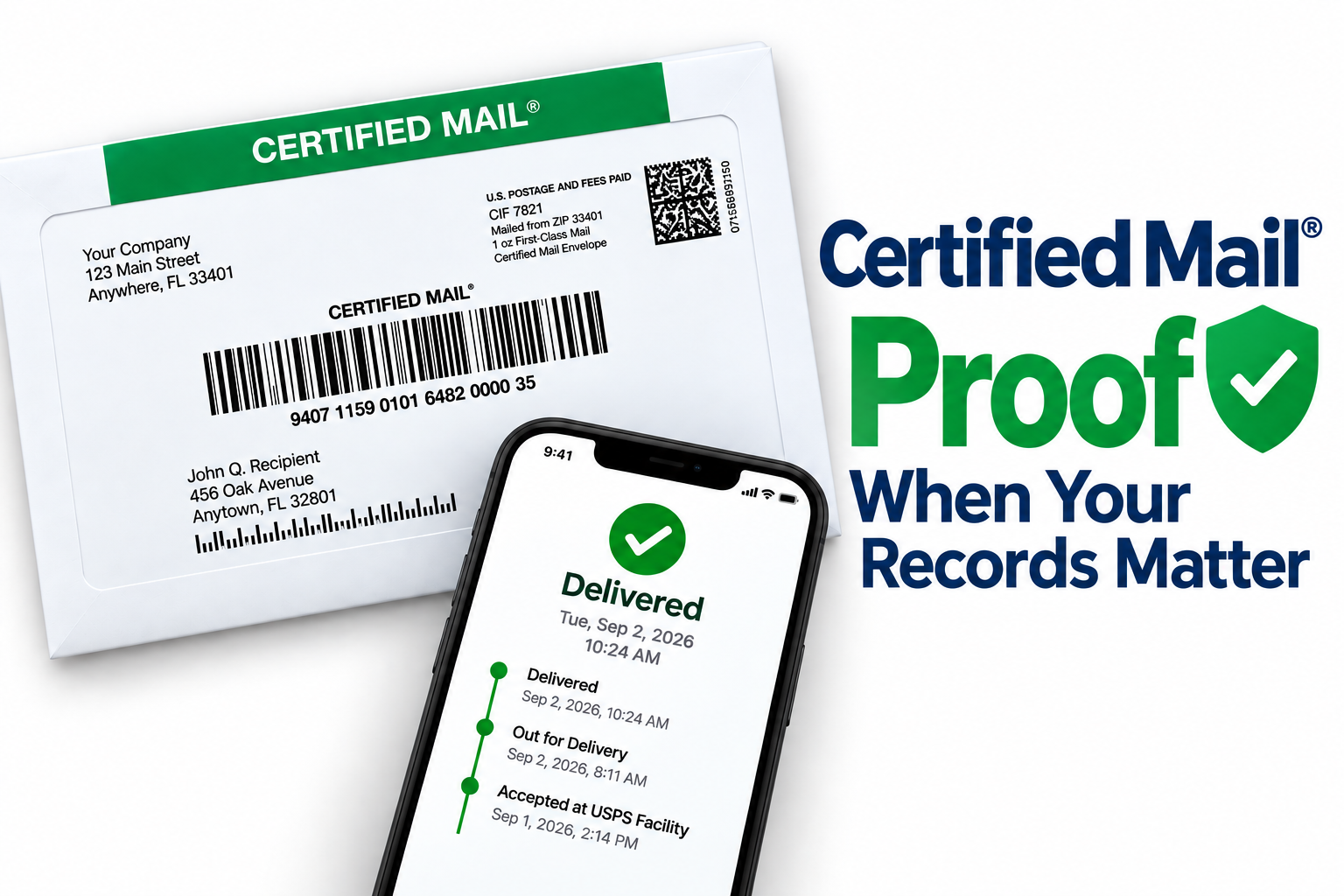 USPS Certified Mail is a service that gives the sender proof of mailing and proof of delivery. Your letter travels with a unique tracking number, its journey is scanned at each USPS checkpoint, and the recipient must sign when it arrives. That signature record is what makes Certified Mail the standard choice for legal papers, contracts, tax documents, and any correspondence where you need to prove it was sent and received.
This page defines the service, explains how it works step by step, covers who uses it and why, and shows how to send it online without a Post Office trip.
Defining USPS Certified Mail
What Is USPS Certified Mail?
Certified Mail is a USPS add-on service that provides the sender with proof of mailing and delivery. Unlike regular mail, it requires a signature from the recipient, ensuring the item reaches its destination and that the delivery itself is documented. The sender receives a mailing receipt with a tracking number, and delivery is confirmed with a recorded signature.
The Purpose of Certified Mail
The purpose is verifiability. A regular letter disappears into the mail stream with no record; Certified Mail creates a documented trail from your hands to the recipient's signature. That trail is what courts, agencies, and counterparties accept as evidence that notice was given.
Key Features of Certified Mail
- Tracking: every item carries a unique tracking number, with scan events logged at each USPS facility.
- Delivery confirmation: you receive confirmation when the mail is delivered, which is crucial for legal and business matters.
- Secure handling: signature-required handling adds a layer of accountability regular mail does not have.
How USPS Certified Mail Works
Sending Certified Mail the Easy Way: Online
- Prepare your documents and log in to your Certified Mail Labels account.
- Enter the address and choose your services, including Return Receipt or Restricted Delivery if needed.
- Print your label on a standard printer. It carries live USPS postage and a real Certified Mail tracking number.
- Mail your letter: hand it to USPS or drop it in any collection box, where acceptance starts the tracking record.
Your account stores the mailing receipt, tracking history, and delivery confirmation, with records retained for 10 years at no extra charge, so there is no paper receipt to keep up with.
Sending Certified Mail the Traditional Way: Post Office Counter
- Prepare and address your envelope.
- Go to the Post Office and request PS Form 3800.
- Fill out the form and attach the label portion to your mailpiece.
- Wait at the counter for the clerk to process it and collect postage plus the Certified Mail fee.
- Keep your receipt; it holds the tracking number you will use to follow the item.
Both routes produce the same result. The online route simply costs less per letter, skips the line, and stores your records automatically.
The Delivery Process
However you send it, USPS carriers deliver the item, and the recipient must sign. That signature is recorded with the date and time and is available to you for verification. If nobody is available to sign, USPS leaves a notice and holds the item at the local Post Office for pickup, typically for 15 days, before returning it to sender.
Tracking and Confirmation
You can track Certified Mail on the USPS website or in your Certified Mail Labels dashboard, where updates show the item's position at every step. Certified Mail Labels users also receive email notifications with Electronic Delivery Confirmations and Return Receipt signatures as soon as delivery happens.
Benefits of Using USPS Certified Mail
Documented Proof
The core benefit: documented evidence of when your mail was sent, where it traveled, and when and to whom it was delivered. In disputes, that record is often the difference between "we never got it" and a verifiable delivery event.
Security and Reliability
Certified Mail is more secure than regular mail because delivery requires a signature. Restricted Delivery can be added when the item must be signed for only by the addressee or their authorized agent.
Peace of Mind
Knowing your important documents are tracked and signed for removes the uncertainty of the mail stream. If a delivery cannot be completed, a second attempt is scheduled and the notice process takes over, so the item is never simply lost in silence.
Who Uses USPS Certified Mail?
Common Users
- Law firms: legal documents, court notices, and client correspondence requiring documented delivery.
- Businesses: contracts, policy notices, and important communications.
- Government agencies: official notices with compliance requirements.
- Individuals: tax returns, disputes, and important personal documents.
Typical Documents
Legal papers, contracts and agreements, tax returns, court notices, eviction and foreclosure notices, insurance correspondence, and HR documents.
Common Questions About Certified Mail
Can USPS Certified Mail Be Sent Internationally?
No. Certified Mail is a USPS service available only within the United States, and it cannot be sent to military APO addresses. For international destinations, other USPS services offer comparable tracking and proof features.
Will USPS Forward Certified Mail?
USPS does not automatically forward Certified Mail. If the recipient has moved and a forwarding order is on file, the item may be redirected, but it is not guaranteed. For critical documents, confirm the recipient's current address before you send.
What Does Certified Mail Cost?
The cost combines the underlying postage (First-Class or Priority), a flat Certified Mail service fee, and any add-ons such as a Return Receipt. Rates change whenever USPS updates prices, so check the current figures on our USPS postal rates page rather than relying on cached numbers.
How Certified Mail Labels Streamlines the Process
Certified Mail Labels lets you create and print live-postage Certified Mail labels online, without visiting the Post Office. You get proof of mailing, tracking, and delivery confirmation automatically, with every record stored in a free 10-year compliance archive you can search at any time. There are no monthly fees, no contracts, and no software or equipment to buy, and you pay less per letter than retail counter rates.
For volume senders, Excel batch labels handle mailing lists, API and SFTP automation manages enterprise workflows with USPS SCAN Forms, and our Print & Mail service prints, inserts, applies postage, and hands your letters to USPS the same business day for orders placed by 5:00 PM Eastern, with a notarized affidavit of mailing.
Want a guided walkthrough? See how the platform works or schedule a free demo call with our Customer Support Team.
FAQ: What USPS Certified Mail Means
What does USPS Certified Mail mean?
USPS Certified Mail is a service that provides the sender with proof of mailing and proof of delivery. Each item carries a unique tracking number, and the recipient must sign on delivery, creating a documented record of when the mail was sent and who received it.
What is Certified Mail used for?
It is used for documents where the sender needs to prove mailing and delivery: legal papers, contracts, tax returns, court notices, government correspondence, and important business or personal documents.
Does Certified Mail require a signature?
Yes. The recipient, or someone authorized at the delivery address, must sign for the item. If you add Restricted Delivery, only the addressee or their authorized agent may sign.
Can Certified Mail be sent internationally?
No. Certified Mail is a USPS domestic service available only within the United States and cannot be sent to military APO addresses. Other USPS services provide comparable tracking for international destinations.
Will USPS forward Certified Mail to a new address?
Not automatically. If the recipient has a forwarding order on file, the item may be redirected, but forwarding is not guaranteed. For critical documents, verify the recipient's current address before mailing.
How much does Certified Mail cost?
The cost is the sum of the underlying postage, a flat Certified Mail service fee, and any add-ons like a Return Receipt. Because USPS updates rates periodically, check the current figures on the USPS postal rates page before you mail.