
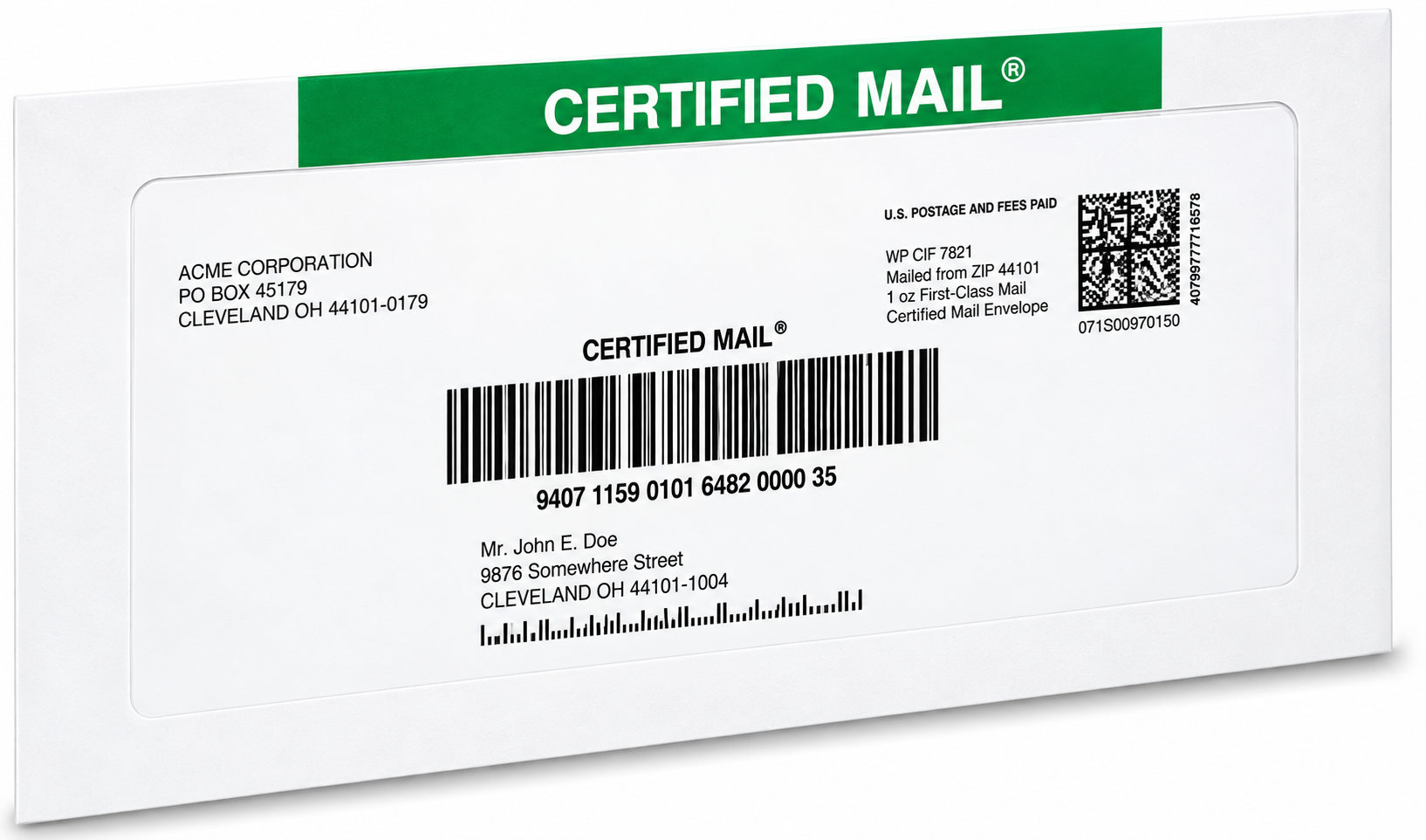
 Certified Mail Labels is worth using when you need a mailing that produces evidence: a USPS mailing receipt, a tracking number, an acceptance record, a delivery outcome, and a signature when you add Return Receipt. It is worth the cost when someone may later ask you to prove what you sent, when you sent it, and who received it. It is not worth the cost when a plain First-Class Mail letter already answers every question your file will face.
Below are eight reasons, each stated as something you can verify rather than something you have to take on faith.
1. You Get a Mailing Receipt, Not a Guess
USPS describes Certified Mail as a numbered extra service that provides the sender with a mailing receipt confirming an item was sent. The receipt carries the article number that becomes your tracking number. That single document is the difference between "we mailed it" and "we can show it was accepted for mailing on this date."
Keep the receipt with your copy of the document. On its own, a receipt filed in a different drawer from the letter is half a record.
2. Acceptance Is a Scanned Event
Tracking is only useful if the first event is real. When USPS accepts a Certified Mail piece, an acceptance event is recorded against the article number. That is the moment your timeline starts. Present the piece at a counter or to a carrier, and for batches present a USPS SCAN Form so one scan covers the whole mailing.
3. Delivery Is Documented, Including Failed Delivery
USPS tracking records delivery, and it also records a delivery attempt when the piece cannot be delivered. A refusal, an unclaimed item, and a returned-to-sender outcome all leave a trail. That matters more than a clean "delivered" status, because the messy outcomes are the ones that end up in disputes.
One caution: read the full history, not the last line. A piece that was refused, held, returned, and finally delivered back to you can end on a Delivered event that has nothing to do with your recipient. A record you can interpret is worth more than a status you can misread.
4. A Signature Is Available When You Need It
Certified Mail requires a signature from the addressee. When you need the signature itself, add Return Receipt and choose the electronic version: Electronic Return Receipt returns the signature record digitally instead of a paper green card. USPS states that Return Receipt must be purchased at the time of mailing, which is why the decision belongs in your workflow, not at the counter.
Add Restricted Delivery when it matters that the named addressee, and not anyone else at the address, is the signer. USPS treats Restricted Delivery as a distinct service from Adult Signature services, so read the definitions before you buy.
5. It Works for Every Format You Are Likely to Mail
Certified Mail is available with First-Class Mail and Priority Mail. It can go to PO boxes, and USPS states that delivery information is available for items destined to APO, FPO, and DPO locations. It also states that Certified Mail may be sent to U.S. possessions and territories. Certified Mail is not available for international mail.
If someone tells you Certified Mail cannot reach a PO box, they are wrong, and the fix costs nothing. The recipient receives a notice in the box and signs at the window.
6. No Equipment, No Contract, No Meter
This is a process reason, not a marketing one. A postage meter is a lease, a service agreement, and a supply chain. Labels printed on a standard office printer replace all three. There is nothing to install, nothing to service, and nothing to cancel.
That is the practical argument behind create and print live-postage Certified Mail labels online: you pay per mailing and skip the counter. Teams that need the physical work removed can use Print & Mail instead and let us print, insert, apply postage, and hand the mail to USPS the same business day for orders by 5:00 PM Eastern.
7. The Record Survives Staff Turnover
The most common way organizations lose proof is not a lost envelope — it is a person who left, a folder nobody can find, and a filing cabinet that was never digitized. When receipt, acceptance scan, tracking events, delivery confirmation, and signature all live in one account, the answer to "can you show me the mailing" does not depend on who is still employed.
The free 10-Year Compliance Archive keeps those records searchable for ten years at no extra charge, which covers the retention window most compliance and litigation-hold policies actually require.
8. It Makes Your Intent Visible to the Recipient
A Certified Mail envelope cannot be mistaken for a bill insert or a flyer. It must be signed for. For a notice where the point is that the recipient knew, that visibility is part of the value, and it is the reason notices that could technically be sent another way are routinely sent this way.
What Certified Mail Does Not Do
- It does not prove what was inside the envelope. Keep a copy of the document.
- It does not add insurance. USPS states you may not purchase additional Insurance as an extra service when Certified Mail is selected, though you can add Certified Mail to a class that already includes insurance, such as Priority Mail.
- It does not guarantee a delivery date. It moves at the speed of the mail class you purchased.
- It does not establish that the recipient read or understood anything.
- It does not tell you whether a statute, court rule, or contract requires Certified Mail. Only the rule and your counsel can do that.
How to Decide for a Specific Letter
- Name the question your file will have to answer. "When was it mailed?" is a different question from "who signed for it?"
- Match the service to the question. A mailing-date question can be met with less than Certified Mail; see our comparison of a Certificate of Mailing vs. Certified Mail. A delivery or signature question needs Certified Mail plus the right add-ons.
- Confirm any legal requirement. If a rule governs the notice, ask counsel what method and what proof it requires before you print anything.
- Check current rates before you commit to a high volume run. Fees change, so read the USPS postal rates page rather than an old article. For the mechanics behind the total, see what drives the cost of a Certified Mail mailing.
Send the Letter With Proof Built In
Start with create and print live-postage Certified Mail labels online: no monthly fees, no contracts, no equipment lease, and no postage meter, and you pay less than Post Office counter rates. Prefer to stay hands-off? Our Print & Mail service prints your uploaded PDF, inserts it, applies postage, and hands the mail to USPS the same business day for orders received by 5:00 PM Eastern, and every full-service mailing includes a notarized affidavit of mailing. High-volume teams can run Excel/CSV batch label tool or API and SFTP automation with USPS SCAN Forms. Add Electronic Return Receipt for an electronic signature record, follow every piece with Certified Mail tracking, and keep the proof in your free 10-Year Compliance Archive. Current postage and service fees are always on the USPS postal rates page.
Certified Mail Labels is a mailing service, not a law firm. We do not provide legal advice. Confirm the method and proof your obligation requires with counsel or the issuing agency.
Frequently Asked Questions
Why should I use Certified Mail Labels instead of going to the Post Office?
You get the same USPS Certified Mail service with less handling: a label printed on a standard office printer, live postage applied online, no equipment lease, no postage meter, no contract, and no monthly fee. Your receipt, tracking, delivery confirmation, and signature records stay in a searchable account instead of a drawer.
What proof does Certified Mail give me?
USPS Certified Mail provides a mailing receipt, a tracking number with an acceptance event when the piece is taken in by USPS, and a delivery or attempted-delivery record. Adding Return Receipt provides the recipient signature, and Restricted Delivery limits who may sign.
Does Certified Mail prove what was inside the envelope?
No. Certified Mail documents the mailing and the delivery events, not the contents. Keep a copy of the letter or notice filed against the tracking number so the document and the mailing record can be produced together.
Is Certified Mail the same as Certificate of Mailing?
No. A Certificate of Mailing provides evidence of the mailing date only and does not provide a record of delivery or a signature. Certified Mail provides a mailing receipt, tracking, a delivery record, and a signature requirement at delivery.
Can I send Certified Mail to a PO Box or an APO address?
Yes. Certified Mail can be sent to PO boxes, and USPS states that delivery information is available for items destined to APO, FPO, and DPO locations. Certified Mail is not available for international mail, though it may be sent to U.S. possessions and territories.
Do I need a postage meter or special printer for Certified Mail labels?
No. Labels print on a standard office printer, on plain paper or on adhesive label sheets. There is no meter, no equipment lease, no software installation, and no service contract to maintain.